Dr. Anjum Hashmi
MBBS,CCS(USA),MPH
 Infection Control
      Director
    MCH Najran
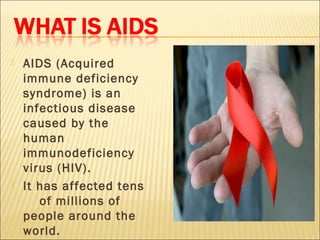
   AIDS (Acquired
    immune deficiency
    syndrome) is an
    infectious disease
    caused by the
    human
    immunodeficiency
    virus (HIV).
   It has affected tens
       of millions of
    people around the
    world.
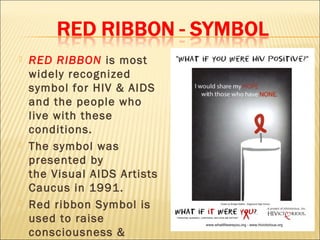
   RED RIBBON is most
    widely recognized
    symbol for HIV & AIDS
    and the people who
    live with these
    conditions.
   The symbol was
    presented by
    the Visual AIDS Artists
    Caucus in 1991.
   Red ribbon Symbol is
    used to raise
    consciousness &
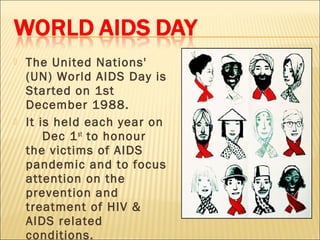
   The United Nations'
    (UN) World AIDS Day is
    Started on 1st
    December 1988.
   It is held each year on
        Dec 1 st to honour
    the victims of AIDS
    pandemic and to focus
    attention on the
    prevention and
    treatment of HIV &
    AIDS related
    conditions.
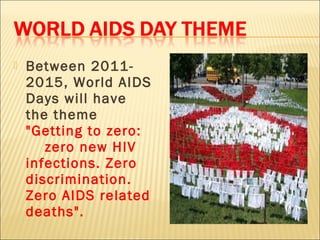
   Between 2011-
    2015, World AIDS
    Days will have
    the theme
    "Getting to zero:
       zero new HIV
    infections. Zero
    discrimination.
    Zero AIDS related
    deaths".
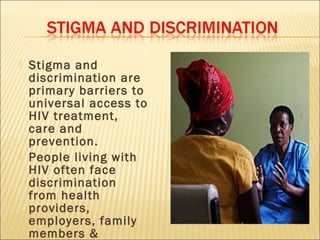
   Stigma and
    discrimination are
    primary barriers to
    universal access to
    HIV treatment,
    care and
    prevention.
   People living with
    HIV often face
    discrimination
    from health
    providers,
    employers, family
    members &
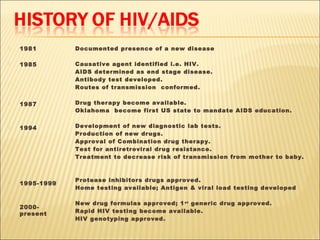
   1981        Documented presence of a new disease

   1985        Causative agent identified i.e. HIV.
                AIDS determined as end stage disease.
                Antibody test developed.
                Routes of transmission conformed.

   1987        Drug therapy become available.
                Oklahoma become first US state to mandate AIDS education.

   1994        Development of new diagnostic lab tests.
                Production of new drugs.
                Approval of Combination drug therapy.
                Test for antiretroviral drug resistance.
                Treatment to decrease risk of transmission from mother to baby.


                Protease inhibitors drugs approved.
   1995-1999
                Home testing available; Antigen & viral load testing developed

                New drug formulas approved; 1 st generic drug approved.
   2000-
    present     Rapid HIV testing become available.
                HIV genotyping approved.
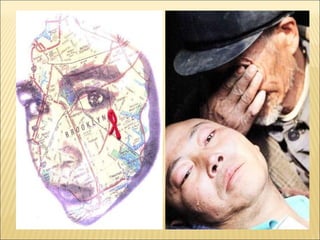
PEOPLE WITH NO HOPE
   Dark coloured areas in
    world map are high
    prevalent regions, the
    most important issue
    world is facing today.
   WHO estimates that 34
    million [31.6–35.2
    million] people living with
    HIV globally and 1.9
    million newly infected in
    2010 with 50,000 in the
    United States.
   1.8 million people died of
    AIDS-related illnesses
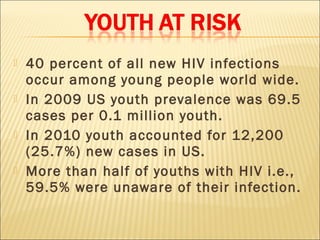
   40 percent of all new HIV infections
    occur among young people world wide.
   In 2009 US youth prevalence was 69.5
    cases per 0.1 million youth.
   In 2010 youth accounted for 12,200
    (25.7%) new cases in US.
   More than half of youths with HIV i.e.,
    59.5% were unaware of their infection.
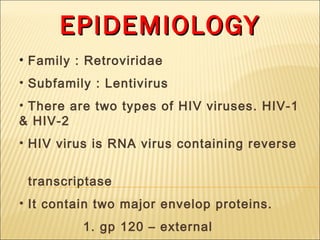
EPIDEMIOLOGY
• Family : Retroviridae
• Subfamily : Lentivirus
• There are two types of HIV viruses. HIV-1
& HIV-2
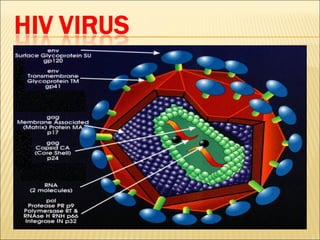
• HIV virus is RNA virus containing reverse


 transcriptase
• It contain two major envelop proteins.
          1. gp 120 – external
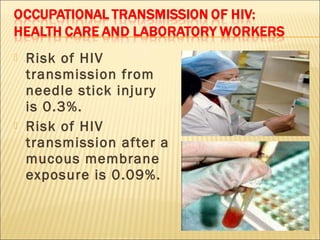
   Risk of HIV
    transmission from
    needle stick injury
    is 0.3%.
   Risk of HIV
    transmission after a
    mucous membrane
    exposure is 0.09%.
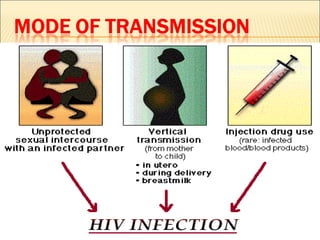
   HIV infection can be transmitted from
    an infected mother to her fetus
   During pregnancy.
   During deliver y.
   By breast-feeding (Low risk).
   In the absence of prophylactic therapy
    probability of transmission of HIV from
    mother to fetus /infant ranges from 15
    to 25% in industrialized countries and
    from 25 to 35% in developing countries.
   HIV present in saliva at low titer,
    but there is no evidence that saliva
    can transmit HIV infection, even
    either through kissing.
   Breast-fed infants were associated
    with a low risk of HIV transmission
    through breast milk.
   There is no evidence that HIV
    transmission can occur as a result
    of exposure to tears, sweat and
   The hallmark of HIV disease is
    profound immunodeficiency
    resulting in the progressive
    quantitative and qualitative
    deficiency of the subset of T
    lymphocytes referred as the helper
    T cells or inducer T cells.
   T cells has CD4 molecule on its
    sur face, which ser ves as the
    primar y cellular receptor for HIV.
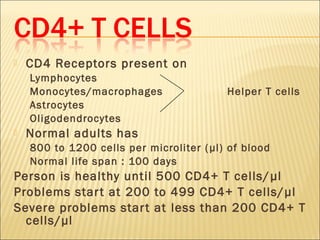
   CD4 Receptors present on
    Lymphocytes
    Monocytes/macrophages                 Helper T cells
    Astrocytes
    Oligodendrocytes
   Normal adults has
    800 to 1200 cells per microliter ( µl) of blood
    Normal life span : 100 days
Person is healthy until 500 CD4+ T cells/ µl
Problems star t at 200 to 499 CD4+ T cells/ µl
Severe problems star t at less than 200 CD4+ T
  cells/µl
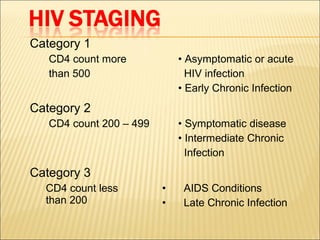
Category 1
   CD4 count more            • Asymptomatic or acute
   than 500                    HIV infection
                             • Early Chronic Infection
Category 2
   CD4 count 200 – 499       • Symptomatic disease
                             • Intermediate Chronic
                               Infection
Category 3
  CD4 count less         •    AIDS Conditions
  than 200               •    Late Chronic Infection
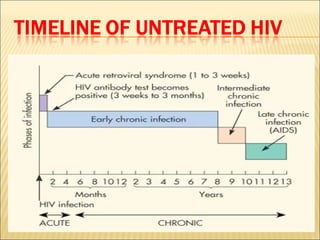
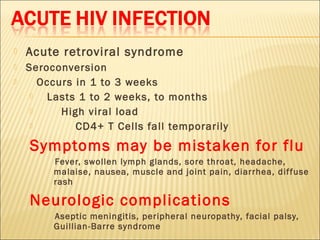
   Acute retroviral syndrome
   Seroconversion
      Occurs in 1 to 3 weeks
       Lasts 1 to 2 weeks, to months
          High viral load
             CD4+ T Cells fall temporarily
    Symptoms may be mistaken for flu
         Fever, swollen lymph glands, sore throat, headache,
         malaise, nausea, muscle and joint pain, diarrhea, dif fuse
         rash

    Neurologic complications
         Aseptic meningitis, peripheral neuropathy, facial palsy,
         Guillian-Barre syndrome
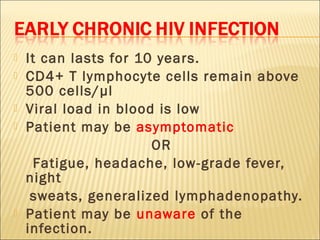
   It can lasts for 10 years.
   CD4+ T lymphocyte cells remain above
    500 cells/µl
   Viral load in blood is low
   Patient may be asymptomatic
                       OR
      Fatigue, headache, low-grade fever,
    night
     sweats, generalized lymphadenopathy.
   Patient may be unaware of the
    infection.
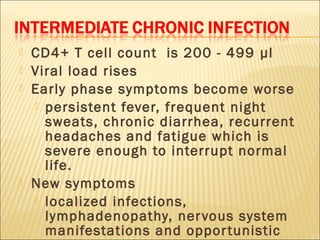
   CD4+ T cell count is 200 - 499 µl
   Viral load rises
   Early phase symptoms become worse
     persistent fever, frequent night
      sweats, chronic diarrhea, recurrent
      headaches and fatigue which is
      severe enough to interrupt normal
      life.
   New symptoms
     localized infections,
      lymphadenopathy, ner vous system
      manifestations and oppor tunistic
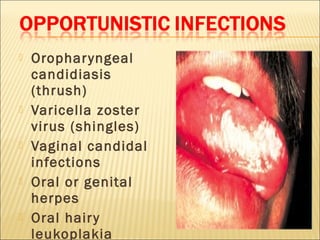
   Orophar yngeal
    candidiasis
    (thrush)
   Varicella zoster
    virus (shingles)
   Vaginal candidal
    infections
   Oral or genital
    herpes
   Oral hair y
    leukoplakia
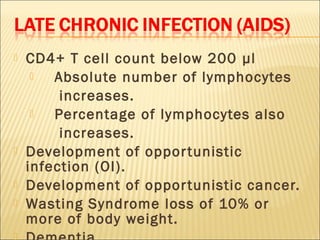
   CD4+ T cell count below 200 µl
       Absolute number of lymphocytes
         increases.
       Percentage of lymphocytes also
         increases.
   Development of oppor tunistic
    infection (OI).
   Development of oppor tunistic cancer.
   Wasting Syndrome loss of 10% or
    more of body weight.

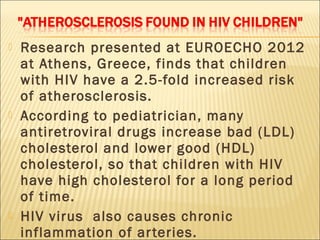
   Research presented at EUROECHO 2012
    at Athens, Greece, finds that children
    with HIV have a 2.5-fold increased risk
    of atherosclerosis.
   According to pediatrician, many
    antiretroviral drugs increase bad (LDL)
    cholesterol and lower good (HDL)
    cholesterol, so that children with HIV
    have high cholesterol for a long period
    of time.
   HIV virus also causes chronic
    inflammation of ar teries.
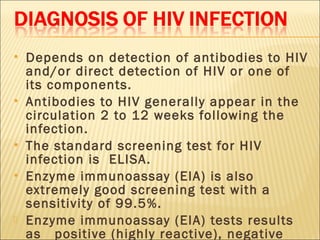
   Depends on detection of antibodies to HIV
    and/or direct detection of HIV or one of
    its components.
   Antibodies to HIV generally appear in the
    circulation 2 to 12 weeks following the
    infection.
   The standard screening test for HIV
    infection is ELISA .
   Enzyme immunoassay (EIA) is also
    extremely good screening test with a
    sensitivity of 99.5%.
   Enzyme immunoassay (EIA) tests results
    as positive (highly reactive), negative
1.   Decreases HIV RNA levels to less
     than      50 copies/ µl.
2.   Maintain or raise CD4+ T cell counts
     to greater than 200 cells/µl. Which
     is also known as Immune
     reconstitution.
3.   Delay development of HIV-related
     symptoms
         Oppor tunistic diseases
   Histor y and physical examination.
   Routine chemistr y and hematology.
   CD4 T lymphocyte count.
   Two plasma HIV RNA levels.
   RPR (Rapid Plasma Reagin) test for
    syphilis.
   Anti-Toxoplasma antibody titer.
   PPD skin test.
   Mini-mental status examination.
   Tests for hepatitis A, B & C.
   Immunization with pneumococcal and influenza
    vaccines.
   Immunization with hepatitis A and B vaccines.
   Counseling regarding natural history and
    transmission.
   Help others people who might be at risk of getting
    infection.
   Drug treatment guidelines for
    HIV/AIDS change frequently as new
    drugs are approved and new drug
    regimens developed.
   Two principles currently guides
    doctors in developing drug regimens
    for AIDS patients.
   Combinations of drugs should be used
    rather than one medication.
   Treatment decisions should be based
    on the results of the patient's viral
   Antiretroviral therapy to mother during
    pregnancy and infant during the first
    weeks of life dramatically decreasing
    mother to child transmission of HIV.
   A single dose of one drug of
    antiretroviral therapy to the mother
    during labor and to the infant within 48
    hr of bir th has also been successful in
    decreasing the incidence of mother to
    child transmission of HIV.
   Education, counseling and behavior
    modification are the cornerstones of an
    HIV prevention strategy.
   Restricting sexual activity to a single
    par tner.
   Practicing safer sex i.e., always use a
    condom. Use of condoms can markedly
    decrease the chances of HIV
    transmission but not 100%, as condoms
   Avoiding needle sharing among
    intravenous drug users.
   Donating one's own blood before
    planned major surger y to prevent risk
    of infection from a blood transfusion.
   Practicing standard precautions when
    handling blood and body fluids.
   Proper disposal of sharps.
   Test for HIV infection for anyone who is
    suspected of having infection.
   Currently, there are condoms
    treated with     antimicrobial called
    Nonoxynol-9, which are ef fective
    against HIV, but can cause
    inflammation and genital ulcers,
    which may make infection more
    likely.
   At University of Manitoba Canada
    researcher found condoms
    embedded with silver nanopar ticles
    killed all HIV and herpes viruses.
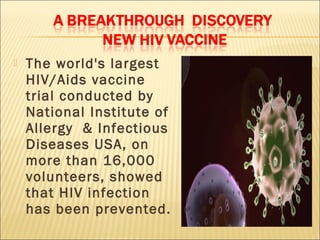
   The world's largest
    HIV/Aids vaccine
    trial conducted by
    National Institute of
    Allergy & Infectious
    Diseases USA, on
    more than 16,000
    volunteers, showed
    that HIV infection
    has been prevented.
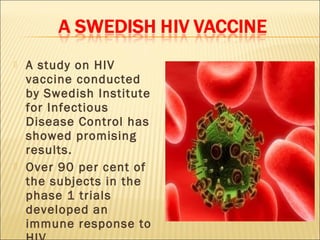
   A study on HIV
    vaccine conducted
    by Swedish Institute
    for Infectious
    Disease Control has
    showed promising
    results.
   Over 90 per cent of
    the subjects in the
    phase 1 trials
    developed an
    immune response to
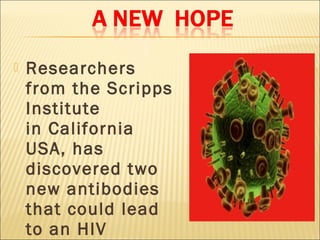
   Researchers
    from the Scripps
    Institute
    in California
    USA, has
    discovered two
    new antibodies
    that could lead
    to an HIV
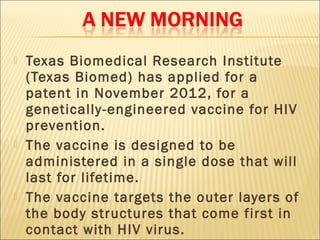
   Texas Biomedical Research Institute
    (Texas Biomed) has applied for a
    patent in November 2012, for a
    genetically-engineered vaccine for HIV
    prevention.
   The vaccine is designed to be
    administered in a single dose that will
    last for lifetime.
   The vaccine targets the outer layers of
    the body structures that come first in
    contact with HIV virus.
   This vaccine restricts viral
    replication at the mucosal level
    of entr y may be the best hope
    of controlling HIV.
   As life-long stimulation of the
    immune system by this vaccine
    will be suf ficient to achieve
    long-term protection.
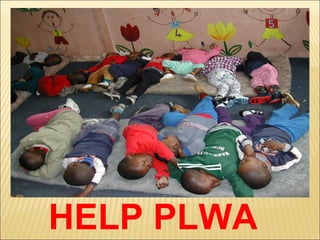
HELP PLWA
Happy Little Crater on Planet Mercury
Snap in 2012 by Messenger Spacecraft
Satellite
View of
Earth At
Night
Lights
On


THANK YOU

Hivaids and world today By Dr Anjum Hashmi MPH

  • 1.
    Dr. Anjum Hashmi MBBS,CCS(USA),MPH Infection Control Director MCH Najran
  • 2.
    AIDS (Acquired immune deficiency syndrome) is an infectious disease caused by the human immunodeficiency virus (HIV).  It has affected tens of millions of people around the world.
  • 3.
    RED RIBBON is most widely recognized symbol for HIV & AIDS and the people who live with these conditions.  The symbol was presented by the Visual AIDS Artists Caucus in 1991.  Red ribbon Symbol is used to raise consciousness &
  • 4.
    The United Nations' (UN) World AIDS Day is Started on 1st December 1988.  It is held each year on Dec 1 st to honour the victims of AIDS pandemic and to focus attention on the prevention and treatment of HIV & AIDS related conditions.
  • 5.
    Between 2011- 2015, World AIDS Days will have the theme "Getting to zero: zero new HIV infections. Zero discrimination. Zero AIDS related deaths".
  • 6.
    Stigma and discrimination are primary barriers to universal access to HIV treatment, care and prevention.  People living with HIV often face discrimination from health providers, employers, family members &
  • 7.
    1981 Documented presence of a new disease  1985 Causative agent identified i.e. HIV. AIDS determined as end stage disease. Antibody test developed. Routes of transmission conformed.  1987 Drug therapy become available. Oklahoma become first US state to mandate AIDS education.  1994 Development of new diagnostic lab tests. Production of new drugs. Approval of Combination drug therapy. Test for antiretroviral drug resistance. Treatment to decrease risk of transmission from mother to baby. Protease inhibitors drugs approved.  1995-1999 Home testing available; Antigen & viral load testing developed New drug formulas approved; 1 st generic drug approved.  2000- present Rapid HIV testing become available. HIV genotyping approved.
  • 8.
  • 10.
    Dark coloured areas in world map are high prevalent regions, the most important issue world is facing today.  WHO estimates that 34 million [31.6–35.2 million] people living with HIV globally and 1.9 million newly infected in 2010 with 50,000 in the United States.  1.8 million people died of AIDS-related illnesses
  • 11.
    40 percent of all new HIV infections occur among young people world wide.  In 2009 US youth prevalence was 69.5 cases per 0.1 million youth.  In 2010 youth accounted for 12,200 (25.7%) new cases in US.  More than half of youths with HIV i.e., 59.5% were unaware of their infection.
  • 12.
    EPIDEMIOLOGY • Family :Retroviridae • Subfamily : Lentivirus • There are two types of HIV viruses. HIV-1 & HIV-2 • HIV virus is RNA virus containing reverse transcriptase • It contain two major envelop proteins. 1. gp 120 – external
  • 15.
    Risk of HIV transmission from needle stick injury is 0.3%.  Risk of HIV transmission after a mucous membrane exposure is 0.09%.
  • 16.
    HIV infection can be transmitted from an infected mother to her fetus  During pregnancy.  During deliver y.  By breast-feeding (Low risk).  In the absence of prophylactic therapy probability of transmission of HIV from mother to fetus /infant ranges from 15 to 25% in industrialized countries and from 25 to 35% in developing countries.
  • 18.
    HIV present in saliva at low titer, but there is no evidence that saliva can transmit HIV infection, even either through kissing.  Breast-fed infants were associated with a low risk of HIV transmission through breast milk.  There is no evidence that HIV transmission can occur as a result of exposure to tears, sweat and
  • 19.
    The hallmark of HIV disease is profound immunodeficiency resulting in the progressive quantitative and qualitative deficiency of the subset of T lymphocytes referred as the helper T cells or inducer T cells.  T cells has CD4 molecule on its sur face, which ser ves as the primar y cellular receptor for HIV.
  • 20.
    CD4 Receptors present on Lymphocytes Monocytes/macrophages Helper T cells Astrocytes Oligodendrocytes  Normal adults has 800 to 1200 cells per microliter ( µl) of blood Normal life span : 100 days Person is healthy until 500 CD4+ T cells/ µl Problems star t at 200 to 499 CD4+ T cells/ µl Severe problems star t at less than 200 CD4+ T cells/µl
  • 22.
    Category 1 CD4 count more • Asymptomatic or acute than 500 HIV infection • Early Chronic Infection Category 2 CD4 count 200 – 499 • Symptomatic disease • Intermediate Chronic Infection Category 3 CD4 count less • AIDS Conditions than 200 • Late Chronic Infection
  • 23.
    Acute retroviral syndrome  Seroconversion  Occurs in 1 to 3 weeks  Lasts 1 to 2 weeks, to months  High viral load  CD4+ T Cells fall temporarily Symptoms may be mistaken for flu Fever, swollen lymph glands, sore throat, headache, malaise, nausea, muscle and joint pain, diarrhea, dif fuse rash Neurologic complications Aseptic meningitis, peripheral neuropathy, facial palsy, Guillian-Barre syndrome
  • 24.
    It can lasts for 10 years.  CD4+ T lymphocyte cells remain above 500 cells/µl  Viral load in blood is low  Patient may be asymptomatic OR Fatigue, headache, low-grade fever, night sweats, generalized lymphadenopathy.  Patient may be unaware of the infection.
  • 25.
    CD4+ T cell count is 200 - 499 µl  Viral load rises  Early phase symptoms become worse  persistent fever, frequent night sweats, chronic diarrhea, recurrent headaches and fatigue which is severe enough to interrupt normal life.  New symptoms  localized infections, lymphadenopathy, ner vous system manifestations and oppor tunistic
  • 26.
    Orophar yngeal candidiasis (thrush)  Varicella zoster virus (shingles)  Vaginal candidal infections  Oral or genital herpes  Oral hair y leukoplakia
  • 28.
    CD4+ T cell count below 200 µl  Absolute number of lymphocytes increases.  Percentage of lymphocytes also increases.  Development of oppor tunistic infection (OI).  Development of oppor tunistic cancer.  Wasting Syndrome loss of 10% or more of body weight. 
  • 29.
    Research presented at EUROECHO 2012 at Athens, Greece, finds that children with HIV have a 2.5-fold increased risk of atherosclerosis.  According to pediatrician, many antiretroviral drugs increase bad (LDL) cholesterol and lower good (HDL) cholesterol, so that children with HIV have high cholesterol for a long period of time.  HIV virus also causes chronic inflammation of ar teries.
  • 30.
    Depends on detection of antibodies to HIV and/or direct detection of HIV or one of its components.  Antibodies to HIV generally appear in the circulation 2 to 12 weeks following the infection.  The standard screening test for HIV infection is ELISA .  Enzyme immunoassay (EIA) is also extremely good screening test with a sensitivity of 99.5%.  Enzyme immunoassay (EIA) tests results as positive (highly reactive), negative
  • 32.
    1. Decreases HIV RNA levels to less than 50 copies/ µl. 2. Maintain or raise CD4+ T cell counts to greater than 200 cells/µl. Which is also known as Immune reconstitution. 3. Delay development of HIV-related symptoms  Oppor tunistic diseases
  • 33.
    Histor y and physical examination.  Routine chemistr y and hematology.  CD4 T lymphocyte count.  Two plasma HIV RNA levels.  RPR (Rapid Plasma Reagin) test for syphilis.  Anti-Toxoplasma antibody titer.  PPD skin test.  Mini-mental status examination.
  • 34.
    Tests for hepatitis A, B & C.  Immunization with pneumococcal and influenza vaccines.  Immunization with hepatitis A and B vaccines.  Counseling regarding natural history and transmission.  Help others people who might be at risk of getting infection.
  • 35.
    Drug treatment guidelines for HIV/AIDS change frequently as new drugs are approved and new drug regimens developed.  Two principles currently guides doctors in developing drug regimens for AIDS patients.  Combinations of drugs should be used rather than one medication.  Treatment decisions should be based on the results of the patient's viral
  • 36.
    Antiretroviral therapy to mother during pregnancy and infant during the first weeks of life dramatically decreasing mother to child transmission of HIV.  A single dose of one drug of antiretroviral therapy to the mother during labor and to the infant within 48 hr of bir th has also been successful in decreasing the incidence of mother to child transmission of HIV.
  • 37.
    Education, counseling and behavior modification are the cornerstones of an HIV prevention strategy.  Restricting sexual activity to a single par tner.  Practicing safer sex i.e., always use a condom. Use of condoms can markedly decrease the chances of HIV transmission but not 100%, as condoms
  • 38.
    Avoiding needle sharing among intravenous drug users.  Donating one's own blood before planned major surger y to prevent risk of infection from a blood transfusion.  Practicing standard precautions when handling blood and body fluids.  Proper disposal of sharps.  Test for HIV infection for anyone who is suspected of having infection.
  • 39.
    Currently, there are condoms treated with antimicrobial called Nonoxynol-9, which are ef fective against HIV, but can cause inflammation and genital ulcers, which may make infection more likely.  At University of Manitoba Canada researcher found condoms embedded with silver nanopar ticles killed all HIV and herpes viruses.
  • 40.
    The world's largest HIV/Aids vaccine trial conducted by National Institute of Allergy & Infectious Diseases USA, on more than 16,000 volunteers, showed that HIV infection has been prevented.
  • 41.
    A study on HIV vaccine conducted by Swedish Institute for Infectious Disease Control has showed promising results.  Over 90 per cent of the subjects in the phase 1 trials developed an immune response to
  • 42.
    Researchers from the Scripps Institute in California USA, has discovered two new antibodies that could lead to an HIV
  • 43.
    Texas Biomedical Research Institute (Texas Biomed) has applied for a patent in November 2012, for a genetically-engineered vaccine for HIV prevention.  The vaccine is designed to be administered in a single dose that will last for lifetime.  The vaccine targets the outer layers of the body structures that come first in contact with HIV virus.
  • 44.
    This vaccine restricts viral replication at the mucosal level of entr y may be the best hope of controlling HIV.  As life-long stimulation of the immune system by this vaccine will be suf ficient to achieve long-term protection.
  • 45.
  • 47.
    Happy Little Crateron Planet Mercury Snap in 2012 by Messenger Spacecraft
  • 48.