APPLICATION OF NANO TECHNOLOGY IN
TEXTILE FINISHING
SUBMITTED TO:
PROF. DEEPTI GUPTA
SUBMITTED BY:
ANUBHAV SHUKLA
(2015TTF2385)
CONTENT
 NANO-TECHNOLOGY
 SYNTHESIS OF NANOPHASE MATERIALS
 NANOFINISHING APPLICATION
 NANOPARTICLES& ITS APPLICATIONS
 NEXT GENERATION NANO FINISHING
 FUTURE ASPECTS
 CONCLUSION
NANO-TECHNOLOGY
We can define it by following means
“It deals with structures whose area is smaller than 100 nm at
least in one dimension”
OR
“Nanotechnology greatly focuses on handling, arranging and
controlling of nanoscale structures to incorporate into large
material structures and components”
SYNTHESIS OF NANOPHASE MATERIALS
Top down approach
It involves breaking down the bulk
materials to nano sizes
Bottom up approach
Building atom by atom by self
assembly
NANOTECHNOLOGY WHY?
 Conventional methods used to impart different properties to
fabrics
 Lower sustainability
 Reduce breathability
 Comfort
 Nanotechnology can provide high durability for fabrics
because:
 Smaller size
 large surface area-to-volume ratio
 high surface energy.
 Coating of nano-particles on fabrics will not affect their
breathability or hand feel.
APPLICATION OF NANOFINISHING
FUNCTIONAL
water repellent
PROTECTION
UV absorption
DURABILITY
color fastness
DURABILITY
abrasion
SAFETY
fire retardancy
FUNCTIONAL HYGIENE
Anti-microbial
FUNCTIONAL PROTECTION
Controlled release
of additives
Nano Treated
Textile
FUNCTIONAL PROTECTION
self-cleaning
NANOPARTICLES& ITS APPLICATIONS
SR. NO. Nanoparticles Properties
1 Silver nanoparticles Anti-bacterial finishing
2 Fe nanoparticles Conductive magnetic properties, remote
heating.
3 ZnO and TiO2 UV-protection, fiber protection, oxidative
catalysis
4 TiO2 and MgO Chemical and biological protective
performance, provide self-sterilizing
function.
5 SiO2 or Al2O3 Nano-particles
with PP or PE coating
Super water repellent finishing.
6 Indium-tin oxide nanoparticles EM / IR protective clothing.
7 Ceramic nanoparticles Increasing resistance to abrasion.
8 Carbon black nanoparticles Increasing resistance to abrasion, chemical
resistance and impart electrical
conductivity, coloration of some textiles.
9 Clay nanoparticles High electrical, heat and chemical
resistance.
WATER REPELLENT FINISHES
PREVIOUSLY BY PARAFFIN WAX:
Paraffin chains wrap themselves spiral-like around individual fibres,
filaments or yarns in a very fine film
Reduces surface tension
water droplets and even mud with significantly higher surface tension
simply run off
Economic
WATER REPELLENT NANO FINISH
SiO2, Al2O3 nanoparticles are
mainly used for super water repellent
finishes
Fibres are coated with millions of
40 nanometer wide silicone
nanofilaments
Silicone is condensed into the fibres
in the form of gas to form
nanofilaments
A permanent layer of air, trapped in
silicone nanofilaments, that is present
in the fabric, prevents the water from
penetrating into the cloth
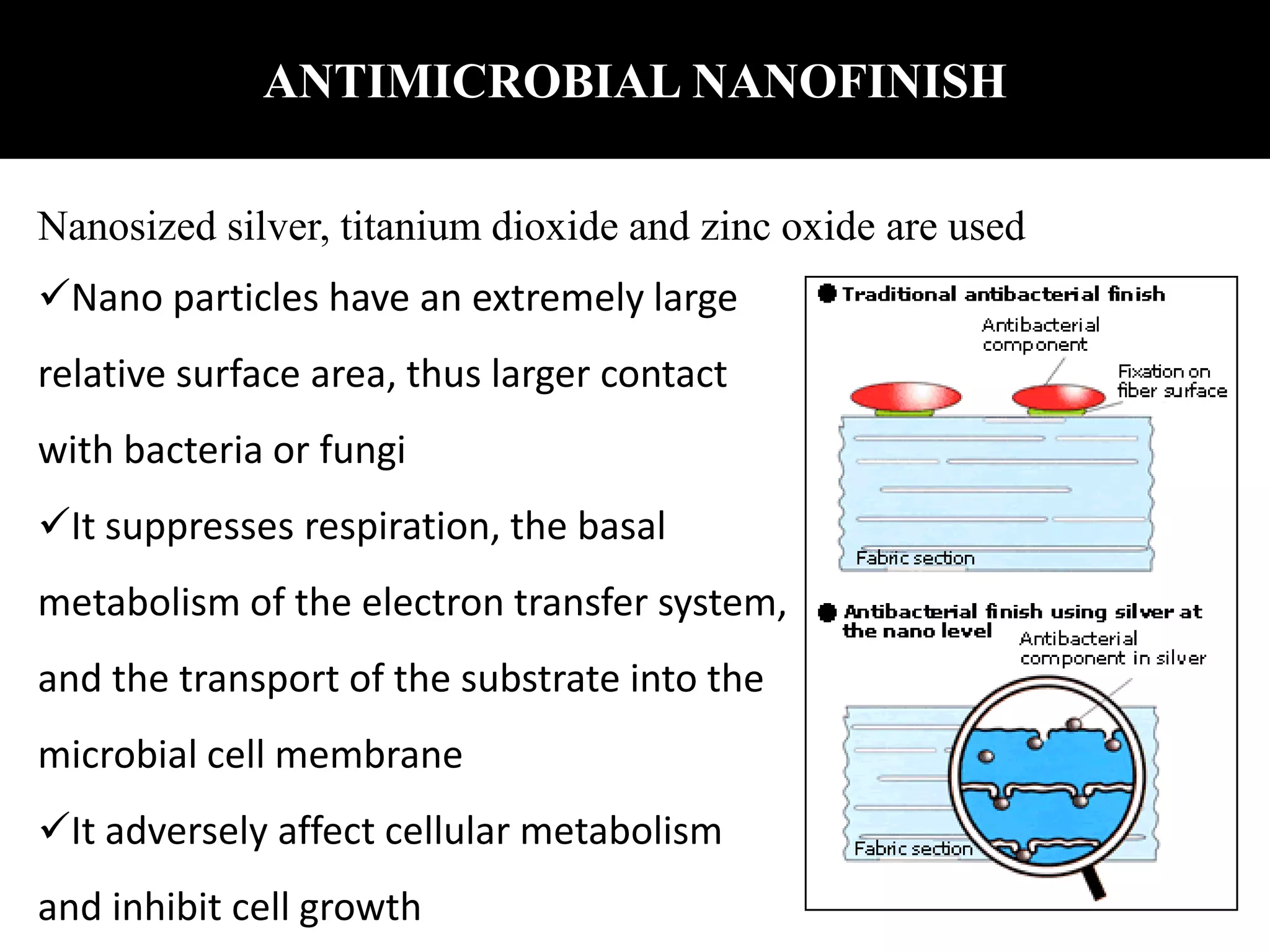
ANTIMICROBIAL NANOFINISH
Nano particles have an extremely large
relative surface area, thus larger contact
with bacteria or fungi
It suppresses respiration, the basal
metabolism of the electron transfer system,
and the transport of the substrate into the
microbial cell membrane
It adversely affect cellular metabolism
and inhibit cell growth
Nanosized silver, titanium dioxide and zinc oxide are used
CONT…
Encapsulate a silver compound or
nano particle with a fibre reactive
polymer
Silver nanoparticles are on the
surface of the capsule
In inner core perfume or thermo
sensitive material
Anti-microbial activity against
various bacteria, fungi are achieved
DISADVANTAGE UF USING SILVER NPs
High cost
Incompatibility to aqueous system
Tendency to cause decoloration in textile
Loss in tensile sttength and elongation both
L. Maleknia, A. S. Rashidi, “Preparation and Characterization of Nylon 6/Silver
anocomposite Fibers for Permanent Antibacterial Effect”, Oriental Journal of Chemistry
Vol 31;(2014);257-262
PHOTOCATALYTIC SELFCLEANING FINISH
UVPROTECTION FINISH
By TiO2, ZnO, SiO2 and Al2O3
nanoparticles
Scattering is inversely proportional to
the wavelength to the fourth power
Light scattering predominates at
approximately onetenth of the
wavelength of the scattered light
LIMITATIONS
Generation of waste chemical residues or wastewater during
the production of self-cleaning fibrous materials
Improper disposal of nanomaterials could lead to a large
amount of nano-sized titanium dioxide entering the soil
Earthworms can absorb nanoparticles from the contaminated
soil and move up to the food chain
Nano Tio2 induces oxidative DNA damage increases DNA
strand breaks
NEXT GENERATION NANO FINISHING
Finish Fibre suitability Functions End use
Nano Care Cellulosic Wrinkle
resistance,
water and stain
repellent
All Cotton wear
Nano Dry PET, NY, Acrylic Hydrophilic
finish
Synthetic sports wear, under
garments
Nano
Touch
Synthetics Cellulose
wrapping on
synthetics
Wrapping on PET microfibres to
produce highly twisted
Georgette, Chiffon Silk substitute.
Wrapping on acrylic to produce
light weight hydrophilic sweater
NANOCARE
Uses whishker like structure
Features
Superior Stain, Water and Oil Repellency
Resists Wrinkles
Breathable Fabric
Preserves Original Hand
Easy Care
Dimension stabilizing finish
Hooks
Whiskers
SUPER HYDROPHOBIC: SELF CLEANING NANO
FINISHES
Billions of Nanowhiskers create a thin
cushion of air above the cotton fabric,
smoothing out wrinkles and allowing
liquids to bead up and roll off without a
trace.
Water droplets form spherical globules
Rough nanoscale surface picks up dirt
Water and dirt roll off
It doesn't affect the hand, breathability
of fabric
NANO DRY
USES NANONET STRUCTURE
Hydrophilic finishing technology
Nanonets alters the property of
synthetic fibers like Polyester to give feel
of cotton & linen.
Wicks body moisture fast
Dries quickly & gives cooling effect.
Preserves Original Hand
Durable Performance
NANO TOUCH
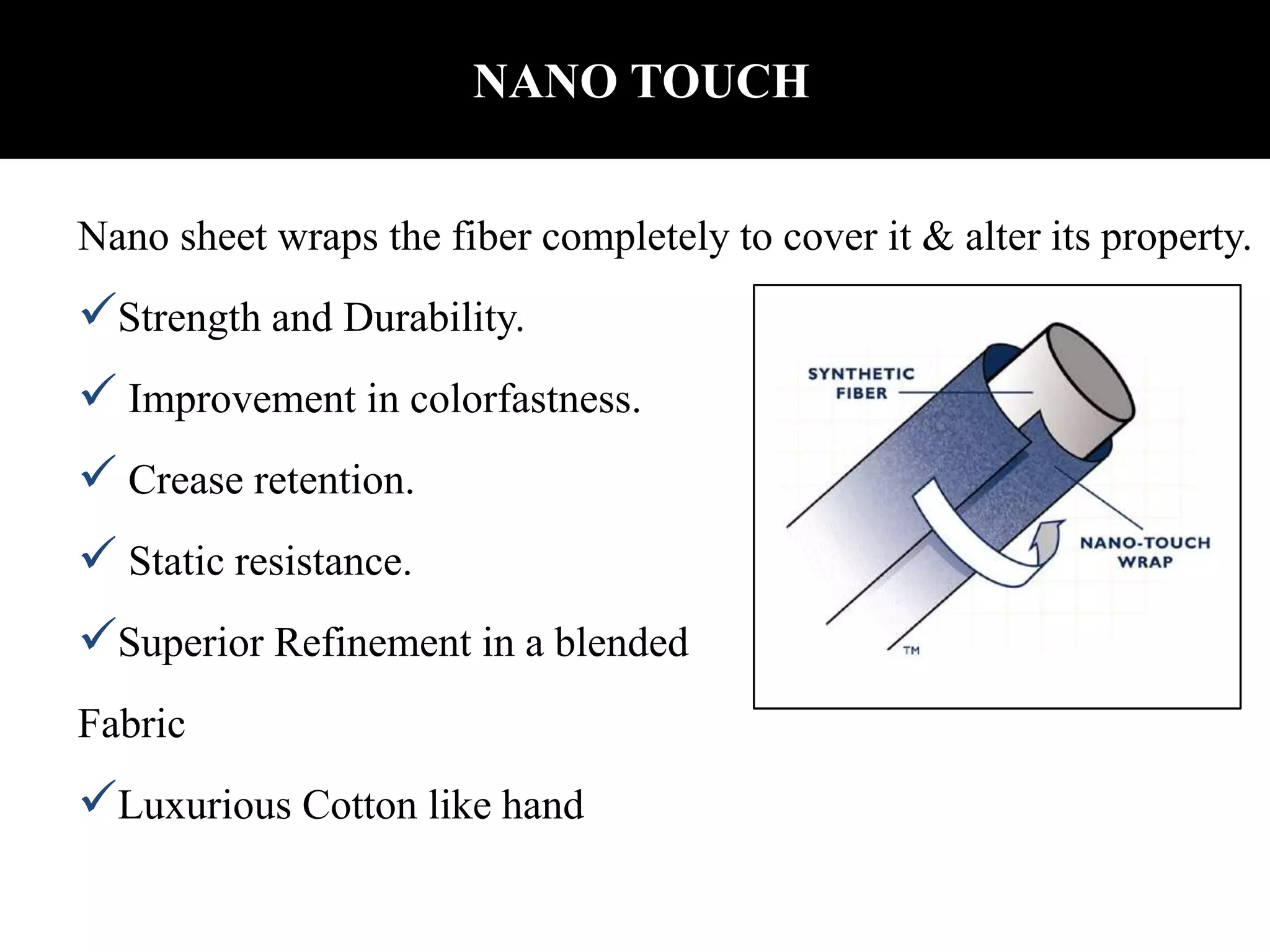
Nano sheet wraps the fiber completely to cover it & alter its property.
Strength and Durability.
 Improvement in colorfastness.
 Crease retention.
 Static resistance.
Superior Refinement in a blended
Fabric
Luxurious Cotton like hand
FUTURE PROSPECT
Future developments of nanotechnologies in textiles will have a
two fold focus:
Upgrading existing functions and performances of textile
materials;
Developing multifunctional finishes using nano technology
The new functions with textiles to be developed include
Nanofibres that would detoxify and filter toxic chemicals, warfare
agents. Multiple and sophisticated protection and detection.
Healthcare and wound healing functions
CONCLUSION
 Nanotechnology takes finishing to an advance level by covering
demerits of conventional finishes
 Nano finish impart some valuable property to fabric but may
have some disadvantage in terms of strength loss, toxicity.
 To overcome these barrier the research on nanofinish need to
expand in direction of sustainable, ecofriendly nanofinish
REFERENCES
S.Kathirvelu,“Nanotechnology applications in textiles”, Indian Journal of
Science and Technology;Vol.1(2008);Pg.1-10
A. Ebissy,“Effect of nano ZnO on structural characteristic, tensile thermal
properties of textile fabrics”,Journal of industrial textiles;(2015);Pg.1-13
Wing Sze Tung,“Self-cleaning fibers via nanotechnology: a virtual reality”,
Journal of Materials Chemistry; Vol.21; (2011); Pg.7858–7869
Mehreen Ijaz,“Role of Nanotechnology in the Field of Textile Finishes”,
RJSSM;Vol.03;(2013);Pg.201-207
M. Joshi and A. Bhattacharyya Nanotechnology,“A New Route to High
Performance and Functional Textiles” ,Textile Progress;(2011) ; Pg.155-233
Mohammad Mirjalili,“Antibacterial properties of nano silver finish
cellulose fabric”,Journal Of Nanostructure in Chemistry; (2013); Pg.1-5
D. Gopalakrishnan,“Functional Nano Finishes ForTextiles”,
Fibre2Fashion;2016;Pg.1-10
A.P.S.Sawhney,“Modern Applications of Nanotechnology in Textiles”,
Textile Research Journal;Vol 78;2008;Pg.731-739
THANK YOU

Nano finish

  • 1.
    APPLICATION OF NANOTECHNOLOGY IN TEXTILE FINISHING SUBMITTED TO: PROF. DEEPTI GUPTA SUBMITTED BY: ANUBHAV SHUKLA (2015TTF2385)
  • 2.
    CONTENT  NANO-TECHNOLOGY  SYNTHESISOF NANOPHASE MATERIALS  NANOFINISHING APPLICATION  NANOPARTICLES& ITS APPLICATIONS  NEXT GENERATION NANO FINISHING  FUTURE ASPECTS  CONCLUSION
  • 3.
    NANO-TECHNOLOGY We can defineit by following means “It deals with structures whose area is smaller than 100 nm at least in one dimension” OR “Nanotechnology greatly focuses on handling, arranging and controlling of nanoscale structures to incorporate into large material structures and components”
  • 4.
    SYNTHESIS OF NANOPHASEMATERIALS Top down approach It involves breaking down the bulk materials to nano sizes Bottom up approach Building atom by atom by self assembly
  • 5.
    NANOTECHNOLOGY WHY?  Conventionalmethods used to impart different properties to fabrics  Lower sustainability  Reduce breathability  Comfort  Nanotechnology can provide high durability for fabrics because:  Smaller size  large surface area-to-volume ratio  high surface energy.  Coating of nano-particles on fabrics will not affect their breathability or hand feel.
  • 6.
    APPLICATION OF NANOFINISHING FUNCTIONAL waterrepellent PROTECTION UV absorption DURABILITY color fastness DURABILITY abrasion SAFETY fire retardancy FUNCTIONAL HYGIENE Anti-microbial FUNCTIONAL PROTECTION Controlled release of additives Nano Treated Textile FUNCTIONAL PROTECTION self-cleaning
  • 7.
    NANOPARTICLES& ITS APPLICATIONS SR.NO. Nanoparticles Properties 1 Silver nanoparticles Anti-bacterial finishing 2 Fe nanoparticles Conductive magnetic properties, remote heating. 3 ZnO and TiO2 UV-protection, fiber protection, oxidative catalysis 4 TiO2 and MgO Chemical and biological protective performance, provide self-sterilizing function. 5 SiO2 or Al2O3 Nano-particles with PP or PE coating Super water repellent finishing. 6 Indium-tin oxide nanoparticles EM / IR protective clothing. 7 Ceramic nanoparticles Increasing resistance to abrasion. 8 Carbon black nanoparticles Increasing resistance to abrasion, chemical resistance and impart electrical conductivity, coloration of some textiles. 9 Clay nanoparticles High electrical, heat and chemical resistance.
  • 8.
    WATER REPELLENT FINISHES PREVIOUSLYBY PARAFFIN WAX: Paraffin chains wrap themselves spiral-like around individual fibres, filaments or yarns in a very fine film Reduces surface tension water droplets and even mud with significantly higher surface tension simply run off Economic
  • 9.
    WATER REPELLENT NANOFINISH SiO2, Al2O3 nanoparticles are mainly used for super water repellent finishes Fibres are coated with millions of 40 nanometer wide silicone nanofilaments Silicone is condensed into the fibres in the form of gas to form nanofilaments A permanent layer of air, trapped in silicone nanofilaments, that is present in the fabric, prevents the water from penetrating into the cloth
  • 10.
    ANTIMICROBIAL NANOFINISH Nano particleshave an extremely large relative surface area, thus larger contact with bacteria or fungi It suppresses respiration, the basal metabolism of the electron transfer system, and the transport of the substrate into the microbial cell membrane It adversely affect cellular metabolism and inhibit cell growth Nanosized silver, titanium dioxide and zinc oxide are used
  • 11.
    CONT… Encapsulate a silvercompound or nano particle with a fibre reactive polymer Silver nanoparticles are on the surface of the capsule In inner core perfume or thermo sensitive material Anti-microbial activity against various bacteria, fungi are achieved
  • 12.
    DISADVANTAGE UF USINGSILVER NPs High cost Incompatibility to aqueous system Tendency to cause decoloration in textile Loss in tensile sttength and elongation both L. Maleknia, A. S. Rashidi, “Preparation and Characterization of Nylon 6/Silver anocomposite Fibers for Permanent Antibacterial Effect”, Oriental Journal of Chemistry Vol 31;(2014);257-262
  • 13.
  • 14.
    UVPROTECTION FINISH By TiO2,ZnO, SiO2 and Al2O3 nanoparticles Scattering is inversely proportional to the wavelength to the fourth power Light scattering predominates at approximately onetenth of the wavelength of the scattered light
  • 15.
    LIMITATIONS Generation of wastechemical residues or wastewater during the production of self-cleaning fibrous materials Improper disposal of nanomaterials could lead to a large amount of nano-sized titanium dioxide entering the soil Earthworms can absorb nanoparticles from the contaminated soil and move up to the food chain Nano Tio2 induces oxidative DNA damage increases DNA strand breaks
  • 16.
    NEXT GENERATION NANOFINISHING Finish Fibre suitability Functions End use Nano Care Cellulosic Wrinkle resistance, water and stain repellent All Cotton wear Nano Dry PET, NY, Acrylic Hydrophilic finish Synthetic sports wear, under garments Nano Touch Synthetics Cellulose wrapping on synthetics Wrapping on PET microfibres to produce highly twisted Georgette, Chiffon Silk substitute. Wrapping on acrylic to produce light weight hydrophilic sweater
  • 17.
    NANOCARE Uses whishker likestructure Features Superior Stain, Water and Oil Repellency Resists Wrinkles Breathable Fabric Preserves Original Hand Easy Care Dimension stabilizing finish Hooks Whiskers
  • 18.
    SUPER HYDROPHOBIC: SELFCLEANING NANO FINISHES Billions of Nanowhiskers create a thin cushion of air above the cotton fabric, smoothing out wrinkles and allowing liquids to bead up and roll off without a trace. Water droplets form spherical globules Rough nanoscale surface picks up dirt Water and dirt roll off It doesn't affect the hand, breathability of fabric
  • 19.
    NANO DRY USES NANONETSTRUCTURE Hydrophilic finishing technology Nanonets alters the property of synthetic fibers like Polyester to give feel of cotton & linen. Wicks body moisture fast Dries quickly & gives cooling effect. Preserves Original Hand Durable Performance
  • 20.
    NANO TOUCH Nano sheetwraps the fiber completely to cover it & alter its property. Strength and Durability.  Improvement in colorfastness.  Crease retention.  Static resistance. Superior Refinement in a blended Fabric Luxurious Cotton like hand
  • 21.
    FUTURE PROSPECT Future developmentsof nanotechnologies in textiles will have a two fold focus: Upgrading existing functions and performances of textile materials; Developing multifunctional finishes using nano technology The new functions with textiles to be developed include Nanofibres that would detoxify and filter toxic chemicals, warfare agents. Multiple and sophisticated protection and detection. Healthcare and wound healing functions
  • 22.
    CONCLUSION  Nanotechnology takesfinishing to an advance level by covering demerits of conventional finishes  Nano finish impart some valuable property to fabric but may have some disadvantage in terms of strength loss, toxicity.  To overcome these barrier the research on nanofinish need to expand in direction of sustainable, ecofriendly nanofinish
  • 23.
    REFERENCES S.Kathirvelu,“Nanotechnology applications intextiles”, Indian Journal of Science and Technology;Vol.1(2008);Pg.1-10 A. Ebissy,“Effect of nano ZnO on structural characteristic, tensile thermal properties of textile fabrics”,Journal of industrial textiles;(2015);Pg.1-13 Wing Sze Tung,“Self-cleaning fibers via nanotechnology: a virtual reality”, Journal of Materials Chemistry; Vol.21; (2011); Pg.7858–7869 Mehreen Ijaz,“Role of Nanotechnology in the Field of Textile Finishes”, RJSSM;Vol.03;(2013);Pg.201-207 M. Joshi and A. Bhattacharyya Nanotechnology,“A New Route to High Performance and Functional Textiles” ,Textile Progress;(2011) ; Pg.155-233 Mohammad Mirjalili,“Antibacterial properties of nano silver finish cellulose fabric”,Journal Of Nanostructure in Chemistry; (2013); Pg.1-5 D. Gopalakrishnan,“Functional Nano Finishes ForTextiles”, Fibre2Fashion;2016;Pg.1-10 A.P.S.Sawhney,“Modern Applications of Nanotechnology in Textiles”, Textile Research Journal;Vol 78;2008;Pg.731-739
  • 24.