


Special Finishes
Fabric & Garment Finishing
BIOLOGICAL FINISHES
Bio-polishing

To produce this effect cellulose
enzymes were introduced. The
regular acid acting celluloses
produced following effects:
• More cutting
• Colour loss
• Prone to contour patches
• Bluish heavy effect
• High back staining
• Economical
Bio-polishing
•Genetically Modified enzymes were produced, called GMO's
(Genetically Modified Organisms).
•Enzymes have various activities Endoglucanase (I, II)
Exoglucanase, cello-biohydrolase (CBH II) etc.
•With the advent of genetic engineering it is now possible to
increase or suppress one or more of these activities to achieve
tailor made results.
•The effectiveness of the catalytic core (to hydrolyse glycosidic
linkages) depends greatly on the absorption by the CBD tail.
Bio-polishing

•When tightly bound to the substrate, certain
endoglucanases disturb the crystalline structure and induces
the various properties like fading, defibrillation, etc. as a
result of the mechano-chemical effect.
•optimal temperature range of about 45 C to 60 C.
Denim Bleaching

•Laccases enzymes are used to get outstanding contrast look
on denim fabrics.
•They also eliminate all the negative effects of the indigo dye
redeposition at the same time reducing the time of the process
necessary to achieve a highly abraded look.
•Various effects are obtained on denim fabrics using Laccases.
PROTECTIVE FINISHES
Insect Repellent Finishing

•An ANTIMO MGL a menthoglycol is a natural insect
repellent active ingredient, derived from lemon eucalyptus,
which is a natural and renewable source.
•Testing of Antimos MGL with a moderately aggressive cage
population of Aedes aegypti mosquitoes resulted in no bites up
to at least 4 hours.
•This indicates that the products has unusual repellency.
Antibacterial Finishing

•Microbes are minute organisms, which can be most
dangerous for creating harm to our lifestyle in different ways.
So to make the environment healthy, hygienic and fresh, it
becomes very important to have the control over growth of the
microbes and for these the garments / fabrics should be treated
with some specialty chemicals, which can restrict the growth
of these microorganisms.
•Antimicrobial finishing is one of the special types of
finishing given to the textiles where the chances of bacterial
growth are high and the safety is paramount.


                               .
Antibacterial Finishing

•Biquanides, phenols and their derivatives, isothiazolones,
metals, ammonium compounds and alcohols serve as anti-
bacterial agents in finishing recipe. Some other important
chemicals are Zeolite (inorganic compound of sodium
aluminose ), Triclosan ( a phenolic derivative), Chitin
(extracted from shells of crabs and shrimps) and Quarternary
ammonium compounds .
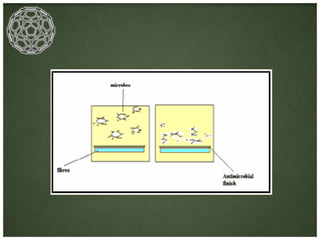
Action of Antimicrobial finish
•Anti-microbial treatment on the undergarments controls the
growth of microbes on it, which will in turn control the above
effects .
Characteristics
•This type of finishing inhibits the growth of microbes on the
surface of the fabric.
•Maintains hygiene and freshness, stops bad odour.
•Controls or eliminates microbial staining.
•Improves life of the articles wherever it is applied.
•Improves hand of most of the fabric.
•Eliminates the chances of disease transmission.
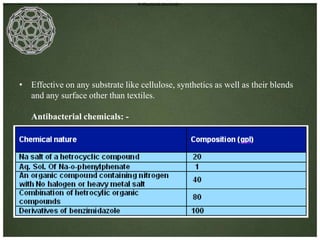
Antibacterial chemicals: -


• Effective on any substrate like cellulose, synthetics as well as their blends
  and any surface other than textiles.

   Antibacterial chemicals: -
FUNCTIONAL FINISHES
Cool Finish (snocool)
•When temperature rises, we tend to sweat. This is a natural
reaction of our body to maintain the temperature around
97�F.The sweat when evaporates, takes along with it heat
equivalent to heat of evaporation of water, thereby
maintaining the temperature of the body.
•The Snocool finish uses the moisture management route i.e. it
will enhance the natural phenomenon of sweat evaporation.
This finish absorbs and dissipates sweat evenly throughout
and thus gives a cool feeling to the wearer.
Cool Finish (snocool)
Characteristics: -

•Garments finished with Snocool produces a cool effect.
•The finish has two fold effect, it reflects light (special polymer)
and transfers moisture faster than normal from body to fabric
and finally to the atmosphere.
•These finishing agents can be manufactured with or without
fragrance.
Thermocat Finish
•A finishing agent for producing heat retaining effect.
•This type of finishing when applied to the fabric keeps it
warm.
• Produces heat retaining effect due to infrared radiation
owing to its porosity.
•Especially suitable for 100% cellulose and its blends.
UV Protective Finish
•The protection offered by UV cutting fabrics is expressed in
terms of UV protection factor (UPF) or sun protection factor
(SPF), which are equivalent to the user.
•UPF of 40 for a garment means the wearer can stay 40 times
longer in the sun before skin reddening (erythema) sets in
other words if skin reddens in 15 minutes without UV cutting
garment, the same level of reddening would take 10
hours, when UV cutting garment is worn.
•This means that UPF is a ratio of the time taken for skin
reddings with and without protection.
UV Protective Finish
•Characteristics:                                              -

A specialty finishes for protecting the fabric from UV
radiation. Protects human's underlying tissues from UV
radiation. Protects against short wavelength radiation i.e. from
100 - 400 nm, Non-yellowing. Should be applied during
dyeing under a reductive process Applicable by exhaust as
well as padding method

Special finishes

  • 1.
    Special Finishes Fabric &Garment Finishing
  • 2.
  • 3.
    Bio-polishing To produce thiseffect cellulose enzymes were introduced. The regular acid acting celluloses produced following effects: • More cutting • Colour loss • Prone to contour patches • Bluish heavy effect • High back staining • Economical
  • 4.
    Bio-polishing •Genetically Modified enzymeswere produced, called GMO's (Genetically Modified Organisms). •Enzymes have various activities Endoglucanase (I, II) Exoglucanase, cello-biohydrolase (CBH II) etc. •With the advent of genetic engineering it is now possible to increase or suppress one or more of these activities to achieve tailor made results. •The effectiveness of the catalytic core (to hydrolyse glycosidic linkages) depends greatly on the absorption by the CBD tail.
  • 5.
    Bio-polishing •When tightly boundto the substrate, certain endoglucanases disturb the crystalline structure and induces the various properties like fading, defibrillation, etc. as a result of the mechano-chemical effect. •optimal temperature range of about 45 C to 60 C.
  • 6.
    Denim Bleaching •Laccases enzymesare used to get outstanding contrast look on denim fabrics. •They also eliminate all the negative effects of the indigo dye redeposition at the same time reducing the time of the process necessary to achieve a highly abraded look. •Various effects are obtained on denim fabrics using Laccases.
  • 7.
  • 8.
    Insect Repellent Finishing •AnANTIMO MGL a menthoglycol is a natural insect repellent active ingredient, derived from lemon eucalyptus, which is a natural and renewable source. •Testing of Antimos MGL with a moderately aggressive cage population of Aedes aegypti mosquitoes resulted in no bites up to at least 4 hours. •This indicates that the products has unusual repellency.
  • 9.
    Antibacterial Finishing •Microbes areminute organisms, which can be most dangerous for creating harm to our lifestyle in different ways. So to make the environment healthy, hygienic and fresh, it becomes very important to have the control over growth of the microbes and for these the garments / fabrics should be treated with some specialty chemicals, which can restrict the growth of these microorganisms. •Antimicrobial finishing is one of the special types of finishing given to the textiles where the chances of bacterial growth are high and the safety is paramount. .
  • 10.
    Antibacterial Finishing •Biquanides, phenolsand their derivatives, isothiazolones, metals, ammonium compounds and alcohols serve as anti- bacterial agents in finishing recipe. Some other important chemicals are Zeolite (inorganic compound of sodium aluminose ), Triclosan ( a phenolic derivative), Chitin (extracted from shells of crabs and shrimps) and Quarternary ammonium compounds .
  • 11.
    Action of Antimicrobialfinish •Anti-microbial treatment on the undergarments controls the growth of microbes on it, which will in turn control the above effects . Characteristics •This type of finishing inhibits the growth of microbes on the surface of the fabric. •Maintains hygiene and freshness, stops bad odour. •Controls or eliminates microbial staining. •Improves life of the articles wherever it is applied. •Improves hand of most of the fabric. •Eliminates the chances of disease transmission.
  • 13.
    Antibacterial chemicals: - •Effective on any substrate like cellulose, synthetics as well as their blends and any surface other than textiles. Antibacterial chemicals: -
  • 14.
  • 15.
    Cool Finish (snocool) •Whentemperature rises, we tend to sweat. This is a natural reaction of our body to maintain the temperature around 97�F.The sweat when evaporates, takes along with it heat equivalent to heat of evaporation of water, thereby maintaining the temperature of the body. •The Snocool finish uses the moisture management route i.e. it will enhance the natural phenomenon of sweat evaporation. This finish absorbs and dissipates sweat evenly throughout and thus gives a cool feeling to the wearer.
  • 16.
    Cool Finish (snocool) Characteristics:- •Garments finished with Snocool produces a cool effect. •The finish has two fold effect, it reflects light (special polymer) and transfers moisture faster than normal from body to fabric and finally to the atmosphere. •These finishing agents can be manufactured with or without fragrance.
  • 17.
    Thermocat Finish •A finishingagent for producing heat retaining effect. •This type of finishing when applied to the fabric keeps it warm. • Produces heat retaining effect due to infrared radiation owing to its porosity. •Especially suitable for 100% cellulose and its blends.
  • 18.
    UV Protective Finish •Theprotection offered by UV cutting fabrics is expressed in terms of UV protection factor (UPF) or sun protection factor (SPF), which are equivalent to the user. •UPF of 40 for a garment means the wearer can stay 40 times longer in the sun before skin reddening (erythema) sets in other words if skin reddens in 15 minutes without UV cutting garment, the same level of reddening would take 10 hours, when UV cutting garment is worn. •This means that UPF is a ratio of the time taken for skin reddings with and without protection.
  • 19.
    UV Protective Finish •Characteristics: - A specialty finishes for protecting the fabric from UV radiation. Protects human's underlying tissues from UV radiation. Protects against short wavelength radiation i.e. from 100 - 400 nm, Non-yellowing. Should be applied during dyeing under a reductive process Applicable by exhaust as well as padding method