NAME: ANSARI KAUSAR MOHD KHALID
ID NO: 7763
ROLL NO: 08
CLASS: MSC-I (2022-23)
SUBJECT: PAPER-3 (GENETICS AND EVOLUTION)
DEPARTMENT OF ZOOLOGY
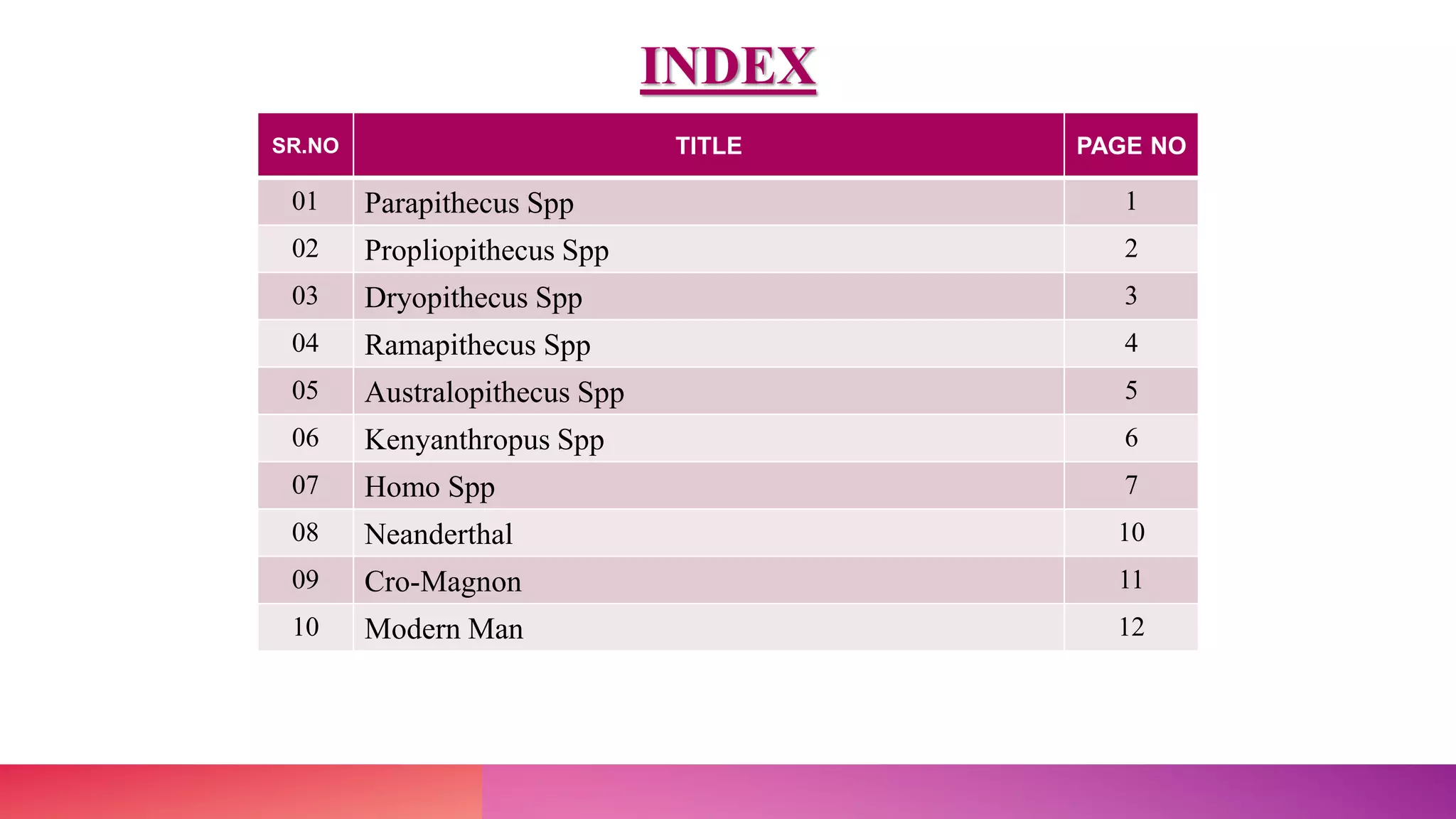
INDEX
SR.NO TITLE PAGE NO
01 Parapithecus Spp 1
02 Propliopithecus Spp 2
03 Dryopithecus Spp 3
04 Ramapithecus Spp 4
05 Australopithecus Spp 5
06 Kenyanthropus Spp 6
07 Homo Spp 7
08 Neanderthal 10
09 Cro-Magnon 11
10 Modern Man 12
 PARAPITHECUS SPP
 Parapithecus belong to the group of Fayum anthropoids that are mostly
closely related to the ancestry of New World Monkey.
 Parapithecus is an extinct genus of primate that lived during the Late Eocene-
Earliest Oligocene in what is now Egypt.
 Its members are considered to be basal anthropoids and the genus is closely
related to Apidium.
 They lived about 40 to 33 million years ago.
 Parapithecus had an unusual dentition, which contained no adult lower
incisors.
 The upper dentition likely had four incisors.
4.1 HUMAN EVOLUTION 1
 PROPLIOPITHECUS SPP:
 It was an ape-like primate. It lived in the Oligocene epoch about
30 million years ago.
 The fossil of first known ape was obtained from Fayum deposits
of Egypt.
 It was represent by the fossil jaw and teeth.
 No doubt more or less ape-like, its incisors were vertical rather
than directed forward.
 Simpson (1967) presumed that propliopithecus might be the
ancestor of modern apes and man.
4.1 HUMAN EVOLUTION 2
 DRYOPITHECUS (PROCONSUL) SPP:
 The fossil of this ape was discovered by L.S.B Leakey in 1930
on an island in Lake Victoria of Africa.
 It is ape, that lived in Miocene epoch about 20-25 millions years
ago.
 It exhibits close similarity to chimpanzee.
 Its legs and heels indicate that it must have assumed a semi-erect
posture.
 Recently, an almost complete lower jaw of a Dryopithecus has
been obtained from Haritalyanga in Bilaspur district of Himachal
Pradesh.
4.1 HUMAN EVOLUTION 3
 RAMAPITHECUS SPP:
 It was an ape-man like primate.
 The teeth and jaw bones of Ramapithecus were found in the rocks
of Siwalik Hills in India by G.E.Lewis (1930).
 It lived during Miocene and early Pliocene epoch about 14 to 12
million years ago.
 Fossils of similar features were discovered from Kenya in Africa
called Kenyapithecus.
 They walked erect on their hind limbs. On the basis of these
features, some scientists believed that Dryopithecus evolved into
Ramapithecus which is on direct line of human evolution.
4.1 HUMAN EVOLUTION 4
 AUSTRALOPITHECUS SPP:
 The first fossil, Australopithecus africanus in the form of skull
cap of child (called Taung baby) was discovered in a lime quarry
by workers at Taung, in South Africa.
 The specimen was studied by Raymond Dart.
 They lived in late Pliocene or early Pleistocene epoch about 4 to
1.8 million years ago.
 Australopithecus hunted with stone weapons but essentially ate
fruit.
 Australopithecus can be considering as connecting link between
ape and man.
 Dentition was man like because the dental arch was smoothly
rounded parabola and a simian gap was absent
 Thus, Australopithecus is rightly described as a Man with Ape
brain.
4.1 HUMAN EVOLUTION 5
 KENYANTHROPUS SPP:
 Found in 2001 west of Lake Turkana in northern Kenya.
 Found in deposits dating between 3.2 and 3.5 mya
 Shows mixture of features, including very small, chimpanzee like
braincase and flat, vertically straight face also seen in much later,
more human-like specimens from the same area
 Distinct from A. afarensis which lived in the same region and at
the same time
 However, some suggest the cranium is too damaged to properly
diagnose
4.1 HUMAN EVOLUTION 6
 HOMO SPP:
 It is the genus that includes modern humans and species closely
related to them.
 The genus is estimated to be about 2.3 to 2.4 million years old
evolving from australopithecine ancestors with the appearance of
Homo habilis.
 All species of the genus except Homo sapiens (modern humans)
are extinct.
Two types of homo spp are as follow:
1. Homo habilis
2. Homo erectus
4.1 HUMAN EVOLUTION 7
 HOMO HABILIS:
 The fossil of this primitive man were discovered from the
Olduvai Gorge, Tanzania (Africa) by Leakey in 1964.
 Homo habilis evolved in Africa in late Pliocene or early
Pleistocene epoch about 2.5 to 1.4 millions years ago.
 It lived in open grassy land, moved erect and was omnivorous.
 The lower jaw was lightly built and the dentition was more like
that of modern man.
 It had smaller molars and made tools from stones.
 Its cranial capacity was about 650 to 800 c.c.
 It was called handy man or Tool-maker.
4.1 HUMAN EVOLUTION 8
 HOMO ERECTUS:
 Homo erectus was the first true man. This primitive man lived in
Java and Peking.
 The first fossil were obtained from rocks on the bank of solo river
in Java by Dubois in 1891.
 It lived in the middle Pleistocene epoch about 5,00,000 years ago.
 It had cranial capacity about 940 c.c.
 It was about five feet in height and walked erect.
 Its face was prognathous and the jaws were massive with huge
teeth.
 The chin was absent, bony eyebrow was present.
 It was more ape like than man like, hence it is also called as Java
Ape Man.
4.1 HUMAN EVOLUTION 9
 NEANDERTHAL:
 Neanderthal man was an advanced prehistoric man
 Its first fossil was collected from neanderthal valley in Germany by
Fuhlrott (1856).
 Neanderthal man existed in late Pleistocene epoch abbot 1,50.000 years
ago and were wide spread in Europe, Asia and North America.
 The cranial capacity was about 1450 c.c. roughly equal to that of modern
man.
 They were quite intelligent to use and construct flint tools.
 They buried their dead bodies along with their tools and were supposed
to perform ceremonies.
4.1 HUMAN EVOLUTION 10
 CRO-MAGNON:
 Cro-Magnon man was the extinct modern man.
 The fossil was first discovered by Mac Gregor in 1868 from Cro-
Magnon rocks of France.
 They originated nearly 50,000 years ago.
 The cranial capacity was about 1600 c.c.
 They lived in caves with families.
 They were expert in hunting and painting. They made tools and
weapons such as spear-heads, bows and arrows.
 They made ornaments from ivory and decorated their bodies.
 They use hides of animals to protect their body and buried their dead
according to their customs
4.1 HUMAN EVOLUTION 11
 MODERN MAN:
 It includes all the human beings existing today on the earth.
 A modern man (Homo sapiens), the species that we are, means “wise
man” in Latin.
 The essential features in modern man include the increase in size of
brain, bipedalism, the use of tools and fire, transition from hunting to
gathering to agriculture and cultural evolution.
 This includes the development of language, funeral and burial rites.
4.1 HUMAN EVOLUTION 12
 REFERENCE:
Organic evolution (seventh Revised Edition, 2009) by Dr. N. Arumugam
Organic Evolution by Veer Bala Rastogi
https://www.slideshare.net/pramodgpramod/evolution-of-man-74665654
https://slideplayer.com/slide/7736558
4.1 HUMAN EVOLUTION 13
THANK-YOU 

HUMAN EVOLUTION

  • 1.
    NAME: ANSARI KAUSARMOHD KHALID ID NO: 7763 ROLL NO: 08 CLASS: MSC-I (2022-23) SUBJECT: PAPER-3 (GENETICS AND EVOLUTION) DEPARTMENT OF ZOOLOGY
  • 2.
    INDEX SR.NO TITLE PAGENO 01 Parapithecus Spp 1 02 Propliopithecus Spp 2 03 Dryopithecus Spp 3 04 Ramapithecus Spp 4 05 Australopithecus Spp 5 06 Kenyanthropus Spp 6 07 Homo Spp 7 08 Neanderthal 10 09 Cro-Magnon 11 10 Modern Man 12
  • 3.
     PARAPITHECUS SPP Parapithecus belong to the group of Fayum anthropoids that are mostly closely related to the ancestry of New World Monkey.  Parapithecus is an extinct genus of primate that lived during the Late Eocene- Earliest Oligocene in what is now Egypt.  Its members are considered to be basal anthropoids and the genus is closely related to Apidium.  They lived about 40 to 33 million years ago.  Parapithecus had an unusual dentition, which contained no adult lower incisors.  The upper dentition likely had four incisors. 4.1 HUMAN EVOLUTION 1
  • 4.
     PROPLIOPITHECUS SPP: It was an ape-like primate. It lived in the Oligocene epoch about 30 million years ago.  The fossil of first known ape was obtained from Fayum deposits of Egypt.  It was represent by the fossil jaw and teeth.  No doubt more or less ape-like, its incisors were vertical rather than directed forward.  Simpson (1967) presumed that propliopithecus might be the ancestor of modern apes and man. 4.1 HUMAN EVOLUTION 2
  • 5.
     DRYOPITHECUS (PROCONSUL)SPP:  The fossil of this ape was discovered by L.S.B Leakey in 1930 on an island in Lake Victoria of Africa.  It is ape, that lived in Miocene epoch about 20-25 millions years ago.  It exhibits close similarity to chimpanzee.  Its legs and heels indicate that it must have assumed a semi-erect posture.  Recently, an almost complete lower jaw of a Dryopithecus has been obtained from Haritalyanga in Bilaspur district of Himachal Pradesh. 4.1 HUMAN EVOLUTION 3
  • 6.
     RAMAPITHECUS SPP: It was an ape-man like primate.  The teeth and jaw bones of Ramapithecus were found in the rocks of Siwalik Hills in India by G.E.Lewis (1930).  It lived during Miocene and early Pliocene epoch about 14 to 12 million years ago.  Fossils of similar features were discovered from Kenya in Africa called Kenyapithecus.  They walked erect on their hind limbs. On the basis of these features, some scientists believed that Dryopithecus evolved into Ramapithecus which is on direct line of human evolution. 4.1 HUMAN EVOLUTION 4
  • 7.
     AUSTRALOPITHECUS SPP: The first fossil, Australopithecus africanus in the form of skull cap of child (called Taung baby) was discovered in a lime quarry by workers at Taung, in South Africa.  The specimen was studied by Raymond Dart.  They lived in late Pliocene or early Pleistocene epoch about 4 to 1.8 million years ago.  Australopithecus hunted with stone weapons but essentially ate fruit.  Australopithecus can be considering as connecting link between ape and man.  Dentition was man like because the dental arch was smoothly rounded parabola and a simian gap was absent  Thus, Australopithecus is rightly described as a Man with Ape brain. 4.1 HUMAN EVOLUTION 5
  • 8.
     KENYANTHROPUS SPP: Found in 2001 west of Lake Turkana in northern Kenya.  Found in deposits dating between 3.2 and 3.5 mya  Shows mixture of features, including very small, chimpanzee like braincase and flat, vertically straight face also seen in much later, more human-like specimens from the same area  Distinct from A. afarensis which lived in the same region and at the same time  However, some suggest the cranium is too damaged to properly diagnose 4.1 HUMAN EVOLUTION 6
  • 9.
     HOMO SPP: It is the genus that includes modern humans and species closely related to them.  The genus is estimated to be about 2.3 to 2.4 million years old evolving from australopithecine ancestors with the appearance of Homo habilis.  All species of the genus except Homo sapiens (modern humans) are extinct. Two types of homo spp are as follow: 1. Homo habilis 2. Homo erectus 4.1 HUMAN EVOLUTION 7
  • 10.
     HOMO HABILIS: The fossil of this primitive man were discovered from the Olduvai Gorge, Tanzania (Africa) by Leakey in 1964.  Homo habilis evolved in Africa in late Pliocene or early Pleistocene epoch about 2.5 to 1.4 millions years ago.  It lived in open grassy land, moved erect and was omnivorous.  The lower jaw was lightly built and the dentition was more like that of modern man.  It had smaller molars and made tools from stones.  Its cranial capacity was about 650 to 800 c.c.  It was called handy man or Tool-maker. 4.1 HUMAN EVOLUTION 8
  • 11.
     HOMO ERECTUS: Homo erectus was the first true man. This primitive man lived in Java and Peking.  The first fossil were obtained from rocks on the bank of solo river in Java by Dubois in 1891.  It lived in the middle Pleistocene epoch about 5,00,000 years ago.  It had cranial capacity about 940 c.c.  It was about five feet in height and walked erect.  Its face was prognathous and the jaws were massive with huge teeth.  The chin was absent, bony eyebrow was present.  It was more ape like than man like, hence it is also called as Java Ape Man. 4.1 HUMAN EVOLUTION 9
  • 12.
     NEANDERTHAL:  Neanderthalman was an advanced prehistoric man  Its first fossil was collected from neanderthal valley in Germany by Fuhlrott (1856).  Neanderthal man existed in late Pleistocene epoch abbot 1,50.000 years ago and were wide spread in Europe, Asia and North America.  The cranial capacity was about 1450 c.c. roughly equal to that of modern man.  They were quite intelligent to use and construct flint tools.  They buried their dead bodies along with their tools and were supposed to perform ceremonies. 4.1 HUMAN EVOLUTION 10
  • 13.
     CRO-MAGNON:  Cro-Magnonman was the extinct modern man.  The fossil was first discovered by Mac Gregor in 1868 from Cro- Magnon rocks of France.  They originated nearly 50,000 years ago.  The cranial capacity was about 1600 c.c.  They lived in caves with families.  They were expert in hunting and painting. They made tools and weapons such as spear-heads, bows and arrows.  They made ornaments from ivory and decorated their bodies.  They use hides of animals to protect their body and buried their dead according to their customs 4.1 HUMAN EVOLUTION 11
  • 14.
     MODERN MAN: It includes all the human beings existing today on the earth.  A modern man (Homo sapiens), the species that we are, means “wise man” in Latin.  The essential features in modern man include the increase in size of brain, bipedalism, the use of tools and fire, transition from hunting to gathering to agriculture and cultural evolution.  This includes the development of language, funeral and burial rites. 4.1 HUMAN EVOLUTION 12
  • 15.
     REFERENCE: Organic evolution(seventh Revised Edition, 2009) by Dr. N. Arumugam Organic Evolution by Veer Bala Rastogi https://www.slideshare.net/pramodgpramod/evolution-of-man-74665654 https://slideplayer.com/slide/7736558 4.1 HUMAN EVOLUTION 13
  • 16.