BY MEHWISH MANZOOR
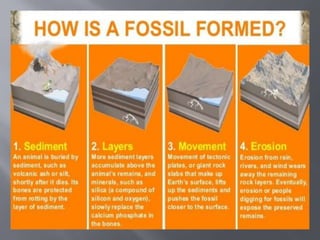
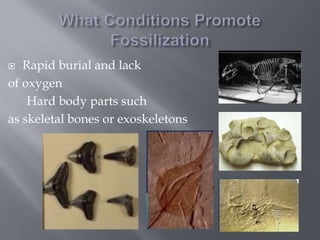
 Rapid burial and lack
of oxygen
Hard body parts such
as skeletal bones or exoskeletons
 Ground Thin Section Technique
 Peel Technique
 Transfer Technique
 Maceration Technique
 X- ray Technique
 Microtome Technique
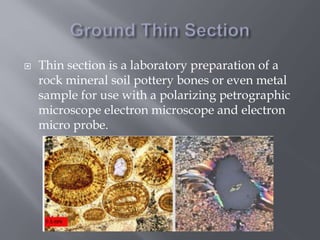
 Thin section is a laboratory preparation of a
rock mineral soil pottery bones or even metal
sample for use with a polarizing petrographic
microscope electron microscope and electron
micro probe.
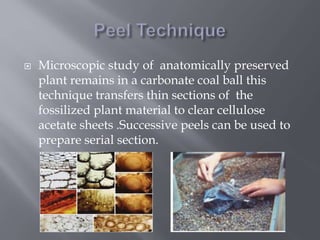
 Microscopic study of anatomically preserved
plant remains in a carbonate coal ball this
technique transfers thin sections of the
fossilized plant material to clear cellulose
acetate sheets .Successive peels can be used to
prepare serial section.
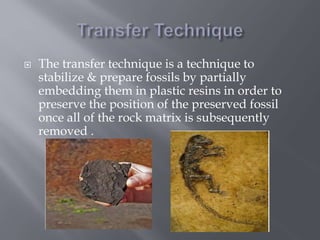
 The transfer technique is a technique to
stabilize & prepare fossils by partially
embedding them in plastic resins in order to
preserve the position of the preserved fossil
once all of the rock matrix is subsequently
removed .
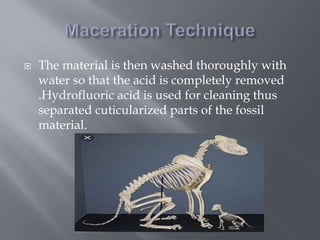
 The material is then washed thoroughly with
water so that the acid is completely removed
.Hydrofluoric acid is used for cleaning thus
separated cuticularized parts of the fossil
material.
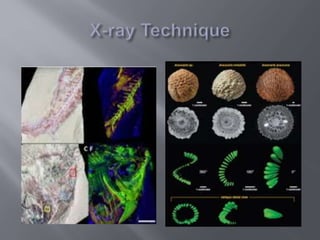
 Highly sensitive celluloid films are used to
obtain x-ray photographs of the fossil
specimens
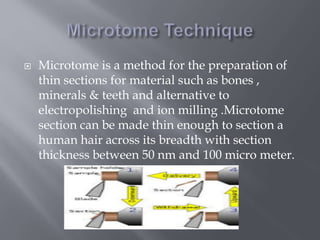
 Microtome is a method for the preparation of
thin sections for material such as bones ,
minerals & teeth and alternative to
electropolishing and ion milling .Microtome
section can be made thin enough to section a
human hair across its breadth with section
thickness between 50 nm and 100 micro meter.
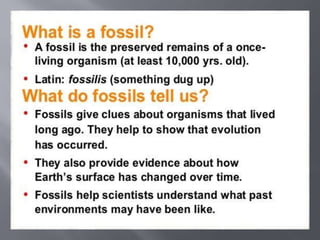
 Fossils are important evidence for evolution
because they show that life on earth was once
different from found on earth today.
 By studying fossils , scientists can learn how
much organisms have changed as life
developed on earth .
 There are gaps in the fossil record because
many early forms of life were soft-bodied ,
which means that they have left few traces
behind.
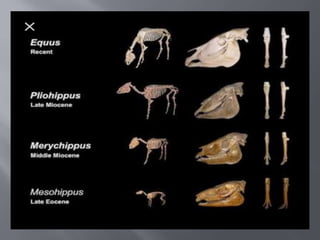
 Examination of fossils over earth history shows
the evolution of life through time .
 Because fossils show a continuous change
through time and no fossils disappear &
reappear later, they can be used to give relative
ages of fossil-bearing strata .
 Strata bearing the same fossil assemblage can
be correlated .
 Fossil indicate environment of deposition .
 Fossils can constitute most of a rock.
THANK YOU

Fossils formation & their significance in evolution

  • 1.
  • 5.
     Rapid burialand lack of oxygen Hard body parts such as skeletal bones or exoskeletons
  • 10.
     Ground ThinSection Technique  Peel Technique  Transfer Technique  Maceration Technique  X- ray Technique  Microtome Technique
  • 11.
     Thin sectionis a laboratory preparation of a rock mineral soil pottery bones or even metal sample for use with a polarizing petrographic microscope electron microscope and electron micro probe.
  • 12.
     Microscopic studyof anatomically preserved plant remains in a carbonate coal ball this technique transfers thin sections of the fossilized plant material to clear cellulose acetate sheets .Successive peels can be used to prepare serial section.
  • 13.
     The transfertechnique is a technique to stabilize & prepare fossils by partially embedding them in plastic resins in order to preserve the position of the preserved fossil once all of the rock matrix is subsequently removed .
  • 14.
     The materialis then washed thoroughly with water so that the acid is completely removed .Hydrofluoric acid is used for cleaning thus separated cuticularized parts of the fossil material.
  • 16.
     Highly sensitivecelluloid films are used to obtain x-ray photographs of the fossil specimens
  • 17.
     Microtome isa method for the preparation of thin sections for material such as bones , minerals & teeth and alternative to electropolishing and ion milling .Microtome section can be made thin enough to section a human hair across its breadth with section thickness between 50 nm and 100 micro meter.
  • 18.
     Fossils areimportant evidence for evolution because they show that life on earth was once different from found on earth today.  By studying fossils , scientists can learn how much organisms have changed as life developed on earth .  There are gaps in the fossil record because many early forms of life were soft-bodied , which means that they have left few traces behind.
  • 20.
     Examination offossils over earth history shows the evolution of life through time .  Because fossils show a continuous change through time and no fossils disappear & reappear later, they can be used to give relative ages of fossil-bearing strata .  Strata bearing the same fossil assemblage can be correlated .  Fossil indicate environment of deposition .  Fossils can constitute most of a rock.
  • 21.