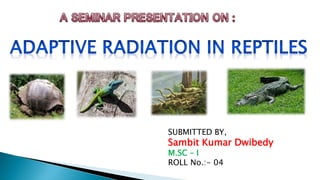
SUBMITTED BY,
Sambit Kumar Dwibedy
M.SC – I
ROLL No.:- 04
CONTENTS
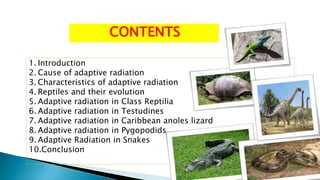
1. Introduction
2. Cause of adaptive radiation
3. Characteristics of adaptive radiation
4. Reptiles and their evolution
5. Adaptive radiation in Class Reptilia
6. Adaptive radiation in Testudines
7. Adaptive radiation in Caribbean anoles lizard
8. Adaptive radiation in Pygopodids
9. Adaptive Radiation in Snakes
10.Conclusion
INTRODUCTION:
WHAT IS ADAPTIVE RADIATION:
 The term adaptive radiation was coined by Osborn(1902).
 It is the diversification of species to fill a wide variety of ecological
niches.
 It is the differentiation of a single ancestor into an array of species that
causes different morphological and physiological traits according to their
habitat.
TYPES OF ADAPTIVE RADIATION:
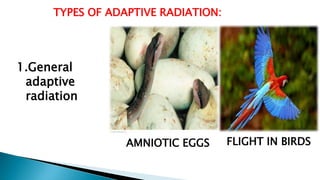
1.General
adaptive
radiation
AMNIOTIC EGGS FLIGHT IN BIRDS
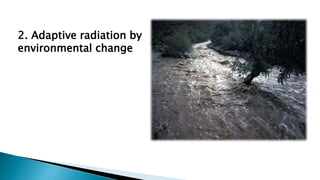
2. Adaptive radiation by
environmental change
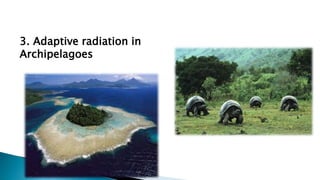
3. Adaptive radiation in
Archipelagoes
CAUSES OF ADAPTIVE RADIATION:
1. ACCORDING TO SIMPSON:
Entry into an adaptive zone is the perquisite for adaptive
radiation. Adaptive zone is entered in one of the following 3 ways
:
• Evolution of a key innovation
• Dispersal into a new habitat
• Extinction of antagonists
2. ACCORDING TO SCHLUTER:
Ecological opportunities triggers adaptive radiations.
SIMPSON
SCHLUTLER
3. MASS EXTINCTION :
Mass extinction is a pre-requisite to adaptive radiation
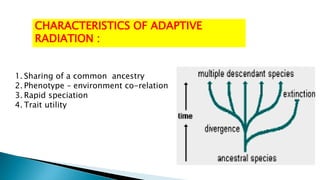
CHARACTERISTICS OF ADAPTIVE
RADIATION :
1. Sharing of a common ancestry
2. Phenotype – environment co-relation
3. Rapid speciation
4. Trait utility
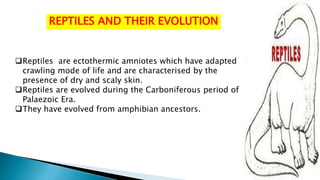
REPTILES AND THEIR EVOLUTION
Reptiles are ectothermic amniotes which have adapted
crawling mode of life and are characterised by the
presence of dry and scaly skin.
Reptiles are evolved during the Carboniferous period of
Palaezoic Era.
They have evolved from amphibian ancestors.
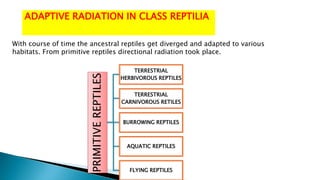
ADAPTIVE RADIATION IN CLASS REPTILIA
With course of time the ancestral reptiles get diverged and adapted to various
habitats. From primitive reptiles directional radiation took place.
PRIMITIVEREPTILES
TERRESTRIAL
HERBIVOROUS REPTILES
TERRESTRIAL
CARNIVOROUS RETILES
BURROWING REPTILES
AQUATIC REPTILES
FLYING REPTILES
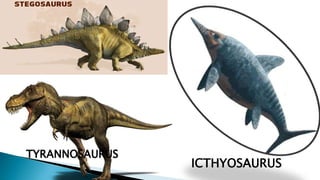
TYRANNOSAURUS
ICTHYOSAURUS
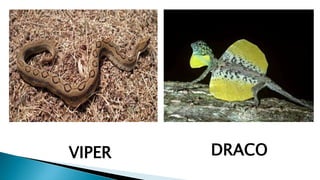
VIPER DRACO
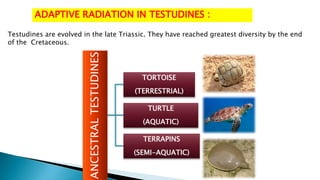
ADAPTIVE RADIATION IN TESTUDINES :
Testudines are evolved in the late Triassic. They have reached greatest diversity by the end
of the Cretaceous.
ANCESTRALTESTUDINES
TORTOISE
(TERRESTRIAL)
TURTLE
(AQUATIC)
TERRAPINS
(SEMI-AQUATIC)
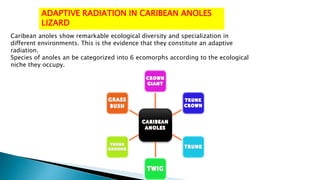
ADAPTIVE RADIATION IN CARIBEAN ANOLES
LIZARD
Caribean anoles show remarkable ecological diversity and specialization in
different environments. This is the evidence that they constitute an adaptive
radiation.
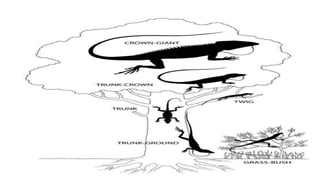
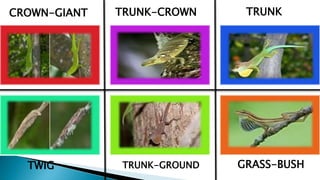
Species of anoles an be categorized into 6 ecomorphs according to the ecological
niche they occupy.
CROWN-GIANT TRUNK-CROWN TRUNK
TWIG TRUNK-GROUND GRASS-BUSH
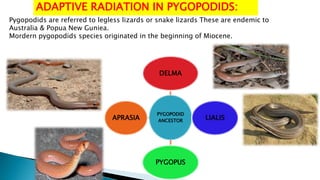
ADAPTIVE RADIATION IN PYGOPODIDS:
Pygopodids are referred to legless lizards or snake lizards These are endemic to
Australia & Popua New Guniea.
Mordern pygopodids species originated in the beginning of Miocene.
PYGOPODID
ANCESTOR
DELMA
LIALIS
PYGOPUS
APRASIA
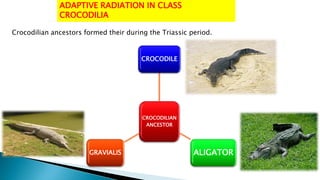
ADAPTIVE RADIATION IN CLASS
CROCODILIA
Crocodilian ancestors formed their during the Triassic period.
CROCODILIAN
ANCESTOR
CROCODILE
ALIGATORGRAVIALIS
1. Formation of new Taxon
2. Responsible for evolution
3. Better resource availability
4. Less possibility of extinction
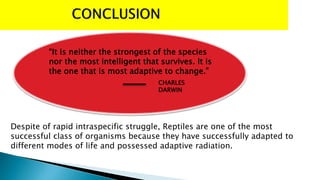
“It is neither the strongest of the species
nor the most intelligent that survives. It is
the one that is most adaptive to change.”
CHARLES
DARWIN
Despite of rapid intraspecific struggle, Reptiles are one of the most
successful class of organisms because they have successfully adapted to
different modes of life and possessed adaptive radiation.
REFERENCES:
1. Chattopadhyay.S,”Evolution Adaptation
&Ethology”pp.334-343.
2. Briggs.C.John(2014),Invasions, adaptive radiations,
and the generation of biodiversity,pp.8-16
3. Yoder.J.B(2010),”Ecological opportunity and the origin
of adaptive radiation”
Adaptive radiation in reptiles copy

Adaptive radiation in reptiles copy

  • 1.
    SUBMITTED BY, Sambit KumarDwibedy M.SC – I ROLL No.:- 04
  • 2.
    CONTENTS 1. Introduction 2. Causeof adaptive radiation 3. Characteristics of adaptive radiation 4. Reptiles and their evolution 5. Adaptive radiation in Class Reptilia 6. Adaptive radiation in Testudines 7. Adaptive radiation in Caribbean anoles lizard 8. Adaptive radiation in Pygopodids 9. Adaptive Radiation in Snakes 10.Conclusion
  • 3.
    INTRODUCTION: WHAT IS ADAPTIVERADIATION:  The term adaptive radiation was coined by Osborn(1902).  It is the diversification of species to fill a wide variety of ecological niches.  It is the differentiation of a single ancestor into an array of species that causes different morphological and physiological traits according to their habitat.
  • 4.
    TYPES OF ADAPTIVERADIATION: 1.General adaptive radiation AMNIOTIC EGGS FLIGHT IN BIRDS
  • 5.
    2. Adaptive radiationby environmental change
  • 6.
    3. Adaptive radiationin Archipelagoes
  • 7.
    CAUSES OF ADAPTIVERADIATION: 1. ACCORDING TO SIMPSON: Entry into an adaptive zone is the perquisite for adaptive radiation. Adaptive zone is entered in one of the following 3 ways : • Evolution of a key innovation • Dispersal into a new habitat • Extinction of antagonists 2. ACCORDING TO SCHLUTER: Ecological opportunities triggers adaptive radiations. SIMPSON SCHLUTLER 3. MASS EXTINCTION : Mass extinction is a pre-requisite to adaptive radiation
  • 8.
    CHARACTERISTICS OF ADAPTIVE RADIATION: 1. Sharing of a common ancestry 2. Phenotype – environment co-relation 3. Rapid speciation 4. Trait utility
  • 9.
    REPTILES AND THEIREVOLUTION Reptiles are ectothermic amniotes which have adapted crawling mode of life and are characterised by the presence of dry and scaly skin. Reptiles are evolved during the Carboniferous period of Palaezoic Era. They have evolved from amphibian ancestors.
  • 10.
    ADAPTIVE RADIATION INCLASS REPTILIA With course of time the ancestral reptiles get diverged and adapted to various habitats. From primitive reptiles directional radiation took place. PRIMITIVEREPTILES TERRESTRIAL HERBIVOROUS REPTILES TERRESTRIAL CARNIVOROUS RETILES BURROWING REPTILES AQUATIC REPTILES FLYING REPTILES
  • 11.
  • 12.
  • 13.
    ADAPTIVE RADIATION INTESTUDINES : Testudines are evolved in the late Triassic. They have reached greatest diversity by the end of the Cretaceous. ANCESTRALTESTUDINES TORTOISE (TERRESTRIAL) TURTLE (AQUATIC) TERRAPINS (SEMI-AQUATIC)
  • 14.
    ADAPTIVE RADIATION INCARIBEAN ANOLES LIZARD Caribean anoles show remarkable ecological diversity and specialization in different environments. This is the evidence that they constitute an adaptive radiation. Species of anoles an be categorized into 6 ecomorphs according to the ecological niche they occupy.
  • 16.
    CROWN-GIANT TRUNK-CROWN TRUNK TWIGTRUNK-GROUND GRASS-BUSH
  • 17.
    ADAPTIVE RADIATION INPYGOPODIDS: Pygopodids are referred to legless lizards or snake lizards These are endemic to Australia & Popua New Guniea. Mordern pygopodids species originated in the beginning of Miocene. PYGOPODID ANCESTOR DELMA LIALIS PYGOPUS APRASIA
  • 18.
    ADAPTIVE RADIATION INCLASS CROCODILIA Crocodilian ancestors formed their during the Triassic period. CROCODILIAN ANCESTOR CROCODILE ALIGATORGRAVIALIS
  • 19.
    1. Formation ofnew Taxon 2. Responsible for evolution 3. Better resource availability 4. Less possibility of extinction
  • 20.
    “It is neitherthe strongest of the species nor the most intelligent that survives. It is the one that is most adaptive to change.” CHARLES DARWIN Despite of rapid intraspecific struggle, Reptiles are one of the most successful class of organisms because they have successfully adapted to different modes of life and possessed adaptive radiation.
  • 21.
    REFERENCES: 1. Chattopadhyay.S,”Evolution Adaptation &Ethology”pp.334-343. 2.Briggs.C.John(2014),Invasions, adaptive radiations, and the generation of biodiversity,pp.8-16 3. Yoder.J.B(2010),”Ecological opportunity and the origin of adaptive radiation”