REPRESENTED BY- PAWAN KUMAR SAHU
Animal Tissues
Introduction
 Living organisms that are found in the world are classified into
unicellular and multicellular organisms. So, if you see
unicellular organisms like Amoeba, Paramecium,
diatoms, bacteria , etc. have only one cell. They do not have
tissue level of organization. Even in some lower order animals,
tissue differentiation is absent.
 This means that cells form groups. But they do not perform a
definite function. But if you see multicellular higher order
animals like humans, dogs, etc. different groups of cells
perform different specific functions.
 If a cell is called the basic unit of life, then a group of cells
together make up the tissues. These groups of cells have a
common origin with a similar structure. And the groups
of cells perform a definite function. So, in simple terms, tissues
can be defined as a group of cells performing similar functions.
Classification of tissues
 The tissue are classified into four major parts:
1. Epithelial Tissue
2. Connective Tissue
3. Muscular Tissue
4. Nervous Tissue
1. Epithelial Tissue
 Epithelial tissue form the covering to the free surface of
the body.
 They are found on the outer surface of the body,
inner surface of alimentary canal, respiratory
system and urogenital system (genitourinary
system).
 They perfect vital function like protection, excretion,
glandular secretion and absorption.
 They are arranged on an inert connective tissue called
the basement membrane.
Classification of epithelial tissue
a) Simple epithelial tissue
b) Stratified epithelial tissue
c) Transitional epithelial
tissue
a) Simple epithelial tissue
 Simple epithelial tissue consist of single layer of cell.
 It is further classified into:
A) Squamous epithelium tissue
B) Cuboidal epithelium tissue
C) Columnar epithelium tissue
D) Ciliated epithelium tissue
E) Glandular epithelium tissue
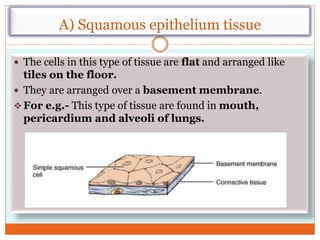
A) Squamous epithelium tissue
 The cells in this type of tissue are flat and arranged like
tiles on the floor.
 They are arranged over a basement membrane.
 For e.g.- This type of tissue are found in mouth,
pericardium and alveoli of lungs.
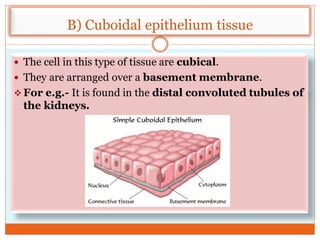
B) Cuboidal epithelium tissue
 The cell in this type of tissue are cubical.
 They are arranged over a basement membrane.
 For e.g.- It is found in the distal convoluted tubules of
the kidneys.
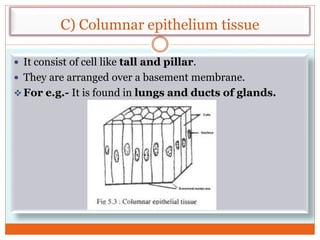
C) Columnar epithelium tissue
 It consist of cell like tall and pillar.
 They are arranged over a basement membrane.
 For e.g.- It is found in lungs and ducts of glands.
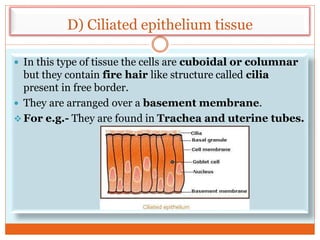
D) Ciliated epithelium tissue
 In this type of tissue the cells are cuboidal or columnar
but they contain fire hair like structure called cilia
present in free border.
 They are arranged over a basement membrane.
 For e.g.- They are found in Trachea and uterine tubes.
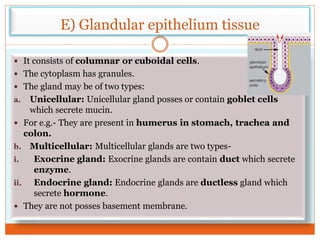
E) Glandular epithelium tissue
 It consists of columnar or cuboidal cells.
 The cytoplasm has granules.
 The gland may be of two types:
a. Unicellular: Unicellular gland posses or contain goblet cells
which secrete mucin.
 For e.g.- They are present in humerus in stomach, trachea and
colon.
b. Multicellular: Multicellular glands are two types-
i. Exocrine gland: Exocrine glands are contain duct which secrete
enzyme.
ii. Endocrine gland: Endocrine glands are ductless gland which
secrete hormone.
 They are not posses basement membrane.
b) Stratified epithelium tissue
 It is also called as compound epithelium.
 It consist of several layer of cell, it usually do not contain basement
membrane.
 It is present in surface where there is considerable wear and tear.
 Depending on the type of cells present on stratified
epithelium tissue is further classified into-
A. Stratified squamous epithelium
B. Stratified cuboidal epithelium
C. Stratified columnar epithelium
b) Stratified epithelium tissue
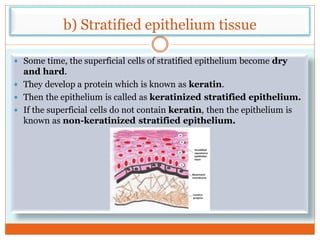
 Some time, the superficial cells of stratified epithelium become dry
and hard.
 They develop a protein which is known as keratin.
 Then the epithelium is called as keratinized stratified epithelium.
 If the superficial cells do not contain keratin, then the epithelium is
known as non-keratinized stratified epithelium.
c) Transitional epithelial tissue
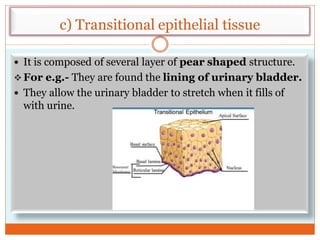
 It is composed of several layer of pear shaped structure.
 For e.g.- They are found the lining of urinary bladder.
 They allow the urinary bladder to stretch when it fills of
with urine.
Function of epithelial tissue
It protects from injury.
For e.g.- Squamous epithelium
It secretes enzyme and hormone.
For e.g.- Glandular epithelium
It helps in excretion.
For e.g.- Cuboidal epithelium
It helps in secretion and absorption.
For e.g.- Columnar epithelium
2. Connective tissue
 Connective tissue connect or bind together different
organ or different parts of organ.
 They contain an intra-cellular substance called matrix.
 It helps in binding and supporting of cell.
 Blood is also a connective tissue.
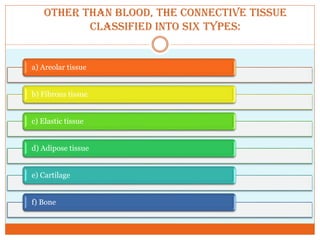
Other than blood, the connective tissue
classified into six types:
a) Areolar tissue
b) Fibrous tissue
c) Elastic tissue
d) Adipose tissue
e) Cartilage
f) Bone
a) Areolar tissue
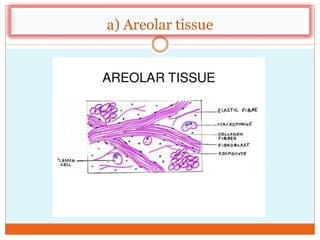
 It is most widely distributed tissue in the body.
 It is a loose irregular connective tissue.
 It connect the skin and the underlying structure.
 It also fills unoccupied spaces between organs.
 It has jellies like matrix.
 Within this matrix, white fibres and yellow fibres are
present.
For e.g.- It is found between muscles, blood vessels
and nerves.
 Fibro plast are also present in oral tissue.
a) Areolar tissue
b) Fibrous tissue
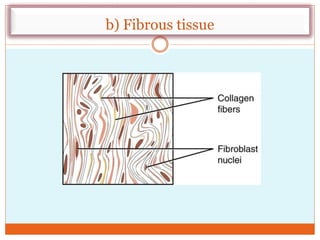
 This type of tissue contain collagen fibres, which are dense
and inter-spaces are reduced.
 Fibres are arranged in bundles, few cells which are known
as fibro plast are arranged between fibres.
 But the number of fibro plast are less than the number of
cell present in areolar tissue.
 For e.g.- This type of tissues are found in tendons,
ligaments and dermis of skin etc.
b) Fibrous tissue
c) Elastic tissue
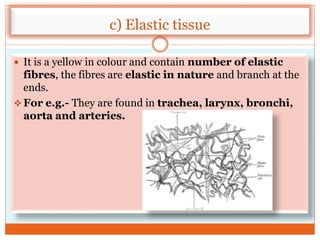
 It is a yellow in colour and contain number of elastic
fibres, the fibres are elastic in nature and branch at the
ends.
 For e.g.- They are found in trachea, larynx, bronchi,
aorta and arteries.
d) Adipose tissue
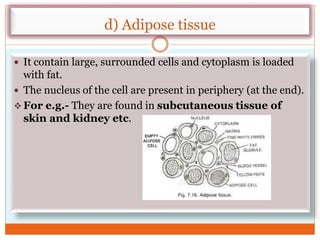
 It contain large, surrounded cells and cytoplasm is loaded
with fat.
 The nucleus of the cell are present in periphery (at the end).
 For e.g.- They are found in subcutaneous tissue of
skin and kidney etc.
e) Cartilage
 It is the modify connective tissue, it is strong and tuff.
 It has tuff gelatinous and elastic matrix which is formed of
chondrin.
 The cells are more or less round and present in group of 4 or 5 in
the matrix.
 There are three types of cartilage:
1. Hyaline cartilage
2. Elastic cartilage
3. Fibro cartilage
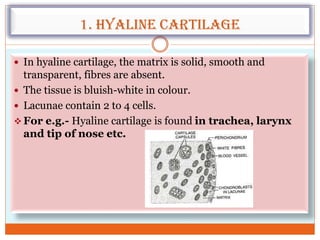
1. Hyaline cartilage
 In hyaline cartilage, the matrix is solid, smooth and
transparent, fibres are absent.
 The tissue is bluish-white in colour.
 Lacunae contain 2 to 4 cells.
 For e.g.- Hyaline cartilage is found in trachea, larynx
and tip of nose etc.
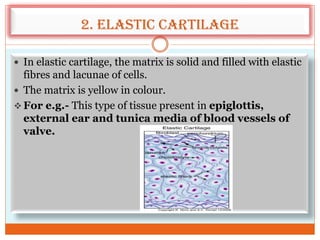
2. Elastic cartilage
 In elastic cartilage, the matrix is solid and filled with elastic
fibres and lacunae of cells.
 The matrix is yellow in colour.
 For e.g.- This type of tissue present in epiglottis,
external ear and tunica media of blood vessels of
valve.
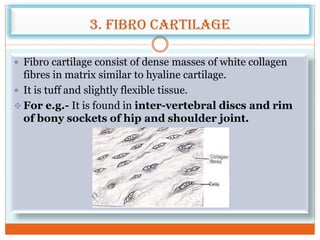
3. Fibro cartilage
 Fibro cartilage consist of dense masses of white collagen
fibres in matrix similar to hyaline cartilage.
 It is tuff and slightly flexible tissue.
 For e.g.- It is found in inter-vertebral discs and rim
of bony sockets of hip and shoulder joint.
f) Bone
 Bone is the hardest connective tissue.
 Bone contain a high concentration of salt like Calcium
phosphate and Calcium carbonate.
 A bone consist of:
1) Periosteum
2) Compact Bone
3) Cancellous bone
4) Bone marrow
f) Bone
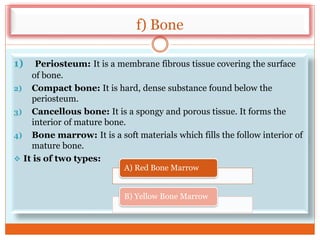
1) Periosteum: It is a membrane fibrous tissue covering the surface
of bone.
2) Compact bone: It is hard, dense substance found below the
periosteum.
3) Cancellous bone: It is a spongy and porous tissue. It forms the
interior of mature bone.
4) Bone marrow: It is a soft materials which fills the follow interior of
mature bone.
 It is of two types:
A) Red Bone Marrow
B) Yellow Bone Marrow
Function of Connective Tissue
 Areolar tissue connect different kinds of tissue.
 Fibrous tissue found in tendence, and it connects muscle
and bone.
 Elastic tissue permits enlargement due to elasticity.
 Adipose tissue prevents loss of body heat and they
maintain proper position of the organ.
 Bone gives shape to the body and protect the vital organ
like heart and brains.
3. Muscular tissue
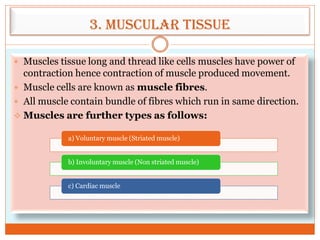
 Muscles tissue long and thread like cells muscles have power of
contraction hence contraction of muscle produced movement.
 Muscle cells are known as muscle fibres.
 All muscle contain bundle of fibres which run in same direction.
 Muscles are further types as follows:
a) Voluntary muscle (Striated muscle)
b) Involuntary muscle (Non striated muscle)
c) Cardiac muscle
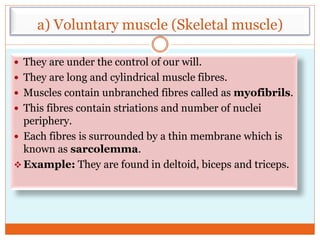
a) Voluntary muscle (Skeletal muscle)
 They are under the control of our will.
 They are long and cylindrical muscle fibres.
 Muscles contain unbranched fibres called as myofibrils.
 This fibres contain striations and number of nuclei
periphery.
 Each fibres is surrounded by a thin membrane which is
known as sarcolemma.
 Example: They are found in deltoid, biceps and triceps.
b) Involuntary muscle
 They are not controlled by our will.
 They are long spindle shaped muscles fibres with a central
nucleus.
 The fibres are not striated and not covered by any
membrane of sarcolemma but they are joint together by a
loose connective tissue.
 These muscles are controlled by automatic nervous system.
 Example: They are present intestinal organ like as
stomach, intestine, blood vessels and uterus.
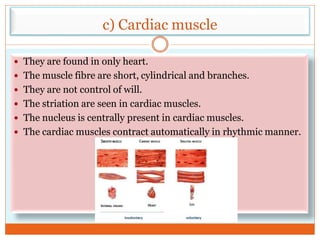
c) Cardiac muscle
 They are found in only heart.
 The muscle fibre are short, cylindrical and branches.
 They are not control of will.
 The striation are seen in cardiac muscles.
 The nucleus is centrally present in cardiac muscles.
 The cardiac muscles contract automatically in rhythmic manner.
Function of muscular tissue
Voluntary muscles provide voluntary movement of
the body.
Involuntary muscles bring about movement of
food in the alimentary canal, movement of blood
and urine etc.
Cardiac muscles bring about the contraction of the
heart.
4. Nervous tissue
 The nervous tissue has importance in the body because it
carry out the function of reception, conduction and
discharge of the nerve impulses.
 This is important for co-ordination in the working of the
various part of the body.
 Nervous tissue is composed of three kind of matter;
a) Gray matter
b) White matter
c) Neuralgia
4. Nervous tissue
a) Gray matter: It forms the nerve cells or neurons.
b) White matter: It forms the nerve fibres.
c) Neuralgia: It is a supporting nervous connective
tissue.
 It fold together and support nerve cells and nerve
fibres.
Notes
 A nerve fibres possess the power of conductivity and
excitability.
 It is capable of receiving and responding to stimuli from
out side agent.
 A stimulus may be mechanical, electrical, chemical or
physical.
 This give rise to (am impulses which conducted along the
nerve fibres).
Neurons
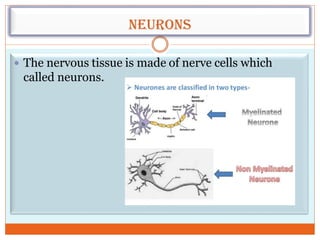
 The nervous tissue is made of nerve cells which
called neurons.
Neurons
 These neurons are connective to one-another in such a way
that the nerve impulse is passed on from one to other till
reach the CNS.
 A neuron is the fundamental unit of nervous system.
 It consist of:
1. Nerve cell body
2. Axon
3. Dendrites
1. Nerve cell body
 Each nerve cell body is irregular shape.
 The nerve cell body has a nucleus in the centre which is
surrounded by cytoplasm with mitochondria, golgi
body, lysosome, ribosome which combined with
rough endoplasmic reticulum.
 The axon and dendrites arise from the nerve cell body.
 The nerve cells are present in the gray matter of
cerebrum and spinal cord etc.
2. Axon
 Axon is the longest structure of the neurons.
 It is main nerve fibers which arise from the nerve cell
body.
 The nerve fibers are also two types:
a. Medullated sheath or
myelin sheath
b. Non medullated sheath
a. Medullated sheath
 The medullated sheath is covered by a transparent
membrane which is called as neurilemma.
 Nodes of raniver are seen at the interception found in
myelin sheath at regular interval.
 The impulse pass through the axon in one direction
only.
b. Non medullated sheath
 The non medullated nerve fiber is without a myelin
sheath but the nuclei and cytoplasm are present at the
regular interval.
 Due to the absence of myelin sheath the nodes of raniver
are also absence.
 This type of nerve fiber are present in autonomic
nervous system.
3. Dendrites
 They are short fibers arising from the nerve cell
body.
 They are many a number they conduct impulse
towards the cell body.
Function of nervous tissue
1. Sensory neurons:
 Those neurons which establish a contact between sense
organ and CNS are known as sensory neurons. E.g.
Optic nerve
 Sensory neuron conduct impulse from sense organ to the
brain and spinal cord.
2. Motor Neurons:
 Those neurons which connect the muscles with CNS are
known as Motor neurons.
 Motor neurons conduct impulses from the brain and
spinal cord to the muscle, glands and organ etc.
Animal tissue

Animal tissue

  • 1.
    REPRESENTED BY- PAWANKUMAR SAHU Animal Tissues
  • 2.
    Introduction  Living organismsthat are found in the world are classified into unicellular and multicellular organisms. So, if you see unicellular organisms like Amoeba, Paramecium, diatoms, bacteria , etc. have only one cell. They do not have tissue level of organization. Even in some lower order animals, tissue differentiation is absent.  This means that cells form groups. But they do not perform a definite function. But if you see multicellular higher order animals like humans, dogs, etc. different groups of cells perform different specific functions.  If a cell is called the basic unit of life, then a group of cells together make up the tissues. These groups of cells have a common origin with a similar structure. And the groups of cells perform a definite function. So, in simple terms, tissues can be defined as a group of cells performing similar functions.
  • 3.
    Classification of tissues The tissue are classified into four major parts: 1. Epithelial Tissue 2. Connective Tissue 3. Muscular Tissue 4. Nervous Tissue
  • 4.
    1. Epithelial Tissue Epithelial tissue form the covering to the free surface of the body.  They are found on the outer surface of the body, inner surface of alimentary canal, respiratory system and urogenital system (genitourinary system).  They perfect vital function like protection, excretion, glandular secretion and absorption.  They are arranged on an inert connective tissue called the basement membrane.
  • 5.
    Classification of epithelialtissue a) Simple epithelial tissue b) Stratified epithelial tissue c) Transitional epithelial tissue
  • 6.
    a) Simple epithelialtissue  Simple epithelial tissue consist of single layer of cell.  It is further classified into: A) Squamous epithelium tissue B) Cuboidal epithelium tissue C) Columnar epithelium tissue D) Ciliated epithelium tissue E) Glandular epithelium tissue
  • 7.
    A) Squamous epitheliumtissue  The cells in this type of tissue are flat and arranged like tiles on the floor.  They are arranged over a basement membrane.  For e.g.- This type of tissue are found in mouth, pericardium and alveoli of lungs.
  • 8.
    B) Cuboidal epitheliumtissue  The cell in this type of tissue are cubical.  They are arranged over a basement membrane.  For e.g.- It is found in the distal convoluted tubules of the kidneys.
  • 9.
    C) Columnar epitheliumtissue  It consist of cell like tall and pillar.  They are arranged over a basement membrane.  For e.g.- It is found in lungs and ducts of glands.
  • 10.
    D) Ciliated epitheliumtissue  In this type of tissue the cells are cuboidal or columnar but they contain fire hair like structure called cilia present in free border.  They are arranged over a basement membrane.  For e.g.- They are found in Trachea and uterine tubes.
  • 11.
    E) Glandular epitheliumtissue  It consists of columnar or cuboidal cells.  The cytoplasm has granules.  The gland may be of two types: a. Unicellular: Unicellular gland posses or contain goblet cells which secrete mucin.  For e.g.- They are present in humerus in stomach, trachea and colon. b. Multicellular: Multicellular glands are two types- i. Exocrine gland: Exocrine glands are contain duct which secrete enzyme. ii. Endocrine gland: Endocrine glands are ductless gland which secrete hormone.  They are not posses basement membrane.
  • 12.
    b) Stratified epitheliumtissue  It is also called as compound epithelium.  It consist of several layer of cell, it usually do not contain basement membrane.  It is present in surface where there is considerable wear and tear.  Depending on the type of cells present on stratified epithelium tissue is further classified into- A. Stratified squamous epithelium B. Stratified cuboidal epithelium C. Stratified columnar epithelium
  • 13.
    b) Stratified epitheliumtissue  Some time, the superficial cells of stratified epithelium become dry and hard.  They develop a protein which is known as keratin.  Then the epithelium is called as keratinized stratified epithelium.  If the superficial cells do not contain keratin, then the epithelium is known as non-keratinized stratified epithelium.
  • 14.
    c) Transitional epithelialtissue  It is composed of several layer of pear shaped structure.  For e.g.- They are found the lining of urinary bladder.  They allow the urinary bladder to stretch when it fills of with urine.
  • 15.
    Function of epithelialtissue It protects from injury. For e.g.- Squamous epithelium It secretes enzyme and hormone. For e.g.- Glandular epithelium It helps in excretion. For e.g.- Cuboidal epithelium It helps in secretion and absorption. For e.g.- Columnar epithelium
  • 16.
    2. Connective tissue Connective tissue connect or bind together different organ or different parts of organ.  They contain an intra-cellular substance called matrix.  It helps in binding and supporting of cell.  Blood is also a connective tissue.
  • 17.
    Other than blood,the connective tissue classified into six types: a) Areolar tissue b) Fibrous tissue c) Elastic tissue d) Adipose tissue e) Cartilage f) Bone
  • 18.
    a) Areolar tissue It is most widely distributed tissue in the body.  It is a loose irregular connective tissue.  It connect the skin and the underlying structure.  It also fills unoccupied spaces between organs.  It has jellies like matrix.  Within this matrix, white fibres and yellow fibres are present. For e.g.- It is found between muscles, blood vessels and nerves.  Fibro plast are also present in oral tissue.
  • 19.
  • 20.
    b) Fibrous tissue This type of tissue contain collagen fibres, which are dense and inter-spaces are reduced.  Fibres are arranged in bundles, few cells which are known as fibro plast are arranged between fibres.  But the number of fibro plast are less than the number of cell present in areolar tissue.  For e.g.- This type of tissues are found in tendons, ligaments and dermis of skin etc.
  • 21.
  • 22.
    c) Elastic tissue It is a yellow in colour and contain number of elastic fibres, the fibres are elastic in nature and branch at the ends.  For e.g.- They are found in trachea, larynx, bronchi, aorta and arteries.
  • 23.
    d) Adipose tissue It contain large, surrounded cells and cytoplasm is loaded with fat.  The nucleus of the cell are present in periphery (at the end).  For e.g.- They are found in subcutaneous tissue of skin and kidney etc.
  • 24.
    e) Cartilage  Itis the modify connective tissue, it is strong and tuff.  It has tuff gelatinous and elastic matrix which is formed of chondrin.  The cells are more or less round and present in group of 4 or 5 in the matrix.  There are three types of cartilage: 1. Hyaline cartilage 2. Elastic cartilage 3. Fibro cartilage
  • 25.
    1. Hyaline cartilage In hyaline cartilage, the matrix is solid, smooth and transparent, fibres are absent.  The tissue is bluish-white in colour.  Lacunae contain 2 to 4 cells.  For e.g.- Hyaline cartilage is found in trachea, larynx and tip of nose etc.
  • 26.
    2. Elastic cartilage In elastic cartilage, the matrix is solid and filled with elastic fibres and lacunae of cells.  The matrix is yellow in colour.  For e.g.- This type of tissue present in epiglottis, external ear and tunica media of blood vessels of valve.
  • 27.
    3. Fibro cartilage Fibro cartilage consist of dense masses of white collagen fibres in matrix similar to hyaline cartilage.  It is tuff and slightly flexible tissue.  For e.g.- It is found in inter-vertebral discs and rim of bony sockets of hip and shoulder joint.
  • 28.
    f) Bone  Boneis the hardest connective tissue.  Bone contain a high concentration of salt like Calcium phosphate and Calcium carbonate.  A bone consist of: 1) Periosteum 2) Compact Bone 3) Cancellous bone 4) Bone marrow
  • 29.
    f) Bone 1) Periosteum:It is a membrane fibrous tissue covering the surface of bone. 2) Compact bone: It is hard, dense substance found below the periosteum. 3) Cancellous bone: It is a spongy and porous tissue. It forms the interior of mature bone. 4) Bone marrow: It is a soft materials which fills the follow interior of mature bone.  It is of two types: A) Red Bone Marrow B) Yellow Bone Marrow
  • 30.
    Function of ConnectiveTissue  Areolar tissue connect different kinds of tissue.  Fibrous tissue found in tendence, and it connects muscle and bone.  Elastic tissue permits enlargement due to elasticity.  Adipose tissue prevents loss of body heat and they maintain proper position of the organ.  Bone gives shape to the body and protect the vital organ like heart and brains.
  • 31.
    3. Muscular tissue Muscles tissue long and thread like cells muscles have power of contraction hence contraction of muscle produced movement.  Muscle cells are known as muscle fibres.  All muscle contain bundle of fibres which run in same direction.  Muscles are further types as follows: a) Voluntary muscle (Striated muscle) b) Involuntary muscle (Non striated muscle) c) Cardiac muscle
  • 32.
    a) Voluntary muscle(Skeletal muscle)  They are under the control of our will.  They are long and cylindrical muscle fibres.  Muscles contain unbranched fibres called as myofibrils.  This fibres contain striations and number of nuclei periphery.  Each fibres is surrounded by a thin membrane which is known as sarcolemma.  Example: They are found in deltoid, biceps and triceps.
  • 33.
    b) Involuntary muscle They are not controlled by our will.  They are long spindle shaped muscles fibres with a central nucleus.  The fibres are not striated and not covered by any membrane of sarcolemma but they are joint together by a loose connective tissue.  These muscles are controlled by automatic nervous system.  Example: They are present intestinal organ like as stomach, intestine, blood vessels and uterus.
  • 34.
    c) Cardiac muscle They are found in only heart.  The muscle fibre are short, cylindrical and branches.  They are not control of will.  The striation are seen in cardiac muscles.  The nucleus is centrally present in cardiac muscles.  The cardiac muscles contract automatically in rhythmic manner.
  • 35.
    Function of musculartissue Voluntary muscles provide voluntary movement of the body. Involuntary muscles bring about movement of food in the alimentary canal, movement of blood and urine etc. Cardiac muscles bring about the contraction of the heart.
  • 36.
    4. Nervous tissue The nervous tissue has importance in the body because it carry out the function of reception, conduction and discharge of the nerve impulses.  This is important for co-ordination in the working of the various part of the body.  Nervous tissue is composed of three kind of matter; a) Gray matter b) White matter c) Neuralgia
  • 37.
    4. Nervous tissue a)Gray matter: It forms the nerve cells or neurons. b) White matter: It forms the nerve fibres. c) Neuralgia: It is a supporting nervous connective tissue.  It fold together and support nerve cells and nerve fibres.
  • 38.
    Notes  A nervefibres possess the power of conductivity and excitability.  It is capable of receiving and responding to stimuli from out side agent.  A stimulus may be mechanical, electrical, chemical or physical.  This give rise to (am impulses which conducted along the nerve fibres).
  • 39.
    Neurons  The nervoustissue is made of nerve cells which called neurons.
  • 40.
    Neurons  These neuronsare connective to one-another in such a way that the nerve impulse is passed on from one to other till reach the CNS.  A neuron is the fundamental unit of nervous system.  It consist of: 1. Nerve cell body 2. Axon 3. Dendrites
  • 41.
    1. Nerve cellbody  Each nerve cell body is irregular shape.  The nerve cell body has a nucleus in the centre which is surrounded by cytoplasm with mitochondria, golgi body, lysosome, ribosome which combined with rough endoplasmic reticulum.  The axon and dendrites arise from the nerve cell body.  The nerve cells are present in the gray matter of cerebrum and spinal cord etc.
  • 42.
    2. Axon  Axonis the longest structure of the neurons.  It is main nerve fibers which arise from the nerve cell body.  The nerve fibers are also two types: a. Medullated sheath or myelin sheath b. Non medullated sheath
  • 43.
    a. Medullated sheath The medullated sheath is covered by a transparent membrane which is called as neurilemma.  Nodes of raniver are seen at the interception found in myelin sheath at regular interval.  The impulse pass through the axon in one direction only.
  • 44.
    b. Non medullatedsheath  The non medullated nerve fiber is without a myelin sheath but the nuclei and cytoplasm are present at the regular interval.  Due to the absence of myelin sheath the nodes of raniver are also absence.  This type of nerve fiber are present in autonomic nervous system.
  • 45.
    3. Dendrites  Theyare short fibers arising from the nerve cell body.  They are many a number they conduct impulse towards the cell body.
  • 46.
    Function of nervoustissue 1. Sensory neurons:  Those neurons which establish a contact between sense organ and CNS are known as sensory neurons. E.g. Optic nerve  Sensory neuron conduct impulse from sense organ to the brain and spinal cord. 2. Motor Neurons:  Those neurons which connect the muscles with CNS are known as Motor neurons.  Motor neurons conduct impulses from the brain and spinal cord to the muscle, glands and organ etc.