Represented by-Radiate
Control and Coordination in
humans
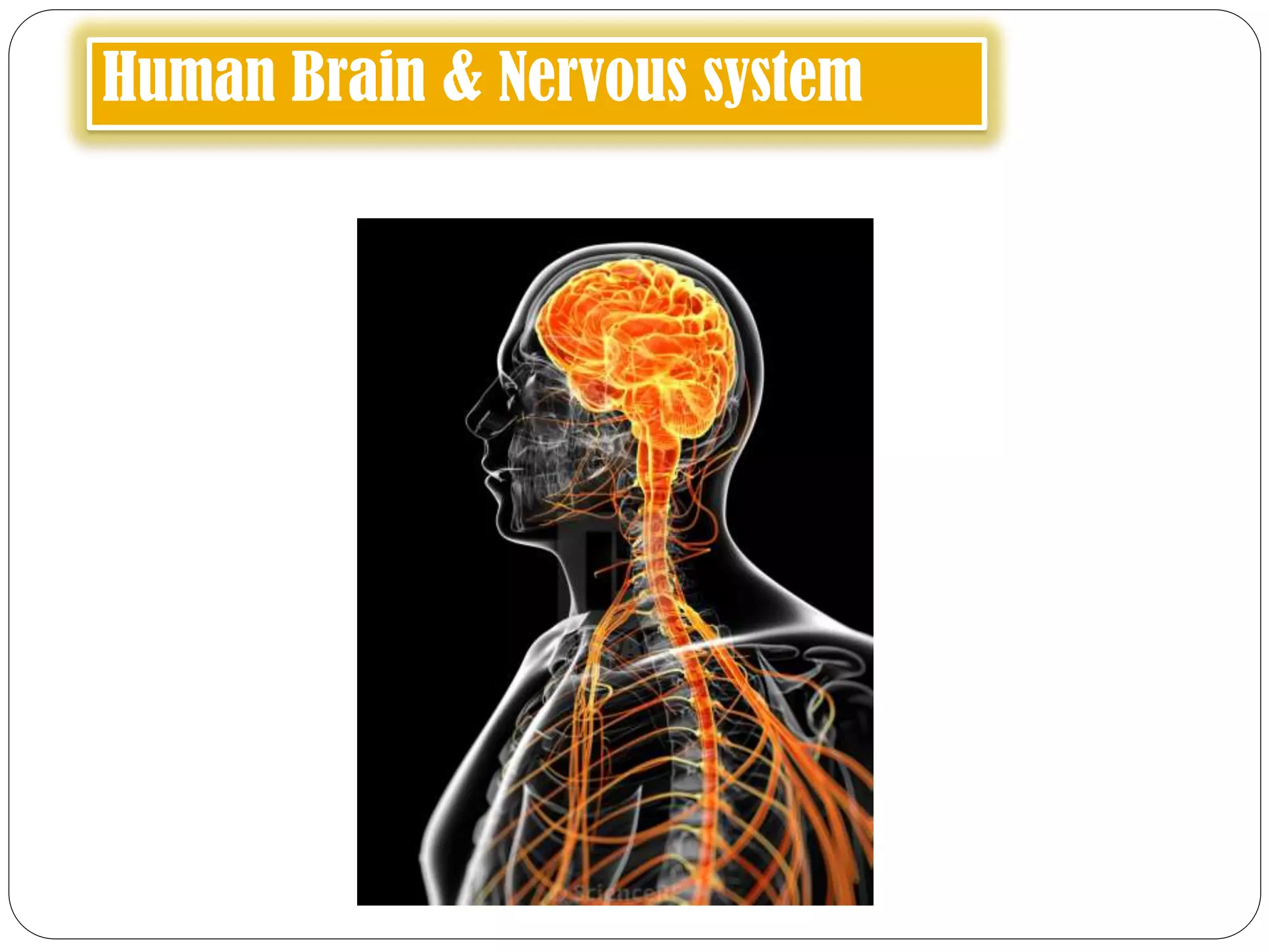
Human Brain & Nervous system
Introduction
 For control and coordination, there is a system inside our body:
Nervous system and Hormonal system.
 The structural and functional unit of any system are its cells.
 In a same way cells of nervous system is ‘neuron’ (largest cell of
our body). It is highly branched cell.
 The control and coordination in human beings take place through
nervous system and hormonal system which is called
endocrine system.
Structure of neuron
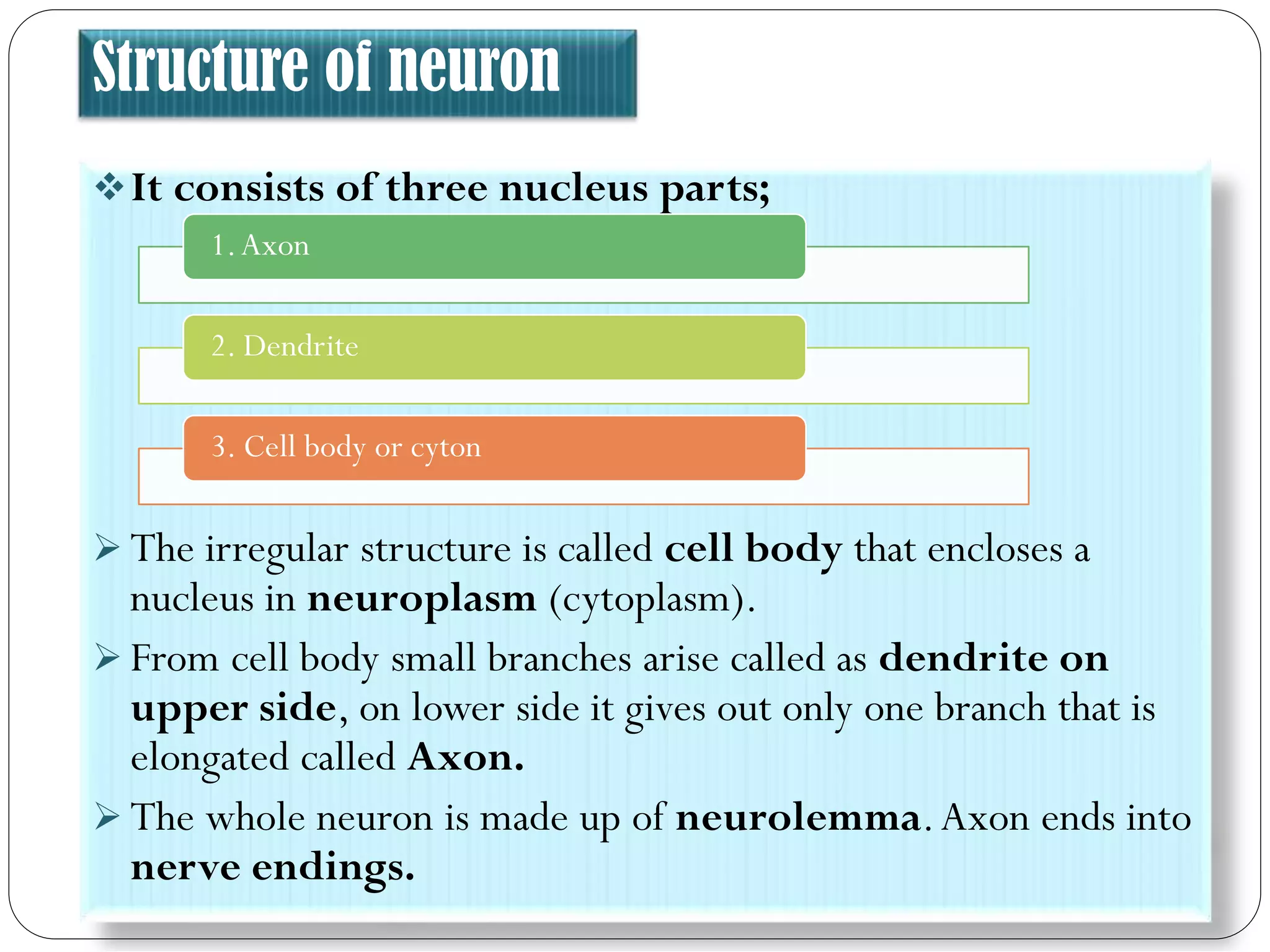
It consists of three nucleus parts;
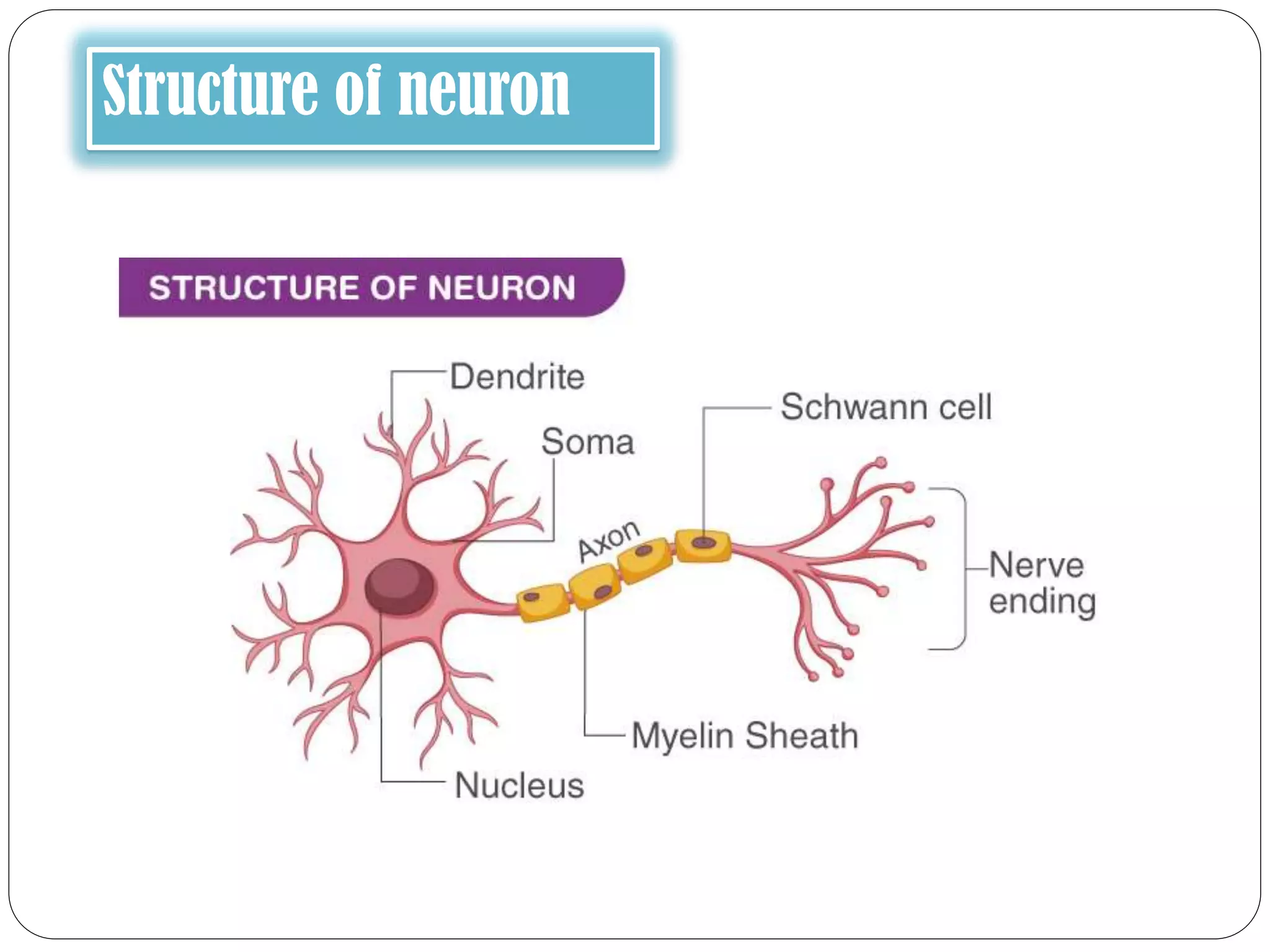
 The irregular structure is called cell body that encloses a
nucleus in neuroplasm (cytoplasm).
 From cell body small branches arise called as dendrite on
upper side, on lower side it gives out only one branch that is
elongated called Axon.
 The whole neuron is made up of neurolemma.Axon ends into
nerve endings.
1.Axon
2. Dendrite
3. Cell body or cyton
Structure of neuron
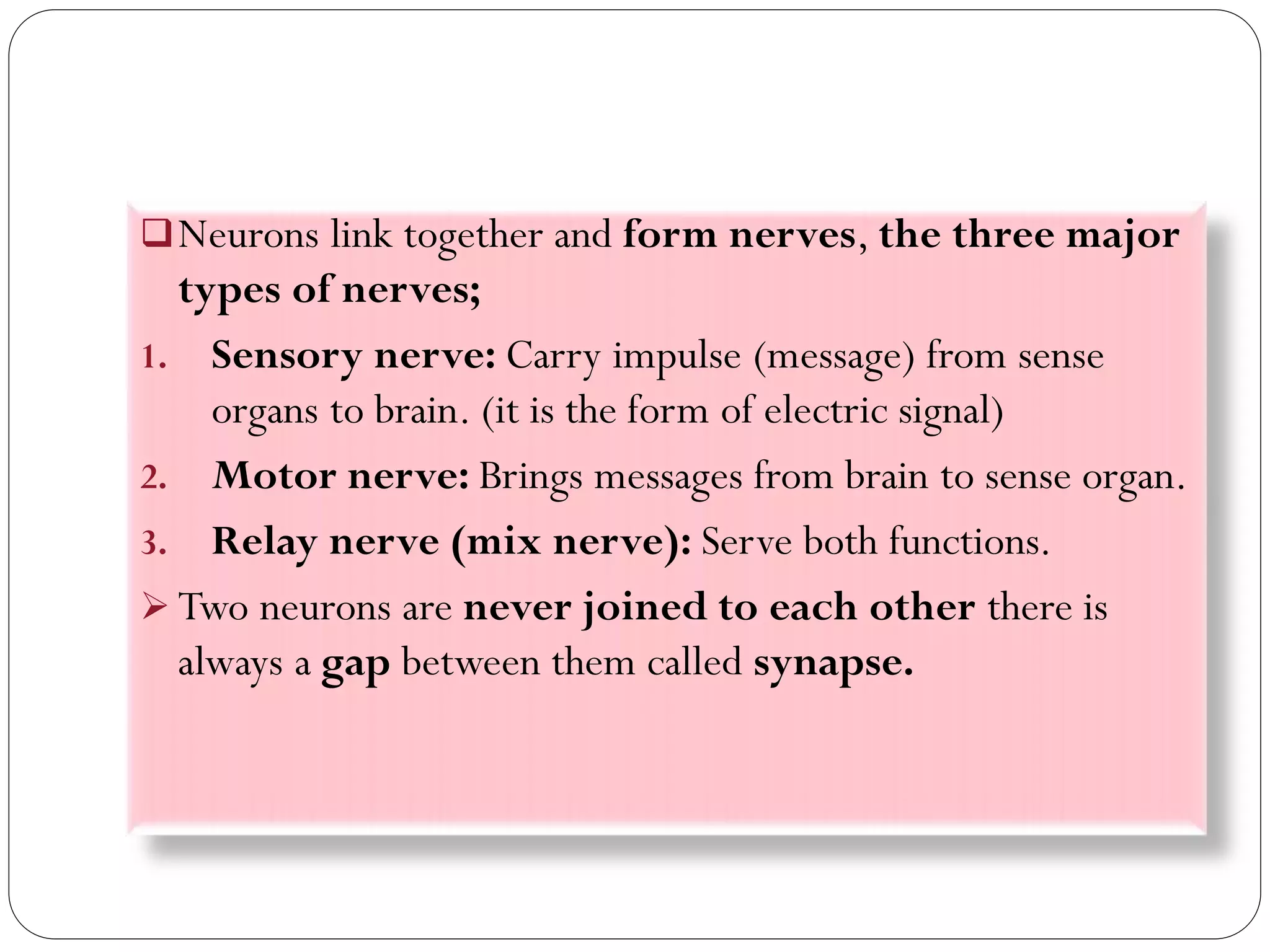
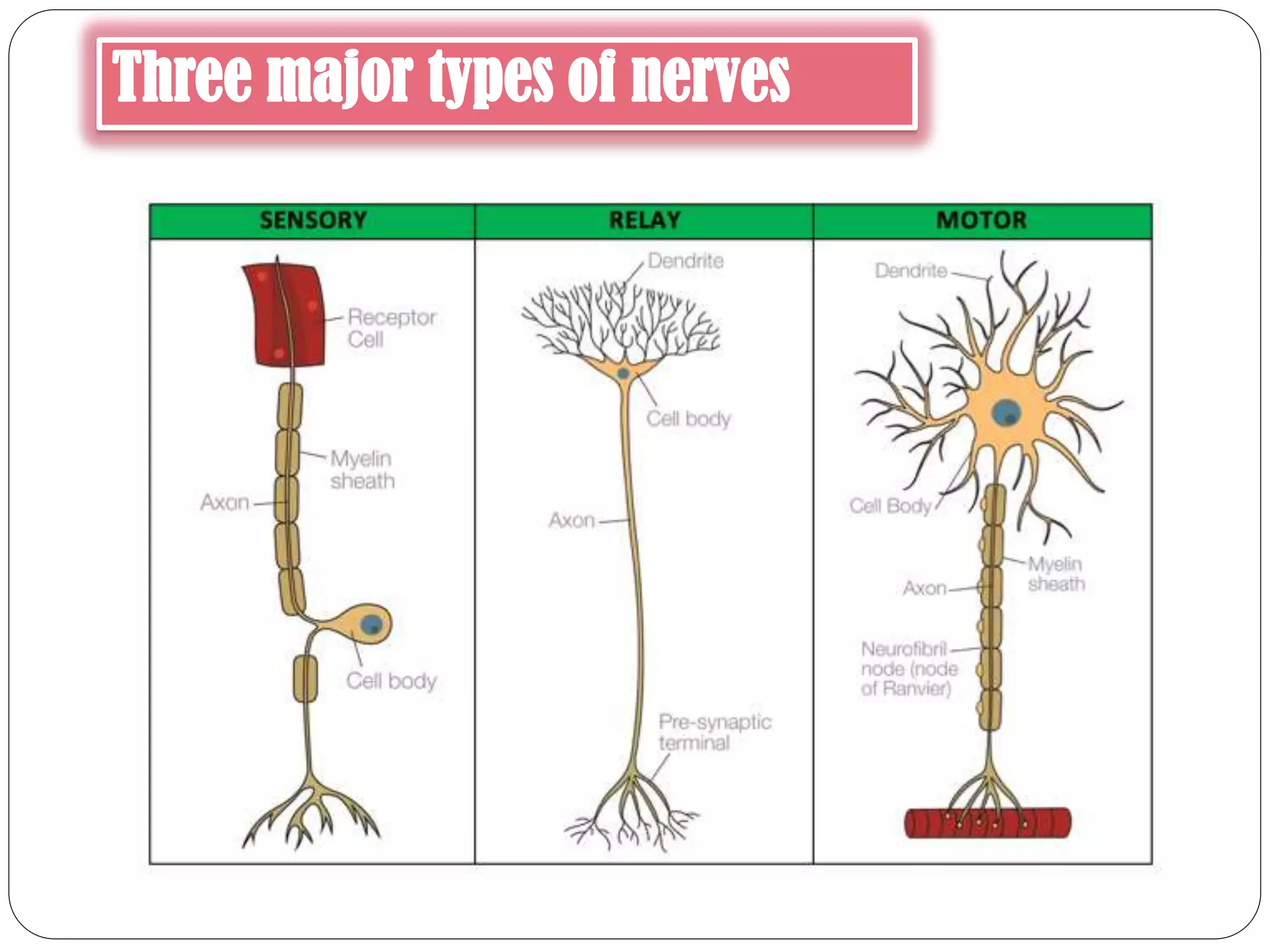
Neurons link together and form nerves, the three major
types of nerves;
1. Sensory nerve: Carry impulse (message) from sense
organs to brain. (it is the form of electric signal)
2. Motor nerve: Brings messages from brain to sense organ.
3. Relay nerve (mix nerve): Serve both functions.
 Two neurons are never joined to each other there is
always a gap between them called synapse.
Three major types of nerves
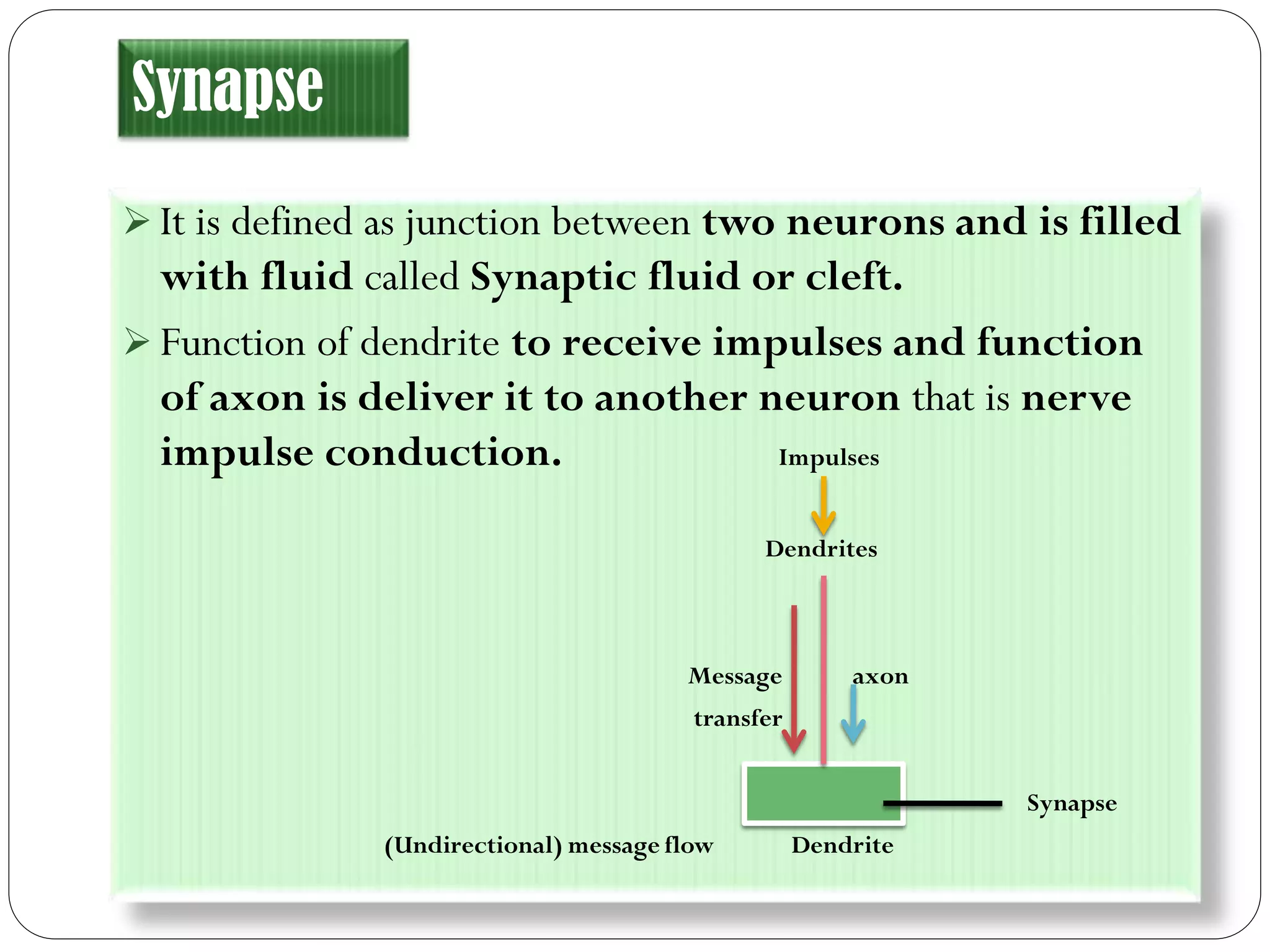
Synapse
 It is defined as junction between two neurons and is filled
with fluid called Synaptic fluid or cleft.
 Function of dendrite to receive impulses and function
of axon is deliver it to another neuron that is nerve
impulse conduction. Impulses
Dendrites
Message axon
transfer
Synapse
(Undirectional) message flow Dendrite
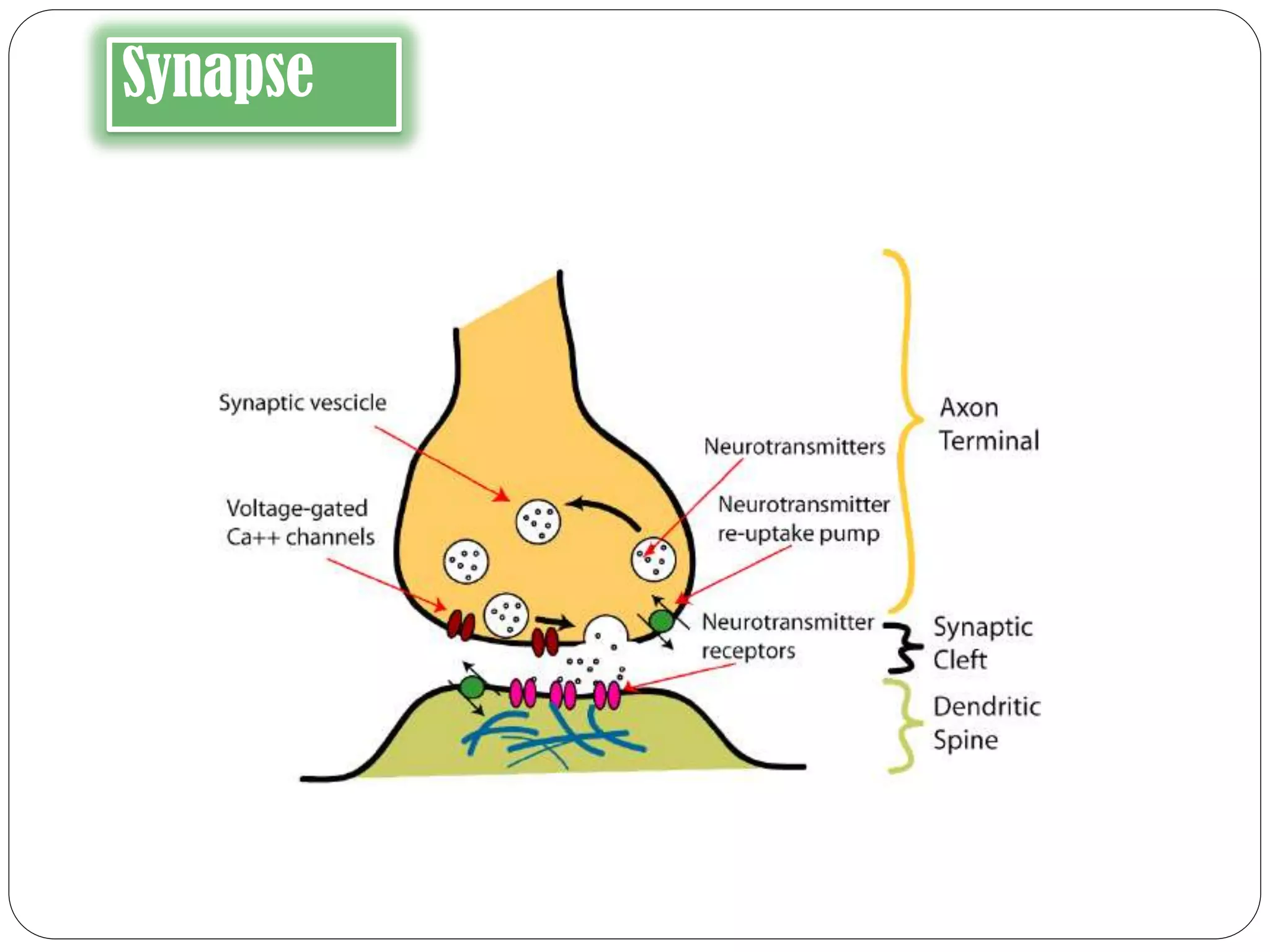
Synapse
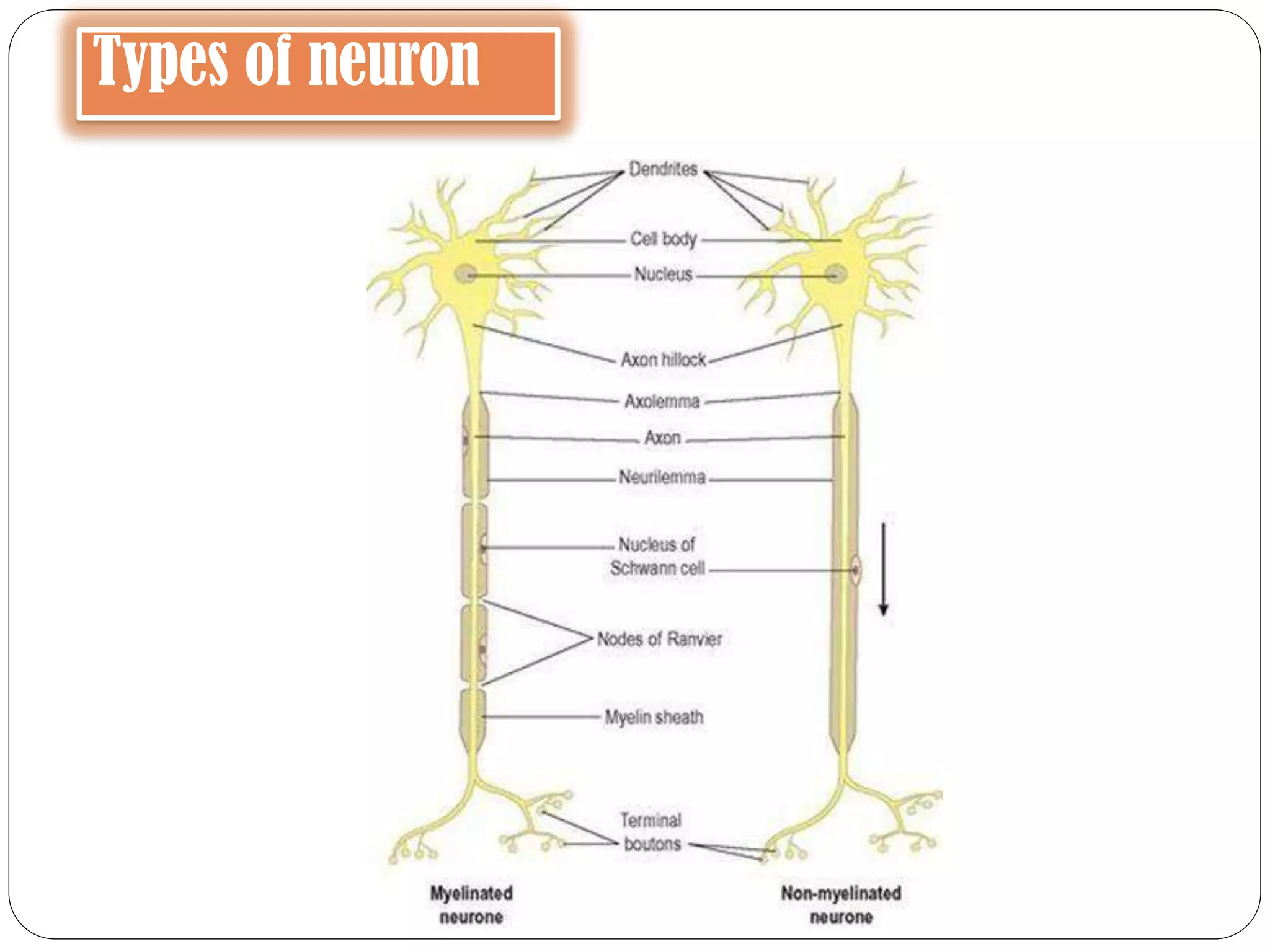
Types of neuron
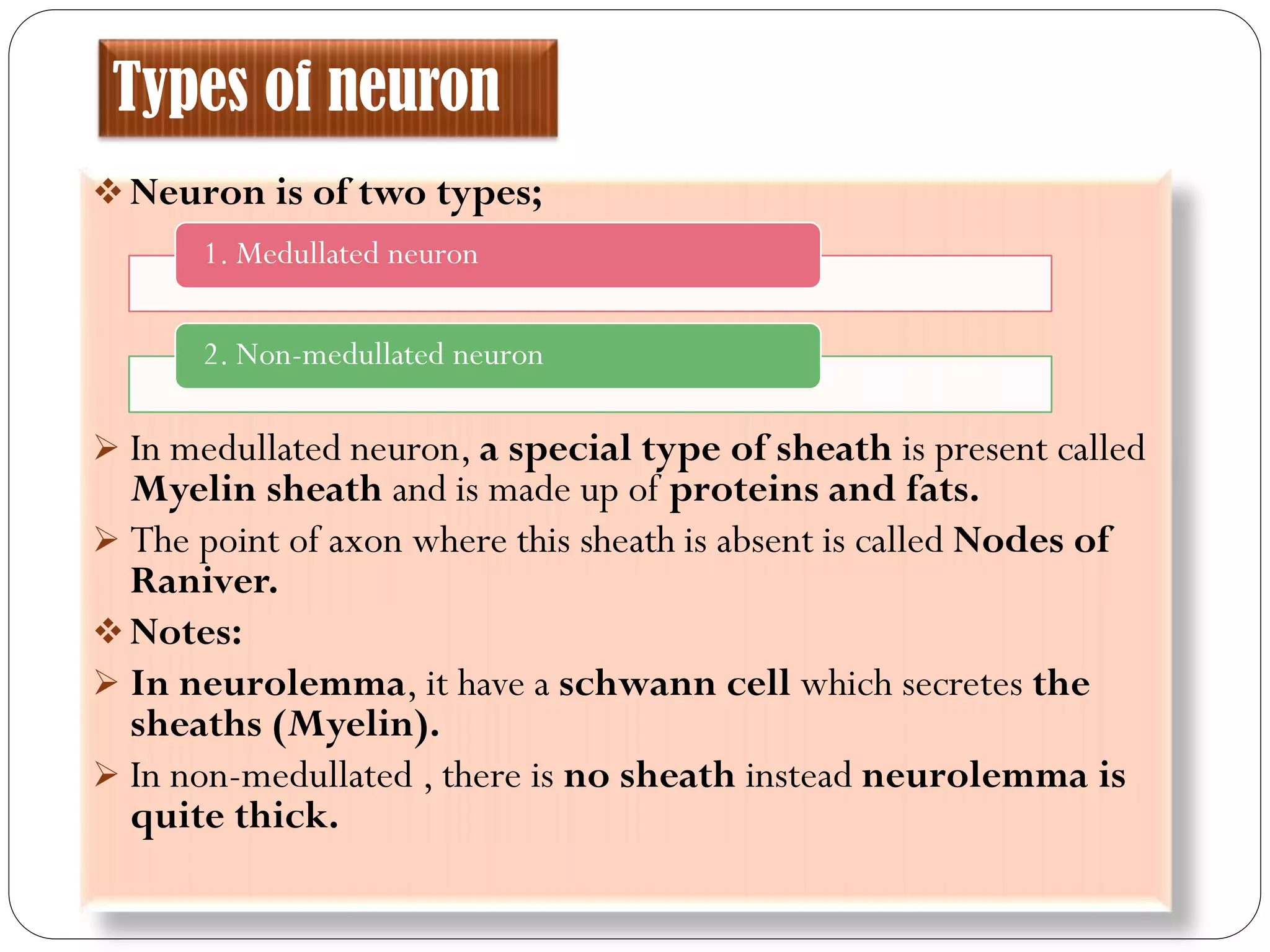
 Neuron is of two types;
 In medullated neuron, a special type of sheath is present called
Myelin sheath and is made up of proteins and fats.
 The point of axon where this sheath is absent is called Nodes of
Raniver.
 Notes:
 In neurolemma, it have a schwann cell which secretes the
sheaths (Myelin).
 In non-medullated , there is no sheath instead neurolemma is
quite thick.
1. Medullated neuron
2. Non-medullated neuron
Types of neuron
Which neuron conducts impulse faster?
 Medullated neurons conduct impulse faster as impulse
moves in a jumping manner that is from one node of
raniver to another (saltatory conduction).
 Whereas the nerve impulse in non-medullated neurons
is quite slow (because ion-exchange is in the whole
membrane).
How nerve impulse passes through synapse?
 Under microscope, axon end appears to be knob like which has
synaptic vessels in it.These synaptic vesicles store a chemical
neurotransmitter.
 We can clearly see the fluid in synapse and we can also see the
receptors on the dendrite of another neuron.
 When impulse reaches the axonal end Ca2+ ions are released
from neurolemma that stimulates the secretion to
neurotransmitter from vesicles into synapse.
 As the synaptic fluid moves, the neurotransmitter also
moves and as soon it touches the dendrite receptors of
another neuron the message is delivered.
 In response the receptors secrete anti-neurotransmitter that
further stops the secretion of neurotransmitter.
 Hence, this is how the impulse travel through synapse.
Conduction of nerve impulse
Notes
Receptors:
 A nerve ending or sense organ in the body that makes the
body react in a particular way to changes outside
such as; light,heat and cold.
Visceral organ which do not work according to our
will. For e.g.- Heart,Brain and Stomach.
Nervous system and its parts
Nervous system
Central nervous
system
Brain & spinal cord
Peripheral nervous
system
Autonomic nervous
system
(Non-voluntary)
Sympathetic
nervous system
Parasympathetic
nervous system
Somatic nervous
system
(Voluntary)
Skeletal muscles
Reflex action
 It is defined as quick, spontaneous and autonomic
response.
 We have receptors in our body, receptors are actually
specialized cells sensitive to different stimulus (any
change in external environment).
For e.g.-
Pain: no-no receptors
Pressure: the go receptors
Temperature: thermo receptors
Light: photo receptors
Reflex action
Mechanism of reflex action
 Suppose you touch an hot substance then thermo-
receptors of our hand get activated and they
generate an impulse to CNS through sensory nerve.
 CNS analyses and interprets its response to effector organ
via motor nerve.
 In this case effector organ is muscles of our hand so it
contract and hand is withdrawn.
The total path covered in reflex action is reflex arc.
Stimulus
(Receptors)
Sensory
neuron
Spinal cord
(Relay neuron)
Motor neuron
Effector
muscle
Cerebrospinal Fluid
Brain
 It is the main controlling centre of our body. It is the
major part of the CNS.
 It is present in a cavity called skull.
 It is surrounded by bony box-cranium.
 It is covered with membranes called meninges.
 The fluid present in vacant spaces and between membranes
is called CSF (Cerebrospinal Fluid). [which act as cushion]
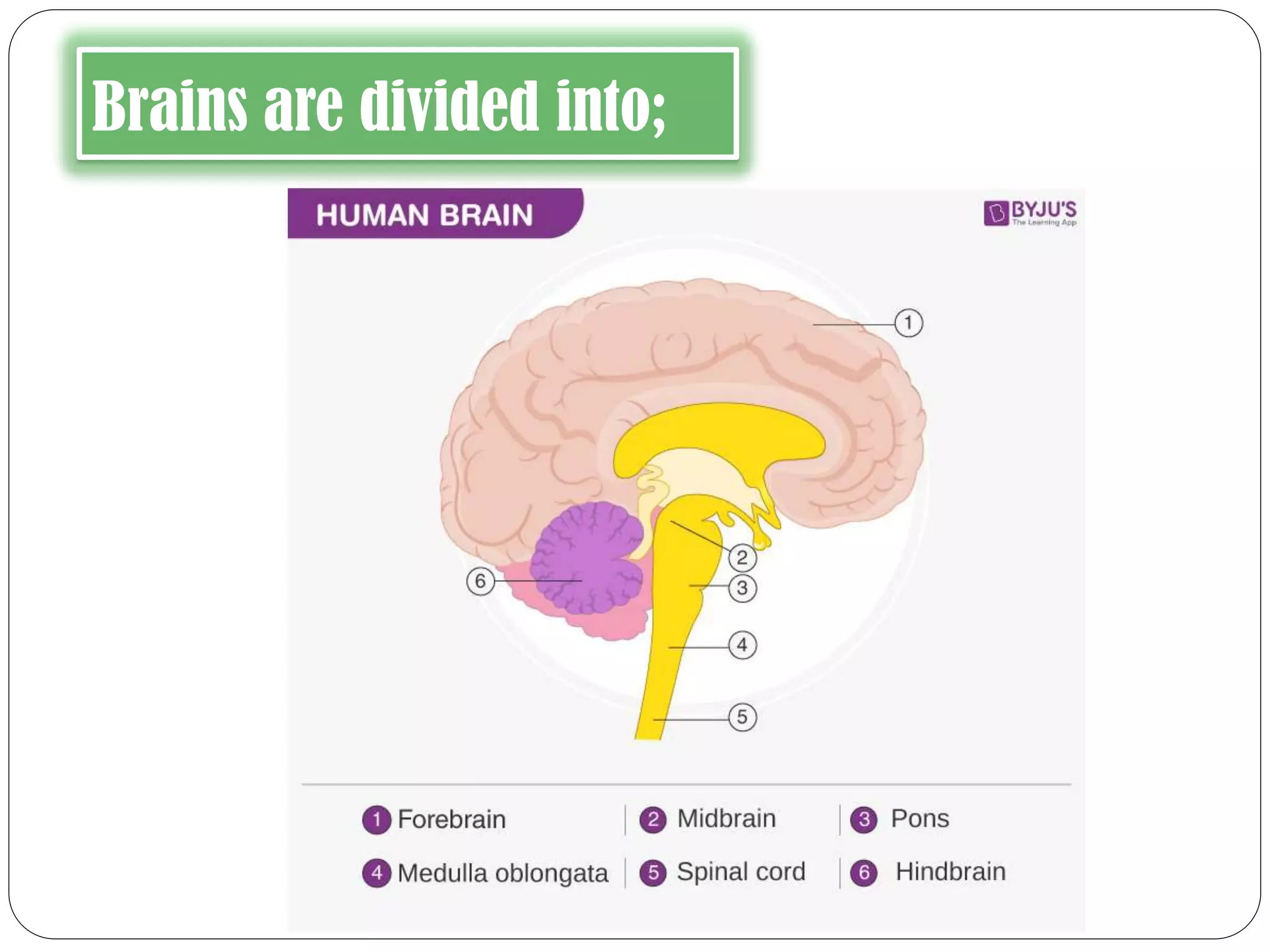
It is divided into:
1. Fore brain
2. Mid brain
3. Hind brain
Brains are divided into;
Brain
Brain
Further their sub-parts
• Cerebrum and Olfactory lobe (smell)1. Fore brain
• Has no sub-divisions2. Mid brain
• Cerebellum, Pons varolii and Medulla
oblongata3. Hind brain
1. Fore brain
Cerebrum:
 It is the largest part of the brain roughly divided into two
parts called cerebral hemispheres.
 These parts are further divided into small parts that
perform different functions.
These hemispheres have certain lobes in it that perform
certain important functions;
• Control facial muscular activitiesFrontal-
• Helps in hearingTemporal-
• Helps in visionOccipital-
• Control sensation of taste, touch and
temperature etc.Parietal-
1. Fore brain
Olfactory lobes:
 They are the prominent lobes and they help in producing
sensation of smell.
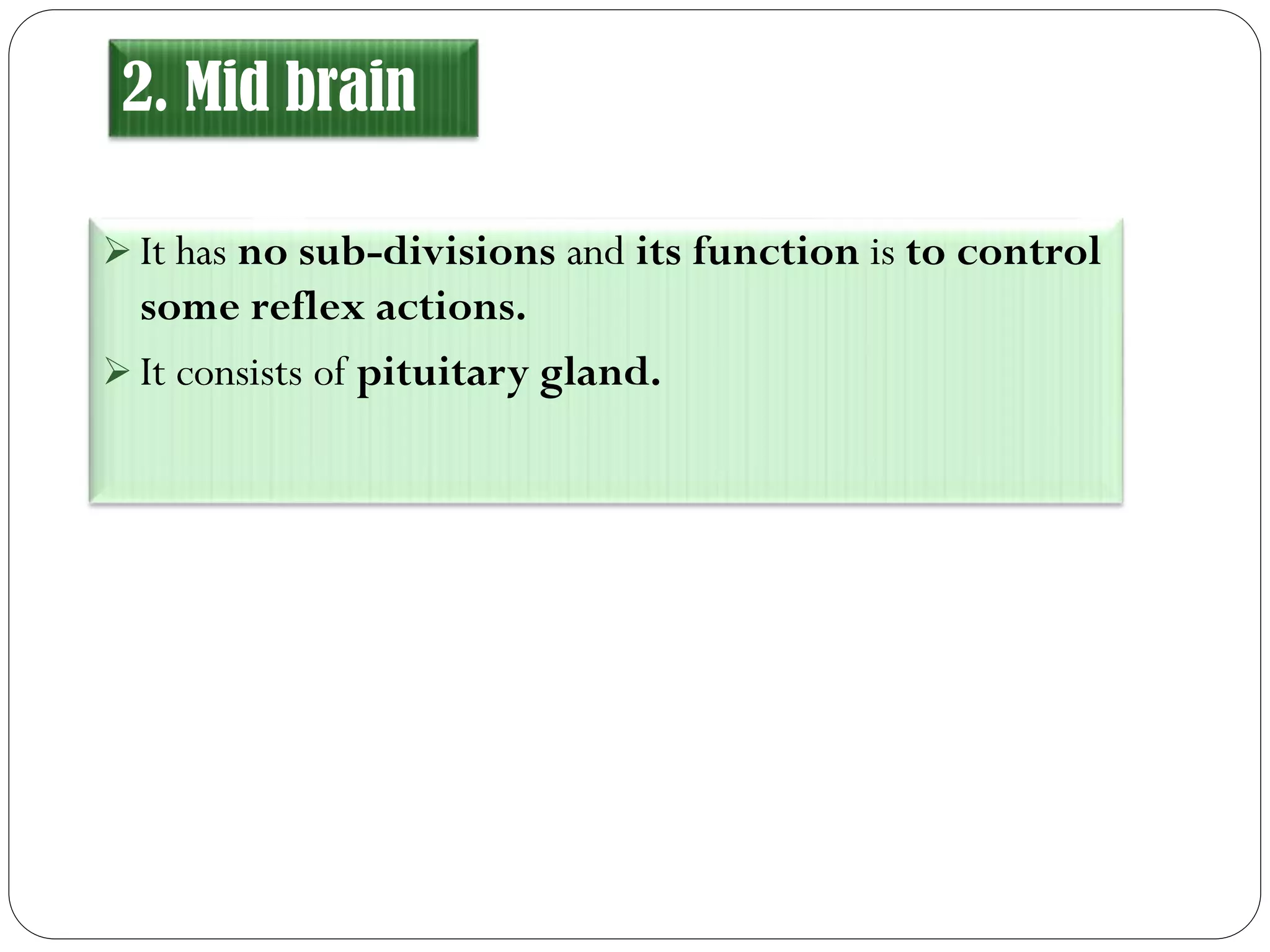
2. Mid brain
 It has no sub-divisions and its function is to control
some reflex actions.
 It consists of pituitary gland.
3. Hind brain
 Cerebellum:
 It is also like cerebrum but no too large. We can say it is
second most biggest part of brain.
 It is also roughly divided into two parts are called cerebellar
hemispheres, which are further divided into small parts.
 Their major function is to control body movements and
posture movements.
 Pons varolii:
 It is the small ovoid body located near brain stem. It controls
some aspect of respiration.
 Medulla oblongata:
 It is the stem of the brain. It controls involuntary activities
like coughing, sneezing and heart beat etc.
EEG
 It is the instrument that help in recording electric signals
generated in brain.
 In this the electrodes with vacuum pads are attached to
scalp of brain and patient is said to relax.This machine
record the electric signals and is printed in the form of
graph.
 The graph consist of different types of waves i.e. alpha, beta,
delta and theta.
 The graph is called Electro Encephalon Gram.
Human brain waves
Spinal cord
 It is the extension of medulla oblongata.The point from
where it leads into spinal cord is called Foramen magnum.
 The spinal cord is divided into 5 regions i.e., Cervical (7),
Thoracic (12), Lumbar (5), Sacrum (5), Coccygeal
region (4).
 The human spinal column is made up of 33 bones.
 There are 32 pairs of nerves that are arising or
terminating into spinal cord.
 Spinal cord has fluid CSF in it and from outside it is enclosed
by backbone.
 The function of spinal cord is to control reflex actions.
Spinal cord
Control and coordination in humans

Control and coordination in humans

  • 1.
    Represented by-Radiate Control andCoordination in humans
  • 2.
    Human Brain &Nervous system
  • 3.
    Introduction  For controland coordination, there is a system inside our body: Nervous system and Hormonal system.  The structural and functional unit of any system are its cells.  In a same way cells of nervous system is ‘neuron’ (largest cell of our body). It is highly branched cell.  The control and coordination in human beings take place through nervous system and hormonal system which is called endocrine system.
  • 4.
    Structure of neuron Itconsists of three nucleus parts;  The irregular structure is called cell body that encloses a nucleus in neuroplasm (cytoplasm).  From cell body small branches arise called as dendrite on upper side, on lower side it gives out only one branch that is elongated called Axon.  The whole neuron is made up of neurolemma.Axon ends into nerve endings. 1.Axon 2. Dendrite 3. Cell body or cyton
  • 5.
  • 6.
    Neurons link togetherand form nerves, the three major types of nerves; 1. Sensory nerve: Carry impulse (message) from sense organs to brain. (it is the form of electric signal) 2. Motor nerve: Brings messages from brain to sense organ. 3. Relay nerve (mix nerve): Serve both functions.  Two neurons are never joined to each other there is always a gap between them called synapse.
  • 7.
  • 8.
    Synapse  It isdefined as junction between two neurons and is filled with fluid called Synaptic fluid or cleft.  Function of dendrite to receive impulses and function of axon is deliver it to another neuron that is nerve impulse conduction. Impulses Dendrites Message axon transfer Synapse (Undirectional) message flow Dendrite
  • 9.
  • 10.
    Types of neuron Neuron is of two types;  In medullated neuron, a special type of sheath is present called Myelin sheath and is made up of proteins and fats.  The point of axon where this sheath is absent is called Nodes of Raniver.  Notes:  In neurolemma, it have a schwann cell which secretes the sheaths (Myelin).  In non-medullated , there is no sheath instead neurolemma is quite thick. 1. Medullated neuron 2. Non-medullated neuron
  • 11.
  • 12.
    Which neuron conductsimpulse faster?  Medullated neurons conduct impulse faster as impulse moves in a jumping manner that is from one node of raniver to another (saltatory conduction).  Whereas the nerve impulse in non-medullated neurons is quite slow (because ion-exchange is in the whole membrane).
  • 13.
    How nerve impulsepasses through synapse?  Under microscope, axon end appears to be knob like which has synaptic vessels in it.These synaptic vesicles store a chemical neurotransmitter.  We can clearly see the fluid in synapse and we can also see the receptors on the dendrite of another neuron.  When impulse reaches the axonal end Ca2+ ions are released from neurolemma that stimulates the secretion to neurotransmitter from vesicles into synapse.  As the synaptic fluid moves, the neurotransmitter also moves and as soon it touches the dendrite receptors of another neuron the message is delivered.  In response the receptors secrete anti-neurotransmitter that further stops the secretion of neurotransmitter.  Hence, this is how the impulse travel through synapse.
  • 14.
  • 15.
    Notes Receptors:  A nerveending or sense organ in the body that makes the body react in a particular way to changes outside such as; light,heat and cold. Visceral organ which do not work according to our will. For e.g.- Heart,Brain and Stomach.
  • 16.
    Nervous system andits parts Nervous system Central nervous system Brain & spinal cord Peripheral nervous system Autonomic nervous system (Non-voluntary) Sympathetic nervous system Parasympathetic nervous system Somatic nervous system (Voluntary) Skeletal muscles
  • 17.
    Reflex action  Itis defined as quick, spontaneous and autonomic response.  We have receptors in our body, receptors are actually specialized cells sensitive to different stimulus (any change in external environment). For e.g.- Pain: no-no receptors Pressure: the go receptors Temperature: thermo receptors Light: photo receptors
  • 18.
  • 19.
    Mechanism of reflexaction  Suppose you touch an hot substance then thermo- receptors of our hand get activated and they generate an impulse to CNS through sensory nerve.  CNS analyses and interprets its response to effector organ via motor nerve.  In this case effector organ is muscles of our hand so it contract and hand is withdrawn.
  • 20.
    The total pathcovered in reflex action is reflex arc. Stimulus (Receptors) Sensory neuron Spinal cord (Relay neuron) Motor neuron Effector muscle
  • 21.
  • 22.
    Brain  It isthe main controlling centre of our body. It is the major part of the CNS.  It is present in a cavity called skull.  It is surrounded by bony box-cranium.  It is covered with membranes called meninges.  The fluid present in vacant spaces and between membranes is called CSF (Cerebrospinal Fluid). [which act as cushion] It is divided into: 1. Fore brain 2. Mid brain 3. Hind brain
  • 23.
  • 24.
  • 25.
  • 26.
    Further their sub-parts •Cerebrum and Olfactory lobe (smell)1. Fore brain • Has no sub-divisions2. Mid brain • Cerebellum, Pons varolii and Medulla oblongata3. Hind brain
  • 27.
    1. Fore brain Cerebrum: It is the largest part of the brain roughly divided into two parts called cerebral hemispheres.  These parts are further divided into small parts that perform different functions. These hemispheres have certain lobes in it that perform certain important functions; • Control facial muscular activitiesFrontal- • Helps in hearingTemporal- • Helps in visionOccipital- • Control sensation of taste, touch and temperature etc.Parietal-
  • 28.
    1. Fore brain Olfactorylobes:  They are the prominent lobes and they help in producing sensation of smell.
  • 29.
    2. Mid brain It has no sub-divisions and its function is to control some reflex actions.  It consists of pituitary gland.
  • 30.
    3. Hind brain Cerebellum:  It is also like cerebrum but no too large. We can say it is second most biggest part of brain.  It is also roughly divided into two parts are called cerebellar hemispheres, which are further divided into small parts.  Their major function is to control body movements and posture movements.  Pons varolii:  It is the small ovoid body located near brain stem. It controls some aspect of respiration.  Medulla oblongata:  It is the stem of the brain. It controls involuntary activities like coughing, sneezing and heart beat etc.
  • 31.
    EEG  It isthe instrument that help in recording electric signals generated in brain.  In this the electrodes with vacuum pads are attached to scalp of brain and patient is said to relax.This machine record the electric signals and is printed in the form of graph.  The graph consist of different types of waves i.e. alpha, beta, delta and theta.  The graph is called Electro Encephalon Gram.
  • 32.
  • 33.
    Spinal cord  Itis the extension of medulla oblongata.The point from where it leads into spinal cord is called Foramen magnum.  The spinal cord is divided into 5 regions i.e., Cervical (7), Thoracic (12), Lumbar (5), Sacrum (5), Coccygeal region (4).  The human spinal column is made up of 33 bones.  There are 32 pairs of nerves that are arising or terminating into spinal cord.  Spinal cord has fluid CSF in it and from outside it is enclosed by backbone.  The function of spinal cord is to control reflex actions.
  • 34.