JIJI.V
 Tissues
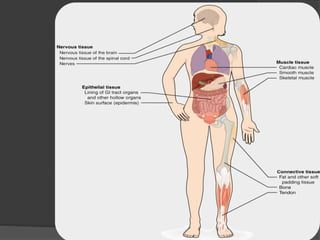
 Tissue is a structure and that function
together as a unit.
 group of cells that have similar
 Primary types of body tissues include
 Epithelial,
 Connective,
 Muscular, and
 Nervous tissues.
 Body membranes are thin sheets of
tissue that cover the body, line body
cavities, and cover organs within the
cavities in hollow organs.
 Two main categories of body membranes
are epithelial and connective tissue
membranes. Sub-categories include
mucous membranes, serous membranes,
synovial membranes, and meninges.
Tissues
 Tissues are groups of similar cells
that have a common function.
 The four basic tissue types are
 Epithelial
 Muscle
 Connective, and
 Nervous tissue.
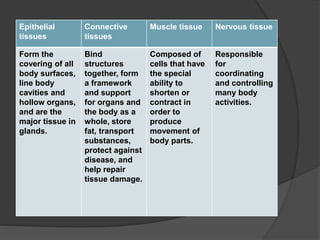
Epithelial
tissues
Connective
tissues
Muscle tissue Nervous tissue
Form the
covering of all
body surfaces,
line body
cavities and
hollow organs,
and are the
major tissue in
glands.
Bind
structures
together, form
a framework
and support
for organs and
the body as a
whole, store
fat, transport
substances,
protect against
disease, and
help repair
tissue damage.
Composed of
cells that have
the special
ability to
shorten or
contract in
order to
produce
movement of
body parts.
Responsible
for
coordinating
and controlling
many body
activities.
Each tissue type has a
characteristic role in the body
1. Epithelium covers the body surface
and lines body cavities.
2. Muscle provides movement.
3. Connective tissue supports and
protects body organs.
4. Nervous tissue provides a means of
rapid internal communication by
transmitting electrical impulses.
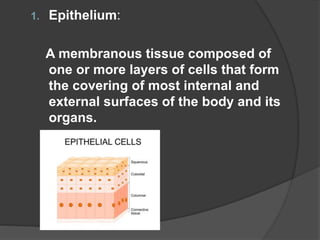
1. Epithelium:
A membranous tissue composed of
one or more layers of cells that form
the covering of most internal and
external surfaces of the body and its
organs.
 The cells in epithelial tissue are tightly
packed together with very little
intercellular matrix.
 Because the tissues form coverings and
linings, the cells have one free surface that
is not in contact with other cells. Opposite
the free surface, the cells are attached to
underlying connective tissue by a non-
cellular basement membrane
 This membrane is a mixture
of carbohydrates and proteins secreted by
the epithelial and connective tissue cells.
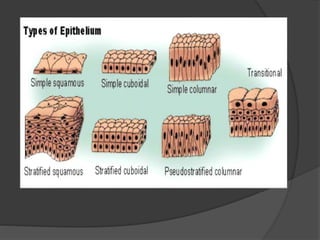
 Types of Epithelial Tissue
 Epithelial tissues are identified by both
the number of layers and the shape of
the cells in the upper layers.
 There are eight basic types of
epithelium: six of them are identified
based on both the number of cells and
their shape;
 Two of them are named by the type of
cell (squamous) found in them.
 I .Simple Epithelia
 Simple epithelium consists of a single layer of cells.
They are typically where absorption, secretion and
filtration occur.
 Simple epithelial tissues are generally classified by the
shape of their cells.
 The four major classes of simple epithelium are:
1]Simple squamous;
2) Simple cuboidal;
3) Simple columnar; and
4) Pseudostratified.
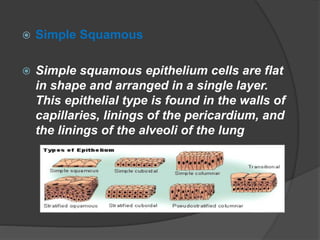
 Simple Squamous
 Simple squamous epithelium cells are flat
in shape and arranged in a single layer.
This epithelial type is found in the walls of
capillaries, linings of the pericardium, and
the linings of the alveoli of the lung
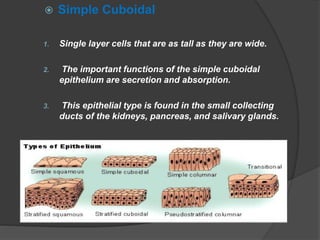
 Simple Cuboidal
1. Single layer cells that are as tall as they are wide.
2. The important functions of the simple cuboidal
epithelium are secretion and absorption.
3. This epithelial type is found in the small collecting
ducts of the kidneys, pancreas, and salivary glands.
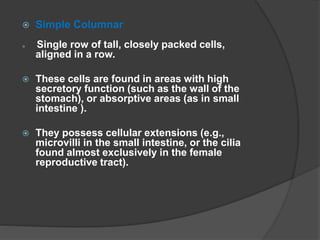
 Simple Columnar
 Single row of tall, closely packed cells,
aligned in a row.
 These cells are found in areas with high
secretory function (such as the wall of the
stomach), or absorptive areas (as in small
intestine ).
 They possess cellular extensions (e.g.,
microvilli in the small intestine, or the cilia
found almost exclusively in the female
reproductive tract).
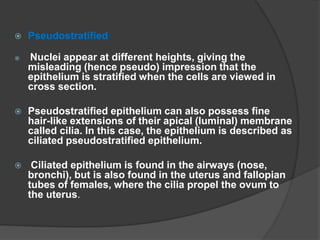
 Pseudostratified
 Nuclei appear at different heights, giving the
misleading (hence pseudo) impression that the
epithelium is stratified when the cells are viewed in
cross section.
 Pseudostratified epithelium can also possess fine
hair-like extensions of their apical (luminal) membrane
called cilia. In this case, the epithelium is described as
ciliated pseudostratified epithelium.
 Ciliated epithelium is found in the airways (nose,
bronchi), but is also found in the uterus and fallopian
tubes of females, where the cilia propel the ovum to
the uterus.
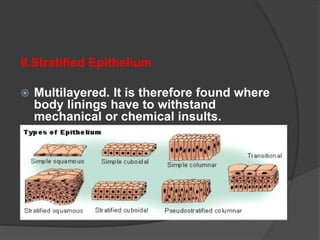
II.Stratified Epithelium
 Multilayered. It is therefore found where
body linings have to withstand
mechanical or chemical insults.
 Stratified epithelia are more durable and
protection is one their major functions.
 Stratified epithelia can be columnar,
cuboidal, or squamous type.
 III.Keratinized Epithelia
 In keratinized epithelia, the most apical layers
(exterior) of cells are dead and lose their nucleus and
cytoplasm.
 They contain a tough, resistant protein called keratin.
This specialization makes the epithelium waterproof,
and it is abundant in mammalian skin.
 The lining of the esophagus is an example of a non-
keratinized or moist stratified epithelium.
IV.Transitional Epithelia
 Transitional epithelia are found in
tissues that stretch and it can appear
to be stratified, or stratified
squamous when the organ is
distended and the tissue stretches.
 It is sometimes called the urothelium
since it is almost exclusively found in
the bladder, ureters, and urethra.
 Connective tissue
 connective tissues bind structures together, form
a framework and support for organs and the
body as a whole, store fat, transport substances,
protect against disease, and help
repair tissue damage.
 They occur throughout the body.
 Connective tissues are characterized by an
abundance of intercellular matrix with relatively
few cells.
 Connective tissue cells are able to reproduce
but not as rapidly as epithelial cells. Most
connective tissues have a good blood supply but
some do not.
Connective tissue
 Numerous cell types are found in connective
tissue.
 Three of the most common are
the fibroblast, macrophage, and mast cell.
 The types of connective tissue include loose
connective tissue, adipose tissue,
dense fibrous connective tissue, elastic
connective tissue, cartilage, osseous tissue
(bone), and blood.

 Structure of Connective Tissue
 Connective tissue has three main
components:
1. Ground substance
2. Fibers
3. Cells
 Together the ground substance and fibers
make up the extracellular matrix.
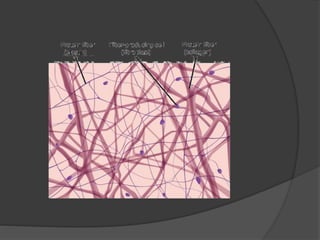
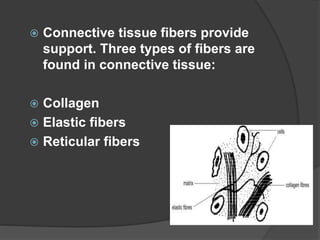
 Connective tissue fibers provide
support. Three types of fibers are
found in connective tissue:
 Collagen
 Elastic fibers
 Reticular fibers
 Collagen: Collagen fibers are the strongest and most abundant of all
the connective tissue fibers.
 Collagen fibers are fibrous proteins and are secreted into the
extracellular space and they provide high tensile strength to the
matrix.
 Elastic Fibers
 Elastic fibers are long, thin fibers that form branching network in the
extracellular matrix. They help the connective tissue to stretch and
recoil.
 Reticular Fibers
 Reticular fibers are short, fine collagenous fibers that can branch
extensively to form a delicate network.
 Function of Connective Tissue
 Binding and supporting.
 Protecting.
 Insulating.
 Storing reserve fuel.
 Transporting substances within the
body.
 Connective tissue is divided into four
main categories:
 Connective proper
 Cartilage
 Bone
 Blood
 Connective tissue proper has two
subclasses: Loose and dense.
 Loose connective tissue is divided
into 1) areolar, 2) adipose, 3)
reticular.
 Dense connective tissue is divided
into 1) dense regular, 2) dense
irregular, 3) elastic.
 Areolar Connective Tissue
 These tissues are widely distributed and
serve as a universal packing material
between other tissues.
 The functions of areolar connective tissue
include the support and binding of other
tissues.
 It also helps in defending against infection.
When a body region is inflamed, the
areolar tissue in the area soaks up the
excess fluid as a sponge and the affected
area swells and becomes puffy, a condition
called edema.
 Adipose Tissue or Body Fat
 Adipose tissue: Yellow adipose tissue in paraffin
section with lipids washed out.
 This is loose connective tissue composed of
adipocytes.
 It is technically composed of roughly only 80% fat. Its
main role is to store energy in the form of lipids,
although it also cushions and insulates the body.
 The two types of adipose tissue are white adipose
tissue (WAT) and brown adipose tissue (BAT).
 Adipose tissue is found in specific locations, referred
to as adipose depots.
 Reticular Connective Tissue
 This tissue resembles areolar
connective tissue, but the only fibers in
its matrix are the reticular fibers, which
form a delicate network. The reticular
tissue is limited to certain sites in the
body, such as internal frameworks that
can support lymph nodes, spleen, and
bone marrow.
 Dense Regular Connective Tissue
 This consists of closely packed
bundles of collagen fibers running in
the same direction.
 This tissue forms the fascia, which is
a fibrous membrane that wraps
around the muscles, blood vessels,
and nerves.
 Dense Irregular Tissue
 This has the same structural elements
as dense regular tissue, but the bundles
of collagen fibers are much thicker and
arranged irregularly.
 It is part of the skin dermis area and in
the joint capsules of the limbs.
 Elastic Connective Tissue
 The main fibers that form this tissue are
elastic in nature. These fibers allow the
tissues to recoil after stretching. This is
especially seen in the arterial blood
vessels and walls of the bronchial tubes.
 VI .Cartilage
 This is a flexible connective tissue found in many areas in the bodies ,
including the joints between bones, the rib cage, the ear, the nose, the elbow,
the knee, the ankle, the bronchial tubes, and the intervertebral discs.
 Cartilage is composed of specialized cells called chondroblasts and, unlike
other connective tissues, cartilage does not contain blood vessels.
 Cartilage is classified in three types:
 1) Elastic cartilage,
 2) Hyaline cartilage, and
 3) Fibrocartilage, which differ in the relative amounts of these
three main components.
 1)Elastic Cartilage
 This is similar to hyaline cartilage but
is more elastic in nature. Its function
is to maintain the shape of the
structure while allowing flexibility. It
is found in the external ear (known as
an auricle) and in the epiglottis.
 2) Hyaline Cartilage
 This is is the most abundant of all cartilage in
the body.
 Its matrix appears transparent or glassy when
viewed under a microscope.
 It provides strong support while providing pads
for shock absorption.
 It is a major part of the embryonic skeleton, the
costal cartilages of the ribs, and the cartilage of
the nose, trachea, and larynx.
3)Fibrocartilage
 This is a blend of hyaline cartilage
and dense regular connective tissue.
Because it is compressible and
resists tension well, fibrocartilage is
found where strong support and the
ability to withstand heavy pressure
are required. It is found in the
intervertebral discs of the bony
vertebrae and knee meniscus.
 VII.Blood
 This is considered a specialized form of
connective tissue.
 Blood is a bodily fluid that delivers
necessary substances, such as nutrients
and oxygen, to the cells and transports
metabolic waste products away from those
same cells.
 It is an atypical connective tissue since it
does not bind, connect, or network with any
body cells. It is made up of blood cells and
is surrounded by a nonliving fluid called
plasma.
 Nervous tissue is found in
the brain, spinal cord, and nerves. It is
responsible for coordinating and controlling
many body activities.
 It stimulates muscle contraction, creates
an awareness of the environment, and
plays a major role in emotions, memory,
and reasoning.
 To do all these things, cells in nervous
tissue need to be able to communicate with
each other by way of
electrical nerve impulses.
 The cells in nervous tissue that generate
and conduct impulses are
called neurons or nerve cells.

 These cells have three principal parts:
the dendrites, the cell body, and one axon.
The main part of the cell, the part that
carries on the general functions, is the cell
body.
 Dendrites are extensions, or processes, of
the cytoplasm that carry impulses to the
cell body. An extension or process called
an axon carries impulses away from the
cell body.
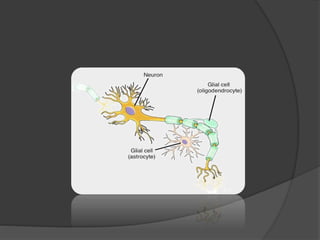
 Nervous tissue also includes cells that
do not transmit impulses, but instead
support the activities of the neurons.
These are the glial cells (neuroglial
cells), together termed the neuroglia.
Supporting, or glia, cells bind neurons
together and insulate the neurons.
 Some are phagocytic and protect
against bacterial invasion, while others
provide nutrients by
binding blood vessels to the neurons.
 Muscle tissue is composed of cells that have the special
ability to shorten or contract in order to produce
movement of the body parts.
 The tissue is highly cellular and is well supplied
with blood vessels.
 The cells are long and slender so they are sometimes
called muscle fibers, and these are usually arranged in
bundles or layers that are surrounded by connective
tissue.
 Actin and myosin are contractile proteins in muscle
tissue.
 Muscle tissue can be categorized into skeletal
muscle tissue, smooth muscle tissue, and cardiac
muscle tissue.
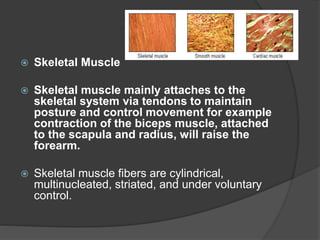
 Skeletal Muscle
 Skeletal muscle mainly attaches to the
skeletal system via tendons to maintain
posture and control movement for example
contraction of the biceps muscle, attached
to the scapula and radius, will raise the
forearm.
 Skeletal muscle fibers are cylindrical,
multinucleated, striated, and under voluntary
control.
 Cardiac Muscle Tissue
 Cardiac muscle has branching fibers,
one nucleus per cell, striations,
and intercalated disks. Its contraction is
not under voluntary control.
 Cardiac muscle tissue is found only in
the heart where cardiac contractions
pump blood throughout the body and
maintain blood pressure.
Smooth Muscle Tissue
 Smooth muscle cells are spindle shaped, have a
single, centrally located nucleus, and lack
striations. They are called involuntary muscles.
 Smooth muscle tissue is found associated with
numerous other organs and tissue systems such
as the digestive system or respiratory system.
 It plays an important role in the regulation of flow
in such tissues for example aiding the movement
of food through the digestive system via
peristalsis.
 Body Membranes
 Body membranes are thin sheets
of tissue that cover the body, line body
cavities, and cover organs within the
cavities in hollow organs.
 They can be categorized into
 Epithelial and connective
tissue membrane.
 Epithelial Membranes
 Epithelial membranes consist
of epithelial tissue and the connective
tissue to which it is attached.
 The two main types of epithelial
membranes are the mucous membranes
and serous membranes.
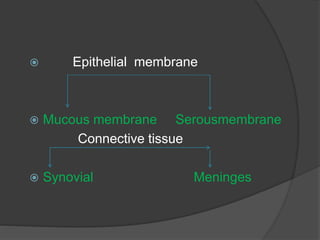
 Epithelial membrane
 Mucous membrane Serousmembrane
Connective tissue
 Synovial Meninges
 Mucous Membranes
 Mucous membranes are epithelial
membranes that consist of epithelial
tissue that is attached to an underlying
loose connective tissue.
 These membranes, sometimes
called mucosae, line the body cavities
that open to the outside.
 The entire digestive tract is lined with
mucous membranes. Other examples
include the respiratory, excretory, and
reproductive tracts.
 Most mucosal membranes contain
stratified squamous or simple columnar
epithelial tissue types.
 The submucosa is the tissue that connects
the mucosa to the muscle outside the tube,
 Submucosal exocrine glands secrete
mucus to facilitate the movement of
particles along the body’s various tubes,
such as the throat and the intestines.
 Serous Membranes
 Serous membranes line body cavities that do not open
directly to the outside, and they cover the organs
located in those cavities.
 Serous membranes are covered by a thin layer of serous
fluid that is secreted by the epithelium.
 Serous fluid lubricates the membrane and reduces
friction and abrasion when organs in the thoracic
or abdominopelvic cavity move against each other or
the cavity wall.
 Serous membranes have special names given according
to their location. For example, the serous membrane that
lines the thoracic cavity and covers the lungs is
called pleura.
 Connective Tissue Membranes
 Connective tissue membranes contain
only connective tissue.
 1.Synovial membranes and
 2.Meninges belong to this category.
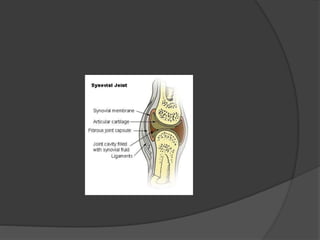
1.Synovial Membranes
 Synovial membranes are connective tissue
membranes that line the cavities of the
freely movable joints such as the shoulder,
elbow, and knee.
 Like serous membranes, they line cavities
that do not open to the outside..
 Synovial membranes secrete synovial
fluid into the joint cavity, and this lubricates
the cartilage on the ends of the bones so
that they can move freely and without
friction.
2. Meninges
 The connective tissue covering on
the brain and spinal cord, within
the dorsal cavity, are called meninges.
They provide protection for these vital
structures.
 Meninges
 The meninges is the system of
membranes that envelopes the central
nervous system. The meninges consist
of three layers: the dura mater, the
arachnoid mater, and the pia mater.
 The primary function of the meninges
and of the cerebrospinal fluid is to
protect the central nervous system.

Tissue

  • 1.
  • 3.
     Tissues  Tissueis a structure and that function together as a unit.  group of cells that have similar  Primary types of body tissues include  Epithelial,  Connective,  Muscular, and  Nervous tissues.
  • 4.
     Body membranesare thin sheets of tissue that cover the body, line body cavities, and cover organs within the cavities in hollow organs.  Two main categories of body membranes are epithelial and connective tissue membranes. Sub-categories include mucous membranes, serous membranes, synovial membranes, and meninges.
  • 5.
    Tissues  Tissues aregroups of similar cells that have a common function.  The four basic tissue types are  Epithelial  Muscle  Connective, and  Nervous tissue.
  • 6.
    Epithelial tissues Connective tissues Muscle tissue Nervoustissue Form the covering of all body surfaces, line body cavities and hollow organs, and are the major tissue in glands. Bind structures together, form a framework and support for organs and the body as a whole, store fat, transport substances, protect against disease, and help repair tissue damage. Composed of cells that have the special ability to shorten or contract in order to produce movement of body parts. Responsible for coordinating and controlling many body activities.
  • 7.
    Each tissue typehas a characteristic role in the body 1. Epithelium covers the body surface and lines body cavities. 2. Muscle provides movement. 3. Connective tissue supports and protects body organs. 4. Nervous tissue provides a means of rapid internal communication by transmitting electrical impulses.
  • 8.
    1. Epithelium: A membranoustissue composed of one or more layers of cells that form the covering of most internal and external surfaces of the body and its organs.
  • 9.
     The cellsin epithelial tissue are tightly packed together with very little intercellular matrix.  Because the tissues form coverings and linings, the cells have one free surface that is not in contact with other cells. Opposite the free surface, the cells are attached to underlying connective tissue by a non- cellular basement membrane  This membrane is a mixture of carbohydrates and proteins secreted by the epithelial and connective tissue cells.
  • 10.
     Types ofEpithelial Tissue  Epithelial tissues are identified by both the number of layers and the shape of the cells in the upper layers.  There are eight basic types of epithelium: six of them are identified based on both the number of cells and their shape;  Two of them are named by the type of cell (squamous) found in them.
  • 11.
     I .SimpleEpithelia  Simple epithelium consists of a single layer of cells. They are typically where absorption, secretion and filtration occur.  Simple epithelial tissues are generally classified by the shape of their cells.  The four major classes of simple epithelium are: 1]Simple squamous; 2) Simple cuboidal; 3) Simple columnar; and 4) Pseudostratified.
  • 13.
     Simple Squamous Simple squamous epithelium cells are flat in shape and arranged in a single layer. This epithelial type is found in the walls of capillaries, linings of the pericardium, and the linings of the alveoli of the lung
  • 14.
     Simple Cuboidal 1.Single layer cells that are as tall as they are wide. 2. The important functions of the simple cuboidal epithelium are secretion and absorption. 3. This epithelial type is found in the small collecting ducts of the kidneys, pancreas, and salivary glands.
  • 15.
     Simple Columnar Single row of tall, closely packed cells, aligned in a row.  These cells are found in areas with high secretory function (such as the wall of the stomach), or absorptive areas (as in small intestine ).  They possess cellular extensions (e.g., microvilli in the small intestine, or the cilia found almost exclusively in the female reproductive tract).
  • 16.
     Pseudostratified  Nucleiappear at different heights, giving the misleading (hence pseudo) impression that the epithelium is stratified when the cells are viewed in cross section.  Pseudostratified epithelium can also possess fine hair-like extensions of their apical (luminal) membrane called cilia. In this case, the epithelium is described as ciliated pseudostratified epithelium.  Ciliated epithelium is found in the airways (nose, bronchi), but is also found in the uterus and fallopian tubes of females, where the cilia propel the ovum to the uterus.
  • 17.
    II.Stratified Epithelium  Multilayered.It is therefore found where body linings have to withstand mechanical or chemical insults.  Stratified epithelia are more durable and protection is one their major functions.  Stratified epithelia can be columnar, cuboidal, or squamous type.
  • 18.
     III.Keratinized Epithelia In keratinized epithelia, the most apical layers (exterior) of cells are dead and lose their nucleus and cytoplasm.  They contain a tough, resistant protein called keratin. This specialization makes the epithelium waterproof, and it is abundant in mammalian skin.  The lining of the esophagus is an example of a non- keratinized or moist stratified epithelium.
  • 19.
    IV.Transitional Epithelia  Transitionalepithelia are found in tissues that stretch and it can appear to be stratified, or stratified squamous when the organ is distended and the tissue stretches.  It is sometimes called the urothelium since it is almost exclusively found in the bladder, ureters, and urethra.
  • 20.
     Connective tissue connective tissues bind structures together, form a framework and support for organs and the body as a whole, store fat, transport substances, protect against disease, and help repair tissue damage.  They occur throughout the body.  Connective tissues are characterized by an abundance of intercellular matrix with relatively few cells.  Connective tissue cells are able to reproduce but not as rapidly as epithelial cells. Most connective tissues have a good blood supply but some do not.
  • 21.
    Connective tissue  Numerouscell types are found in connective tissue.  Three of the most common are the fibroblast, macrophage, and mast cell.  The types of connective tissue include loose connective tissue, adipose tissue, dense fibrous connective tissue, elastic connective tissue, cartilage, osseous tissue (bone), and blood. 
  • 23.
     Structure ofConnective Tissue  Connective tissue has three main components: 1. Ground substance 2. Fibers 3. Cells  Together the ground substance and fibers make up the extracellular matrix.
  • 24.
     Connective tissuefibers provide support. Three types of fibers are found in connective tissue:  Collagen  Elastic fibers  Reticular fibers
  • 25.
     Collagen: Collagenfibers are the strongest and most abundant of all the connective tissue fibers.  Collagen fibers are fibrous proteins and are secreted into the extracellular space and they provide high tensile strength to the matrix.  Elastic Fibers  Elastic fibers are long, thin fibers that form branching network in the extracellular matrix. They help the connective tissue to stretch and recoil.  Reticular Fibers  Reticular fibers are short, fine collagenous fibers that can branch extensively to form a delicate network.
  • 26.
     Function ofConnective Tissue  Binding and supporting.  Protecting.  Insulating.  Storing reserve fuel.  Transporting substances within the body.
  • 27.
     Connective tissueis divided into four main categories:  Connective proper  Cartilage  Bone  Blood
  • 28.
     Connective tissueproper has two subclasses: Loose and dense.  Loose connective tissue is divided into 1) areolar, 2) adipose, 3) reticular.  Dense connective tissue is divided into 1) dense regular, 2) dense irregular, 3) elastic.
  • 29.
     Areolar ConnectiveTissue  These tissues are widely distributed and serve as a universal packing material between other tissues.  The functions of areolar connective tissue include the support and binding of other tissues.  It also helps in defending against infection. When a body region is inflamed, the areolar tissue in the area soaks up the excess fluid as a sponge and the affected area swells and becomes puffy, a condition called edema.
  • 30.
     Adipose Tissueor Body Fat  Adipose tissue: Yellow adipose tissue in paraffin section with lipids washed out.  This is loose connective tissue composed of adipocytes.  It is technically composed of roughly only 80% fat. Its main role is to store energy in the form of lipids, although it also cushions and insulates the body.  The two types of adipose tissue are white adipose tissue (WAT) and brown adipose tissue (BAT).  Adipose tissue is found in specific locations, referred to as adipose depots.
  • 31.
     Reticular ConnectiveTissue  This tissue resembles areolar connective tissue, but the only fibers in its matrix are the reticular fibers, which form a delicate network. The reticular tissue is limited to certain sites in the body, such as internal frameworks that can support lymph nodes, spleen, and bone marrow.
  • 32.
     Dense RegularConnective Tissue  This consists of closely packed bundles of collagen fibers running in the same direction.  This tissue forms the fascia, which is a fibrous membrane that wraps around the muscles, blood vessels, and nerves.
  • 33.
     Dense IrregularTissue  This has the same structural elements as dense regular tissue, but the bundles of collagen fibers are much thicker and arranged irregularly.  It is part of the skin dermis area and in the joint capsules of the limbs.
  • 34.
     Elastic ConnectiveTissue  The main fibers that form this tissue are elastic in nature. These fibers allow the tissues to recoil after stretching. This is especially seen in the arterial blood vessels and walls of the bronchial tubes.
  • 35.
     VI .Cartilage This is a flexible connective tissue found in many areas in the bodies , including the joints between bones, the rib cage, the ear, the nose, the elbow, the knee, the ankle, the bronchial tubes, and the intervertebral discs.  Cartilage is composed of specialized cells called chondroblasts and, unlike other connective tissues, cartilage does not contain blood vessels.  Cartilage is classified in three types:  1) Elastic cartilage,  2) Hyaline cartilage, and  3) Fibrocartilage, which differ in the relative amounts of these three main components.
  • 36.
     1)Elastic Cartilage This is similar to hyaline cartilage but is more elastic in nature. Its function is to maintain the shape of the structure while allowing flexibility. It is found in the external ear (known as an auricle) and in the epiglottis.
  • 37.
     2) HyalineCartilage  This is is the most abundant of all cartilage in the body.  Its matrix appears transparent or glassy when viewed under a microscope.  It provides strong support while providing pads for shock absorption.  It is a major part of the embryonic skeleton, the costal cartilages of the ribs, and the cartilage of the nose, trachea, and larynx.
  • 38.
    3)Fibrocartilage  This isa blend of hyaline cartilage and dense regular connective tissue. Because it is compressible and resists tension well, fibrocartilage is found where strong support and the ability to withstand heavy pressure are required. It is found in the intervertebral discs of the bony vertebrae and knee meniscus.
  • 39.
     VII.Blood  Thisis considered a specialized form of connective tissue.  Blood is a bodily fluid that delivers necessary substances, such as nutrients and oxygen, to the cells and transports metabolic waste products away from those same cells.  It is an atypical connective tissue since it does not bind, connect, or network with any body cells. It is made up of blood cells and is surrounded by a nonliving fluid called plasma.
  • 40.
     Nervous tissueis found in the brain, spinal cord, and nerves. It is responsible for coordinating and controlling many body activities.  It stimulates muscle contraction, creates an awareness of the environment, and plays a major role in emotions, memory, and reasoning.  To do all these things, cells in nervous tissue need to be able to communicate with each other by way of electrical nerve impulses.
  • 41.
     The cellsin nervous tissue that generate and conduct impulses are called neurons or nerve cells.   These cells have three principal parts: the dendrites, the cell body, and one axon. The main part of the cell, the part that carries on the general functions, is the cell body.  Dendrites are extensions, or processes, of the cytoplasm that carry impulses to the cell body. An extension or process called an axon carries impulses away from the cell body.
  • 42.
     Nervous tissuealso includes cells that do not transmit impulses, but instead support the activities of the neurons. These are the glial cells (neuroglial cells), together termed the neuroglia. Supporting, or glia, cells bind neurons together and insulate the neurons.  Some are phagocytic and protect against bacterial invasion, while others provide nutrients by binding blood vessels to the neurons.
  • 44.
     Muscle tissueis composed of cells that have the special ability to shorten or contract in order to produce movement of the body parts.  The tissue is highly cellular and is well supplied with blood vessels.  The cells are long and slender so they are sometimes called muscle fibers, and these are usually arranged in bundles or layers that are surrounded by connective tissue.  Actin and myosin are contractile proteins in muscle tissue.  Muscle tissue can be categorized into skeletal muscle tissue, smooth muscle tissue, and cardiac muscle tissue.
  • 45.
     Skeletal Muscle Skeletal muscle mainly attaches to the skeletal system via tendons to maintain posture and control movement for example contraction of the biceps muscle, attached to the scapula and radius, will raise the forearm.  Skeletal muscle fibers are cylindrical, multinucleated, striated, and under voluntary control.
  • 46.
     Cardiac MuscleTissue  Cardiac muscle has branching fibers, one nucleus per cell, striations, and intercalated disks. Its contraction is not under voluntary control.  Cardiac muscle tissue is found only in the heart where cardiac contractions pump blood throughout the body and maintain blood pressure.
  • 47.
    Smooth Muscle Tissue Smooth muscle cells are spindle shaped, have a single, centrally located nucleus, and lack striations. They are called involuntary muscles.  Smooth muscle tissue is found associated with numerous other organs and tissue systems such as the digestive system or respiratory system.  It plays an important role in the regulation of flow in such tissues for example aiding the movement of food through the digestive system via peristalsis.
  • 48.
  • 49.
     Body membranesare thin sheets of tissue that cover the body, line body cavities, and cover organs within the cavities in hollow organs.  They can be categorized into  Epithelial and connective tissue membrane.
  • 50.
     Epithelial Membranes Epithelial membranes consist of epithelial tissue and the connective tissue to which it is attached.  The two main types of epithelial membranes are the mucous membranes and serous membranes.
  • 51.
     Epithelial membrane Mucous membrane Serousmembrane Connective tissue  Synovial Meninges
  • 52.
     Mucous Membranes Mucous membranes are epithelial membranes that consist of epithelial tissue that is attached to an underlying loose connective tissue.  These membranes, sometimes called mucosae, line the body cavities that open to the outside.  The entire digestive tract is lined with mucous membranes. Other examples include the respiratory, excretory, and reproductive tracts.
  • 53.
     Most mucosalmembranes contain stratified squamous or simple columnar epithelial tissue types.  The submucosa is the tissue that connects the mucosa to the muscle outside the tube,  Submucosal exocrine glands secrete mucus to facilitate the movement of particles along the body’s various tubes, such as the throat and the intestines.
  • 54.
     Serous Membranes Serous membranes line body cavities that do not open directly to the outside, and they cover the organs located in those cavities.  Serous membranes are covered by a thin layer of serous fluid that is secreted by the epithelium.  Serous fluid lubricates the membrane and reduces friction and abrasion when organs in the thoracic or abdominopelvic cavity move against each other or the cavity wall.  Serous membranes have special names given according to their location. For example, the serous membrane that lines the thoracic cavity and covers the lungs is called pleura.
  • 55.
     Connective TissueMembranes  Connective tissue membranes contain only connective tissue.  1.Synovial membranes and  2.Meninges belong to this category.
  • 56.
    1.Synovial Membranes  Synovialmembranes are connective tissue membranes that line the cavities of the freely movable joints such as the shoulder, elbow, and knee.  Like serous membranes, they line cavities that do not open to the outside..  Synovial membranes secrete synovial fluid into the joint cavity, and this lubricates the cartilage on the ends of the bones so that they can move freely and without friction.
  • 58.
    2. Meninges  Theconnective tissue covering on the brain and spinal cord, within the dorsal cavity, are called meninges. They provide protection for these vital structures.
  • 59.
     Meninges  Themeninges is the system of membranes that envelopes the central nervous system. The meninges consist of three layers: the dura mater, the arachnoid mater, and the pia mater.  The primary function of the meninges and of the cerebrospinal fluid is to protect the central nervous system.