BIO 231(Cell biology & Histology)
The study of
Mammalian tissues
Emphasizing on structure and function
DEPARTMENT OF BIOLOGICAL SCIENCES
FEDERAL UNIVERSITY DUTSIN-MA
BY RUQAYYA ADAM
Introduction
• Tissue is a group cells which work together to
perform particular functions .
• The branch of biology that deals with the study
of detailed structure, chemical composition and
function of tissue is known as histology coined
by Mayer
TYPES OF MAMMALIAN TISSUE
•Epithelial tissue
•Connective tissue
•Muscle tissue
•Nervous tissue
EPITHELIAL TISSUE
• Epithelial tissue forms the outer lining of body surfaces and
cavities as well as form glands
• The cells of the tissues are tightly connected to each other via
cellular junctions
• It is non vascular( has no blood vessels) and are dependent
upon the underlying connective tissue for nutrients
• It is found on the edges of organs, hence has two distinct
surfaces.
• The apical surface/layer is exposed to the body cavity or
exterior
• The basal surface/layer is adjacent to the underlying tissue
• It functions in protecting the internal organs from mechanical
injury, invasive microbes and fluid loss
TYPES OF EPITHELIAL TISSUE
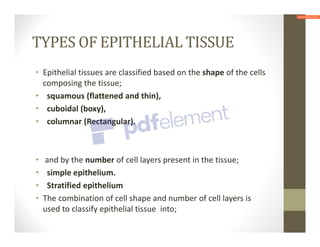
• Epithelial tissues are classified based on the shape of the cells
composing the tissue;
• squamous (flattened and thin),
• cuboidal (boxy),
• columnar (Rectangular).
• and by the number of cell layers present in the tissue;
• simple epithelium.
• Stratified epithelium
• The combination of cell shape and number of cell layers is
used to classify epithelial tissue into;
Inner walls of blood vessels
& alveoli of lung
Kidney tubules and duct of
glands
Location
Location
Location GIT and female reproductive tract
Mouth and oesophagus
Simple epithelium
• Simple squamous epithelium: it appears as thin scales. The
nuclei appears flat, horizontal, and elliptical. It’s found lining
the inner wall of blood vessels(providing smooth surface that
reduces friction as blood passes through) and the small air
sacs(alveoli) of the lung.
• Simple cuboidal epithelium: it appears as box-like cells, having
a round nucleus that is generally located near the center of the
cell. It’s involved in secretion and absorptions of molecules.
These epithelia are observed in the lining of the kidney tubules
and in the ducts of glands.
Simple epithelium contd.
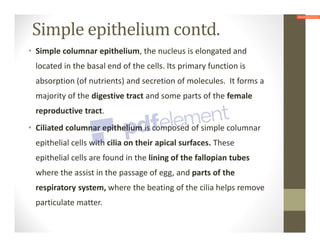
• Simple columnar epithelium, the nucleus is elongated and
located in the basal end of the cells. Its primary function is
absorption (of nutrients) and secretion of molecules. It forms a
majority of the digestive tract and some parts of the female
reproductive tract.
• Ciliated columnar epithelium is composed of simple columnar
epithelial cells with cilia on their apical surfaces. These
epithelial cells are found in the lining of the fallopian tubes
where the assist in the passage of egg, and parts of the
respiratory system, where the beating of the cilia helps remove
particulate matter.
Stratified epithelium
• Stratified squamous epithelium; consists of multiple layers with
squamous cells at the apical surface whereas the basal layer
contains either columnar or cuboidal cells. Its primary function
is protection from abrasion, found in areas like mouth and
oesophagus
• The apical layer may be covered with layer of dead keratin filled
cells. The skin is an example of a keratinized, stratified
squamous epithelium. Alternatively, the lining of the
mouth/oral cavity is an example of an unkeratinized, stratified
squamous epithelium.
• Stratified cuboidal epithelium and stratified columnar
epithelium can also be found in certain glands (sweat glands,
mammary glands, and salivary glands), but are relatively rare in
the human body.
• Pseudo stratified columnar epithelium
• it appears to be stratified but instead consists of a single
layer of irregularly shaped and differently sized columnar
cells.
• Pseudostratified columnar epithelium is found in the
respiratory tract, where some of these cells have cilia.
CONNECTIVE TISSUE
• Connective tissue ranges from vascular to avascular
• These tissues are hard as a bone or has fluid like structure as of
blood.
• Cells called Fibroblasts are found in all types of connective tissue
and are scattered in a matrix. This matrix is called intercellular
matrix or extracellular matrix.
• The matrix consists of fibers and ground substance (solid,
semisolid, viscous). The most abundant fiber in connective tissues is
a tough protein called collagen
• Location; it is present between different tissue and organs.
• functions :
• It supports and connects (binds) other tissues
• Transporting fluids and other dissolved materials
• Protecting organs
• Storing energy
• Defending the body from micro organisms
TYPES OF CONNECTIVE TISSUE
• Areolar (loose) connective tissue.
• Adipose tissue (fat).
• Dense irregular connective tissue.
• Dense regular connective tissue.
• Cartilage (gristle).
• Bone (osseous tissue).
• Blood
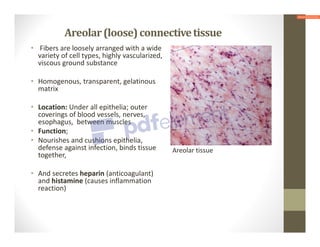
Areolar(loose)connectivetissue
• Fibers are loosely arranged with a wide
variety of cell types, highly vascularized,
viscous ground substance
• Homogenous, transparent, gelatinous
matrix
• Location: Under all epithelia; outer
coverings of blood vessels, nerves,
esophagus, between muscles
• Function;
• Nourishes and cushions epithelia,
defense against infection, binds tissue
together,
• And secretes heparin (anticoagulant)
and histamine (causes inflammation
reaction)
Areolar tissue
Adipose tissue (fat).
• Large fat-filled adipocytes and scanty extracellular matrix.
• Location: Beneath skin; around kidneys, heart, and eyes;
breast; abdominal membranes
• Function: Stores energy, conserves body heat, cushions and
protects many organs, fills space, shapes body
•
Dense irregular connective tissue
• Densely spaced, randomly arranged fibers
and fibroblasts. Highly vascularized
• Location: Dermis of skin, around liver,
spleen, and other organs
• Function: Toughness; protects organs from
injury; provides protective capsules
(covering) around many organs
Dense regularconnectivetissue.
•Densely spaced, parallel collagen fibers
and fibroblasts. Reducibly vascularized
•Location: Tendons and Ligaments
•Function: Binds bones
together(ligaments) and attaches
muscle to bone(tendons); transfers
force from muscle to bone
Cartilage (gristle)
• Cartilage is made up of highly specialized cells
called chondrocytes and chondroblasts ( chondro refers to
cartilage),
• and other extracellular material which forms the cartilage
matrix which is semi solid
• Location: External ear, larynx, rings around trachea, joint
surfaces and growth zones of bones, between ribs
• Function: Eases joint movements; resists compression at
joints; holds airway open; shapes outer ear; moves vocal
cords; forerunner of fetal skeleton; growth zone of children's
bones
Bone (osseous tissue).
• Widely spaced cells called osteocytes in lacunae; much of
matrix in concentric onion like layers; hard mineralized matrix.
• Location: Skeleton
• Function: Physically supports body, provides movement,
encloses and protects soft organs, stores and releases calcium
and phosphorus
Bone (Osseous tissue)
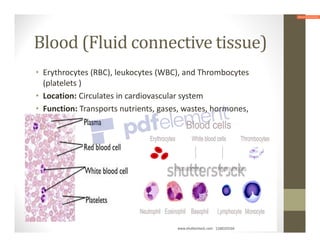
Blood (Fluid connective tissue)
• Erythrocytes (RBC), leukocytes (WBC), and Thrombocytes
(platelets )
• Location: Circulates in cardiovascular system
• Function: Transports nutrients, gases, wastes, hormones,
MUSCLE TISSUE
• It is characterized by properties that allow movement.
• Muscle cells respond to a stimulus and are contractile
• Muscles are made up of highly specialized thin and elongated
cells called muscle fibres
• The muscle fibres contains specialized cytoplasm called
sarcoplasm that contain network of the membrane called
sarcoplasmic reticulum.
• The muscle fibres may be bounded by the cell membrane
called sarcolemma.
• Each muscle fibre may contain numerous longitudinal fibrils
called myofibrils
• Muscle tissue is classified into three types according to
structure and function:
• Skeletal,cardiac, and smooth
Skeletal muscle
• Structure: Long cylindrical fiber, striated, many peripherally
located nuclei
• is arranged in bundles surrounded by connective tissue.
• Location: Attached to bones and around entry & exit sites of
body (e.g., mouth, anus)
• Function: Voluntary movement (its contraction makes possible
locomotion, facial expressions, posture,), produces heat,
protects organs
Cardiac Muscle
• Structure: Short, branched (Y-Shaped), striated, single central
nucleus
• Location: Heart
• Function: Contracts to pump blood through the heart by
alternate contraction and relaxation
Smooth Muscle
• Short, spindle-shaped, not striated, single nucleus in each
fiber and centrally located
• Location; Walls of major organs and passageways
• Function; Involuntary movement, moves food along the GIT,
involuntary control of respiration, moves secretions, regulates
flow of blood in arteries by contraction
NERVOUS TISSUE
• Nervous tissue is the main tissue component of the two parts
of the nervous system; the brain and spinal cord of the
central nervous system (CNS), and
• the branching peripheral nerves of the peripheral nervous
system (PNS), which regulates and controls bodily functions
and activity.
• It’s characterized as being excitable and capable of sending
and receiving electrochemical signals that provide the body
with information.
• Two main classes of cells make up nervous tissue:
the neuron and neuroglia
Neuron
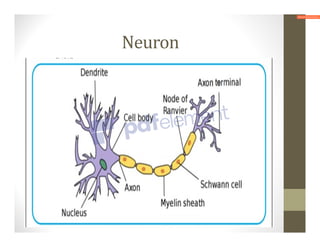
• Neurons secrete chemical substances(neurotrnsmitters)
which are responsible for stimulating other neurons as a
result of a stimuli
• The cell body is the enlarged portion of the neurons that
contains the nucleus. It is the “nutritional centre” of the
neuron where macromolecules are produced.
• Dendrites (from the Greek dendron = tree branch) are thin,
branched processes or structure that extend from the
cytoplasm of the cell body. Dendrites provide a receptive
area that transmits electrical impulses to the cell body.
• The axon is a longer process that conducts impulses away
from the cell body.
Neuron
Neuroglia
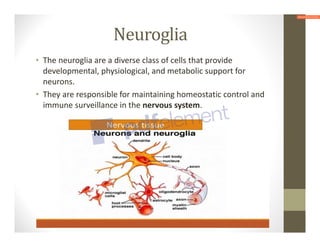
• The neuroglia are a diverse class of cells that provide
developmental, physiological, and metabolic support for
neurons.
• They are responsible for maintaining homeostatic control and
immune surveillance in the nervous system.

Mammalian tissues

  • 1.
    BIO 231(Cell biology& Histology) The study of Mammalian tissues Emphasizing on structure and function DEPARTMENT OF BIOLOGICAL SCIENCES FEDERAL UNIVERSITY DUTSIN-MA BY RUQAYYA ADAM
  • 2.
    Introduction • Tissue isa group cells which work together to perform particular functions . • The branch of biology that deals with the study of detailed structure, chemical composition and function of tissue is known as histology coined by Mayer
  • 3.
    TYPES OF MAMMALIANTISSUE •Epithelial tissue •Connective tissue •Muscle tissue •Nervous tissue
  • 4.
    EPITHELIAL TISSUE • Epithelialtissue forms the outer lining of body surfaces and cavities as well as form glands • The cells of the tissues are tightly connected to each other via cellular junctions • It is non vascular( has no blood vessels) and are dependent upon the underlying connective tissue for nutrients • It is found on the edges of organs, hence has two distinct surfaces. • The apical surface/layer is exposed to the body cavity or exterior • The basal surface/layer is adjacent to the underlying tissue • It functions in protecting the internal organs from mechanical injury, invasive microbes and fluid loss
  • 5.
    TYPES OF EPITHELIALTISSUE • Epithelial tissues are classified based on the shape of the cells composing the tissue; • squamous (flattened and thin), • cuboidal (boxy), • columnar (Rectangular). • and by the number of cell layers present in the tissue; • simple epithelium. • Stratified epithelium • The combination of cell shape and number of cell layers is used to classify epithelial tissue into;
  • 6.
    Inner walls ofblood vessels & alveoli of lung Kidney tubules and duct of glands Location Location Location GIT and female reproductive tract Mouth and oesophagus
  • 7.
    Simple epithelium • Simplesquamous epithelium: it appears as thin scales. The nuclei appears flat, horizontal, and elliptical. It’s found lining the inner wall of blood vessels(providing smooth surface that reduces friction as blood passes through) and the small air sacs(alveoli) of the lung. • Simple cuboidal epithelium: it appears as box-like cells, having a round nucleus that is generally located near the center of the cell. It’s involved in secretion and absorptions of molecules. These epithelia are observed in the lining of the kidney tubules and in the ducts of glands.
  • 8.
    Simple epithelium contd. •Simple columnar epithelium, the nucleus is elongated and located in the basal end of the cells. Its primary function is absorption (of nutrients) and secretion of molecules. It forms a majority of the digestive tract and some parts of the female reproductive tract. • Ciliated columnar epithelium is composed of simple columnar epithelial cells with cilia on their apical surfaces. These epithelial cells are found in the lining of the fallopian tubes where the assist in the passage of egg, and parts of the respiratory system, where the beating of the cilia helps remove particulate matter.
  • 9.
    Stratified epithelium • Stratifiedsquamous epithelium; consists of multiple layers with squamous cells at the apical surface whereas the basal layer contains either columnar or cuboidal cells. Its primary function is protection from abrasion, found in areas like mouth and oesophagus • The apical layer may be covered with layer of dead keratin filled cells. The skin is an example of a keratinized, stratified squamous epithelium. Alternatively, the lining of the mouth/oral cavity is an example of an unkeratinized, stratified squamous epithelium. • Stratified cuboidal epithelium and stratified columnar epithelium can also be found in certain glands (sweat glands, mammary glands, and salivary glands), but are relatively rare in the human body.
  • 10.
    • Pseudo stratifiedcolumnar epithelium • it appears to be stratified but instead consists of a single layer of irregularly shaped and differently sized columnar cells. • Pseudostratified columnar epithelium is found in the respiratory tract, where some of these cells have cilia.
  • 11.
    CONNECTIVE TISSUE • Connectivetissue ranges from vascular to avascular • These tissues are hard as a bone or has fluid like structure as of blood. • Cells called Fibroblasts are found in all types of connective tissue and are scattered in a matrix. This matrix is called intercellular matrix or extracellular matrix. • The matrix consists of fibers and ground substance (solid, semisolid, viscous). The most abundant fiber in connective tissues is a tough protein called collagen • Location; it is present between different tissue and organs. • functions : • It supports and connects (binds) other tissues • Transporting fluids and other dissolved materials • Protecting organs • Storing energy • Defending the body from micro organisms
  • 12.
    TYPES OF CONNECTIVETISSUE • Areolar (loose) connective tissue. • Adipose tissue (fat). • Dense irregular connective tissue. • Dense regular connective tissue. • Cartilage (gristle). • Bone (osseous tissue). • Blood
  • 13.
    Areolar(loose)connectivetissue • Fibers areloosely arranged with a wide variety of cell types, highly vascularized, viscous ground substance • Homogenous, transparent, gelatinous matrix • Location: Under all epithelia; outer coverings of blood vessels, nerves, esophagus, between muscles • Function; • Nourishes and cushions epithelia, defense against infection, binds tissue together, • And secretes heparin (anticoagulant) and histamine (causes inflammation reaction) Areolar tissue
  • 14.
    Adipose tissue (fat). •Large fat-filled adipocytes and scanty extracellular matrix. • Location: Beneath skin; around kidneys, heart, and eyes; breast; abdominal membranes • Function: Stores energy, conserves body heat, cushions and protects many organs, fills space, shapes body •
  • 15.
    Dense irregular connectivetissue • Densely spaced, randomly arranged fibers and fibroblasts. Highly vascularized • Location: Dermis of skin, around liver, spleen, and other organs • Function: Toughness; protects organs from injury; provides protective capsules (covering) around many organs
  • 16.
    Dense regularconnectivetissue. •Densely spaced,parallel collagen fibers and fibroblasts. Reducibly vascularized •Location: Tendons and Ligaments •Function: Binds bones together(ligaments) and attaches muscle to bone(tendons); transfers force from muscle to bone
  • 18.
    Cartilage (gristle) • Cartilageis made up of highly specialized cells called chondrocytes and chondroblasts ( chondro refers to cartilage), • and other extracellular material which forms the cartilage matrix which is semi solid • Location: External ear, larynx, rings around trachea, joint surfaces and growth zones of bones, between ribs • Function: Eases joint movements; resists compression at joints; holds airway open; shapes outer ear; moves vocal cords; forerunner of fetal skeleton; growth zone of children's bones
  • 20.
    Bone (osseous tissue). •Widely spaced cells called osteocytes in lacunae; much of matrix in concentric onion like layers; hard mineralized matrix. • Location: Skeleton • Function: Physically supports body, provides movement, encloses and protects soft organs, stores and releases calcium and phosphorus
  • 21.
  • 22.
    Blood (Fluid connectivetissue) • Erythrocytes (RBC), leukocytes (WBC), and Thrombocytes (platelets ) • Location: Circulates in cardiovascular system • Function: Transports nutrients, gases, wastes, hormones,
  • 23.
    MUSCLE TISSUE • Itis characterized by properties that allow movement. • Muscle cells respond to a stimulus and are contractile • Muscles are made up of highly specialized thin and elongated cells called muscle fibres • The muscle fibres contains specialized cytoplasm called sarcoplasm that contain network of the membrane called sarcoplasmic reticulum. • The muscle fibres may be bounded by the cell membrane called sarcolemma. • Each muscle fibre may contain numerous longitudinal fibrils called myofibrils • Muscle tissue is classified into three types according to structure and function: • Skeletal,cardiac, and smooth
  • 25.
    Skeletal muscle • Structure:Long cylindrical fiber, striated, many peripherally located nuclei • is arranged in bundles surrounded by connective tissue. • Location: Attached to bones and around entry & exit sites of body (e.g., mouth, anus) • Function: Voluntary movement (its contraction makes possible locomotion, facial expressions, posture,), produces heat, protects organs
  • 26.
    Cardiac Muscle • Structure:Short, branched (Y-Shaped), striated, single central nucleus • Location: Heart • Function: Contracts to pump blood through the heart by alternate contraction and relaxation
  • 27.
    Smooth Muscle • Short,spindle-shaped, not striated, single nucleus in each fiber and centrally located • Location; Walls of major organs and passageways • Function; Involuntary movement, moves food along the GIT, involuntary control of respiration, moves secretions, regulates flow of blood in arteries by contraction
  • 28.
    NERVOUS TISSUE • Nervoustissue is the main tissue component of the two parts of the nervous system; the brain and spinal cord of the central nervous system (CNS), and • the branching peripheral nerves of the peripheral nervous system (PNS), which regulates and controls bodily functions and activity. • It’s characterized as being excitable and capable of sending and receiving electrochemical signals that provide the body with information. • Two main classes of cells make up nervous tissue: the neuron and neuroglia
  • 29.
    Neuron • Neurons secretechemical substances(neurotrnsmitters) which are responsible for stimulating other neurons as a result of a stimuli • The cell body is the enlarged portion of the neurons that contains the nucleus. It is the “nutritional centre” of the neuron where macromolecules are produced. • Dendrites (from the Greek dendron = tree branch) are thin, branched processes or structure that extend from the cytoplasm of the cell body. Dendrites provide a receptive area that transmits electrical impulses to the cell body. • The axon is a longer process that conducts impulses away from the cell body.
  • 30.
  • 31.
    Neuroglia • The neurogliaare a diverse class of cells that provide developmental, physiological, and metabolic support for neurons. • They are responsible for maintaining homeostatic control and immune surveillance in the nervous system.