Represented by- Pawan Kumar Sahu
Periodic classification of
elements
Introduction
 At present, 118 elements are known to us.All these have
different properties. Out of these 118, only 94 are naturally
occurring.
Making order out of chaos (disorder)- Early attempts
at the classification of elements (History):
 The earliest attempt to classify the elements result in grouping
then known elements as metals and non-metals.
 Later further classification were tried out as our knowledge of
elements and their properties increased.
 Döbereiner's triads (groups):
 In the year 1817, JohannWolfgang Döbereiner, a German
chemist, tried to arrange the elements with similar properties
into groups.
Introduction (Döbereiner's triads)
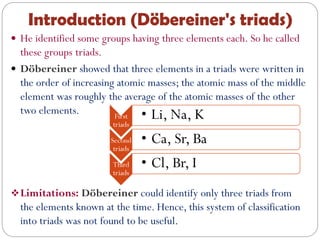
 He identified some groups having three elements each. So he called
these groups triads.
 Döbereiner showed that three elements in a triads were written in
the order of increasing atomic masses; the atomic mass of the middle
element was roughly the average of the atomic masses of the other
two elements.
Limitations: Döbereiner could identify only three triads from
the elements known at the time. Hence, this system of classification
into triads was not found to be useful.
First
triads
• Li, Na, K
Second
triads
• Ca, Sr, Ba
Third
triads
• Cl, Br, I
Newland’s law of octaves
 The attempts of Döbereiner encouraged other chemists to
correlate the properties of elements with their atomic
masses.
 In 1866, John Newland an English scientist, arranged the then
known elements in the order of increasing atomic masses.
 He started with the element having the lowest atomic mass
(Hydrogen) and ended a Thorium which was the 56th element.
 He found that every eight elements had properties to similar that of
the first.
 He compared this to the octaves found in the music.Therefore, He
called it the “Law of Octaves”. It is known as ‘Newlands law of
octaves’.
Newland’s law of octaves
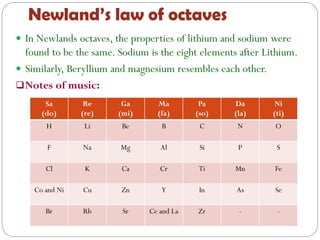
 In Newlands octaves, the properties of lithium and sodium were
found to be the same. Sodium is the eight elements after Lithium.
 Similarly, Beryllium and magnesium resembles each other.
Notes of music:
Sa
(do)
Re
(re)
Ga
(mi)
Ma
(fa)
Pa
(so)
Da
(la)
Ni
(ti)
H Li Be B C N O
F Na Mg Al Si P S
Cl K Ca Cr Ti Mn Fe
Co and Ni Cu Zn Y In As Se
Br Rb Sr Ce and La Zr - -
Limitation of law of octaves
 It was found that the law of octaves was applicable only upto calcium, as
after Ca every eight element did not possess properties similar to that
of the first.
 It was assumed by Newlands that only 56 elements existed in nature
and no more elements would be discovered in the future.
 But, later on, several new elements were discovered, whose properties
did not fit into the law of octaves.
 In order to fit elements into his table, Newlands adjusted two elements
in the same slot, but also put same unlike elements under the same
note.
 Co and Ni are in the same slot and these are placed in the same column
as F, Cl and Br which have very different properties than these
elements.
 Thus, Newton’s law of octaves worked well with lighter
elements only.
Mendeleev's Periodic Table
 Even after the rejection of Newland’s law of octaves, many scientist
continued to search for a pattern that correlated the properties of
elements with their atomic masses.
 The main credit for classifying elements goes to Dmitri Ivanovich
Mendeleev, a Russian chemist.
 He was the most important contributor to the early development of
PeriodicTables of elements where in the elements were arranged
on the basis of their fundamental property, the atomic masses and
also on the similarity of chemical properties.
 When Mendeleev started his work, 63 elements were known.
 He examined the relationship between the atomic masses of the
elements and their physical and chemical properties.
 Among chemical properties, Mendeleev concentrated on the
compounds formed by elements with oxygen and hydrogen.
 He selected Hydrogen and Oxygen as they are very reactive and
formed compounds with most elements.
 The formulae of hydrides and oxides formed by an element
were treated as one of the basic properties of an element for
its classification;
 He then took 63 cards and on each cards, He wrote down the properties
of one element.
 He sorted out of the elements with similar properties and pinned the
cards together on the wall.
 He observed that most of the elements got a place in periodic table and
were arranged in the order of their increasing atomic masses.
 It was also observed that there occurs a periodic recurrence of elements
with similar physical and chemical properties.
 On the basis, Mendeleev’s formulated a periodic law, which that ‘the
properties of elements are the periodic function (similar
characteristics) of atomic masses’.
 Mendeleev’s PeriodicTable contains vertical columns called
‘groups’ and horizontal rows called ‘periods’.
Notes
 Mendeleev’s PeriodicTable was published in a German
journal in 1872.
 In the formula for oxides and hydrides at the top of the
column the letter ‘R’ is used to represent any of the
elements in the group.
Note the way of formulae written;
For example: The hydrides of carbon, CH4 is written as
RH4 and the oxide CO2, as RO2.
Achievements of Mendeleev’s
Periodic Table
 While developing periodic table, there were few instances where
Mendeleev’s had to place an element with a slightly greater atomic
mass before an element with a slightly lower atomic mass.
 The sequence was inverted so that elements with similar properties
could be grouped together.
For examples: Co (Atomic mass 58.9) appeared before Ni
(Atomic mass 58.7)
 Further, Mendeleev’s left some gaps in his periodic table. Instead of
looking upon these gaps as defects.
 Mendeleev’s boldly predicted the existence of some elements that
had not been discovered at that time.
 Mendeleev’s named them by prefixing a Sanskrit numeral, Eka
(one) to the name of preceeding element in the same group.
 For instance, Scandium, Gallium, and Germanium, discarded
later, have properties similar to Eka-Boron, Eka-Aluminium and
Eka-Silicon respectively.
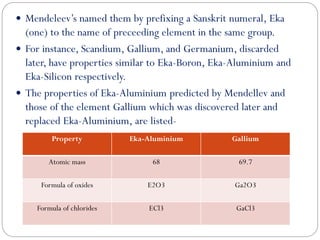
 The properties of Eka-Aluminium predicted by Mendellev and
those of the element Gallium which was discovered later and
replaced Eka-Aluminium, are listed-
Property Eka-Aluminium Gallium
Atomic mass 68 69.7
Formula of oxides E2O3 Ga2O3
Formula of chlorides ECl3 GaCl3
Achievements of Mendeleev’s
Periodic Table
 Nobel gases like He, Ne andAr have been mentioned in many
a context before this.
 These gases were discovered very late because they are inert
and present in extremely low concentrations in our
atmosphere.
 One of the strengths of Mendeleev’s PeriodicTable was that,
when these gases were discovered, they could be placed in a
new group without disturbing the existence order.
Limitations of Mendeleev’s Classification
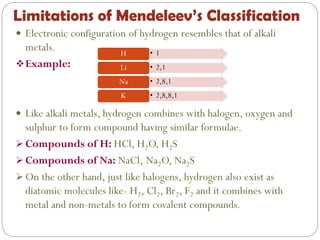
 Electronic configuration of hydrogen resembles that of alkali
metals.
Example:
 Like alkali metals, hydrogen combines with halogen, oxygen and
sulphur to form compound having similar formulae.
 Compounds of H: HCl, H2O, H2S
 Compounds of Na: NaCl, Na2O, Na2S
 On the other hand, just like halogens, hydrogen also exist as
diatomic molecules like- H2, Cl2, Br2, F2 and it combines with
metal and non-metals to form covalent compounds.
• 1H
• 2,1Li
• 2,8,1Na
• 2,8,8,1K
Limitations of Mendeleev’s Classification
 Certainly, no fixed position can be given to hydrogen in the given
periodic table.This was the first limitation of Mendeleev’s Periodic
Table.
 He could not assign to correct position to hydrogen in his table.
 Isotopes were discovered long after Mendeleev had proposed his
periodic classification of elements. Let us recall that isotopes of an
element have similar chemical properties, but different atomic
masses.
1H1
1H2
1H3 and Cl35 Cl37
Demerits
 Thus, isotopes of all elements posed a challenge to Mendeleev’s
PeriodicTable.
 Another problem was that the atomic mass don not increase in a
regular manner in going from one elements to the next.
 So it was not possible to predict how many elements could be
discovered between two elements- especially when we consider
the heavier elements.
The Modern Periodic Table
 In 1913, Henry Mosely showed that atomic number (symbolised as
z) of an element is a more fundamental property than its atomic
mass.
 Accordingly, Mendeleev’s Periodic Law was modified and atomic
number was adopted as the basis of Modern PeriodicTable.
Modern Periodic Law can be stated as follows:
 ‘Properties of elements are a periodic function of their atomic
number’.
• Let us recall that atomic number gives the number protons in the
nucleus of an atom and this number increases by one in going from
one element to the next.
• Elements, when arranged in order of increasing atomic number,
lead us to the classification known as the Modern PeriodicTable.
The Modern Periodic Table
 Prediction of properties of elements could be made with more
precision when elements were arranged on the basis of increasing
atomic number.
 The anomalous position of hydrogen can be discussed after we see
what are the bases on which the position of an element in the
Modern PeriodicTable depends.
Position of elements in the Modern PeriodicTable:
 The Modern PeriodicTable has 18 vertical columns know as
‘groups’ (Electronic configuration) and 7 horizontal rows
known as ‘periods’ (shell).
Trends in the Modern PeriodicTable:
Valency: As you know, the valency of an element is determined by
the number of valence electrons present in the outermost shell
of its atom.
The Modern Periodic Table
 Notes: The valency of atom is equal to the number of electrons in
the outer shell if that number is 4 or less. Otherwise,
Valency= 8 – number of electrons in the outer shell
 Once you have know the number of electrons, you can easily
calculated the valency.
Atomic size:
 The term atomic size refers to the radius of an atom.
 The atomic size may be visualised as the distance between the centre
of the nucleus and the outermost shell of an isolated atom.
When down a group Atomic number increases, shell number
increase, radius increases
For e.g.; Li3, Be4, B5, C6, N7, O8
152 111 88 77 74 66
The Modern Periodic Table
 You will see that atomic radius decreases in moving from left to
right along a period.
 This is due to an increase in nuclear charge (electron and proton)
which ends to pull the electrons closer to the nucleus and reduces
the size of atom.
 You will see that the atomic size increases down the group.This is
because new shells are being added as we go down the group.
 This increases the distance between the outermost electrons and
the nucleus so that the atomic size increases in spite of the increase
in nuclear charge.
Metallic and Non-Metallic Property
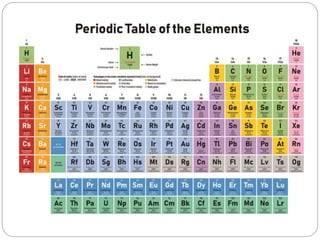
 As we can see, the metals like Na and Mg are towards left-
hand side of the PeriodicTable while the non-metals like S and
Cl are found on the right-hand side.
 In the middle, we have Si which is classified as a semi-metal or
metalloid because it exhibits some properties of both metals and
non-metals.
 In the Modern PeriodicTable, a Zigzag line separates metals from
non-metals.
 The borderline elements- B, Si, Ge,As,Te and Po are
intermediate in properties and are called metalloids or semi-metals.
 Metals tend to lose electrons while forming bonds i.e., they are
electro positive in nature.
 As the effective nuclear charge acting on the valence shell electrons
increases across a period, the tendency to lose electrons will decrease.
Metallic and Non-Metallic Property
 Down the group, the effective nuclear charge experienced by
valence electrons decreasing the outermost electrons are farthest
away from the nucleus.Therefore, these can be lost easily.
 Hence metallic character decreases across a period and
increases down a group.
 Non-metals, on the other hand, are electro negative. They
tend to form bond by gaining electrons.
 As the trends in the electro-negativity show, non-metals are found
the right-hand side of the PeriodicTable towards the top.
Periodic Classification of Elements

Periodic Classification of Elements

  • 1.
    Represented by- PawanKumar Sahu Periodic classification of elements
  • 2.
    Introduction  At present,118 elements are known to us.All these have different properties. Out of these 118, only 94 are naturally occurring. Making order out of chaos (disorder)- Early attempts at the classification of elements (History):  The earliest attempt to classify the elements result in grouping then known elements as metals and non-metals.  Later further classification were tried out as our knowledge of elements and their properties increased.  Döbereiner's triads (groups):  In the year 1817, JohannWolfgang Döbereiner, a German chemist, tried to arrange the elements with similar properties into groups.
  • 3.
    Introduction (Döbereiner's triads) He identified some groups having three elements each. So he called these groups triads.  Döbereiner showed that three elements in a triads were written in the order of increasing atomic masses; the atomic mass of the middle element was roughly the average of the atomic masses of the other two elements. Limitations: Döbereiner could identify only three triads from the elements known at the time. Hence, this system of classification into triads was not found to be useful. First triads • Li, Na, K Second triads • Ca, Sr, Ba Third triads • Cl, Br, I
  • 4.
    Newland’s law ofoctaves  The attempts of Döbereiner encouraged other chemists to correlate the properties of elements with their atomic masses.  In 1866, John Newland an English scientist, arranged the then known elements in the order of increasing atomic masses.  He started with the element having the lowest atomic mass (Hydrogen) and ended a Thorium which was the 56th element.  He found that every eight elements had properties to similar that of the first.  He compared this to the octaves found in the music.Therefore, He called it the “Law of Octaves”. It is known as ‘Newlands law of octaves’.
  • 5.
    Newland’s law ofoctaves  In Newlands octaves, the properties of lithium and sodium were found to be the same. Sodium is the eight elements after Lithium.  Similarly, Beryllium and magnesium resembles each other. Notes of music: Sa (do) Re (re) Ga (mi) Ma (fa) Pa (so) Da (la) Ni (ti) H Li Be B C N O F Na Mg Al Si P S Cl K Ca Cr Ti Mn Fe Co and Ni Cu Zn Y In As Se Br Rb Sr Ce and La Zr - -
  • 6.
    Limitation of lawof octaves  It was found that the law of octaves was applicable only upto calcium, as after Ca every eight element did not possess properties similar to that of the first.  It was assumed by Newlands that only 56 elements existed in nature and no more elements would be discovered in the future.  But, later on, several new elements were discovered, whose properties did not fit into the law of octaves.  In order to fit elements into his table, Newlands adjusted two elements in the same slot, but also put same unlike elements under the same note.  Co and Ni are in the same slot and these are placed in the same column as F, Cl and Br which have very different properties than these elements.  Thus, Newton’s law of octaves worked well with lighter elements only.
  • 7.
    Mendeleev's Periodic Table Even after the rejection of Newland’s law of octaves, many scientist continued to search for a pattern that correlated the properties of elements with their atomic masses.  The main credit for classifying elements goes to Dmitri Ivanovich Mendeleev, a Russian chemist.  He was the most important contributor to the early development of PeriodicTables of elements where in the elements were arranged on the basis of their fundamental property, the atomic masses and also on the similarity of chemical properties.  When Mendeleev started his work, 63 elements were known.  He examined the relationship between the atomic masses of the elements and their physical and chemical properties.  Among chemical properties, Mendeleev concentrated on the compounds formed by elements with oxygen and hydrogen.  He selected Hydrogen and Oxygen as they are very reactive and formed compounds with most elements.
  • 8.
     The formulaeof hydrides and oxides formed by an element were treated as one of the basic properties of an element for its classification;  He then took 63 cards and on each cards, He wrote down the properties of one element.  He sorted out of the elements with similar properties and pinned the cards together on the wall.  He observed that most of the elements got a place in periodic table and were arranged in the order of their increasing atomic masses.  It was also observed that there occurs a periodic recurrence of elements with similar physical and chemical properties.  On the basis, Mendeleev’s formulated a periodic law, which that ‘the properties of elements are the periodic function (similar characteristics) of atomic masses’.  Mendeleev’s PeriodicTable contains vertical columns called ‘groups’ and horizontal rows called ‘periods’.
  • 9.
    Notes  Mendeleev’s PeriodicTablewas published in a German journal in 1872.  In the formula for oxides and hydrides at the top of the column the letter ‘R’ is used to represent any of the elements in the group. Note the way of formulae written; For example: The hydrides of carbon, CH4 is written as RH4 and the oxide CO2, as RO2.
  • 10.
    Achievements of Mendeleev’s PeriodicTable  While developing periodic table, there were few instances where Mendeleev’s had to place an element with a slightly greater atomic mass before an element with a slightly lower atomic mass.  The sequence was inverted so that elements with similar properties could be grouped together. For examples: Co (Atomic mass 58.9) appeared before Ni (Atomic mass 58.7)  Further, Mendeleev’s left some gaps in his periodic table. Instead of looking upon these gaps as defects.  Mendeleev’s boldly predicted the existence of some elements that had not been discovered at that time.
  • 11.
     Mendeleev’s namedthem by prefixing a Sanskrit numeral, Eka (one) to the name of preceeding element in the same group.  For instance, Scandium, Gallium, and Germanium, discarded later, have properties similar to Eka-Boron, Eka-Aluminium and Eka-Silicon respectively.  The properties of Eka-Aluminium predicted by Mendellev and those of the element Gallium which was discovered later and replaced Eka-Aluminium, are listed- Property Eka-Aluminium Gallium Atomic mass 68 69.7 Formula of oxides E2O3 Ga2O3 Formula of chlorides ECl3 GaCl3
  • 12.
    Achievements of Mendeleev’s PeriodicTable  Nobel gases like He, Ne andAr have been mentioned in many a context before this.  These gases were discovered very late because they are inert and present in extremely low concentrations in our atmosphere.  One of the strengths of Mendeleev’s PeriodicTable was that, when these gases were discovered, they could be placed in a new group without disturbing the existence order.
  • 13.
    Limitations of Mendeleev’sClassification  Electronic configuration of hydrogen resembles that of alkali metals. Example:  Like alkali metals, hydrogen combines with halogen, oxygen and sulphur to form compound having similar formulae.  Compounds of H: HCl, H2O, H2S  Compounds of Na: NaCl, Na2O, Na2S  On the other hand, just like halogens, hydrogen also exist as diatomic molecules like- H2, Cl2, Br2, F2 and it combines with metal and non-metals to form covalent compounds. • 1H • 2,1Li • 2,8,1Na • 2,8,8,1K
  • 14.
    Limitations of Mendeleev’sClassification  Certainly, no fixed position can be given to hydrogen in the given periodic table.This was the first limitation of Mendeleev’s Periodic Table.  He could not assign to correct position to hydrogen in his table.  Isotopes were discovered long after Mendeleev had proposed his periodic classification of elements. Let us recall that isotopes of an element have similar chemical properties, but different atomic masses. 1H1 1H2 1H3 and Cl35 Cl37
  • 15.
    Demerits  Thus, isotopesof all elements posed a challenge to Mendeleev’s PeriodicTable.  Another problem was that the atomic mass don not increase in a regular manner in going from one elements to the next.  So it was not possible to predict how many elements could be discovered between two elements- especially when we consider the heavier elements.
  • 16.
    The Modern PeriodicTable  In 1913, Henry Mosely showed that atomic number (symbolised as z) of an element is a more fundamental property than its atomic mass.  Accordingly, Mendeleev’s Periodic Law was modified and atomic number was adopted as the basis of Modern PeriodicTable. Modern Periodic Law can be stated as follows:  ‘Properties of elements are a periodic function of their atomic number’. • Let us recall that atomic number gives the number protons in the nucleus of an atom and this number increases by one in going from one element to the next. • Elements, when arranged in order of increasing atomic number, lead us to the classification known as the Modern PeriodicTable.
  • 17.
    The Modern PeriodicTable  Prediction of properties of elements could be made with more precision when elements were arranged on the basis of increasing atomic number.  The anomalous position of hydrogen can be discussed after we see what are the bases on which the position of an element in the Modern PeriodicTable depends. Position of elements in the Modern PeriodicTable:  The Modern PeriodicTable has 18 vertical columns know as ‘groups’ (Electronic configuration) and 7 horizontal rows known as ‘periods’ (shell). Trends in the Modern PeriodicTable: Valency: As you know, the valency of an element is determined by the number of valence electrons present in the outermost shell of its atom.
  • 18.
    The Modern PeriodicTable  Notes: The valency of atom is equal to the number of electrons in the outer shell if that number is 4 or less. Otherwise, Valency= 8 – number of electrons in the outer shell  Once you have know the number of electrons, you can easily calculated the valency. Atomic size:  The term atomic size refers to the radius of an atom.  The atomic size may be visualised as the distance between the centre of the nucleus and the outermost shell of an isolated atom. When down a group Atomic number increases, shell number increase, radius increases For e.g.; Li3, Be4, B5, C6, N7, O8 152 111 88 77 74 66
  • 19.
    The Modern PeriodicTable  You will see that atomic radius decreases in moving from left to right along a period.  This is due to an increase in nuclear charge (electron and proton) which ends to pull the electrons closer to the nucleus and reduces the size of atom.  You will see that the atomic size increases down the group.This is because new shells are being added as we go down the group.  This increases the distance between the outermost electrons and the nucleus so that the atomic size increases in spite of the increase in nuclear charge.
  • 20.
    Metallic and Non-MetallicProperty  As we can see, the metals like Na and Mg are towards left- hand side of the PeriodicTable while the non-metals like S and Cl are found on the right-hand side.  In the middle, we have Si which is classified as a semi-metal or metalloid because it exhibits some properties of both metals and non-metals.  In the Modern PeriodicTable, a Zigzag line separates metals from non-metals.  The borderline elements- B, Si, Ge,As,Te and Po are intermediate in properties and are called metalloids or semi-metals.  Metals tend to lose electrons while forming bonds i.e., they are electro positive in nature.  As the effective nuclear charge acting on the valence shell electrons increases across a period, the tendency to lose electrons will decrease.
  • 21.
    Metallic and Non-MetallicProperty  Down the group, the effective nuclear charge experienced by valence electrons decreasing the outermost electrons are farthest away from the nucleus.Therefore, these can be lost easily.  Hence metallic character decreases across a period and increases down a group.  Non-metals, on the other hand, are electro negative. They tend to form bond by gaining electrons.  As the trends in the electro-negativity show, non-metals are found the right-hand side of the PeriodicTable towards the top.