Represented by- Radiate
Blood
Introduction
 Blood is a specialized connective tissue which is fluid in nature.
 The total volume of blood in the body is about 6 litre.
 The colour of blood opaque red.
 The taste is saltish, pH is alkaline (about 7.4).
 Blood is 5 times more viscous than water.
Function of blood
 There are following important function of blood;
1. Respiratory function: It transport oxygen to various tissue and
take a way the CO2 from the tissue.
2. Nutrition function: It carries nutritional substance to various
tissue of body.
3. Excretory function: Blood carries waste product from the tissues,
kidney, lungs and skin.
4. Immunological function: It protect the body from infection
because it contain antibodies andWBC.
5. It regulate the body temperature.
6. It carries the hormones from the endocrine gland to various
tissue of the body.
7. It protects against haemorrhage due to the function of clotting
of blood.
Composition of blood
 Blood contain fluid called plasma, in which cellular elements of blood are
suspended.
1. Plasma: (55%)
a) Water: (91-92%)
b) Solids: (7-9%)
i. Plasma proteins: (7%) [Albumin, Globulin and Fibrinogen]
ii. Inorganic substance:(0.9%) [Na, K, Ca, Mg, Fe & Cu etc.]
iii. Organic substance: [Proteins, non-protein nitrogenous substance like
Urea, Uric acid,Amino acid, Glucose, Fat, Hormones & various enzymes
etc.]
2. Cell: (45%)
I. RBC
II. WBC
III. Platelets
 Albumin:
 It is present in very high concentration.
 It produces the largest fraction of colloid osmotic pressure.
 It is synthesized in the liver.
 Globulin:
 It is a three types; alpha, beta and gamma.
 It is produced in lymphoid tissue.
 It produce antibodies and immune substance.
 Fibrinogen:
 It is responsible for coagulation of blood.
 Fibrinogen is produced by the liver and released into the blood along
with several other clotting factors (also called coagulation
factors).
Function of plasma protein
 They transport hormone, iron and other substance.
 They provide viscosity of blood (which helps in
maintaining blood pressure).
 Fibrinogen of plasma is necessary for blood clotting.
 Globulin of plasma is important for synthesis of immune
substance called antibodies.
Red Blood Corpuscles (RBC) or Erythrocytes
 They are circular, biconcave and disc shaped cells.They do not
have a nucleus.
 The size of RBC is 7.2 in diameter.
 They have respiratory pigment called haemoglobin.
 The normal RBC count is 4.5 to 5.5 millions per cubic mm in male
and 4 to 5.1 millions per cubic mm in female.
 Every second 2.5 millions RBC’s are produce and equal numbers are
destroy.
 RBC count is increase during muscular exercise, emotion in new born
children and in living in hilly people.
 RBC serve important function such as transport of oxygen and
maintain acid-base balance.
 They are synthesized in bone marrow found at the end of long and short
bone.
 The average life span of RBC is about 120 days.
Disorder of RBC
Polycythaemia: It is a condition where there is an
increase in number of RBC.
Anaemia: It is a condition where is decrease in a
number of RBC.
Erythropoiesis
 It is a process by which RBC is formed.The formation of
red cells from the red bone marrow is known as
Erythropoiesis.
 In the foetus, RBC are formed in the liver, spleen and
red bone marrow.
 In the infant, all the bones are filled with red bone
marrow, but at age advance red bone marrow replaced
by yellow bone marrow.
 In the adult, flat bone like sternum, ribs, vertebra,
cranial bones and proximal part of long bone
contain only red bone marrow.
Stage in the development of RBC’s
1. Proerythroblast:
 It is the first stage.
 It is a large cell having a nucleus.
 It does not have a haemoglobin initially.
 In the later stage haemoglobin start appearing.
2. Normoblast:
 It is the second stage.
 It is a smaller cell with a degenerated nucleus but
haemoglobin fully present.
Stage in the development of RBC’s
3. Reticulocytes:
 It is the third stage.
 It develop from the normoblast it contain haemoglobin
and reticulum it the cytoplasm.
4. Erythrocytes:
 It is the fourth stage.
 It is the fully developed RBC.
 It does not have reticulum but contain adequate
haemoglobin.
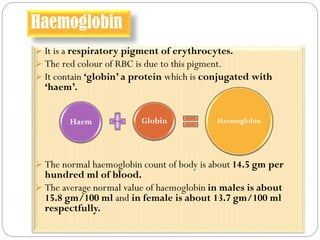
Haemoglobin
 It is a respiratory pigment of erythrocytes.
 The red colour of RBC is due to this pigment.
 It contain ‘globin’ a protein which is conjugated with
‘haem’.
 The normal haemoglobin count of body is about 14.5 gm per
hundred ml of blood.
 The average normal value of haemoglobin in males is about
15.8 gm/100 ml and in female is about 13.7 gm/100 ml
respectfully.
Haem Globin Haemoglobin
Function of haemoglobin
 It helps in transport of O2 and CO2 .
 It maintain acid-base balance.
 These are the function RBC too, because haemoglobin
is the integral part of RBC.
White Blood Corpuscles (WBC) or Leucocytes
 WBC are colourless cell containing nucleus.
 They have no haemoglobin in the cytoplasm.
 They are larger than RBC.
 They are about 8 to 15  in diameter.
 There are four thousand to nine thousandWBC in 13
mm of blood.
 WBC are fewer in number than RBC, with a ratio of about
1WBC to every 600-700 RBCs.
 The life span of WBC is about 13 to 20 days.
Classification of WBC
WBC are classified as:
WBC
Granulocytes
Neutrophils Eosinophils Basophils
Agranulocytes
Lymphocytes Monocytes
Classification of WBC
1. Granulocytes:
 TheseWBC’s have granules in the cytoplasm.
 They have a nucleus which contain two or more lobes.
 Granulocytes further classified as three types;
A. Neutrophils (Polymorphs):
 They contain granular cytoplasm which stains natural dyes.
 The nucleus may contain 2 to 5 lobes.
 Neutrophils occur to the extent of 65 to 70% of totalWBC.
B. Eosinophils (Acidophils):
 These cells are larger than neutrophils.
 The granules are coarse (rough) and closely packed.
 These granules stain in acidic dyes.
 The nucleus contain two lobes (Horse shoe shaped structure).
 Normal acidophils count is about 2 to 4% of totalWBC.
C. Basophils (Mast cells):
 They contain coarse granules as in eosinophils but these granules stain basic dyes.
 The nucleus is kidney shaped.
 Basophils count is 0.5% of totalWBC.
Classification of WBC
2. Agranulocytes:
 This type of WBC do not have a granules but they have a single
nucleus which is not lobed.
 They are further classified into;
A. Lymphocytes:
 They are two types;
i. Small lymphocytes:
 They occur to the extent of 25% of totalWBC’s.
 They are smaller in size with a nucleus so the cytoplasm is less.
ii. Large lymphocytes:
 They are larger lymphocytes so they contain more cytoplasm.
B. Monocytes:
 They are the largest ofWBC’s.
 They occur to the extent 2 to 4% ofWBC’s.
 The nucleus is kidney or bean shaped structure.
Function of WBC
 They protect against infection.This is done by
neutrophils and monocytes, which engulf bacteria.
This process is called as phagocytosis.
 They help in the repair of the injured tissue.
 They produced immune substance which defence
against disease.This is done by lymphocytes.
 Basophil secrete an anticoagulant substance called
heparin.
Platelets
 Platelets are spherical and oval shaped cells.
 They are 2 to 4  in diameter and ¼ size of RBC.
 Normal platelets count is 2 to 5 lakh per cubic mm of
blood.
 Platelets do not have a nucleus but cytoplasm contains
granules.
 They are synthesised by megakaryocytes (giant cells)
of bone marrow.
 The life span of platelets is about 8 to 14 days.
Function of platelets
 Thromboplastin liberate from platelets is essential for
clotting.
 They close minute lesions in the wall of blood vessels.
 They helps in body’s defence mechanism against
bacteria.
 They contain histamine and 5-hydroxy-tryptamin
(Serotonin) which is necessary for constriction of blood
vessels, so the bleeding after injury is reduced.
Clotting of blood (Coagulation of blood)
 Clotting of blood is a defence mechanism of the
body.
 It prevents loss of blood from the site of
injury.
 If a leaks develops in blood vessels, a clot is
formed and plug the leak.This prevent the
loss of blood.
Mechanism of clotting
Clotting of blood occur in the following stage;
Thromboplastin is liberate from disintegrated and
damage platelets.
Thromboplastin convert prothrombin into
thrombin, this occur in the presence of calcium ions.
Thrombin convert fibrinogen into fibrin.
The soluble fibrins forms threads and clot, which
prevents oozing of blood.
Mechanism of clotting
Tissue damage Thromboplastin
(haemorrhagic condition)
Ca2+
Prothrombin Thrombin
Ca2+
Fibrinogen Fibrin (clot)
Clotting factors
Factor 1 Fibrinogen
Factor 2 Prothrombin
Factor 3 Thromboplastin
Factor 4 Calcium
Factor 5 Quick’s labile factor
Factor 6 Existence of this factor not accepted
Factor 7 Quick’s stable factor
Factor 8 Antihemophilic factor
Factor 9 Christmas factor
Factor 10 Stuart power factor
Factor 11 Plasma thromboplastin antecedent
activators
Factor 12 Hageman factor
Factor 13 Fibrin stabilising factor
Disorders of blood
(Disorder of RBC)
A. Anemia:
 It is a disease of involving deficiency in number of RBC or deficiency of
hemoglobin.
 The symptoms of anemia is present in the form of the breathlessness, tiredness
and loss of appetite.
 The important types of anemia are;
1. Iron deficiency anemia
2. Megaloblastic anemia
3. Hemolytic anemia
4.Aplastic anemia
1. Iron deficiency anemia:
 This is also called as hypochromic, microcytic anaemia.
 In this type of anemia, there is deficiency of iron due to low dietary
intake and decreased absorption.
 Due to lack of iron, sufficient hemoglobin is not synthesized so this type
of anemia is produced.
2. Megaloblastic anemia:
 This is also called hyper chromic, macrocytic anemia.
 In this type of anemia occur due to deficiency of either vitamin B12 or
folic acid, both these are necessary for the maturation of RBC.
3. Hemolytic anemia:
 It occurs due to increased destruction of RBC.
 It occurs due to hereditary disorder, mechanical injury to RBC and
infection like malaria.
4. Aplastic anemia:
 It occurs due to the suppression of bone marrow function.
 It can be caused by drugs, chemicals, irradiation or malignant
disease.
Disorders of blood
(Disorder of RBC)
 Polycythemia:
 In this condition, there is abnormal increase in the number
of RBC.
 This increase the viscosity of blood and increase the
intravascular clotting, this decrease the rate of flow of
blood.
Disorders of WBC
1. Leucocytosis:
 In this condition, there is increase in the number of WBC beyond 10,000 per
cubic mm.
a. Neutrophilia:
 An increase in the number of neutophils.
 It occurs in many inflammatory condition.
b. Eosinophilia:
 An increase in the number of eosinophils.
 It is an indication for allergic manifestations.
c. Leukemia:
 It is a cancerous condition characterized by an overproduction ofWBC (more
than 50,000 cubic mm).
 Leukemia can occurs at any age but it is more common in childhood.
2. Leucopenia:
 It is a condition, there is an decreased in the number of WBC.
 It is produced by infection and some drugs.
 It may be called as neutropenia, lymphopenia and eosinopenia.
Disorders of platelets
 They occurs in the form of thrombocytopenia.
 It is a condition where there is decrease in the
platelets count.
Disorders of clotting
 Hemophilia:
 This disease is caused due to absence of Factor 8
(Antihemophilic factor).
 This disease occur mostly in men.
 But it is genetically transmitted through women.
 Women generally carry the genes but not disease.
 Here blood clot very slowly when there is an injury.
 Clotting time:
 It is the time taken for the clotting of human blood removed
from circulation.
 The average clotting time varies from 5 to 15 minutes.
Blood groups
 In early times, transfusion of blood from one person to another was
dangerous and unsuccessful.
 This is because, plasma of some individuals contain some
factors.
 These factors produce agglutination or haemolysis of the
erythrocytes of other persons.
 These reactions occur due to the presence of agglutinins and
agglutinogens in blood.
 Agglutinogens are present in erythrocytes.They are of two
types; A & B
 Agglutinins are present in plasma. They are of two types; a & b.
 Depending on the presence of these two substances, blood is
grouped as follows.
Blood groups
Group A contains A agglutinogen and b agglutinin.
Group B contains B agglutinogen and a agglutinin.
Group AB contains AB agglutinogens and no agglutinins.
Group O contains no agglutinogen but a & b agglutinins.
Blood groups
 Agglutination occur between the some type of agglutinogen
and agglutinin (e.g.- A and a).
 But no agglutination occurs between different types of
agglutinogen and agglutinin (e.g.- A and b).
 So it can be seen that Group O blood (contains no
agglutinogen) can match with all other blood groups.
 But this group of individuals can receive blood only from O
group and not from any other group.
 Individuals with O group of blood are called Universal donors.
 Individuals with blood group AB (contains no agglutinins) can
receive blood from all groups.
 They are called as (Universal recipients).
Blood groups
Blood group Agglutingens Agglutinins Receive Donate
A A b A,O A,AB
B B a B,O B,AB
AB A,B - A,B,AB,O AB
O - ab O A,B,AB,O
Rh factors
 It is another type of agglutinogen. It is called as Rhesus
factor (Rh factor) since it was first seen in Rhesus macaque.
 Rh +ve individuals have this factor but Rh –ve individuals do
not have this.
 The corresponding agglutinin is never present in the body,
but it is developed after the first exposure to the
agglutinogen.
 If a Rh +ve blood is given to a Rh –ve person, no
immediate reaction occurs.
 But during a second transfusion, the Rh –ve person
develops anti Rh agglutinin.This is further leads to
agglutination.
Erythroblastosis fetalis
 The foetus of a Rh –ve mother and Rh +ve father is
Rh +ve.
 If foetus is Rh +ve and the mother is Rh –ve, serious
complications may occur.
 Then the Rh antigen will travel from the foetus to
mother’s blood.
 Where these antibodies reach the foetus, they produce
severe hemolytic reactions.
 This condition is called as erythroblastosis fetalis.
Blood
Blood

Blood

  • 1.
  • 2.
    Introduction  Blood isa specialized connective tissue which is fluid in nature.  The total volume of blood in the body is about 6 litre.  The colour of blood opaque red.  The taste is saltish, pH is alkaline (about 7.4).  Blood is 5 times more viscous than water.
  • 3.
    Function of blood There are following important function of blood; 1. Respiratory function: It transport oxygen to various tissue and take a way the CO2 from the tissue. 2. Nutrition function: It carries nutritional substance to various tissue of body. 3. Excretory function: Blood carries waste product from the tissues, kidney, lungs and skin. 4. Immunological function: It protect the body from infection because it contain antibodies andWBC. 5. It regulate the body temperature. 6. It carries the hormones from the endocrine gland to various tissue of the body. 7. It protects against haemorrhage due to the function of clotting of blood.
  • 4.
    Composition of blood Blood contain fluid called plasma, in which cellular elements of blood are suspended. 1. Plasma: (55%) a) Water: (91-92%) b) Solids: (7-9%) i. Plasma proteins: (7%) [Albumin, Globulin and Fibrinogen] ii. Inorganic substance:(0.9%) [Na, K, Ca, Mg, Fe & Cu etc.] iii. Organic substance: [Proteins, non-protein nitrogenous substance like Urea, Uric acid,Amino acid, Glucose, Fat, Hormones & various enzymes etc.] 2. Cell: (45%) I. RBC II. WBC III. Platelets
  • 5.
     Albumin:  Itis present in very high concentration.  It produces the largest fraction of colloid osmotic pressure.  It is synthesized in the liver.  Globulin:  It is a three types; alpha, beta and gamma.  It is produced in lymphoid tissue.  It produce antibodies and immune substance.  Fibrinogen:  It is responsible for coagulation of blood.  Fibrinogen is produced by the liver and released into the blood along with several other clotting factors (also called coagulation factors).
  • 7.
    Function of plasmaprotein  They transport hormone, iron and other substance.  They provide viscosity of blood (which helps in maintaining blood pressure).  Fibrinogen of plasma is necessary for blood clotting.  Globulin of plasma is important for synthesis of immune substance called antibodies.
  • 8.
    Red Blood Corpuscles(RBC) or Erythrocytes  They are circular, biconcave and disc shaped cells.They do not have a nucleus.  The size of RBC is 7.2 in diameter.  They have respiratory pigment called haemoglobin.  The normal RBC count is 4.5 to 5.5 millions per cubic mm in male and 4 to 5.1 millions per cubic mm in female.  Every second 2.5 millions RBC’s are produce and equal numbers are destroy.  RBC count is increase during muscular exercise, emotion in new born children and in living in hilly people.  RBC serve important function such as transport of oxygen and maintain acid-base balance.  They are synthesized in bone marrow found at the end of long and short bone.  The average life span of RBC is about 120 days.
  • 10.
    Disorder of RBC Polycythaemia:It is a condition where there is an increase in number of RBC. Anaemia: It is a condition where is decrease in a number of RBC.
  • 11.
    Erythropoiesis  It isa process by which RBC is formed.The formation of red cells from the red bone marrow is known as Erythropoiesis.  In the foetus, RBC are formed in the liver, spleen and red bone marrow.  In the infant, all the bones are filled with red bone marrow, but at age advance red bone marrow replaced by yellow bone marrow.  In the adult, flat bone like sternum, ribs, vertebra, cranial bones and proximal part of long bone contain only red bone marrow.
  • 13.
    Stage in thedevelopment of RBC’s 1. Proerythroblast:  It is the first stage.  It is a large cell having a nucleus.  It does not have a haemoglobin initially.  In the later stage haemoglobin start appearing. 2. Normoblast:  It is the second stage.  It is a smaller cell with a degenerated nucleus but haemoglobin fully present.
  • 14.
    Stage in thedevelopment of RBC’s 3. Reticulocytes:  It is the third stage.  It develop from the normoblast it contain haemoglobin and reticulum it the cytoplasm. 4. Erythrocytes:  It is the fourth stage.  It is the fully developed RBC.  It does not have reticulum but contain adequate haemoglobin.
  • 15.
    Haemoglobin  It isa respiratory pigment of erythrocytes.  The red colour of RBC is due to this pigment.  It contain ‘globin’ a protein which is conjugated with ‘haem’.  The normal haemoglobin count of body is about 14.5 gm per hundred ml of blood.  The average normal value of haemoglobin in males is about 15.8 gm/100 ml and in female is about 13.7 gm/100 ml respectfully. Haem Globin Haemoglobin
  • 16.
    Function of haemoglobin It helps in transport of O2 and CO2 .  It maintain acid-base balance.  These are the function RBC too, because haemoglobin is the integral part of RBC.
  • 17.
    White Blood Corpuscles(WBC) or Leucocytes  WBC are colourless cell containing nucleus.  They have no haemoglobin in the cytoplasm.  They are larger than RBC.  They are about 8 to 15  in diameter.  There are four thousand to nine thousandWBC in 13 mm of blood.  WBC are fewer in number than RBC, with a ratio of about 1WBC to every 600-700 RBCs.  The life span of WBC is about 13 to 20 days.
  • 18.
    Classification of WBC WBCare classified as: WBC Granulocytes Neutrophils Eosinophils Basophils Agranulocytes Lymphocytes Monocytes
  • 19.
    Classification of WBC 1.Granulocytes:  TheseWBC’s have granules in the cytoplasm.  They have a nucleus which contain two or more lobes.  Granulocytes further classified as three types; A. Neutrophils (Polymorphs):  They contain granular cytoplasm which stains natural dyes.  The nucleus may contain 2 to 5 lobes.  Neutrophils occur to the extent of 65 to 70% of totalWBC. B. Eosinophils (Acidophils):  These cells are larger than neutrophils.  The granules are coarse (rough) and closely packed.  These granules stain in acidic dyes.  The nucleus contain two lobes (Horse shoe shaped structure).  Normal acidophils count is about 2 to 4% of totalWBC. C. Basophils (Mast cells):  They contain coarse granules as in eosinophils but these granules stain basic dyes.  The nucleus is kidney shaped.  Basophils count is 0.5% of totalWBC.
  • 20.
    Classification of WBC 2.Agranulocytes:  This type of WBC do not have a granules but they have a single nucleus which is not lobed.  They are further classified into; A. Lymphocytes:  They are two types; i. Small lymphocytes:  They occur to the extent of 25% of totalWBC’s.  They are smaller in size with a nucleus so the cytoplasm is less. ii. Large lymphocytes:  They are larger lymphocytes so they contain more cytoplasm. B. Monocytes:  They are the largest ofWBC’s.  They occur to the extent 2 to 4% ofWBC’s.  The nucleus is kidney or bean shaped structure.
  • 22.
    Function of WBC They protect against infection.This is done by neutrophils and monocytes, which engulf bacteria. This process is called as phagocytosis.  They help in the repair of the injured tissue.  They produced immune substance which defence against disease.This is done by lymphocytes.  Basophil secrete an anticoagulant substance called heparin.
  • 23.
    Platelets  Platelets arespherical and oval shaped cells.  They are 2 to 4  in diameter and ¼ size of RBC.  Normal platelets count is 2 to 5 lakh per cubic mm of blood.  Platelets do not have a nucleus but cytoplasm contains granules.  They are synthesised by megakaryocytes (giant cells) of bone marrow.  The life span of platelets is about 8 to 14 days.
  • 25.
    Function of platelets Thromboplastin liberate from platelets is essential for clotting.  They close minute lesions in the wall of blood vessels.  They helps in body’s defence mechanism against bacteria.  They contain histamine and 5-hydroxy-tryptamin (Serotonin) which is necessary for constriction of blood vessels, so the bleeding after injury is reduced.
  • 26.
    Clotting of blood(Coagulation of blood)  Clotting of blood is a defence mechanism of the body.  It prevents loss of blood from the site of injury.  If a leaks develops in blood vessels, a clot is formed and plug the leak.This prevent the loss of blood.
  • 28.
    Mechanism of clotting Clottingof blood occur in the following stage; Thromboplastin is liberate from disintegrated and damage platelets. Thromboplastin convert prothrombin into thrombin, this occur in the presence of calcium ions. Thrombin convert fibrinogen into fibrin. The soluble fibrins forms threads and clot, which prevents oozing of blood.
  • 29.
    Mechanism of clotting Tissuedamage Thromboplastin (haemorrhagic condition) Ca2+ Prothrombin Thrombin Ca2+ Fibrinogen Fibrin (clot)
  • 30.
    Clotting factors Factor 1Fibrinogen Factor 2 Prothrombin Factor 3 Thromboplastin Factor 4 Calcium Factor 5 Quick’s labile factor Factor 6 Existence of this factor not accepted Factor 7 Quick’s stable factor Factor 8 Antihemophilic factor Factor 9 Christmas factor Factor 10 Stuart power factor Factor 11 Plasma thromboplastin antecedent activators Factor 12 Hageman factor Factor 13 Fibrin stabilising factor
  • 31.
    Disorders of blood (Disorderof RBC) A. Anemia:  It is a disease of involving deficiency in number of RBC or deficiency of hemoglobin.  The symptoms of anemia is present in the form of the breathlessness, tiredness and loss of appetite.  The important types of anemia are; 1. Iron deficiency anemia 2. Megaloblastic anemia 3. Hemolytic anemia 4.Aplastic anemia
  • 32.
    1. Iron deficiencyanemia:  This is also called as hypochromic, microcytic anaemia.  In this type of anemia, there is deficiency of iron due to low dietary intake and decreased absorption.  Due to lack of iron, sufficient hemoglobin is not synthesized so this type of anemia is produced. 2. Megaloblastic anemia:  This is also called hyper chromic, macrocytic anemia.  In this type of anemia occur due to deficiency of either vitamin B12 or folic acid, both these are necessary for the maturation of RBC. 3. Hemolytic anemia:  It occurs due to increased destruction of RBC.  It occurs due to hereditary disorder, mechanical injury to RBC and infection like malaria. 4. Aplastic anemia:  It occurs due to the suppression of bone marrow function.  It can be caused by drugs, chemicals, irradiation or malignant disease.
  • 33.
    Disorders of blood (Disorderof RBC)  Polycythemia:  In this condition, there is abnormal increase in the number of RBC.  This increase the viscosity of blood and increase the intravascular clotting, this decrease the rate of flow of blood.
  • 34.
    Disorders of WBC 1.Leucocytosis:  In this condition, there is increase in the number of WBC beyond 10,000 per cubic mm. a. Neutrophilia:  An increase in the number of neutophils.  It occurs in many inflammatory condition. b. Eosinophilia:  An increase in the number of eosinophils.  It is an indication for allergic manifestations. c. Leukemia:  It is a cancerous condition characterized by an overproduction ofWBC (more than 50,000 cubic mm).  Leukemia can occurs at any age but it is more common in childhood. 2. Leucopenia:  It is a condition, there is an decreased in the number of WBC.  It is produced by infection and some drugs.  It may be called as neutropenia, lymphopenia and eosinopenia.
  • 35.
    Disorders of platelets They occurs in the form of thrombocytopenia.  It is a condition where there is decrease in the platelets count.
  • 36.
    Disorders of clotting Hemophilia:  This disease is caused due to absence of Factor 8 (Antihemophilic factor).  This disease occur mostly in men.  But it is genetically transmitted through women.  Women generally carry the genes but not disease.  Here blood clot very slowly when there is an injury.  Clotting time:  It is the time taken for the clotting of human blood removed from circulation.  The average clotting time varies from 5 to 15 minutes.
  • 38.
    Blood groups  Inearly times, transfusion of blood from one person to another was dangerous and unsuccessful.  This is because, plasma of some individuals contain some factors.  These factors produce agglutination or haemolysis of the erythrocytes of other persons.  These reactions occur due to the presence of agglutinins and agglutinogens in blood.  Agglutinogens are present in erythrocytes.They are of two types; A & B  Agglutinins are present in plasma. They are of two types; a & b.  Depending on the presence of these two substances, blood is grouped as follows.
  • 39.
    Blood groups Group Acontains A agglutinogen and b agglutinin. Group B contains B agglutinogen and a agglutinin. Group AB contains AB agglutinogens and no agglutinins. Group O contains no agglutinogen but a & b agglutinins.
  • 40.
    Blood groups  Agglutinationoccur between the some type of agglutinogen and agglutinin (e.g.- A and a).  But no agglutination occurs between different types of agglutinogen and agglutinin (e.g.- A and b).  So it can be seen that Group O blood (contains no agglutinogen) can match with all other blood groups.  But this group of individuals can receive blood only from O group and not from any other group.  Individuals with O group of blood are called Universal donors.  Individuals with blood group AB (contains no agglutinins) can receive blood from all groups.  They are called as (Universal recipients).
  • 41.
    Blood groups Blood groupAgglutingens Agglutinins Receive Donate A A b A,O A,AB B B a B,O B,AB AB A,B - A,B,AB,O AB O - ab O A,B,AB,O
  • 42.
    Rh factors  Itis another type of agglutinogen. It is called as Rhesus factor (Rh factor) since it was first seen in Rhesus macaque.  Rh +ve individuals have this factor but Rh –ve individuals do not have this.  The corresponding agglutinin is never present in the body, but it is developed after the first exposure to the agglutinogen.  If a Rh +ve blood is given to a Rh –ve person, no immediate reaction occurs.  But during a second transfusion, the Rh –ve person develops anti Rh agglutinin.This is further leads to agglutination.
  • 43.
    Erythroblastosis fetalis  Thefoetus of a Rh –ve mother and Rh +ve father is Rh +ve.  If foetus is Rh +ve and the mother is Rh –ve, serious complications may occur.  Then the Rh antigen will travel from the foetus to mother’s blood.  Where these antibodies reach the foetus, they produce severe hemolytic reactions.  This condition is called as erythroblastosis fetalis.