Coronary Angiogram
Interpretation
Dr. S.Sivasankar
 Conscious sedation using a narcotic and a benzodiazepine
 Vascular access: Either femoral (described in the section on vascular
access and closure devices), radial, or brachial
 Flush the selected diagnostic catheter with saline to ensure an air-free
system
 Once arterial access is obtained (as described in the section on vascular
access and closure devices) a catheter of appropriate size and
configuration is advanced over a 0.035 or 0.038 inch guidewire
 Once in the ascending aorta, the guidewire is removed, the catheter
allowed to bleed back to remove any thrombus or atherosclerotic debris
 The catheter is then connected to a manifold assembly connected to a
pressure transducer for continuous central pressure monitoring
 The catheter is flushed to ensure an air-free system
Equipment & Technique
 Zeroing and referencing: The transducer should be opened to air to
zero the system. Care must be taken to ensure that the pressure
transducer is at the level of phlebostatic axis, which is roughly the
midportion between the anterior and posterior chest wall along the
left 4th intercostal space
 The central aortic pressure should be recorded and compared with the
cuff measured brachial pressure. If there is considerable difference
between the two, subclavian artery stenosis should be in the
differential
 The catheter should then be filled with 3-4 cc of contrast and
advanced to engage the coronary ostium, in the LAO projection
 After ensuring that there is no ventricularization or damping of the
pressure, a 2 to 3 cc of contrast should be injected to confirm the
position of the catheter in the coronary ostium
Technique
 Coronary angiography should be performed in standard views in
orthogonal planes to visualize the lesion and serve as a roadmap
for PCI
 Non-standard views should be considered based on the lesion
location, orientation of the heart, and patient body habitus
 Before injecting contrast, with every view care should be taken to
ensure no ventricularization or damping of the pressure wave
forms
Technique
 The overall risk of major complications with coronary angiography is 1-
2%. This includes death, myocardial infarction, stroke, bleeding,
vascular complications and contrast reaction.
Complications
 Selecting the right catheter is important and is dependent upon the following:
 Access site: Choice of catheters depends to certain degree on the access site -
femoral vs. radial vs. brachial
 Aortic width: Normal aortic width - 3.5 to 4.0 mm; Narrow- <3.5 mm, Dilated
>4.0 mm
 Coronary ostial location: high vs. low; anterior vs. posterior
 Coronary ostial orientation: Superior, inferior, horizontal or shepherd’s
crook (for RCA only)
 Standard workhorse catheters for routine coronary angiography are Judkins right
size 4 (JR4) and Judkins left size 4(JL4) and the ostia are engaged in the LAO
projection
 Always ensure co-axial alignment of the catheter
 Catheters generally have two curves: Primary (distal) curve and a secondary
(proximal) curve. The distance between the two curves is the length of the catheter
 Shorter curve more ideal for superior take-offs
 Longer curve more ideal for inferior take-offs
Catheter Selection
 If using a power injector for contrast opacification, the following settings
may be considered:
 RCA- 2 to 3ml/sec for 2 to 3 seconds, i.e., 3 for 6 represents a flow rate
of 3ml/sec for a total volume of 6ml
 LCA- 3 to 4ml/sec for 2 to 3 seconds, i.e., 4 for 8 which represents a
flow rate of 4ml/sec for a total of 8ml
 Ventriculography - 10 to 16ml/sec for 30 to 55ml, i.e., 13 for 39 which
represents a flow rate of 13ml/sec for a total of 39ml
 Common carotid artery - 8ml/sec for 10 cc
 Internal carotid artery - 8ml/sec for 8cc
 Vertebral artery - 7ml/sec for 7cc
 Renal artery - 5ml/sec for 5 to 10cc
 Iliofemoral - 7 to 9ml/sec for 70 to 120 cc
Flow Rate and Volume
Source: Baim, DS et al. Grossman’s Cardiac catheterization, angiography and intervention. Lippincott Williams & Wilkins, Philadephia
Standard Angiographic Views
 LAO-Caudal view: 400 to 600 LAO and 100 to 300 caudal
 Best for visualizing left main, proximal LAD and proximal LCx
 RAO-Caudal view: 100 to 200 RAO and 150 to 200 caudal
 Best for visualizing left main bifurcation, proximal LAD and the
proximal to mid LCx
 Shallow RAO-Cranial view: 00 to 100 RAO and 250 to 400 cranial
 Best for visualizing mid and distal LAD and the distal LCx (LPDA
and LPL)
 Separates out the septals from the diagonals
 LAO-Cranial view: 300 to 600 LAO and 150 to 300 cranial
 Best for visualizing mid and distal LAD, and the distal LCx in a left
dominant system
 Separates out the septals from the diagonals
Left Coronary Artery
Standard Angiographic Views
 PA projection: 00 lateral and 00 cranio-caudal
 Best for visualizing ostium of the left main
 PA-Caudal view: 00 lateral and 200 to 300 caudal
 Best for visualizing distal left main bifurcation as well as the
proximal LAD and the proximal to mid LCx
 PA-Cranial view: 00 lateral and 300 cranial
 Best for visualizing proximal and mid LAD
 Left lateral view:
 Best for visualizing proximal LCx, proximal and distal LAD
 Also good for visualizing LIMA to LAD anastomotic site
Left Coronary Artery (other views)
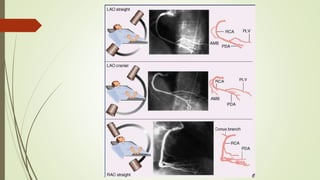
Standard Angiographic Views
 LAO 30: 300 LAO
 Best for visualizing ostial and proximal RCA
 RAO 30: 300 RAO
 Best for visualizing mid RCA and PDA
 PA Cranial: PA and 300 cranial
 Best for visualizing distal RCA bifurcation and the PDA
Right Coronary Artery
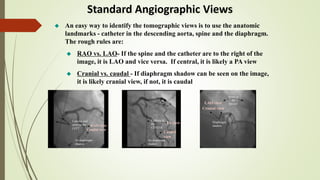
Standard Angiographic Views
 An easy way to identify the tomographic views is to use the anatomic
landmarks - catheter in the descending aorta, spine and the diaphragm.
The rough rules are:
 RAO vs. LAO- If the spine and the catheter are to the right of the
image, it is LAO and vice versa. If central, it is likely a PA view
 Cranial vs. caudal - If diaphragm shadow can be seen on the image,
it is likely cranial view, if not, it is caudal
Catheter and
spine to the
LEFT
RAO view
No diaphragm
shadow
Caudal view
Catheter at
the
CENTER
PA view
No diaphragm
shadow
Caudal
view
Spine to
the
RIGHTLAO view
Diaphragm
shadow
Cranial view
Standard Angiographic Views
Left Coronary Artery
RAO 20 Caudal 20
LM
LAD
Diagonal
Septals
Distal
LAD
LCx
RAO 20 Caudal 20
Knowledge of the orientation of the artery
for a given view can help identify the
probable path of the artery in the setting of
complete occlusion
Distal LAD
fills by
collaterals
LAD
Best for visualization of
LM bifurcation and
proximal LAD and LCx
Standard Angiographic Views
Left Coronary Artery
LAO 50 Cranial 30
LM
LAD
Diagonal
Septals
Distal
LAD
LCx
PA 0 Cranial 30
LM
LAD
Diagonal
Septals
Distal
LAD
LCx
Best for visualization of LM
proximal and mid LAD
Best for visualization of proximal and
mid LAD and splaying of the septals
from the diagonals. Also ideal for
visualization of distal LCx
Standard Angiographic Views
Left Coronary Artery
PA0 Caudal 30
LM
LAD
Diagonal
Septals
Distal
LAD
LCx
LAO 50 Caudal 30
OM
LM
LAD
Diagonal
Distal
LAD
LCx
OM
‘Spider’ view
Best for visualization of LM
bifurcation and proximal
LAD and LCx
Best for visualization of LM
bifurcation, proximal LAD and LCx
and OM
Standard Angiographic Views
Right Coronary Artery
LAO 30
Proximal
RCA
PDA
Distal
RCA
Mid
RCA
RAO 30
Mid
RCA
PDA/
PLV
PA 0 Cranial 30
Proximal
RCA
PDADistal
RCA
Mid
RCA
Best for visualization of
ostial and proximal RCA
Best for visualization of mid
RCA and PDA
Best for visualization of distal
RCA and its bifurcation
Angiogram-Interpretation
 A systematic interpretation of a coronary angiogram would involve:
 Evaluation of the extent and severity of coronary calcification just
prior to or soon after contrast opacification
 Lesion quantification in at least 2 orthogonal views:
 Severity
 Calcification
 Presence of ulceration/thrombus
 Degree of tortuosity
 ACC/AHA lesion classification
 Reference vessel size
 Grading TIMI flow ( Thrombolysis In Myocardial Ischemia)
 Grading TIMI myocardial perfusion blush grade
 Identifying and quantifying coronary collaterals
ACC/AHA Lesion Classification
 Type A Lesion: Minimally complex, discrete (length <10 mm),
concentric, readily accessible, non-angulated segment (<45°), smooth
contour, little or no calcification, less than totally occlusive, not ostial in
location, no major side branch involvement, and absence of thrombus
 Type B Lesion: Moderately complex, tubular (length 10 to 20 mm),
eccentric, moderate tortuosity of proximal segment, moderately
angulated segment (>45°, <90°), irregular contour, moderate or heavy
calcification, total occlusions <3 months old, ostial in location, bifurcation
lesions requiring double guidewires, and some thrombus present
 Type C Lesion: Severely complex, diffuse (length >2 cm), excessive
tortuosity of proximal segment, extremely angulated segments >90°,
total occlusions >3 months old and/or bridging collaterals, inability to
protect major side branches, and degenerated vein grafts with friable
lesions.
Source: Guidelines for percutaneous transluminal coronary angioplasty. A report of the American College of Cardiology/American Heart Association Task Force on Assessment of Diagnostic and
Therapeutic Cardiovascular Procedures (Subcommittee on Percutaneous Transluminal Coronary Angioplasty). J Am Coll Cardiology. 1988;12:528-45
Other Definitions
 Lesion length: Measured “shoulder-to-shoulder” in an unforeshortened view
Discrete Lesion length < 10 mm
Tubular Lesion length 10–20 mm
Diffuse Lesion length ≥ 20 mm
 Lesion angulation: Vessel angle formed by the centerline through the lumen
proximal to the stenosis and extending beyond it and a second centerline in the straight
portion of the artery distal to the stenosis
Moderate: Lesion angulation ≥ 45 degrees
Severe: Lesion angulation ≥ 90 degrees
 Calcification: Readily apparent densities noted within the apparent vascular wall at
the site of the stenosis
Moderate: Densities noted only with cardiac motion prior to contrast injection
Severe: Radiopacities noted without cardiac motion prior to contrast injection
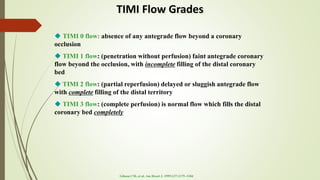
TIMI Flow Grades
 TIMI 0 flow: absence of any antegrade flow beyond a coronary
occlusion
 TIMI 1 flow: (penetration without perfusion) faint antegrade coronary
flow beyond the occlusion, with incomplete filling of the distal coronary
bed
 TIMI 2 flow: (partial reperfusion) delayed or sluggish antegrade flow
with complete filling of the distal territory
 TIMI 3 flow: (complete perfusion) is normal flow which fills the distal
coronary bed completely
Gibson CM, et al. Am Heart J. 1999;137:1179–1184
TIMI Myocardial Perfusion Grades
 Grade 0: Either minimal or no ground glass appearance (“blush”) of the
myocardium in the distribution of the culprit artery
 Grade 1: Dye slowly enters but fails to exit the microvasculature. Ground glass
appearance (“blush”) of the myocardium in the distribution of the culprit lesion that
fails to clear from the microvasculature, and dye staining is present on the next
injection (approximately 30 seconds between injections)
 Grade 2: Delayed entry and exit of dye from the microvasculature. There is the
ground glass appearance (“blush”) of the myocardium that is strongly persistent at
the end of the washout phase (i.e. dye is strongly persistent after 3 cardiac cycles of
the washout phase and either does not or only minimally diminishes in intensity
during washout).
 Grade 3: Normal entry and exit of dye from the microvasculature. There is the
ground glass appearance (“blush”) of the myocardium that clears normally, and is
either gone or only mildly/moderately persistent at the end of the washout phase (i.e.
dye is gone or is mildly/moderately persistent after 3 cardiac cycles of the washout
phase and noticeably diminishes in intensity during the washout phase), similar to
that in an uninvolved artery.
Gibson CM, et al. Circulation. 2000;101:125-130
Thank You for your listening…

CAG interpretation Dr Shiva CTVS JIPMER

  • 1.
  • 2.
     Conscious sedationusing a narcotic and a benzodiazepine  Vascular access: Either femoral (described in the section on vascular access and closure devices), radial, or brachial  Flush the selected diagnostic catheter with saline to ensure an air-free system  Once arterial access is obtained (as described in the section on vascular access and closure devices) a catheter of appropriate size and configuration is advanced over a 0.035 or 0.038 inch guidewire  Once in the ascending aorta, the guidewire is removed, the catheter allowed to bleed back to remove any thrombus or atherosclerotic debris  The catheter is then connected to a manifold assembly connected to a pressure transducer for continuous central pressure monitoring  The catheter is flushed to ensure an air-free system Equipment & Technique
  • 3.
     Zeroing andreferencing: The transducer should be opened to air to zero the system. Care must be taken to ensure that the pressure transducer is at the level of phlebostatic axis, which is roughly the midportion between the anterior and posterior chest wall along the left 4th intercostal space  The central aortic pressure should be recorded and compared with the cuff measured brachial pressure. If there is considerable difference between the two, subclavian artery stenosis should be in the differential  The catheter should then be filled with 3-4 cc of contrast and advanced to engage the coronary ostium, in the LAO projection  After ensuring that there is no ventricularization or damping of the pressure, a 2 to 3 cc of contrast should be injected to confirm the position of the catheter in the coronary ostium Technique
  • 4.
     Coronary angiographyshould be performed in standard views in orthogonal planes to visualize the lesion and serve as a roadmap for PCI  Non-standard views should be considered based on the lesion location, orientation of the heart, and patient body habitus  Before injecting contrast, with every view care should be taken to ensure no ventricularization or damping of the pressure wave forms Technique
  • 5.
     The overallrisk of major complications with coronary angiography is 1- 2%. This includes death, myocardial infarction, stroke, bleeding, vascular complications and contrast reaction. Complications
  • 6.
     Selecting theright catheter is important and is dependent upon the following:  Access site: Choice of catheters depends to certain degree on the access site - femoral vs. radial vs. brachial  Aortic width: Normal aortic width - 3.5 to 4.0 mm; Narrow- <3.5 mm, Dilated >4.0 mm  Coronary ostial location: high vs. low; anterior vs. posterior  Coronary ostial orientation: Superior, inferior, horizontal or shepherd’s crook (for RCA only)  Standard workhorse catheters for routine coronary angiography are Judkins right size 4 (JR4) and Judkins left size 4(JL4) and the ostia are engaged in the LAO projection  Always ensure co-axial alignment of the catheter  Catheters generally have two curves: Primary (distal) curve and a secondary (proximal) curve. The distance between the two curves is the length of the catheter  Shorter curve more ideal for superior take-offs  Longer curve more ideal for inferior take-offs Catheter Selection
  • 7.
     If usinga power injector for contrast opacification, the following settings may be considered:  RCA- 2 to 3ml/sec for 2 to 3 seconds, i.e., 3 for 6 represents a flow rate of 3ml/sec for a total volume of 6ml  LCA- 3 to 4ml/sec for 2 to 3 seconds, i.e., 4 for 8 which represents a flow rate of 4ml/sec for a total of 8ml  Ventriculography - 10 to 16ml/sec for 30 to 55ml, i.e., 13 for 39 which represents a flow rate of 13ml/sec for a total of 39ml  Common carotid artery - 8ml/sec for 10 cc  Internal carotid artery - 8ml/sec for 8cc  Vertebral artery - 7ml/sec for 7cc  Renal artery - 5ml/sec for 5 to 10cc  Iliofemoral - 7 to 9ml/sec for 70 to 120 cc Flow Rate and Volume Source: Baim, DS et al. Grossman’s Cardiac catheterization, angiography and intervention. Lippincott Williams & Wilkins, Philadephia
  • 10.
    Standard Angiographic Views LAO-Caudal view: 400 to 600 LAO and 100 to 300 caudal  Best for visualizing left main, proximal LAD and proximal LCx  RAO-Caudal view: 100 to 200 RAO and 150 to 200 caudal  Best for visualizing left main bifurcation, proximal LAD and the proximal to mid LCx  Shallow RAO-Cranial view: 00 to 100 RAO and 250 to 400 cranial  Best for visualizing mid and distal LAD and the distal LCx (LPDA and LPL)  Separates out the septals from the diagonals  LAO-Cranial view: 300 to 600 LAO and 150 to 300 cranial  Best for visualizing mid and distal LAD, and the distal LCx in a left dominant system  Separates out the septals from the diagonals Left Coronary Artery
  • 11.
    Standard Angiographic Views PA projection: 00 lateral and 00 cranio-caudal  Best for visualizing ostium of the left main  PA-Caudal view: 00 lateral and 200 to 300 caudal  Best for visualizing distal left main bifurcation as well as the proximal LAD and the proximal to mid LCx  PA-Cranial view: 00 lateral and 300 cranial  Best for visualizing proximal and mid LAD  Left lateral view:  Best for visualizing proximal LCx, proximal and distal LAD  Also good for visualizing LIMA to LAD anastomotic site Left Coronary Artery (other views)
  • 12.
    Standard Angiographic Views LAO 30: 300 LAO  Best for visualizing ostial and proximal RCA  RAO 30: 300 RAO  Best for visualizing mid RCA and PDA  PA Cranial: PA and 300 cranial  Best for visualizing distal RCA bifurcation and the PDA Right Coronary Artery
  • 13.
    Standard Angiographic Views An easy way to identify the tomographic views is to use the anatomic landmarks - catheter in the descending aorta, spine and the diaphragm. The rough rules are:  RAO vs. LAO- If the spine and the catheter are to the right of the image, it is LAO and vice versa. If central, it is likely a PA view  Cranial vs. caudal - If diaphragm shadow can be seen on the image, it is likely cranial view, if not, it is caudal Catheter and spine to the LEFT RAO view No diaphragm shadow Caudal view Catheter at the CENTER PA view No diaphragm shadow Caudal view Spine to the RIGHTLAO view Diaphragm shadow Cranial view
  • 14.
    Standard Angiographic Views LeftCoronary Artery RAO 20 Caudal 20 LM LAD Diagonal Septals Distal LAD LCx RAO 20 Caudal 20 Knowledge of the orientation of the artery for a given view can help identify the probable path of the artery in the setting of complete occlusion Distal LAD fills by collaterals LAD Best for visualization of LM bifurcation and proximal LAD and LCx
  • 15.
    Standard Angiographic Views LeftCoronary Artery LAO 50 Cranial 30 LM LAD Diagonal Septals Distal LAD LCx PA 0 Cranial 30 LM LAD Diagonal Septals Distal LAD LCx Best for visualization of LM proximal and mid LAD Best for visualization of proximal and mid LAD and splaying of the septals from the diagonals. Also ideal for visualization of distal LCx
  • 16.
    Standard Angiographic Views LeftCoronary Artery PA0 Caudal 30 LM LAD Diagonal Septals Distal LAD LCx LAO 50 Caudal 30 OM LM LAD Diagonal Distal LAD LCx OM ‘Spider’ view Best for visualization of LM bifurcation and proximal LAD and LCx Best for visualization of LM bifurcation, proximal LAD and LCx and OM
  • 17.
    Standard Angiographic Views RightCoronary Artery LAO 30 Proximal RCA PDA Distal RCA Mid RCA RAO 30 Mid RCA PDA/ PLV PA 0 Cranial 30 Proximal RCA PDADistal RCA Mid RCA Best for visualization of ostial and proximal RCA Best for visualization of mid RCA and PDA Best for visualization of distal RCA and its bifurcation
  • 18.
    Angiogram-Interpretation  A systematicinterpretation of a coronary angiogram would involve:  Evaluation of the extent and severity of coronary calcification just prior to or soon after contrast opacification  Lesion quantification in at least 2 orthogonal views:  Severity  Calcification  Presence of ulceration/thrombus  Degree of tortuosity  ACC/AHA lesion classification  Reference vessel size  Grading TIMI flow ( Thrombolysis In Myocardial Ischemia)  Grading TIMI myocardial perfusion blush grade  Identifying and quantifying coronary collaterals
  • 19.
    ACC/AHA Lesion Classification Type A Lesion: Minimally complex, discrete (length <10 mm), concentric, readily accessible, non-angulated segment (<45°), smooth contour, little or no calcification, less than totally occlusive, not ostial in location, no major side branch involvement, and absence of thrombus  Type B Lesion: Moderately complex, tubular (length 10 to 20 mm), eccentric, moderate tortuosity of proximal segment, moderately angulated segment (>45°, <90°), irregular contour, moderate or heavy calcification, total occlusions <3 months old, ostial in location, bifurcation lesions requiring double guidewires, and some thrombus present  Type C Lesion: Severely complex, diffuse (length >2 cm), excessive tortuosity of proximal segment, extremely angulated segments >90°, total occlusions >3 months old and/or bridging collaterals, inability to protect major side branches, and degenerated vein grafts with friable lesions. Source: Guidelines for percutaneous transluminal coronary angioplasty. A report of the American College of Cardiology/American Heart Association Task Force on Assessment of Diagnostic and Therapeutic Cardiovascular Procedures (Subcommittee on Percutaneous Transluminal Coronary Angioplasty). J Am Coll Cardiology. 1988;12:528-45
  • 20.
    Other Definitions  Lesionlength: Measured “shoulder-to-shoulder” in an unforeshortened view Discrete Lesion length < 10 mm Tubular Lesion length 10–20 mm Diffuse Lesion length ≥ 20 mm  Lesion angulation: Vessel angle formed by the centerline through the lumen proximal to the stenosis and extending beyond it and a second centerline in the straight portion of the artery distal to the stenosis Moderate: Lesion angulation ≥ 45 degrees Severe: Lesion angulation ≥ 90 degrees  Calcification: Readily apparent densities noted within the apparent vascular wall at the site of the stenosis Moderate: Densities noted only with cardiac motion prior to contrast injection Severe: Radiopacities noted without cardiac motion prior to contrast injection
  • 21.
    TIMI Flow Grades TIMI 0 flow: absence of any antegrade flow beyond a coronary occlusion  TIMI 1 flow: (penetration without perfusion) faint antegrade coronary flow beyond the occlusion, with incomplete filling of the distal coronary bed  TIMI 2 flow: (partial reperfusion) delayed or sluggish antegrade flow with complete filling of the distal territory  TIMI 3 flow: (complete perfusion) is normal flow which fills the distal coronary bed completely Gibson CM, et al. Am Heart J. 1999;137:1179–1184
  • 22.
    TIMI Myocardial PerfusionGrades  Grade 0: Either minimal or no ground glass appearance (“blush”) of the myocardium in the distribution of the culprit artery  Grade 1: Dye slowly enters but fails to exit the microvasculature. Ground glass appearance (“blush”) of the myocardium in the distribution of the culprit lesion that fails to clear from the microvasculature, and dye staining is present on the next injection (approximately 30 seconds between injections)  Grade 2: Delayed entry and exit of dye from the microvasculature. There is the ground glass appearance (“blush”) of the myocardium that is strongly persistent at the end of the washout phase (i.e. dye is strongly persistent after 3 cardiac cycles of the washout phase and either does not or only minimally diminishes in intensity during washout).  Grade 3: Normal entry and exit of dye from the microvasculature. There is the ground glass appearance (“blush”) of the myocardium that clears normally, and is either gone or only mildly/moderately persistent at the end of the washout phase (i.e. dye is gone or is mildly/moderately persistent after 3 cardiac cycles of the washout phase and noticeably diminishes in intensity during the washout phase), similar to that in an uninvolved artery. Gibson CM, et al. Circulation. 2000;101:125-130
  • 23.
    Thank You foryour listening…