Dr Jain T Kallarakkal MD, DM (Cardiology)
Dr Biswajit Sahoo MBBS, PGDC (Cardiology)
   Coronary angiography remains the gold
    standard for detecting clinically significant
    atherosclerotic coronary artery disease

   The technique was first performed by Dr.
    Mason Sones at the Cleveland Clinic in 1958
   To visualize coronary arteries, branches,
    collaterals and anomalies

   Precise localization relative to major and
    minor side branches, thrombi and areas of
    calcification

   To visualize vessel bifurcations, origin of side
    branches and specific lesion characteristics
    (length, eccentricity, calcium etc)
   To rule out the presence of coronary stenosis,
    define therapeutic options, and determine
    prognosis.

   Used as a research tool for follow-up after
    invasive  procedures    or   pharmacologic
    therapy.

   High-risk criteria include low ejection fraction
    and poor exercise capacity on an exercise
    test.
 In patients with non–ST-segment elevation
 acute coronary syndromes with high-risk
 features (e.g., ongoing ischemia, heart
 failure)

 In
   patients with acute ST-segment elevation
 myocardial infarction (STEMI)

 Primary percutaneous intervention (PCI) is
 usually performed in the same procedure,
 immediately after the diagnostic procedure
 Coagulopathy
 Decompensated congestive heart failure
 Uncontrolled Hypertension
 CVA
 Refractory Arrythmia
 GI Haemorrhage
 Pregnancy
 Inability for patient cooperation
 Active infection
 Renal Failure
 Contrast medium allergy
 Major complications are uncommon (<1%)
 Vascular complications related to the arterial
  puncture site
 Mortality risk is 0.1% or less.
 Allergic contrast reactions, worsening kidney
  function, and cerebrovascular accidents are rare
 Ventricular fibrillation may be provoked by
  contrast injection into conal branch of the right
  coronary artery.
 Iatrogenic   coronary artery dissection is a
  potential life-threatening complication, which
  usually is handled by either emergent coronary
  artery stenting or bypass surgery.
   The left and right coronary cusp give rise to
    their respective coronary arteries

   The major epicardial vessels are the left main
    coronary artery that divides into the Left
    anterior  Descending     artery    and     Left
    Circumflex Artery, and the Right Coronary
    artery.
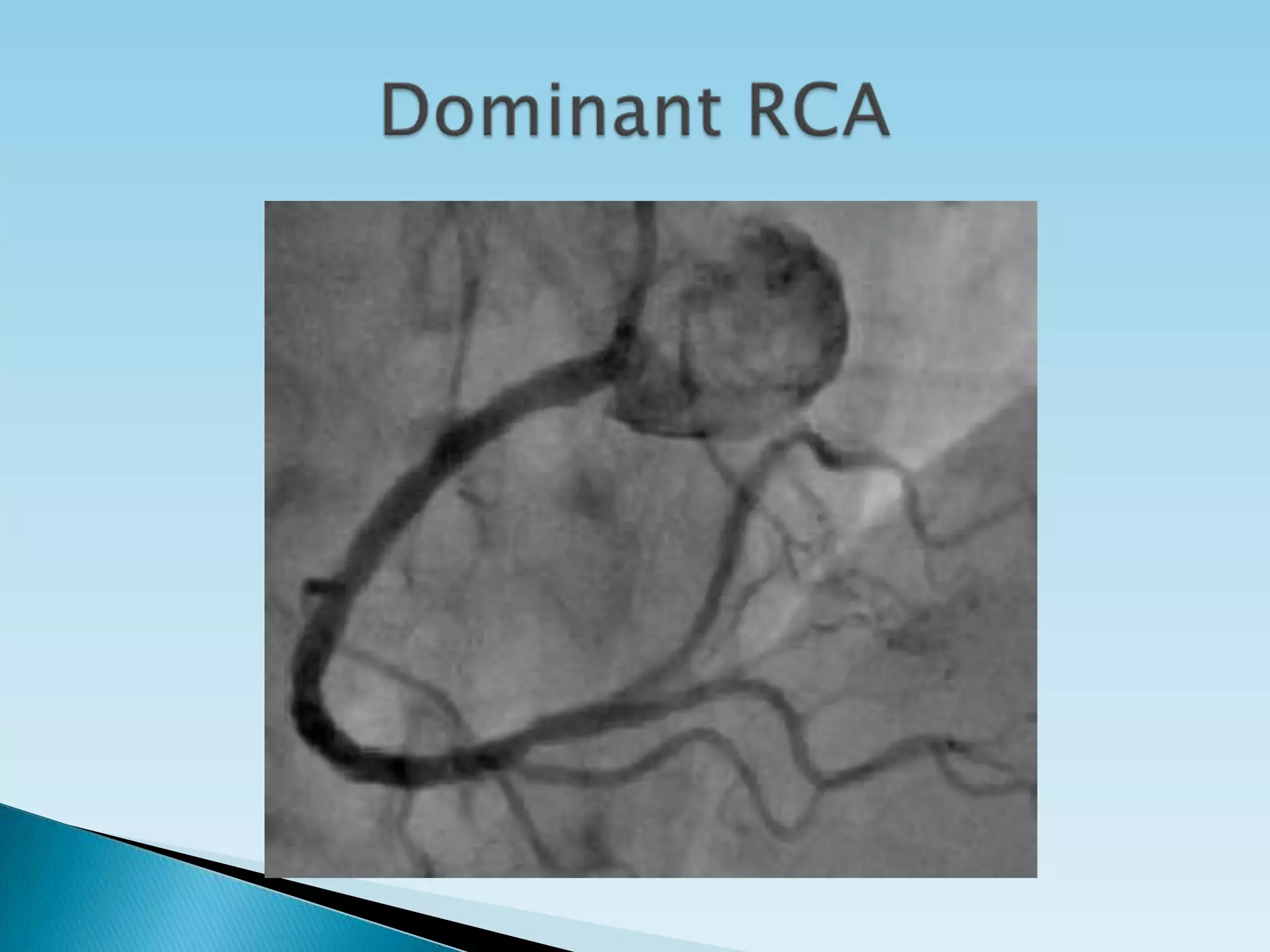
   Coronary dominance is based on the vessel that
    gives rise to the posterior descending artery
    which supplies the Atrio-ventricular node.

   Recognized by the presence of septal perforating
    branches, arises from the RCA in 80% from and
    the LCx in 10% of the population.

   Co-Dominance is found in 10% of the population
    where the posterior interventricular artery is
    formed by both the RCA and LCx.
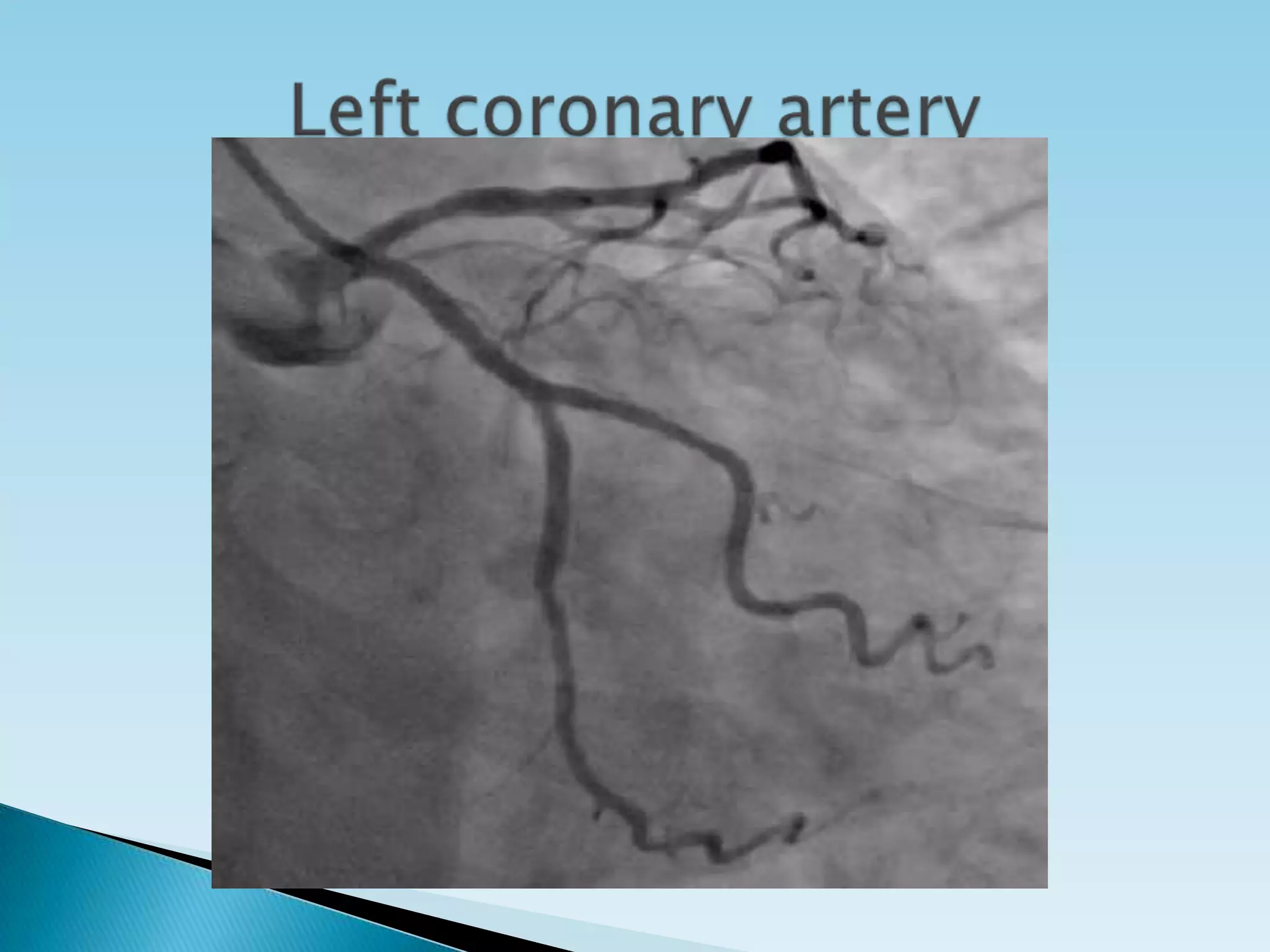
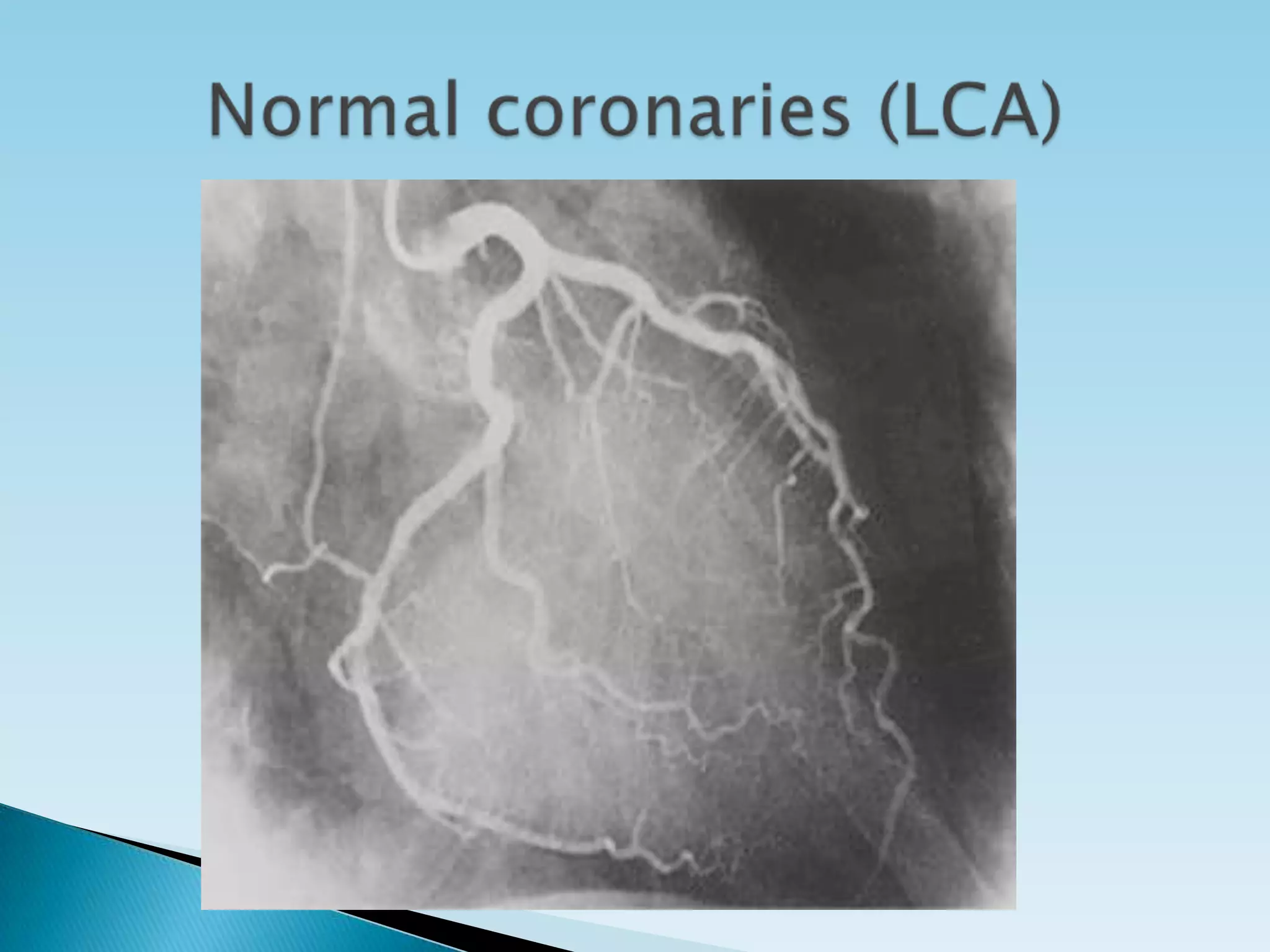
   The Left main coronary artery originates from
    the left coronary cusp and bifurcates to give
    rise to the Left anterior descending and Left
    Circumflex arteries.

   Occasionally, a third branch vessel, the
    Ramus Intermedius arises from the LMCA.

   In a small number of patients, the two major
    branch vessels arise from separate origins.
   LAD provides blood supply to the anterior
    wall of the left ventricle.

   It provides multiple septal branches to the
    interventricular  septum       and     diagonal
    branches to the anterior lateral wall.

   The LAD in some patients wraps around the
    apex to supply a small amount of the
    posterior apex.
   LCx courses around the lateral or left atrio-
    ventricular groove and gives rise to multiple
    marginal or lateral branches. The branches are
    termed obtuse marginal (OM) branches.

   OM branches are sequentially numbered (OM1,
    OM2 etc…).

   As the LCx courses the AV groove it also gives
    rise to several atrial branches, and occasionally
    the sino-atrial branch (40% of the population).
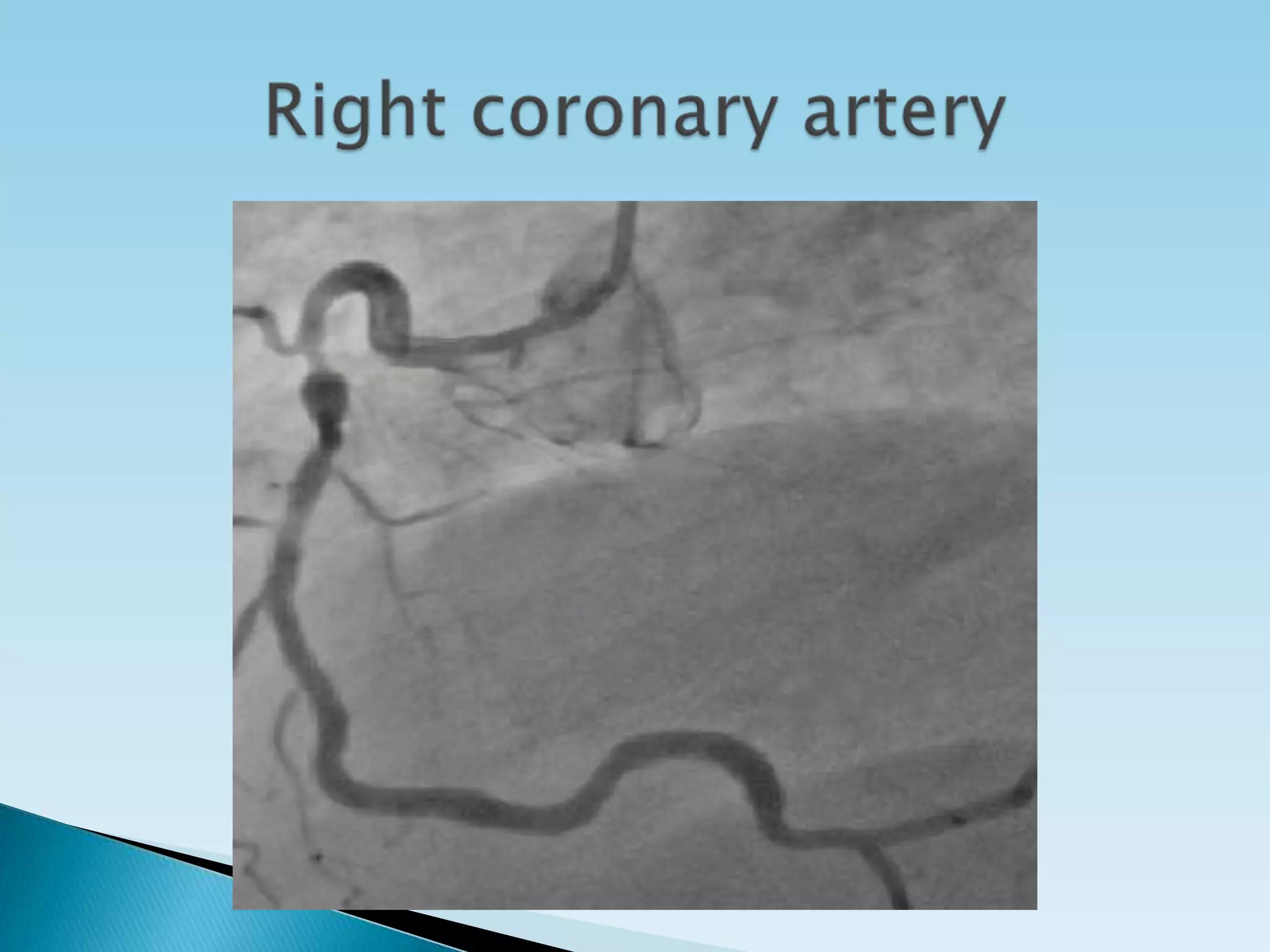
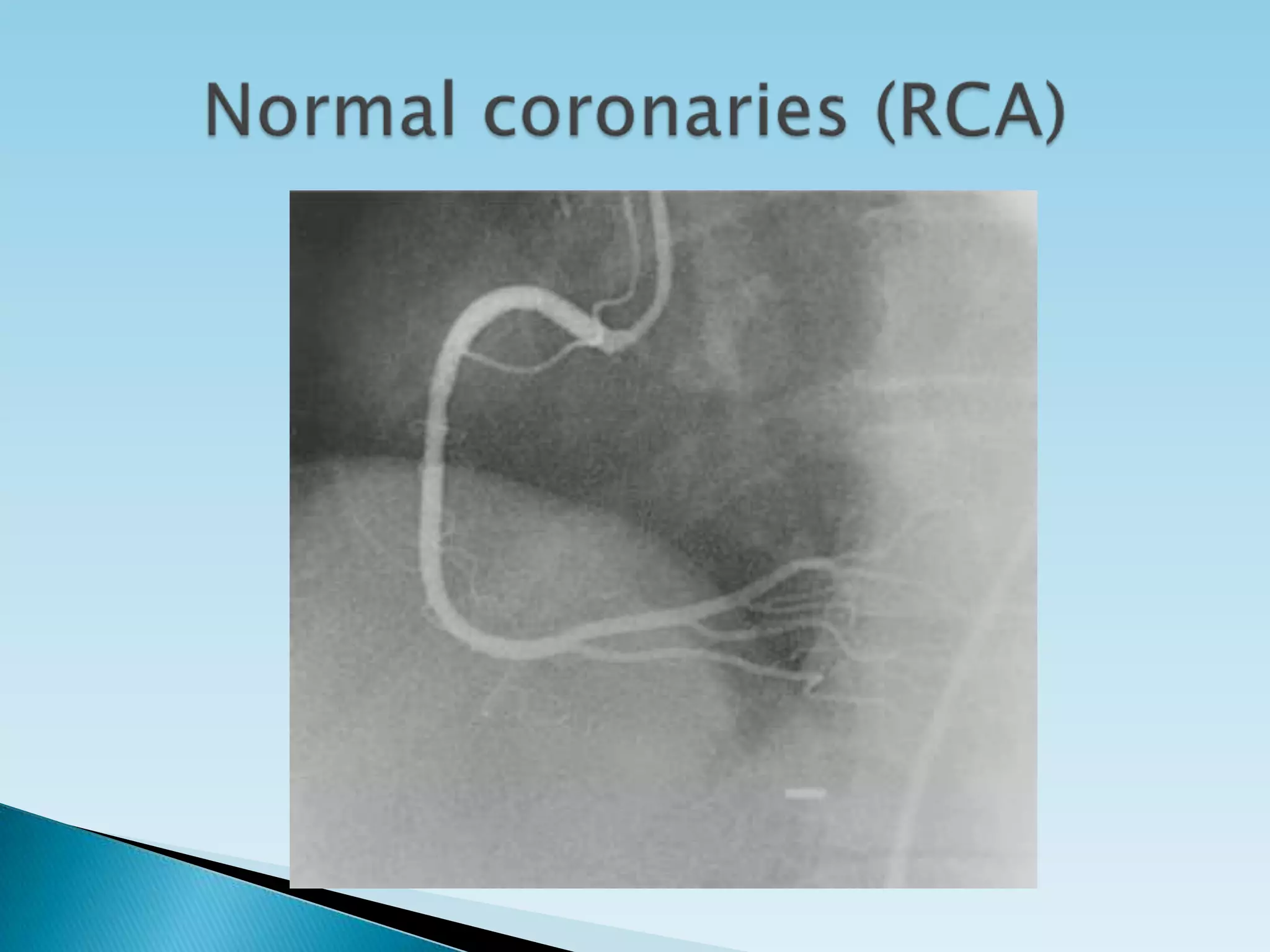
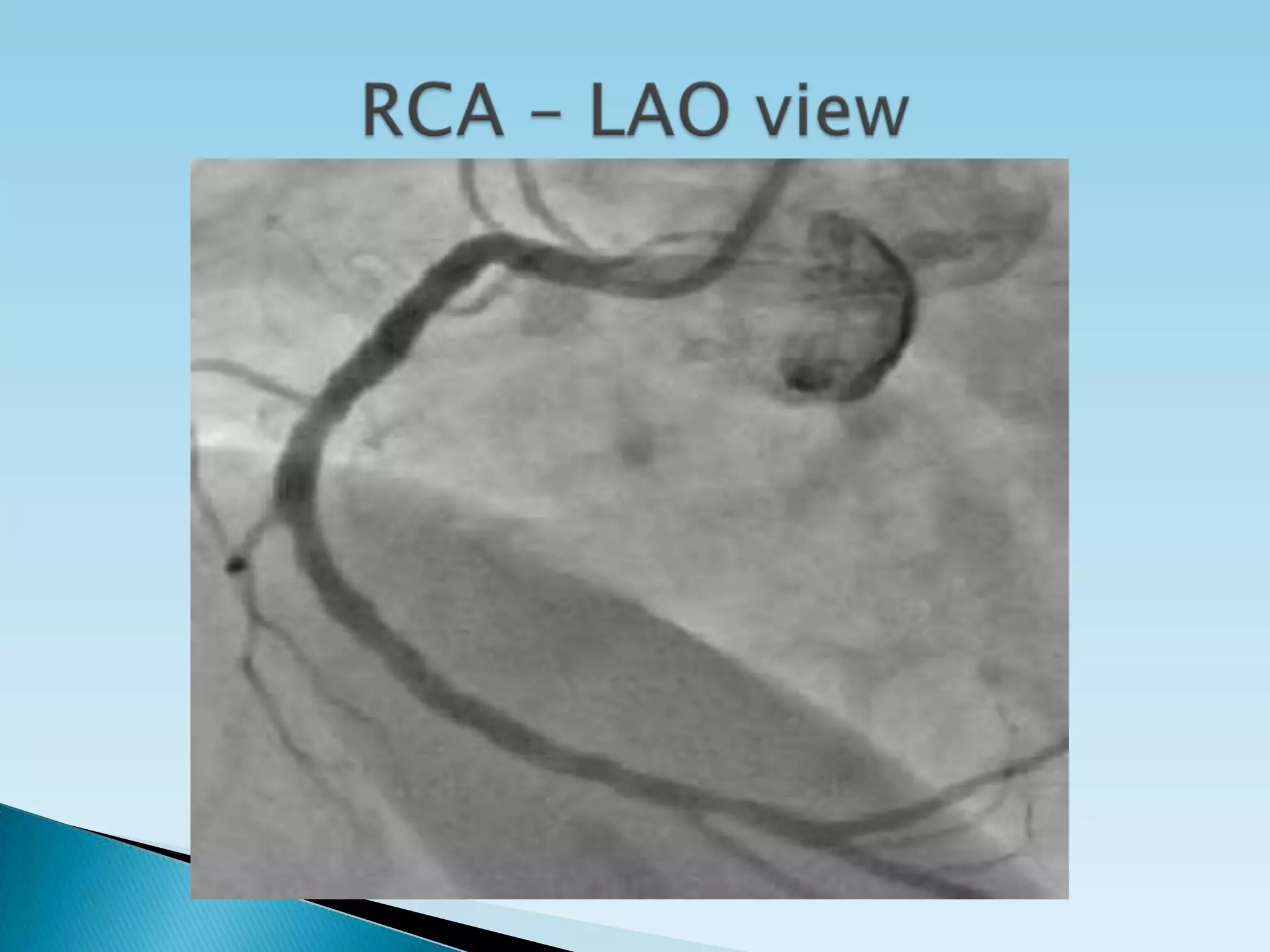
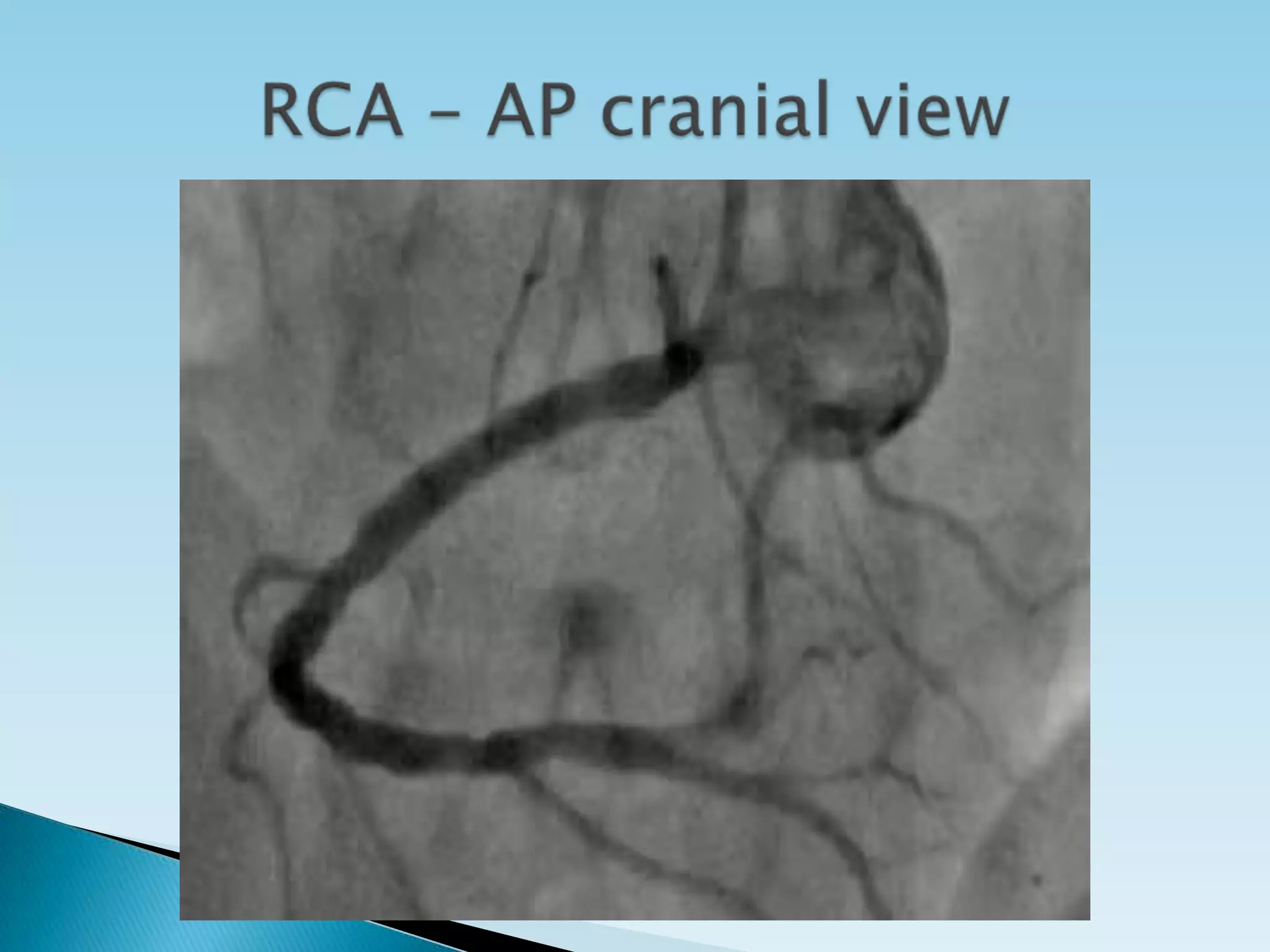
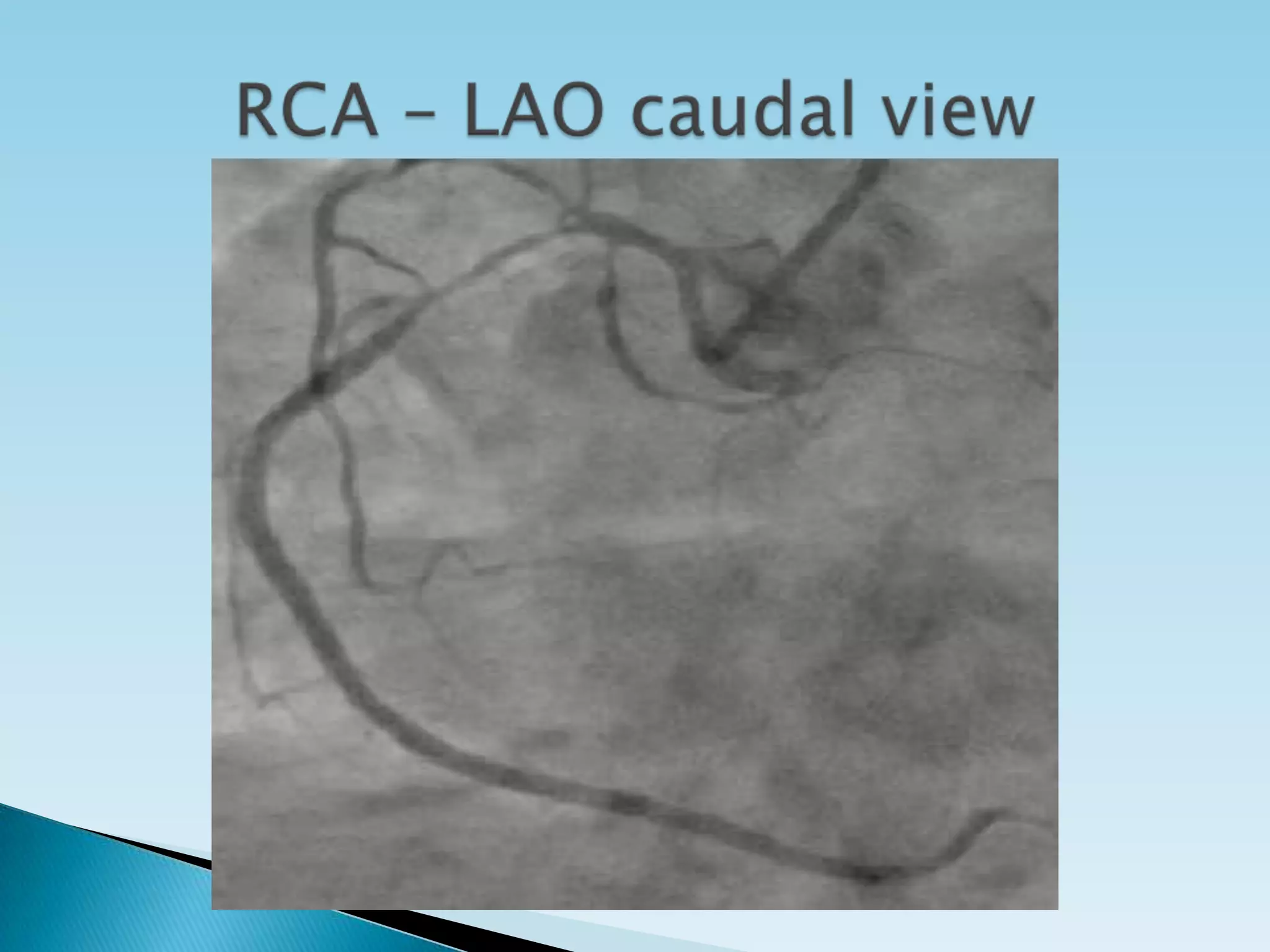
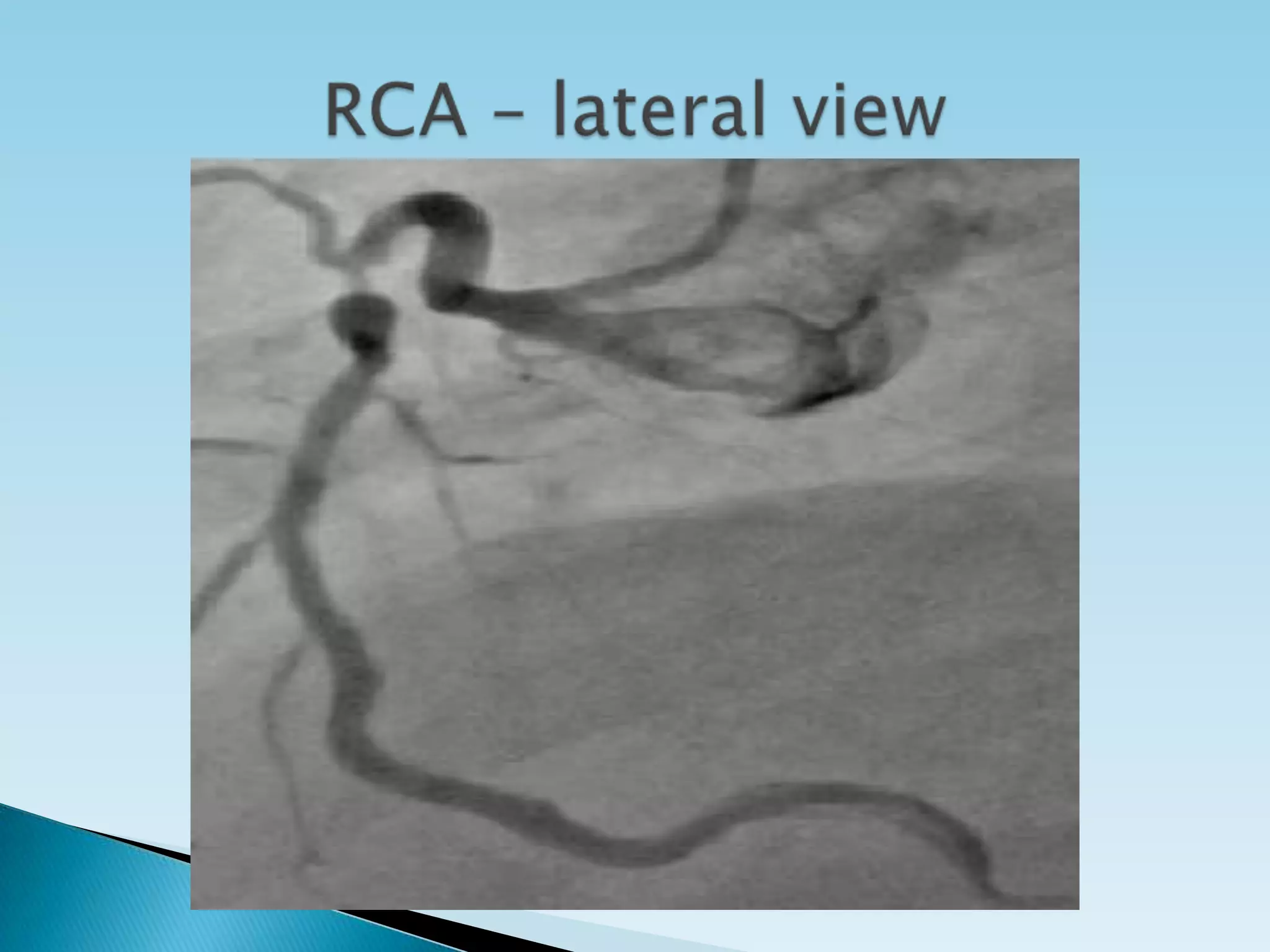
   RCA arises from the right coronary cusp and
    follows the right AV groove.

   The most proximal branches of the RCA are the
    conus-branch     which   supplies the   Right
    ventricular outflow tract and a branch that
    supplies the sino-atrial (SA) node (60% of
    patients).

   RCA gives off the postero lateral and posterior
    descending branches at the crux cordis
   Anatomic landmarks formed by the spine, catheter and
    diaphragm provide information to discern which
    tomographic view from which the image is obtained.

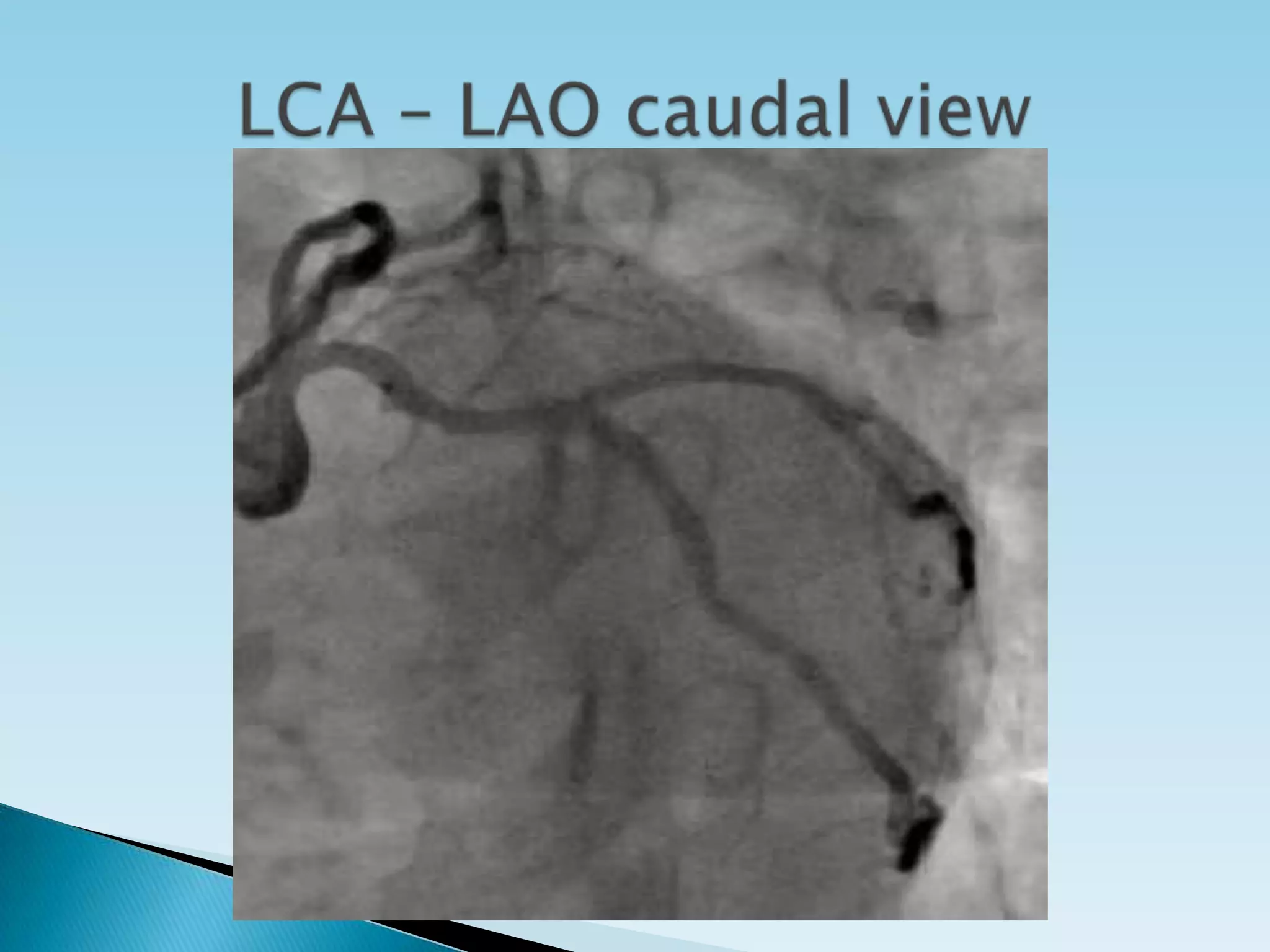
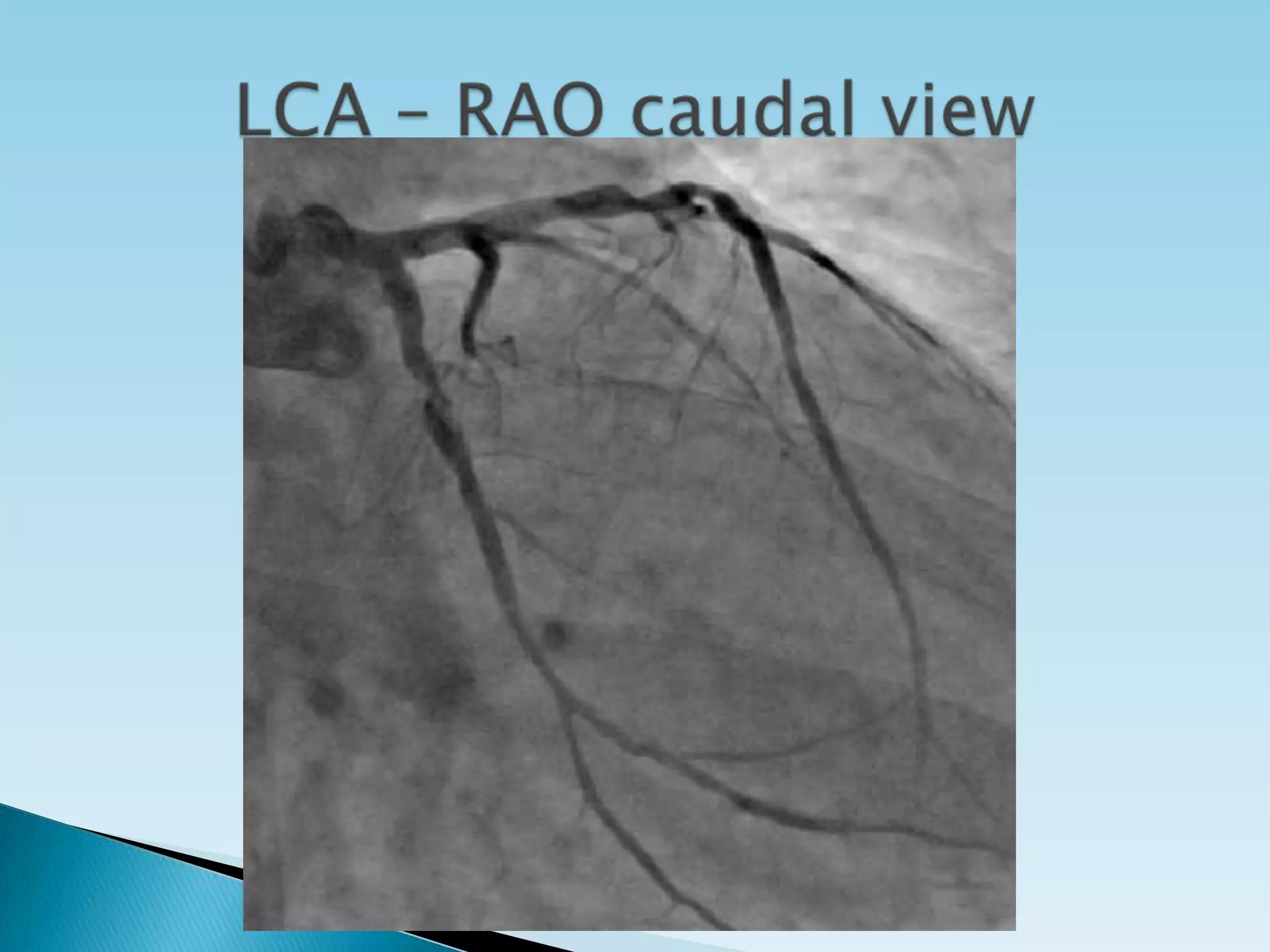
   In the LAO view the catheter and spine are seen on the
    right side of the image, while in the RAO they are found on
    the right.

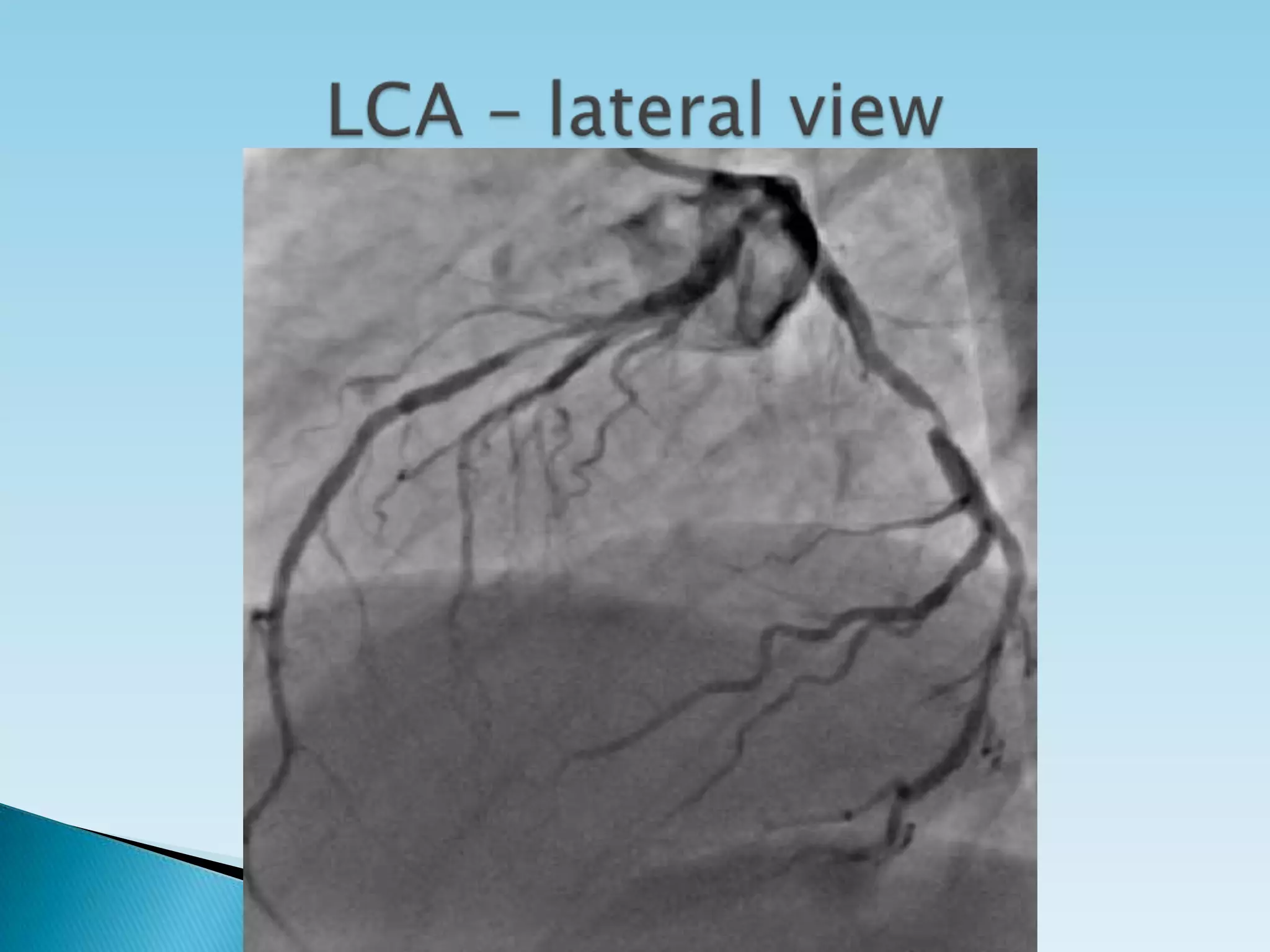
   PA imaging places these landmarks in the center.

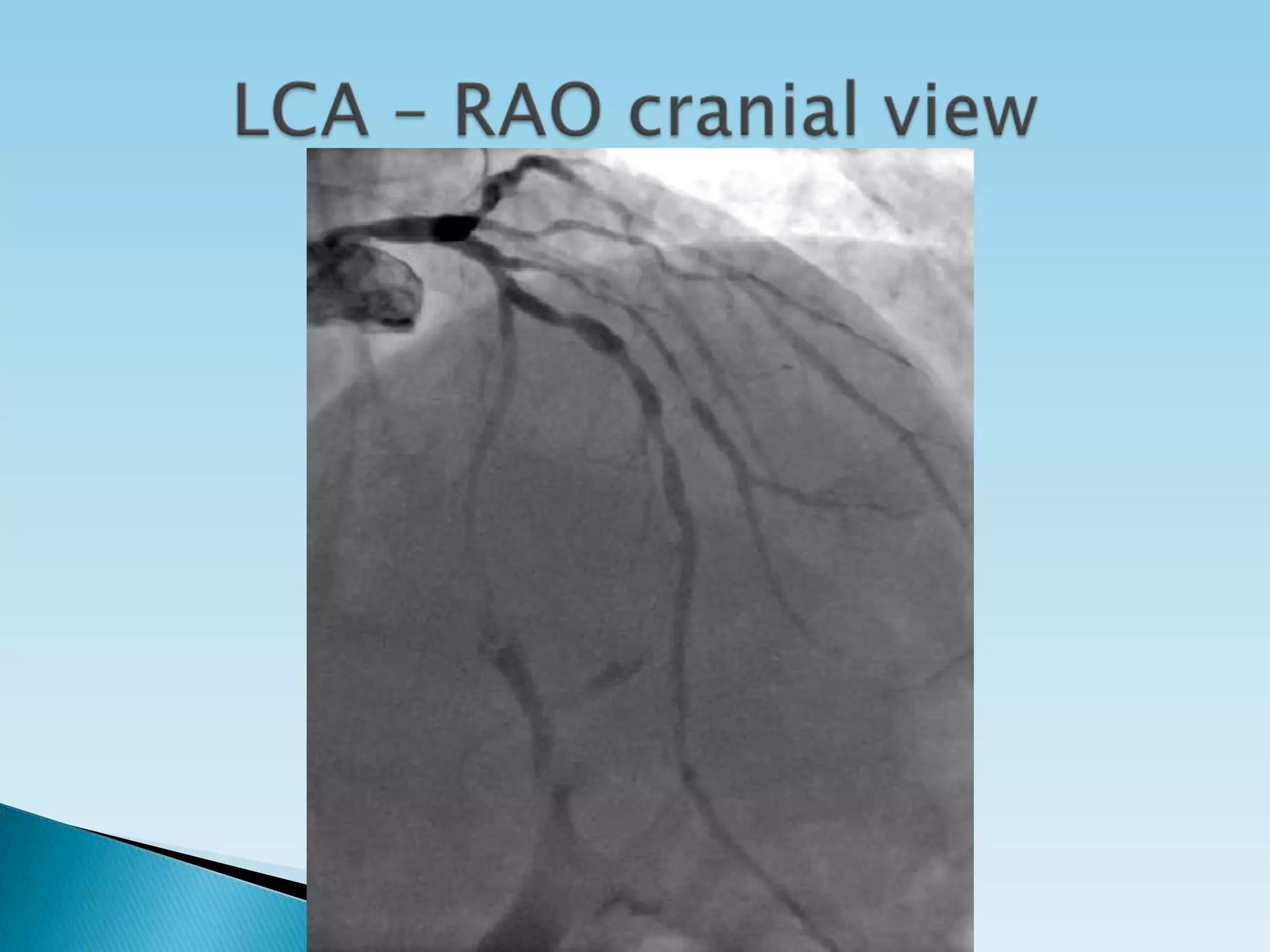
   Cranial can usually be distinguished from caudal
    angulation by the presence of the diaphragm. For cranial
    imaging, the patient should be asked to inspire to remove
    the diaphragmatic shadow from the image.
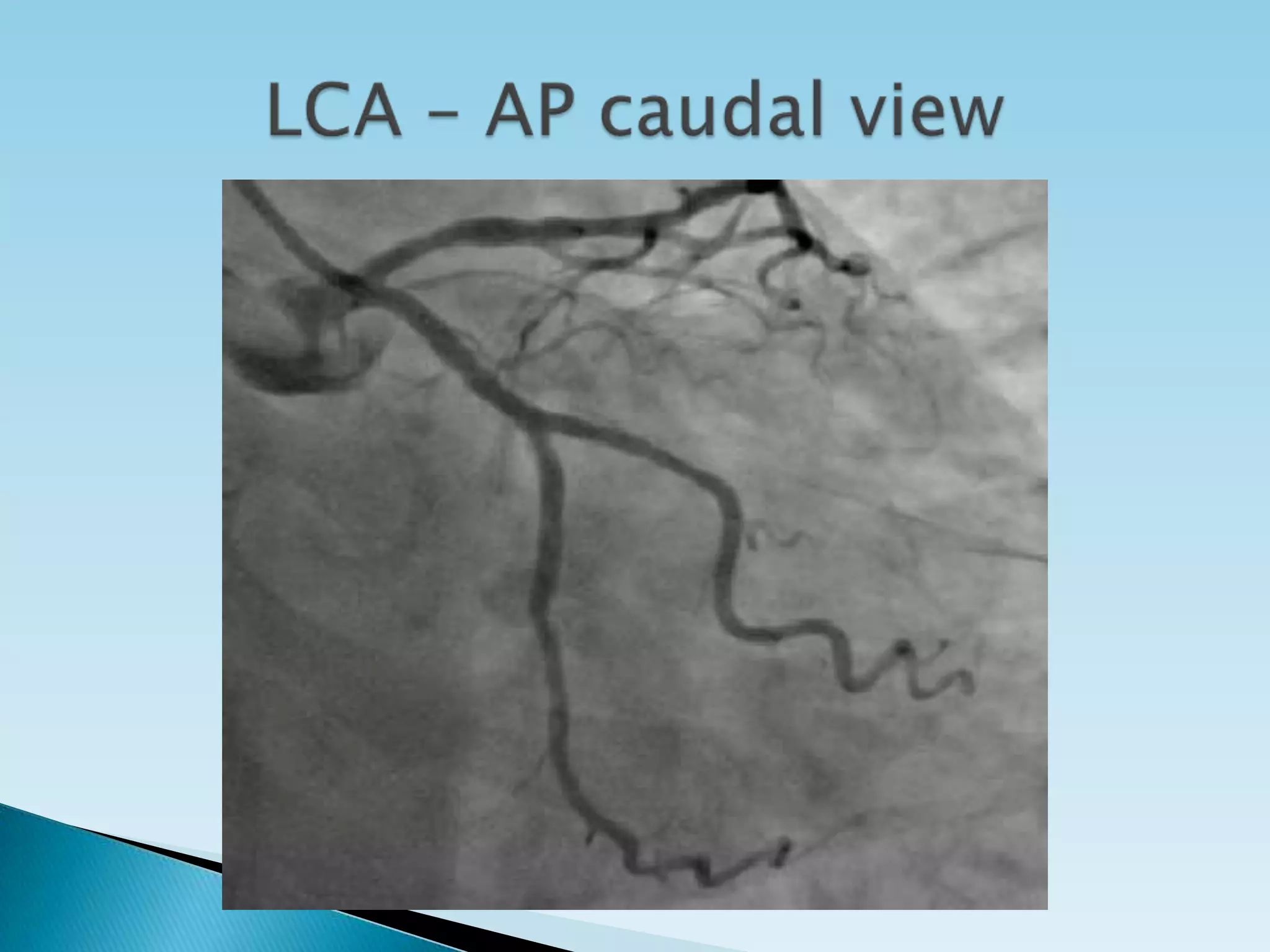
   Generally, for circumflex and proximal
    epicardial visualization the caudal views are
    most useful.

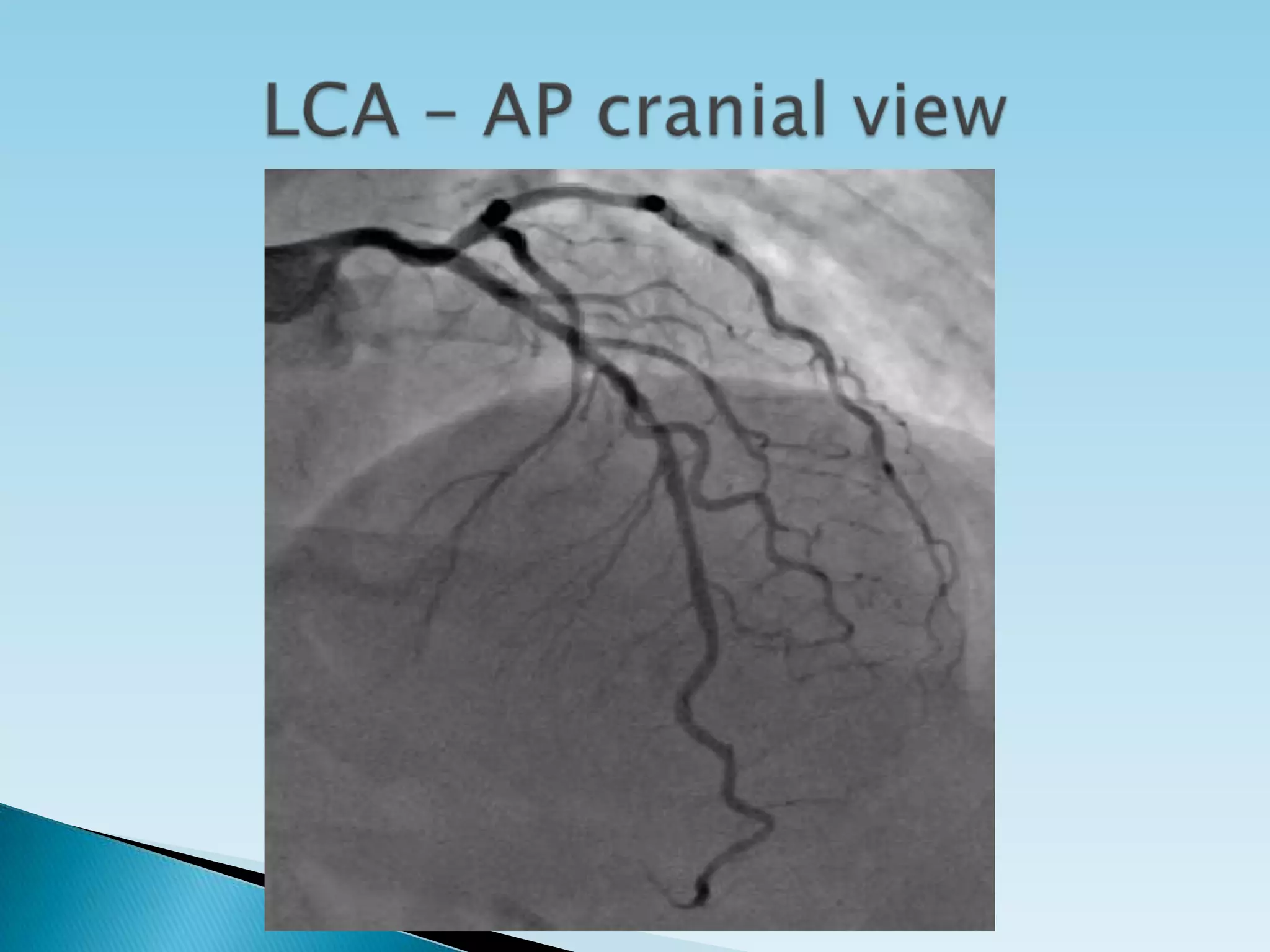
   For LAD and LAD/diagonal bifurcation
    visualization the cranial views are most
    useful.
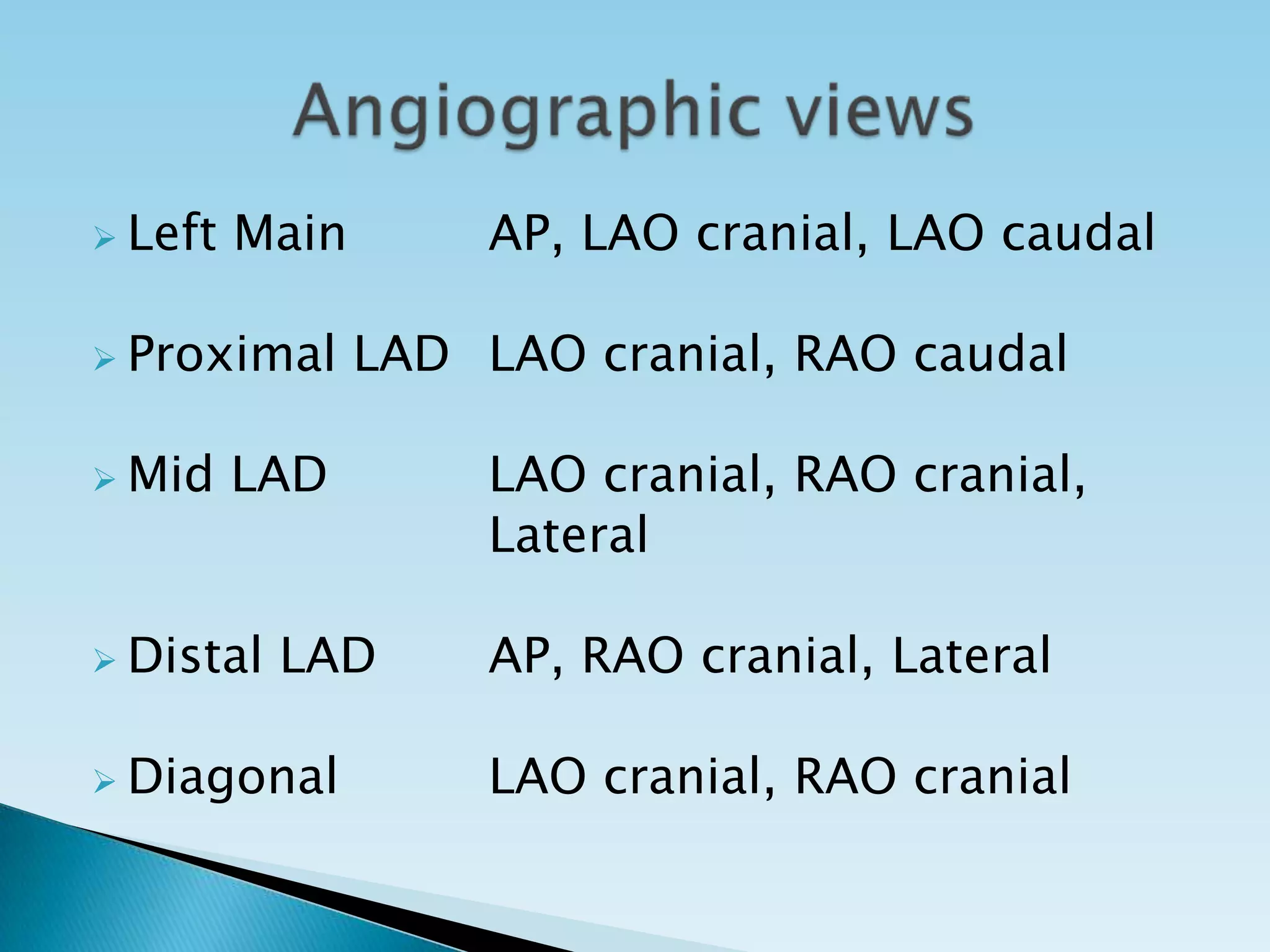
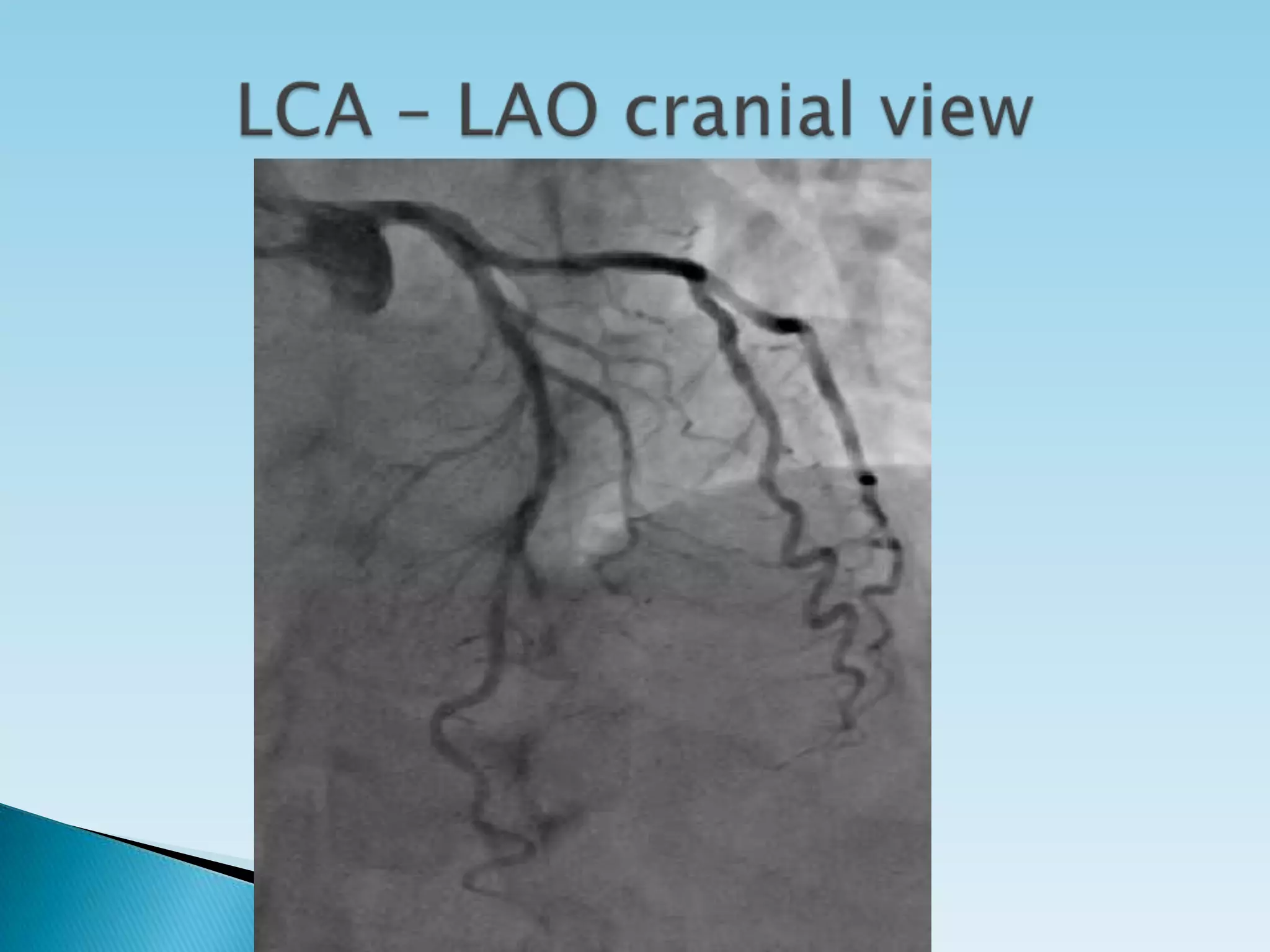
 Left   Main        AP, LAO cranial, LAO caudal

 Proximal      LAD LAO cranial, RAO caudal

 Mid    LAD         LAO cranial, RAO cranial,
                     Lateral

 Distal   LAD       AP, RAO cranial, Lateral

 Diagonal           LAO cranial, RAO cranial
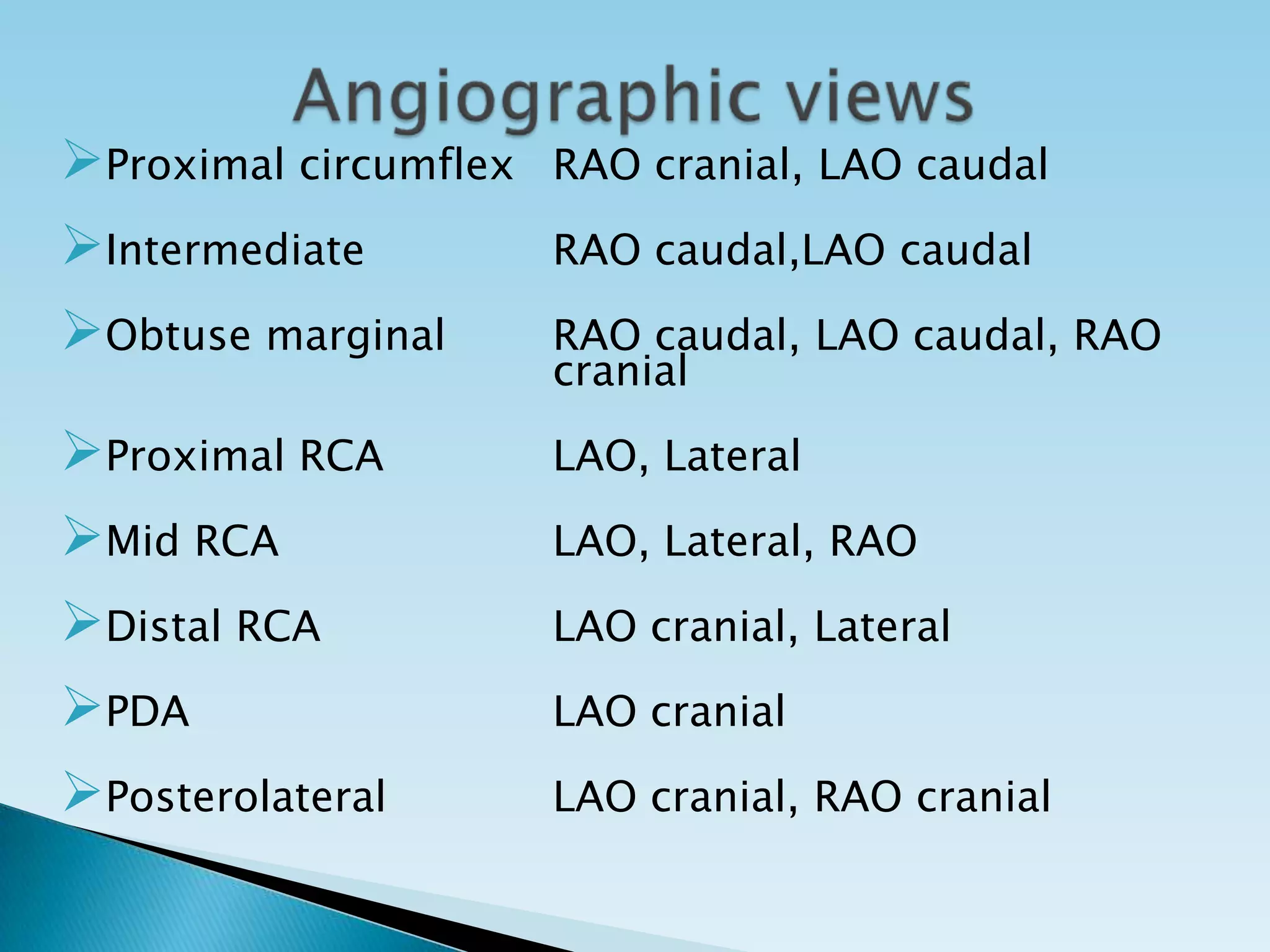
Proximal circumflex   RAO cranial, LAO caudal

Intermediate          RAO caudal,LAO caudal

Obtuse marginal       RAO caudal, LAO caudal, RAO
                       cranial

Proximal RCA          LAO, Lateral

Mid RCA               LAO, Lateral, RAO

Distal RCA            LAO cranial, Lateral

PDA                   LAO cranial

Posterolateral        LAO cranial, RAO cranial
 The severity or degree of stenosis is
 measured by comparing the area of
 narrowing to an adjacent normal
 segment, and as a percentage
 reduction and calculated in the
 projection which demonstrates the
 most severe narrowing.
   Normal distal runoff (TIMI 3)

   Good distal runoff (TIMI 2)

   Poor distal runoff (TIMI 1)

   Absence of distal runoff (TIMI 0)
Grade   Collateral appearance

0       No collateral circulation
1       Very weak reopcification
2       Reopacified segment, less dense
        than the feeding vessel and filling
        slowly
3       Reopacified segment as dense as the
        feeding vessel and filling rapidly
   LMCA originating from right sinus of Valsalva

   RCA originating from left sinus of Valsalva

   RCA originating above the sinus of Valsalva
    or from anterior aortic wall

   LAD originating from right sinus of Valsalva

   LAD and LCx originating from separate ostia
Thank You

Basics of coronary angiography

  • 1.
    Dr Jain TKallarakkal MD, DM (Cardiology) Dr Biswajit Sahoo MBBS, PGDC (Cardiology)
  • 2.
    Coronary angiography remains the gold standard for detecting clinically significant atherosclerotic coronary artery disease  The technique was first performed by Dr. Mason Sones at the Cleveland Clinic in 1958
  • 3.
    To visualize coronary arteries, branches, collaterals and anomalies  Precise localization relative to major and minor side branches, thrombi and areas of calcification  To visualize vessel bifurcations, origin of side branches and specific lesion characteristics (length, eccentricity, calcium etc)
  • 4.
    To rule out the presence of coronary stenosis, define therapeutic options, and determine prognosis.  Used as a research tool for follow-up after invasive procedures or pharmacologic therapy.  High-risk criteria include low ejection fraction and poor exercise capacity on an exercise test.
  • 5.
     In patientswith non–ST-segment elevation acute coronary syndromes with high-risk features (e.g., ongoing ischemia, heart failure)  In patients with acute ST-segment elevation myocardial infarction (STEMI)  Primary percutaneous intervention (PCI) is usually performed in the same procedure, immediately after the diagnostic procedure
  • 6.
     Coagulopathy  Decompensatedcongestive heart failure  Uncontrolled Hypertension  CVA  Refractory Arrythmia  GI Haemorrhage  Pregnancy  Inability for patient cooperation  Active infection  Renal Failure  Contrast medium allergy
  • 7.
     Major complicationsare uncommon (<1%)  Vascular complications related to the arterial puncture site  Mortality risk is 0.1% or less.  Allergic contrast reactions, worsening kidney function, and cerebrovascular accidents are rare  Ventricular fibrillation may be provoked by contrast injection into conal branch of the right coronary artery.  Iatrogenic coronary artery dissection is a potential life-threatening complication, which usually is handled by either emergent coronary artery stenting or bypass surgery.
  • 8.
    The left and right coronary cusp give rise to their respective coronary arteries  The major epicardial vessels are the left main coronary artery that divides into the Left anterior Descending artery and Left Circumflex Artery, and the Right Coronary artery.
  • 11.
    Coronary dominance is based on the vessel that gives rise to the posterior descending artery which supplies the Atrio-ventricular node.  Recognized by the presence of septal perforating branches, arises from the RCA in 80% from and the LCx in 10% of the population.  Co-Dominance is found in 10% of the population where the posterior interventricular artery is formed by both the RCA and LCx.
  • 13.
    The Left main coronary artery originates from the left coronary cusp and bifurcates to give rise to the Left anterior descending and Left Circumflex arteries.  Occasionally, a third branch vessel, the Ramus Intermedius arises from the LMCA.  In a small number of patients, the two major branch vessels arise from separate origins.
  • 14.
    LAD provides blood supply to the anterior wall of the left ventricle.  It provides multiple septal branches to the interventricular septum and diagonal branches to the anterior lateral wall.  The LAD in some patients wraps around the apex to supply a small amount of the posterior apex.
  • 15.
    LCx courses around the lateral or left atrio- ventricular groove and gives rise to multiple marginal or lateral branches. The branches are termed obtuse marginal (OM) branches.  OM branches are sequentially numbered (OM1, OM2 etc…).  As the LCx courses the AV groove it also gives rise to several atrial branches, and occasionally the sino-atrial branch (40% of the population).
  • 16.
    RCA arises from the right coronary cusp and follows the right AV groove.  The most proximal branches of the RCA are the conus-branch which supplies the Right ventricular outflow tract and a branch that supplies the sino-atrial (SA) node (60% of patients).  RCA gives off the postero lateral and posterior descending branches at the crux cordis
  • 19.
    Anatomic landmarks formed by the spine, catheter and diaphragm provide information to discern which tomographic view from which the image is obtained.  In the LAO view the catheter and spine are seen on the right side of the image, while in the RAO they are found on the right.  PA imaging places these landmarks in the center.  Cranial can usually be distinguished from caudal angulation by the presence of the diaphragm. For cranial imaging, the patient should be asked to inspire to remove the diaphragmatic shadow from the image.
  • 20.
    Generally, for circumflex and proximal epicardial visualization the caudal views are most useful.  For LAD and LAD/diagonal bifurcation visualization the cranial views are most useful.
  • 21.
     Left Main AP, LAO cranial, LAO caudal  Proximal LAD LAO cranial, RAO caudal  Mid LAD LAO cranial, RAO cranial, Lateral  Distal LAD AP, RAO cranial, Lateral  Diagonal LAO cranial, RAO cranial
  • 22.
    Proximal circumflex RAO cranial, LAO caudal Intermediate RAO caudal,LAO caudal Obtuse marginal RAO caudal, LAO caudal, RAO cranial Proximal RCA LAO, Lateral Mid RCA LAO, Lateral, RAO Distal RCA LAO cranial, Lateral PDA LAO cranial Posterolateral LAO cranial, RAO cranial
  • 34.
     The severityor degree of stenosis is measured by comparing the area of narrowing to an adjacent normal segment, and as a percentage reduction and calculated in the projection which demonstrates the most severe narrowing.
  • 35.
    Normal distal runoff (TIMI 3)  Good distal runoff (TIMI 2)  Poor distal runoff (TIMI 1)  Absence of distal runoff (TIMI 0)
  • 36.
    Grade Collateral appearance 0 No collateral circulation 1 Very weak reopcification 2 Reopacified segment, less dense than the feeding vessel and filling slowly 3 Reopacified segment as dense as the feeding vessel and filling rapidly
  • 37.
    LMCA originating from right sinus of Valsalva  RCA originating from left sinus of Valsalva  RCA originating above the sinus of Valsalva or from anterior aortic wall  LAD originating from right sinus of Valsalva  LAD and LCx originating from separate ostia
  • 38.