MELWIN AUGUSTINE
3RD YEAR BS.c RADIOGRAPHY
DEPT.OF NIIR
NIMHANS
D – Digital
S – Subtractional
A - Angiography
ANGIO – Means Blood Vessels.
Angiography is the study of Blood Vesslels.
Radiological aspect – It is a medical imaging
technique to visualize the blood vessels after
injecting dye(contrast).
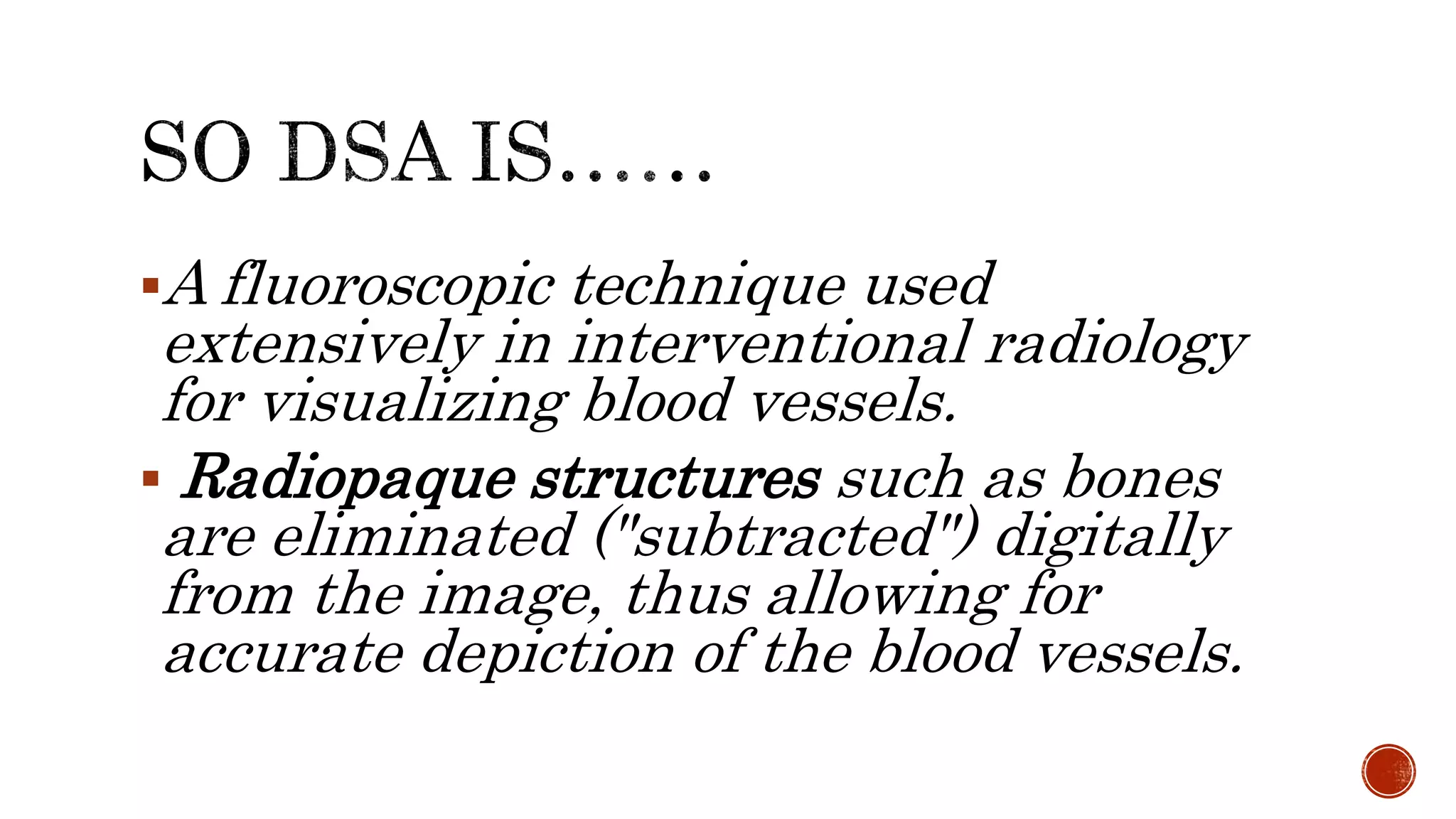
A technique by which bone structure images are
subtracted or removed from a film leaving only the
clear image of blood vessels.
Unwanted elements are eliminated.
- =
MASK IMAGE CONTRAST IMAGE SUBTRACTED IMAGE
A fluoroscopic technique used
extensively in interventional radiology
for visualizing blood vessels.
 Radiopaque structures such as bones
are eliminated ("subtracted") digitally
from the image, thus allowing for
accurate depiction of the blood vessels.
 Portugese neurologist Egas Moniz,in 1972 developed the technique
of contrast x-ray cerebral angiographyto diagnose diseases such as
tumors & AVMs
 The idea of subtraction images was first proposed by the Dutch
radiologist ZIEDES DES PLANTES in 1935 , when he was able to
produce subtracted images using plain films.
 By 1978 the feasibility of DSA for human subjects was demonstrated
& prototype commercial DSA systems were introduced in1980.
 With the introduction of Seldinger Technique in1953,the procedure
become safer as no sharp devices need to remain inside the vascular
lumen
 Photographic method is used to eliminate unwanted images .
 No addition of information, only purpose to make diagnostically important
information to see.
 1st described by Zeides des Plantes,1953
 3 CONDITIONS
*SCOUT FILM
*ANGIOGRAM FILM – CONTRAST
*NO MOTION OF HEAD
MASK SUBTRACTION
First pre contrast mask image is subtracted from sequential post contrast images
DUAL ENERGY
SUBTRACTION
*Two images are taken sequentially one at
high energy (KVp) another at low KVp and
are subtracted from each other
*It is divided into 2
(1) K-edge subtraction
(2)Hybrid subtraction
K-EDGE SUBTRACTION
Iodine attenuates diagnostic x-rays almost entirely by
Photoelectric effect.
One method for achieving high iodine contrast is removal
of all x-rays from the beam except those that lie below the
K-shell Binding Energy of Iodine.
X-ray filter made of rare earth screen named CERIUM can
do this well, since B.E is 40 KeV.
Thick filter will remove most of the x-rays above 40 KeV.
The image to be subtracted should contain few x-rays.
HYBRID SUBTRACTION
MASKSUBTRACTION + DUAL ENERGYSUBTRACTION
• High KVp & low KVp image pair is collected .
• No patient movement –soft tissues cancel properly.But bone
edhes cause severe artifact.
• Consider the subtracted images consist of only two atomic no.
materials (iodine & bone)
• Hybrid subtraction produces 2 sets of subtracted images .
• The same bone & iodine structures are present on both sets.
• D.E.S can now be used to eliminate bone leaving only iodine.
• Final image – more noise.
Similar to simple mask subtraction
but new mask is taken for each
subtraction
Each subtracted image is the
difference between the images
separated by some fixed interval of
time
TIME INTERVAL
DIFFERENCING
TEMPORAL FILTERING
•Generates one final image by adding &
subtracting some of the original images
together,& then shifting & repeating to
form the next image
•Temporal filters are used
•Reduces noise and reduces tube loading
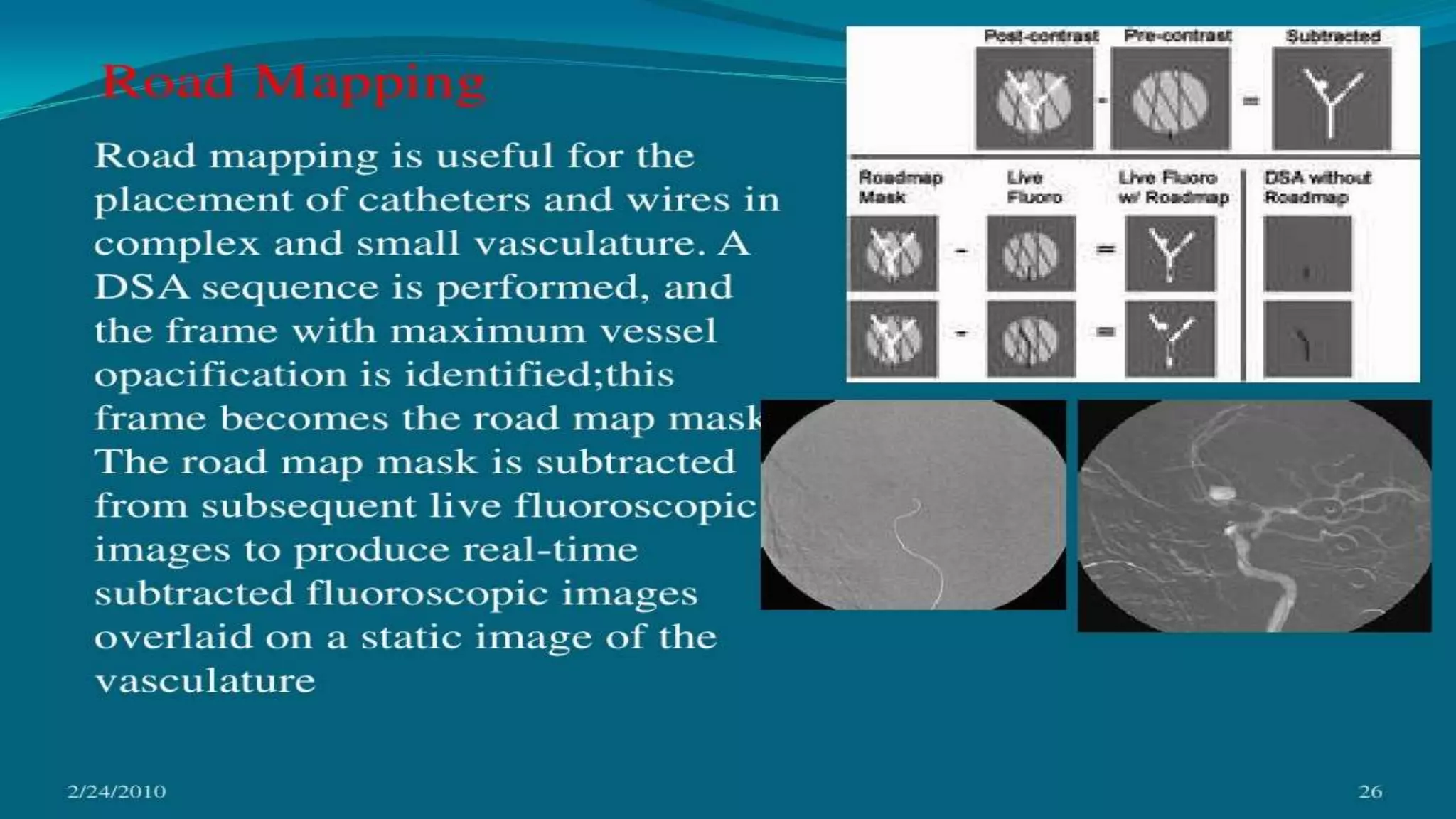
ROAD MAP , SMART MASK
3D DSA
XPER CT/VASO CT
PERFUSION
PIXEL SHIFTING
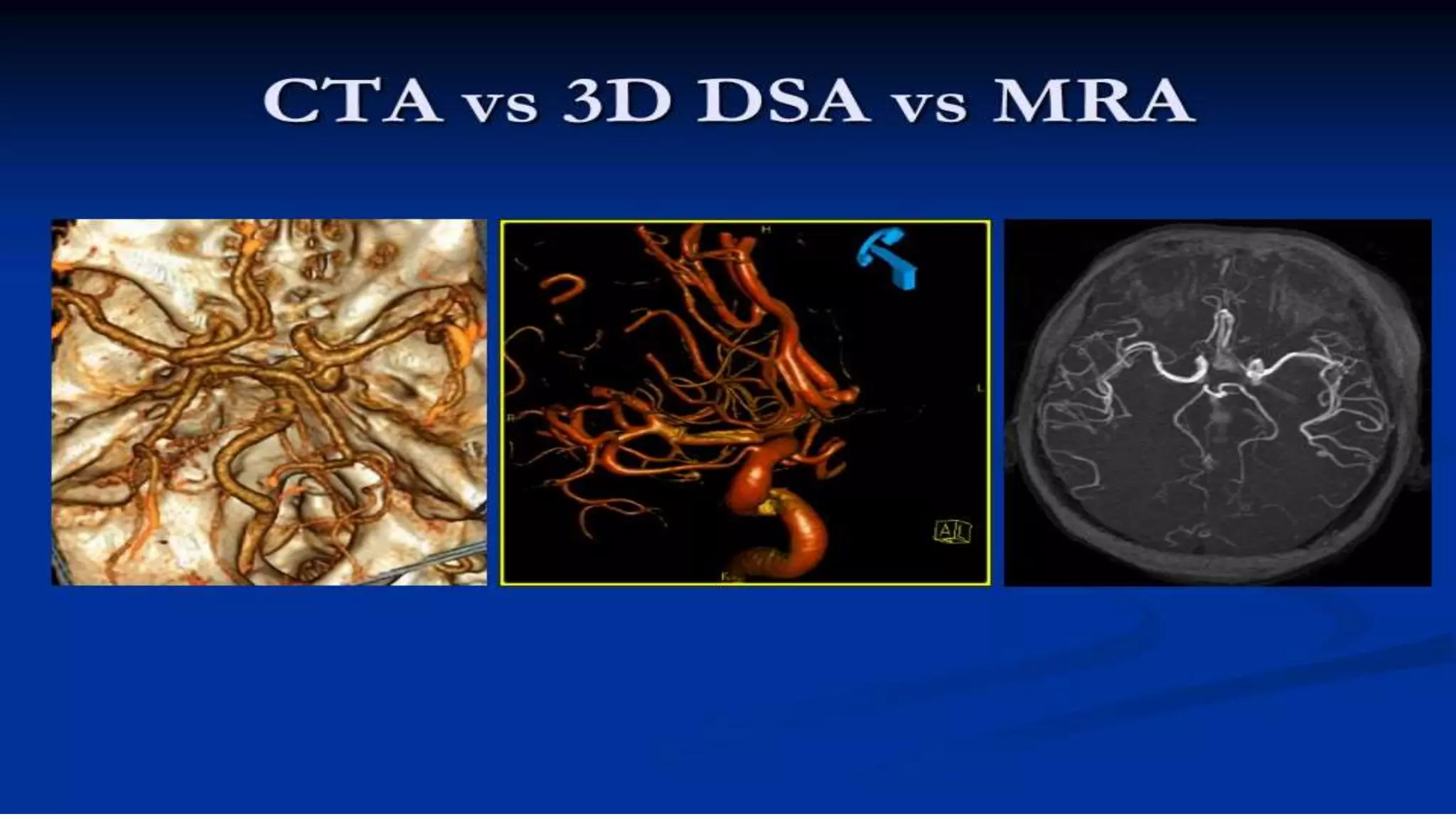
 For the evaluation of intracranial aneurysms, DSA remains the “gold standard”,
and the diagnostic accuracy of 3D-iamges has developed rapidly
 It is necessary to determine the best working angle for endovascular treatment of
intracranial aneurysms and for this purpose, 3D-DSA with auto-positioning
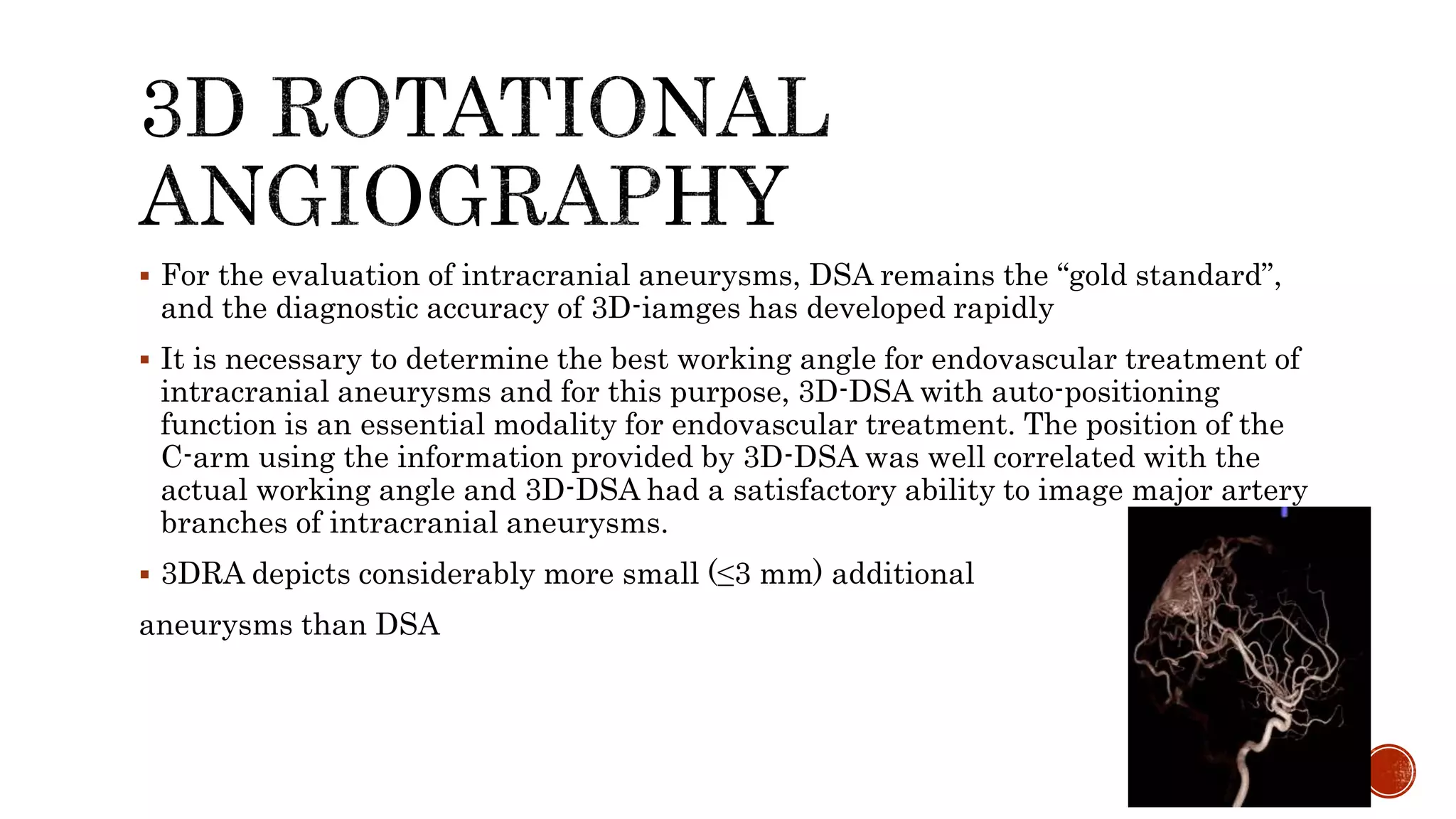
function is an essential modality for endovascular treatment. The position of the
C-arm using the information provided by 3D-DSA was well correlated with the
actual working angle and 3D-DSA had a satisfactory ability to image major artery
branches of intracranial aneurysms.
 3DRA depicts considerably more small (≤3 mm) additional
aneurysms than DSA
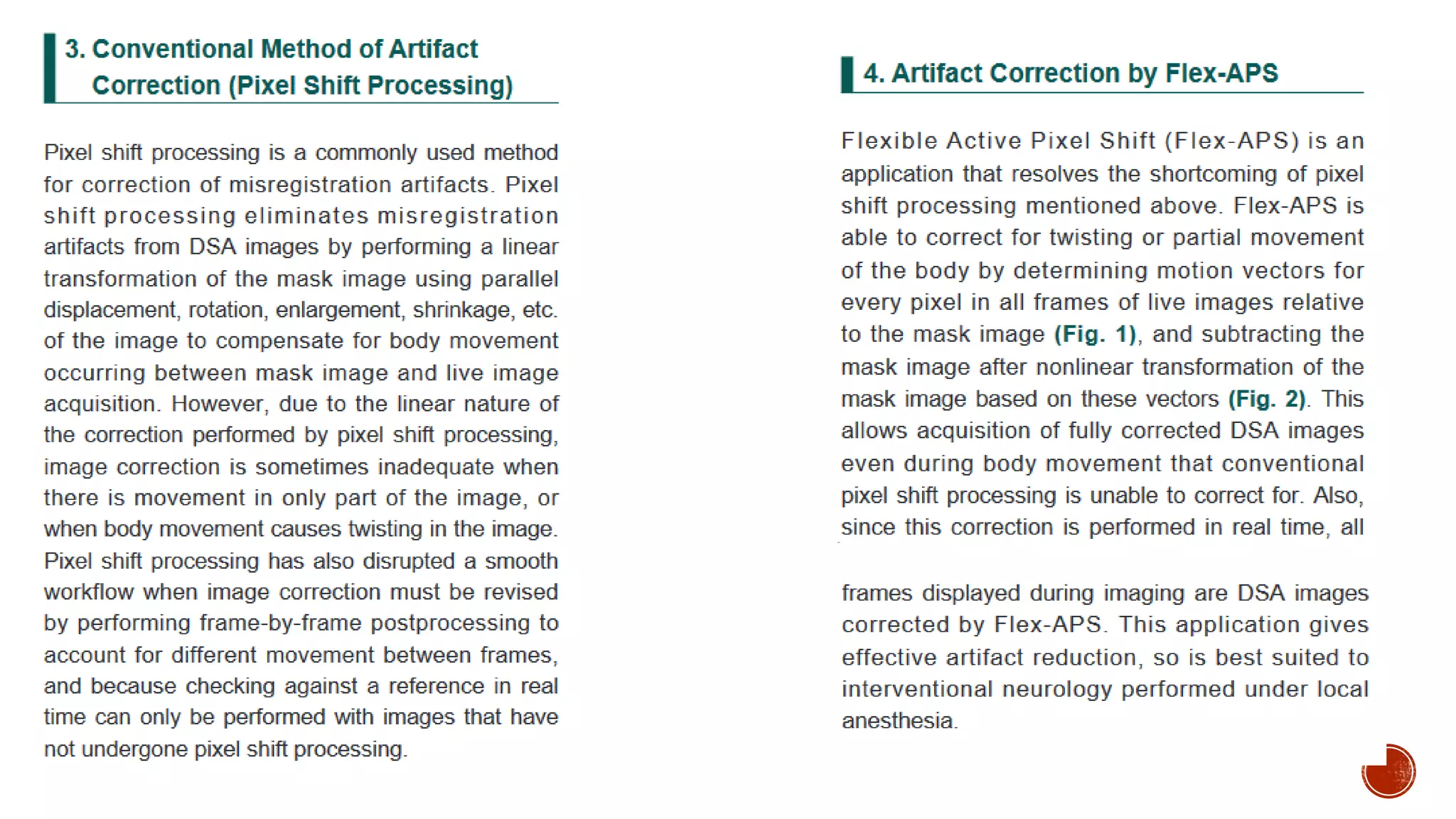
 D DSA provides the ability to create a series of time-resolved volumes of vasculature so that the
passage of a contrast bolus may be viewed in 3D at any time and from any angle. Traditional 3D
DSA acquisitions provide volumetric anatomic information but are not time-resolved. The overlap
of vasculature in these 3D images often makes it difficult to analyze details (eg, angioarchitecture
of an AVM nidus). To overcome this problem, multiple 2D DSA acquisitions at different angles are
often necessary. The 4D algorithm applied to data from a rotational acquisition, obtained by using
an injection protocol that starts the injection shortly after rotation of the C-arm rather than
simultaneous with its rotation, results in a series of 4D DSA volumes that provides a user with
the ability to view both anatomic information and contrast dynamics.1 The anatomic information
provided by this technique has not, to our knowledge, been compared with that provided by
conventional 2D and 3D DSA images. In this study, we aimed to assess the ability of 4D DSA to
depict vascular anatomy. Our methods also aimed to acquire data that would allow us to make
judgments as to whether the content was superior to and/or complementary to that of
conventional DSA studies. We believed that this comparison was important because the ability to
view relevant vasculature at any time and at any angle with a 4D reconstruction should result in
less need to acquire multiple 2D series in both diagnostic and interventional procedures, thereby
leading to reductions in both x-ray and contrast medium doses.
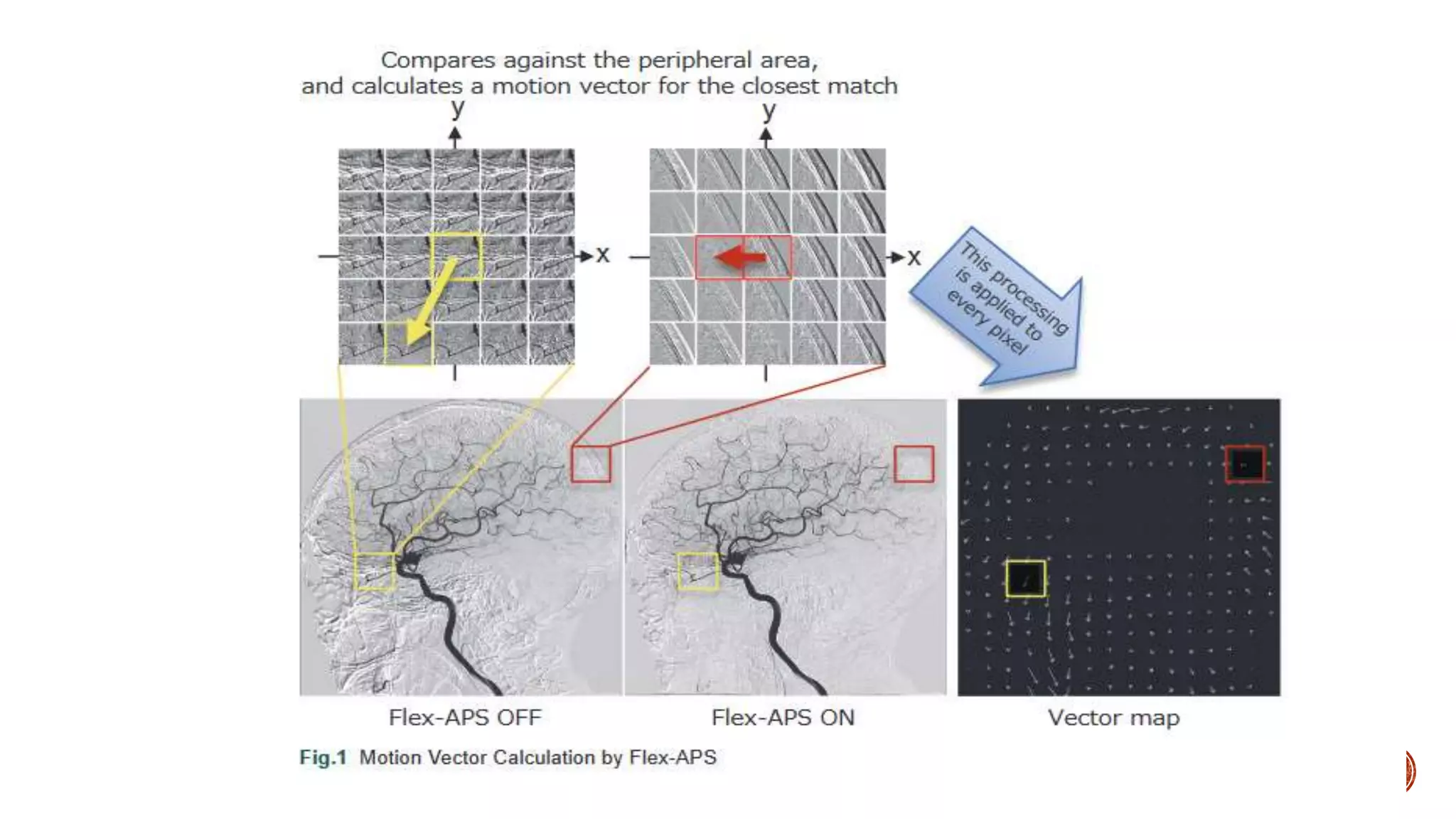
Patient movement between mask image and live image causes
misregistration artifacts that can hinder a correct diagnosis
* Recently, an increasing number of cases of interventional neurology,
including therapeutic procedures, are being performed under local
anesthesia. Although these patient's head is retained firmly and the
patient is asked to remain motionless before acquisition in these cases,
it is not uncommon for the head to move slightly due to respiratory
fluctuation or from the heat sensation and pain associated with
injection of contrast media, which leads to misregistration artifacts
Pixel shift processing is a commonly used method for the correction of
misregistration artifacts.
Principle of DSA
Principle of DSA
Principle of DSA
Principle of DSA

Principle of DSA

  • 1.
    MELWIN AUGUSTINE 3RD YEARBS.c RADIOGRAPHY DEPT.OF NIIR NIMHANS
  • 2.
    D – Digital S– Subtractional A - Angiography
  • 3.
    ANGIO – MeansBlood Vessels. Angiography is the study of Blood Vesslels. Radiological aspect – It is a medical imaging technique to visualize the blood vessels after injecting dye(contrast).
  • 4.
    A technique bywhich bone structure images are subtracted or removed from a film leaving only the clear image of blood vessels. Unwanted elements are eliminated. - = MASK IMAGE CONTRAST IMAGE SUBTRACTED IMAGE
  • 5.
    A fluoroscopic techniqueused extensively in interventional radiology for visualizing blood vessels.  Radiopaque structures such as bones are eliminated ("subtracted") digitally from the image, thus allowing for accurate depiction of the blood vessels.
  • 6.
     Portugese neurologistEgas Moniz,in 1972 developed the technique of contrast x-ray cerebral angiographyto diagnose diseases such as tumors & AVMs  The idea of subtraction images was first proposed by the Dutch radiologist ZIEDES DES PLANTES in 1935 , when he was able to produce subtracted images using plain films.  By 1978 the feasibility of DSA for human subjects was demonstrated & prototype commercial DSA systems were introduced in1980.  With the introduction of Seldinger Technique in1953,the procedure become safer as no sharp devices need to remain inside the vascular lumen
  • 7.
     Photographic methodis used to eliminate unwanted images .  No addition of information, only purpose to make diagnostically important information to see.  1st described by Zeides des Plantes,1953  3 CONDITIONS *SCOUT FILM *ANGIOGRAM FILM – CONTRAST *NO MOTION OF HEAD
  • 8.
    MASK SUBTRACTION First precontrast mask image is subtracted from sequential post contrast images
  • 9.
    DUAL ENERGY SUBTRACTION *Two imagesare taken sequentially one at high energy (KVp) another at low KVp and are subtracted from each other *It is divided into 2 (1) K-edge subtraction (2)Hybrid subtraction
  • 10.
    K-EDGE SUBTRACTION Iodine attenuatesdiagnostic x-rays almost entirely by Photoelectric effect. One method for achieving high iodine contrast is removal of all x-rays from the beam except those that lie below the K-shell Binding Energy of Iodine. X-ray filter made of rare earth screen named CERIUM can do this well, since B.E is 40 KeV. Thick filter will remove most of the x-rays above 40 KeV. The image to be subtracted should contain few x-rays.
  • 11.
    HYBRID SUBTRACTION MASKSUBTRACTION +DUAL ENERGYSUBTRACTION • High KVp & low KVp image pair is collected . • No patient movement –soft tissues cancel properly.But bone edhes cause severe artifact. • Consider the subtracted images consist of only two atomic no. materials (iodine & bone) • Hybrid subtraction produces 2 sets of subtracted images . • The same bone & iodine structures are present on both sets. • D.E.S can now be used to eliminate bone leaving only iodine. • Final image – more noise.
  • 12.
    Similar to simplemask subtraction but new mask is taken for each subtraction Each subtracted image is the difference between the images separated by some fixed interval of time TIME INTERVAL DIFFERENCING
  • 13.
    TEMPORAL FILTERING •Generates onefinal image by adding & subtracting some of the original images together,& then shifting & repeating to form the next image •Temporal filters are used •Reduces noise and reduces tube loading
  • 14.
    ROAD MAP ,SMART MASK 3D DSA XPER CT/VASO CT PERFUSION PIXEL SHIFTING
  • 17.
     For theevaluation of intracranial aneurysms, DSA remains the “gold standard”, and the diagnostic accuracy of 3D-iamges has developed rapidly  It is necessary to determine the best working angle for endovascular treatment of intracranial aneurysms and for this purpose, 3D-DSA with auto-positioning function is an essential modality for endovascular treatment. The position of the C-arm using the information provided by 3D-DSA was well correlated with the actual working angle and 3D-DSA had a satisfactory ability to image major artery branches of intracranial aneurysms.  3DRA depicts considerably more small (≤3 mm) additional aneurysms than DSA
  • 19.
     D DSAprovides the ability to create a series of time-resolved volumes of vasculature so that the passage of a contrast bolus may be viewed in 3D at any time and from any angle. Traditional 3D DSA acquisitions provide volumetric anatomic information but are not time-resolved. The overlap of vasculature in these 3D images often makes it difficult to analyze details (eg, angioarchitecture of an AVM nidus). To overcome this problem, multiple 2D DSA acquisitions at different angles are often necessary. The 4D algorithm applied to data from a rotational acquisition, obtained by using an injection protocol that starts the injection shortly after rotation of the C-arm rather than simultaneous with its rotation, results in a series of 4D DSA volumes that provides a user with the ability to view both anatomic information and contrast dynamics.1 The anatomic information provided by this technique has not, to our knowledge, been compared with that provided by conventional 2D and 3D DSA images. In this study, we aimed to assess the ability of 4D DSA to depict vascular anatomy. Our methods also aimed to acquire data that would allow us to make judgments as to whether the content was superior to and/or complementary to that of conventional DSA studies. We believed that this comparison was important because the ability to view relevant vasculature at any time and at any angle with a 4D reconstruction should result in less need to acquire multiple 2D series in both diagnostic and interventional procedures, thereby leading to reductions in both x-ray and contrast medium doses.
  • 20.
    Patient movement betweenmask image and live image causes misregistration artifacts that can hinder a correct diagnosis * Recently, an increasing number of cases of interventional neurology, including therapeutic procedures, are being performed under local anesthesia. Although these patient's head is retained firmly and the patient is asked to remain motionless before acquisition in these cases, it is not uncommon for the head to move slightly due to respiratory fluctuation or from the heat sensation and pain associated with injection of contrast media, which leads to misregistration artifacts Pixel shift processing is a commonly used method for the correction of misregistration artifacts.