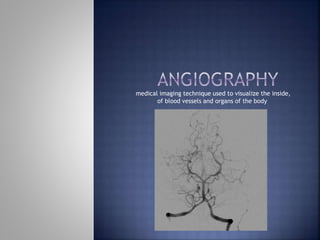
medical imaging technique used to visualize the inside,
of blood vessels and organs of the body
What do we visualize with an angiographic
procedure?
 Is the general term that describes the
radiologic examination of vascular structures
within the body after the introduction of an
iodinated contrast medium or gas
 The first angiogram was performed only
months after Roentgen's discovery
 Which was when?
Two physicians injected chalk or mercury
salts into an amputated hand and created an
image of the arteries
 It is used to assess for diseases of the:
 Arteries (these take blood to the brain, limbs
andabdominal organs)
 Veins (these carry blood back to the heart)
These diseases may include:
1. Atherosclerosis: 'furring' of the arteries causing
them to narrow.
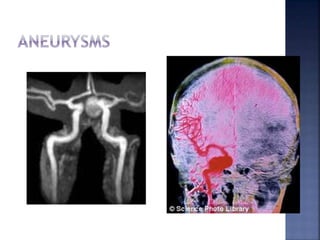
2. Aneurysms: blood vessels that become enlarged
with a risk of bursting.
3. Conditions causing internal bleeding, amongst
many others.
which demonstrate the vasculature to a greater or less degree
 CT
 MRI (MRA)
 Ultrasound (particularly Doppler)
 Nuclear Medicine
 are all used to image vessels and each
has its advantages and disadvantages
 Vessel imaging is a constantly evolving
area.
 Radiologist/ Specialist
 Nurse
 2-3 Radiologic Technologists (CV)
 Sometimes Anesthesiologist
 Verify the presence of tumors
 Blood supply to tumors
 Internal bleeding
 Possible anemia
 Stenosis
 Can be caused form atherosclerosis
 Occlusions
 Clots
 Thrombus
 Embolus
 Aneurysms
 Heart disease
 Previous severe reaction to contrast
 Impaired renal function
 Impaired blood clotting factors
 Inability to undergo surgical procedure
 Iodinated contrast media is used
 Can produce nausea & an uncomfortable burning
sensation
 Allergic reactions
 Severe: anaphylactic shock
 Shock, rapid shallow breathing, high pulse rate &
ALOC
 Mild: Hives or slight difficulty breathing
 Once you are home you should drink plenty of
fluids
 (avoiding alcohol) for the first 24 hours, and take
things
 easy for 48 hours. You should avoid driving,
strenuous
 activity and sexual intercourse. This allows time
for the
 artery to heal. A more detailed booklet will be
given to
 you called "Discharge advice following a Vascular
 Radiology Procedure" when you go home.
 Conventional angiography is usually a very safe
procedure but because it is more invasive than MRA
or CTA, the risks of complications are greater. The
risks include: minor bleeding/bruising and a small risk
of damage to the vessels, but the risk of serious
complications is rare.
 It is possible to suffer an allergic reaction due to the
contrast medium required during the test. Thankfully,
they are uncommon and usually minor (mild rash or
itching). More severe reactions are possible (1 in 2500
patients) and very rarely can be life threatening (1 in
25,000).
 It is important to tell your Doctor or radiographer if
you have had a previous reaction to contrast medium
before your test commences.
 Maintain flow rate
 Includes heating device
( To reduce the viscosity of
the contrast media by
keeping it near body
temperature )
16
 In most angiographic studies
 contrast must be administered at a
consistent speed
 either faster
 as in abdominal angiography
 or slower as in lymphangiography
SAFETY MEASURES: P 638
LIGHT / ALARM /
Now primarily uses:
DSA: Digital subtraction angiography
 This is still considered the gold standard
of vessel imaging when other modalities
are inconclusive
 Now common practice to be considered as an
area needing advanced training for:
1. Radiologist: Interventional
2. R. T. (CIT, CV) etc ANGIO tech
Technical innovations
 image intensification
 three-phase generators
 rapid film changers
 automatic pressure injectors
 advanced catheter technology
 all helped to establish angiography as an essential
diagnostic tool by the 1960s
An important offshoot of angiographic
imaging
 have created a therapeutic technology
 Embolization
 intra-arterial drug therapy
 transluminal angioplasty
 are among the procedures that have
radically changed and broadened the scope
of the diagnostic imaging department
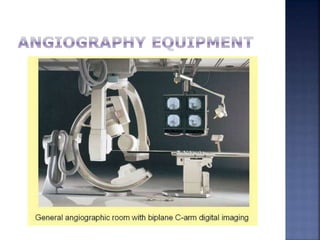
 Biplane C-arm digital imaging
 Autoinjector
 --syringes, a heating device,
 a high-pressure mechanism
 a control panel
 Image Intensifying screen
 Sliding table
Rapid film changer (NOW DIGITAL*)
 Cut film 6 & Cassette changer /magazine
1. Puncture Needle
Stylet and Cannula
large cannula size (1.6mm)
2. Guide Wire
--Soft flexible wire with the strength to pass
through curved vessels (.6 – 1.0)
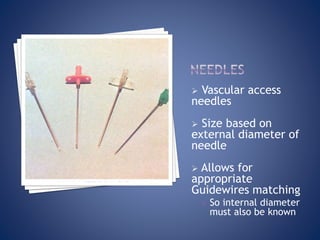
 Vascular access
needles
 Size based on
external diameter of
needle
 Allows for
appropriate
Guidewires matching
 So internal diameter
must also be known
Used as a platform
over which a catheter
is to be advanced
Once positioned
guidewire is fixed and
catheter is advanced
until it meets the tip
of the guidwire
Mostly constructed
on stainless steel &
coated with Teflon
Short catheters used
when multiple
catheters will be used
Placed in lieu of a
catheter
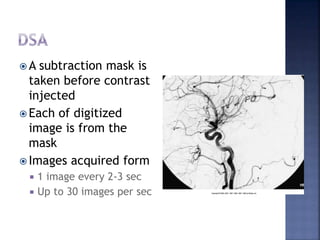
 A subtraction mask is
taken before contrast
injected
 Each of digitized
image is from the
mask
 Images acquired form
 1 image every 2-3 sec
 Up to 30 images per sec
1. www.sth.nhs.uk/clientfiles/File/pd6831_Angiography.pdf
2. http://www.elcamino.edu/faculty/mcolunga/RT%20255/A
ngiography%20and%20Arteriography.ppt
3. https://en.wikipedia.org/wiki/Angiography
4. https://www.slideshare.net/jdtomines/angiography-basics
‫الحبيب‬‫سالم‬‫عبدهللا‬331100725
‫الوهيبي‬‫سليمان‬‫علي‬321102923
‫ي‬‫املصر‬‫سليمان‬‫عبدهللا‬331102611
‫أحمد‬‫إشفاق‬‫محمد‬321103505

Angiography

  • 1.
    medical imaging techniqueused to visualize the inside, of blood vessels and organs of the body
  • 2.
    What do wevisualize with an angiographic procedure?
  • 3.
     Is thegeneral term that describes the radiologic examination of vascular structures within the body after the introduction of an iodinated contrast medium or gas
  • 4.
     The firstangiogram was performed only months after Roentgen's discovery  Which was when? Two physicians injected chalk or mercury salts into an amputated hand and created an image of the arteries
  • 5.
     It isused to assess for diseases of the:  Arteries (these take blood to the brain, limbs andabdominal organs)  Veins (these carry blood back to the heart) These diseases may include: 1. Atherosclerosis: 'furring' of the arteries causing them to narrow. 2. Aneurysms: blood vessels that become enlarged with a risk of bursting. 3. Conditions causing internal bleeding, amongst many others.
  • 8.
    which demonstrate thevasculature to a greater or less degree  CT  MRI (MRA)  Ultrasound (particularly Doppler)  Nuclear Medicine  are all used to image vessels and each has its advantages and disadvantages  Vessel imaging is a constantly evolving area.
  • 9.
     Radiologist/ Specialist Nurse  2-3 Radiologic Technologists (CV)  Sometimes Anesthesiologist
  • 10.
     Verify thepresence of tumors  Blood supply to tumors  Internal bleeding  Possible anemia  Stenosis  Can be caused form atherosclerosis  Occlusions  Clots  Thrombus  Embolus  Aneurysms  Heart disease
  • 11.
     Previous severereaction to contrast  Impaired renal function  Impaired blood clotting factors  Inability to undergo surgical procedure
  • 12.
     Iodinated contrastmedia is used  Can produce nausea & an uncomfortable burning sensation  Allergic reactions  Severe: anaphylactic shock  Shock, rapid shallow breathing, high pulse rate & ALOC  Mild: Hives or slight difficulty breathing
  • 13.
     Once youare home you should drink plenty of fluids  (avoiding alcohol) for the first 24 hours, and take things  easy for 48 hours. You should avoid driving, strenuous  activity and sexual intercourse. This allows time for the  artery to heal. A more detailed booklet will be given to  you called "Discharge advice following a Vascular  Radiology Procedure" when you go home.
  • 14.
     Conventional angiographyis usually a very safe procedure but because it is more invasive than MRA or CTA, the risks of complications are greater. The risks include: minor bleeding/bruising and a small risk of damage to the vessels, but the risk of serious complications is rare.  It is possible to suffer an allergic reaction due to the contrast medium required during the test. Thankfully, they are uncommon and usually minor (mild rash or itching). More severe reactions are possible (1 in 2500 patients) and very rarely can be life threatening (1 in 25,000).  It is important to tell your Doctor or radiographer if you have had a previous reaction to contrast medium before your test commences.
  • 15.
     Maintain flowrate  Includes heating device ( To reduce the viscosity of the contrast media by keeping it near body temperature )
  • 16.
    16  In mostangiographic studies  contrast must be administered at a consistent speed  either faster  as in abdominal angiography  or slower as in lymphangiography SAFETY MEASURES: P 638 LIGHT / ALARM /
  • 18.
    Now primarily uses: DSA:Digital subtraction angiography  This is still considered the gold standard of vessel imaging when other modalities are inconclusive  Now common practice to be considered as an area needing advanced training for: 1. Radiologist: Interventional 2. R. T. (CIT, CV) etc ANGIO tech
  • 19.
    Technical innovations  imageintensification  three-phase generators  rapid film changers  automatic pressure injectors  advanced catheter technology  all helped to establish angiography as an essential diagnostic tool by the 1960s
  • 20.
    An important offshootof angiographic imaging  have created a therapeutic technology  Embolization  intra-arterial drug therapy  transluminal angioplasty  are among the procedures that have radically changed and broadened the scope of the diagnostic imaging department
  • 21.
     Biplane C-armdigital imaging  Autoinjector  --syringes, a heating device,  a high-pressure mechanism  a control panel  Image Intensifying screen  Sliding table Rapid film changer (NOW DIGITAL*)  Cut film 6 & Cassette changer /magazine
  • 22.
    1. Puncture Needle Styletand Cannula large cannula size (1.6mm) 2. Guide Wire --Soft flexible wire with the strength to pass through curved vessels (.6 – 1.0)
  • 23.
     Vascular access needles Size based on external diameter of needle  Allows for appropriate Guidewires matching  So internal diameter must also be known
  • 24.
    Used as aplatform over which a catheter is to be advanced Once positioned guidewire is fixed and catheter is advanced until it meets the tip of the guidwire Mostly constructed on stainless steel & coated with Teflon
  • 25.
    Short catheters used whenmultiple catheters will be used Placed in lieu of a catheter
  • 28.
     A subtractionmask is taken before contrast injected  Each of digitized image is from the mask  Images acquired form  1 image every 2-3 sec  Up to 30 images per sec
  • 43.
  • 44.