CATHETERS
$
GUIDE WIRES
BY
UBAH N.A
CONTENT:
Guide wires
Definitions
Construction
Types
Cores
Torque
Tip Configurations
Length
Diameter
SafetyTest
Precautions
SeldingerTechnique
Catheters
•History $ Origin
•Definition
•Materials
•Ideal Characteristics
•Measurement
•Classification
•Main types
•Other types
•Uses
•Sterilization
•References
WHAT ARE GUIDE WIRES ?
They are the stainless steel metallic
structures that guides the catheter through
the blood vessels for placement. Guide wires
are used for both Cardiology and Radiology
angiographic procedures.
 Guide wires are relatively simple spring type wires that
provides necessary firmness and the control to the site
where Angiogram will be taken.
 As the name suggests it ‘ Guides’ the catheter.
 PTFE coated Soft tip for the smoothness during the
insertion
 Less trauma to the intimal wall of the artery
Construction of Guide wires
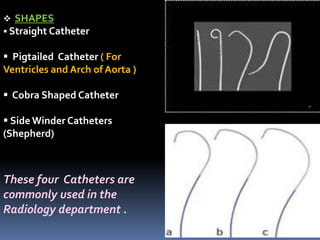
They are Made of Stainless steel or other
metallic Alloys.
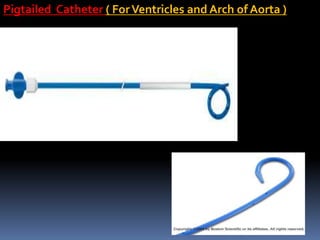
Alloys are formed when two or more metals
are mixed in a particular proportion to
produce a single metallic substance.
Types Of Guide Wires
They are two main types of Guide wires :
The Solid Guide wire
Wrapped Guide wire
BothTypes of Guide wire has one end that is rigid , with the
opposite end flexible.The flexible tip is introduced into the
blood vessel first, so that if the guide wire strikes a vessel
wall, it will bend, thereby preventing damage to the vessel.
The advantages of solid Guide wires are that it reduces the
Possibility of catheter tip flaring, Blood clotting on the
guide wire, Abrasion of the vessel and the danger of
unravelling.The one disadvantage of this type is its lack of
versatility.
The Wrapped guide wire can be constructed so that it has
a movable core, making it more versatile than the Solid
Stainless Steel Guide wires, but it has other
disadvantages:
Possibility of catheter tip flaring.
Blood clotting on the guide wire.
Abrasion of the vessel.
The danger of unravelling.
To reduce the disadvantages of wrapped
Guide wire ( Damage to the catheter or
the vessels ) , the wrapping maybeTeflon-
coated or heparin-coated.
Cores
There are two main types of Guide wire Core :
Fixed Cores ( for NormalVascular System )
Movable Cores ( for Torturous vascular
structures )
The Movable core has a handle MANDRIL
TORQUE
Refers to the response of the guide wire orThe
Catheters to Movements ( likeTwisting, bending
andTurning )
Tip Configuration
There are two tip Configurations that are available for
Guide Wires :
The Straight tip
The J-shaped tip
Length:
Guide Wire Length varies from 30 to 260 cm.The shorter
Guide wires (30 to 50 cm ) are usually used for percutanous
or direct vascular puncture.The average Guide wire
employed for adults undergoing selective Angiography is
approx. 100 to 150 cm in length.The 260 cm guide wires are
used when interchanging vascular catheters.
Diameter:
The diameter of Guide wire s are measured in fractions of
an inch, or millimeters.The range is 0.014” (0.35mm) to
0.052” (1.32mm).
The most common diameters used for adults are 0.035”
(0.089mm) and 0.038” (0.97mm).
There are several factors to consider when selecting the
proper diameter size.
They are :
Needle gauge
Vessel size
Size of the lumen of the vascular catheter
Safety Test
Three test are performed to determine the safety of the
guide wire :
Determination of the flexibility of the Guide wire tip by
bending the tip 180 degrees.
Visual inspection of wrapped guide wires junction of the
stiff core and the external coils at the distal tip.
Checking of the core by giving a slight twist and tug to the
guide wire
After the has passed these three safety tests, it is ready for
use.
Precautions
Certain Precautions must be taken when using a
guide wire.These precautions include –
Care when advancing the guide wire.
Position of the needle beveled end .
Cleaning the guide wire.
Using a new guide wire.
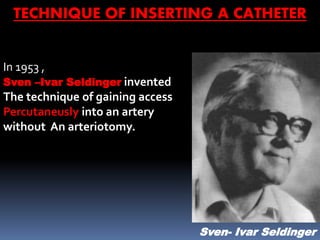
Sven- Ivar Seldinger
In 1953 ,
Sven –Ivar Seldinger invented
The technique of gaining access
Percutaneusly into an artery
without An arteriotomy.
TECHNIQUE OF INSERTING A CATHETER
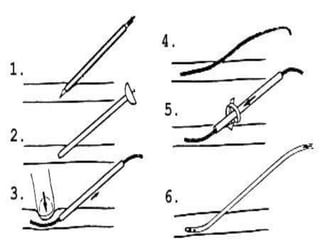
SELDINGER TECHNIQUE :
The technique of catheter insertion via
double-wall needle puncture and guide-wire is known as
The SELDINGER TECHNIQUE.
Double Wall Puncture:
Mostly done.
 Compression to prevent Hematoma of the other wall.
 Rotatory movement to get the needle into the lumen.
Single Wall Puncture:
Usually done for patients coagulation time is less.
18
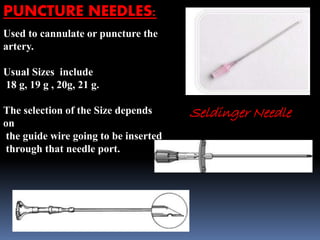
PUNCTURE NEEDLES:
Used to cannulate or puncture the
artery.
Usual Sizes include
18 g, 19 g , 20g, 21 g.
The selection of the Size depends
on
the guide wire going to be inserted
through that needle port.
Seldinger Needle
CATHETERS
Late Latin, from Greek:
KATHETER, came from KATHIENAI,
kathe- to send down : kat-, kata-, cata- + hienai- to send .
HISTORY AND ORIGIN OF “CATHETER”
 In 1929 Werner
Forssmann demonstrated
that a simple Rubber catheter
could be passed to the
pulmonary artery through the
Anti-Cubital Vein and An
angiographic film could be
obtained using radiographic
contrast.
22
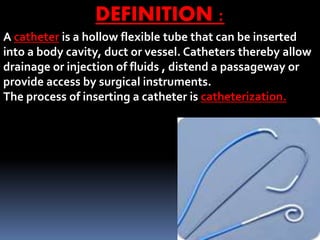
DEFINITION :
A catheter is a hollow flexible tube that can be inserted
into a body cavity, duct or vessel. Catheters thereby allow
drainage or injection of fluids , distend a passageway or
provide access by surgical instruments.
The process of inserting a catheter is catheterization.
WHAT ARE CATHETERS MADE UP OF ?
Materials:
A range of polymers are used for the construction of
catheters, including silicone rubber latex and
thermoplastic elastomers.
Silicone is one of the most common choices because it is
inert and unreactive to body fluids and a range of medical
fluids with which it might come into contact.
Materials:
Polyethylene (PE)
Fluoropolomers (PTFE)
(TEFLON)
Polyurethane (PUR)
Silicone (SI)
Polyvinylchloride (PVC)
Ideal characteristics of catheters.
 BetterTorque Control
 Strength
 Radiopacity
 Flexible
 AtraumaticTip
 Low Surface frictional resistance for good track ability
over guide wire.
Joseph Charrière (March 19, 1803 –
April 28, 1876) was a Swiss-born
French manufacturer of surgical
instruments.
Joseph-Frédéric-Benoît
Charrière
He Invented the French Gauge or
the French Scale for measuring the
Diameter of A Catheter .
MEASUREMENT:
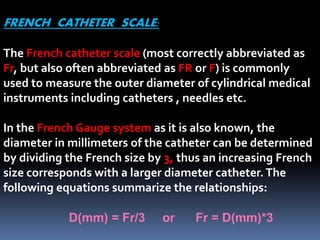
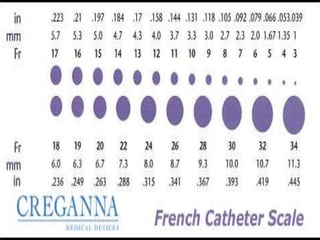
FRENCH CATHETER SCALE:
The French catheter scale (most correctly abbreviated as
Fr, but also often abbreviated as FR or F) is commonly
used to measure the outer diameter of cylindrical medical
instruments including catheters , needles etc.
In the French Gauge system as it is also known, the
diameter in millimeters of the catheter can be determined
by dividing the French size by 3, thus an increasing French
size corresponds with a larger diameter catheter. The
following equations summarize the relationships:
D(mm) = Fr/3 or Fr = D(mm)*3
The French scale or French gauge system is
commonly used to measure the size of a catheter. It
is most often abbreviated as Fr, but can often be
seen abbreviated as Fg, Ga, FR or F. It may also be
abbreviated as CH or Ch (for Charrière, its inventor).
29
A catheter of 1 French has an
external diameter of 1⁄3 mm,[1] and therefore
the diameter of a round catheter in
millimeters can be determined by dividing the
French size by 3:
D (mm) = Fr / 3
or
Fr = D (mm) * 3
For example, if the French size is 9, the
diameter is 3 mm.
 Most commonly in adult Diagnostic Catheters of 5 – 7 Fr
are used.
Diagnostic Angiographic Catheters.
Micro catheters.
Drainage Catheters.
Balloon Catheters.
CentralVenous Catheters.
CATHETERS CAN BE BROADLY CLASSIFIED
UNDER THESE GROUPS:
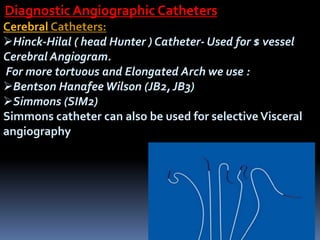
Cerebral Catheters:
Hinck-Hilal ( head Hunter ) Catheter- Used for $ vessel
Cerebral Angiogram.
For more tortuous and Elongated Arch we use :
Bentson Hanafee Wilson (JB2, JB3)
Simmons (SIM2)
Simmons catheter can also be used for selective Visceral
angiography
Diagnostic Angiographic Catheters
Visceral Catheters
Shepherd’s hook / Hockey stick Catheter.
Cobra Head Catheter.
Coronary Catheters
Judkins Catheters.
Amplatz Catheters.
Sones Coronary catheters.
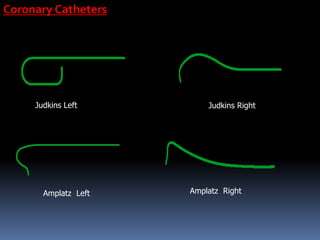
Judkins Left Judkins Right
Amplatz Left Amplatz Right
Coronary Catheters
Renal Catheters
Selective catheters-
Simmons or sidewinder Catheters.
RDC (Renal double curved selective catheters)
Semi selective Catheters has 6 side holes just
proximal to the tapered part.
Mircocatherters
3 F or Smaller.
Designed for distal Catheterization.
Placed over o.010 to 0.018 guide wire.
Used mostly for Neuro-intervention
Helpful in peripheral intervention to select smaller vessels
for embolization.
Drainage Catheters
Used for drainage of fluid collection including
nephrostomy, abscess, biliary gall bladder, pleural
fluid, ascites, lymphoceles.
Balloon (Angioplasty) Catheters
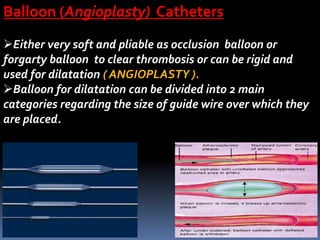
Either very soft and pliable as occlusion balloon or
forgarty balloon to clear thrombosis or can be rigid and
used for dilatation ( ANGIOPLASTY ).
Balloon for dilatation can be divided into 2 main
categories regarding the size of guide wire over which they
are placed.
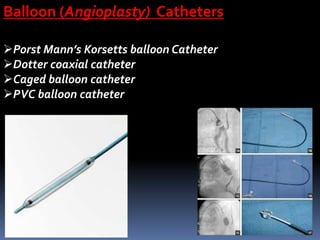
Porst Mann’s Korsetts balloon Catheter
Dotter coaxial catheter
Caged balloon catheter
PVC balloon catheter
Balloon (Angioplasty) Catheters
CentralVenous Catheters
There areThree Basic categories of catheters :
Non-Tunnelled catheters – these catheters are placed via
central veins ( subclavian and internal jugular) by blinded
percutaneus technique.
Tunnelled Catheters –They can be accessed externally
and are designed for long term home use.
Implanted subcutaneus port – these are attached to the
port that is buried subcutaneously for stabilization.They
maybe placed either on chest wall or the upper arm.
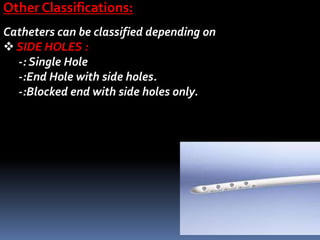
Catheters can be classified depending on
 SIDE HOLES :
-: Single Hole
-:End Hole with side holes.
-:Blocked end with side holes only.
Other Classifications:
SIZES :
Abdominal – 6-80 cm
Thoracic or Carotid Arteries – 100-120 cm
 NOTE: Size depends on :
> age of the patient
> selective or super selective study
> size of the vessels.
NOTE: Ideal practice is to use the smallest diameter
catheter feasible for any particular study to minimize the
risk of arterial damage by the procedure.
 SHAPES
 Straight Catheter
 Pigtailed Catheter ( For
Ventricles and Arch of Aorta )
 Cobra Shaped Catheter
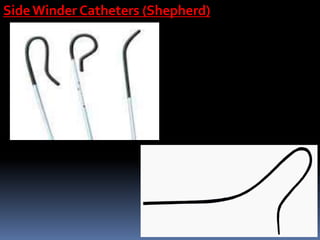
 Side Winder Catheters
(Shepherd)
These four Catheters are
commonly used in the
Radiology department .
Straight Catheter
Pigtailed Catheter ( ForVentricles and Arch of Aorta )
Side Winder Catheters (Shepherd)
Both Pigtailed And Straight Catheters are used for
injecting a large volume of contrast at a high rate (
velocity ) .Thus, they have multiple side holes .
They are also called FLUSH CATHERTERS
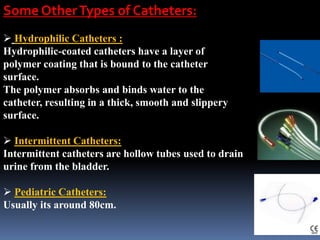
Some OtherTypes of Catheters:
 Hydrophilic Catheters :
Hydrophilic-coated catheters have a layer of
polymer coating that is bound to the catheter
surface.
The polymer absorbs and binds water to the
catheter, resulting in a thick, smooth and slippery
surface.
 Intermittent Catheters:
Intermittent catheters are hollow tubes used to drain
urine from the bladder.
 Pediatric Catheters:
Usually its around 80cm.
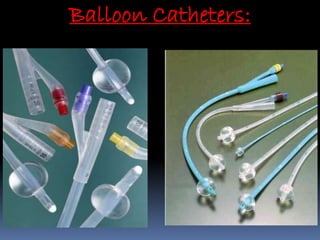
Balloon Catheters:
51
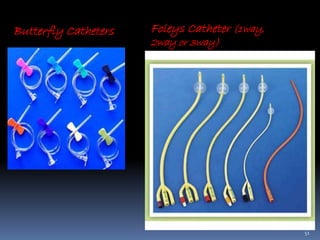
Butterfly Catheters Foleys Catheter (1way,
2way or 3way)
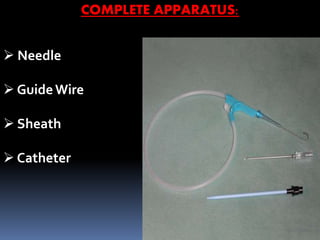
COMPLETE APPARATUS:
 Needle
 GuideWire
 Sheath
 Catheter
USES & APPLICATIONS OF CATHETERS:
Placement of a catheter into a particular part of the body
may allow:
 Draining urine from the urinary bladder as in urinary
catheterization, e.g., the Foley catheter.
 Drainage of urine from the kidney pelvis by percutaneous
nephrostomy.
 Drainage of fluid collections, e.g. an abdominal abscess.
Administration of intravenous fluids, medication or parenteral
nutrition with a peripheral venous catheter.
 Angioplasty , angiography , balloon septostomy, balloon
angioplasty. Often Seldinger technique is used.
A central venous catheter is a conduit for giving drugs or fluids into
a large-bore catheter positioned either in a vein near the heart or just
inside the atrium.
 A Swan - Ganz catheter is a special type of catheter placed into
the pulmonary artery for measuring pressures in the heart.
CONTD…
 Direct measurement of blood pressure in an artery or
vein.
 Direct measurement of intracranial pressure.
 Administration of anesthetic medication into the epidural
space, the subarachnoid space, or around a major nerve
bundle such as the brachial plexus.
 Subcutaneous administration of insulin or other
medications.
CONTD…
 Before giving for sterilization, catheter should be washed
in water and with air jets so that clots in the catheter lumen
come out.
 Methods for cleaning, decontaminating, and sterilizing
catheters are by using a combination of liquid and
gaseous/plasma sterilization techniques to ensure the
complete and efficient sterilization of a catheter .
Methods and apparatus for cleaning,
decontaminating, and sterilizing catheters
Angiographic dye and saline are removed from the
interior of the balloon and its lumen .
The outer surfaces of the catheter and a guide wire lumen
of the catheter are cleaned, decontaminated, and
sterilized with a liquid sterilant.
The liquid sterilant fills a balloon and a balloon lumen of
the catheter .
The filling, retaining, and draining steps are repeated
until an interior of the balloon and the balloon lumen are
sterilized.
STERLIZATION OF CATHETERS:
Methods for catheter sterilization :
The catheter is dried and then a plasma or gaseous
sterilant is used to sterilize at least the outer surfaces and
the guide wire lumen of the catheter.
Techniques for effectively sterilizing catheters, particularly
long-dwelling intravenous catheters includes
>> the transmission and dispersion of ultraviolet or
infrared radiation
Websites:
Wikipedia
 Google
Books:
 Radiological Procedures –A Guideline
 Cardiac Catheterization.
REFERENCES:
Catheters $ guidewires

Catheters $ guidewires

  • 1.
  • 2.
    CONTENT: Guide wires Definitions Construction Types Cores Torque Tip Configurations Length Diameter SafetyTest Precautions SeldingerTechnique Catheters •History$ Origin •Definition •Materials •Ideal Characteristics •Measurement •Classification •Main types •Other types •Uses •Sterilization •References
  • 3.
    WHAT ARE GUIDEWIRES ? They are the stainless steel metallic structures that guides the catheter through the blood vessels for placement. Guide wires are used for both Cardiology and Radiology angiographic procedures.
  • 4.
     Guide wiresare relatively simple spring type wires that provides necessary firmness and the control to the site where Angiogram will be taken.  As the name suggests it ‘ Guides’ the catheter.  PTFE coated Soft tip for the smoothness during the insertion  Less trauma to the intimal wall of the artery
  • 5.
    Construction of Guidewires They are Made of Stainless steel or other metallic Alloys. Alloys are formed when two or more metals are mixed in a particular proportion to produce a single metallic substance.
  • 6.
    Types Of GuideWires They are two main types of Guide wires : The Solid Guide wire Wrapped Guide wire BothTypes of Guide wire has one end that is rigid , with the opposite end flexible.The flexible tip is introduced into the blood vessel first, so that if the guide wire strikes a vessel wall, it will bend, thereby preventing damage to the vessel.
  • 7.
    The advantages ofsolid Guide wires are that it reduces the Possibility of catheter tip flaring, Blood clotting on the guide wire, Abrasion of the vessel and the danger of unravelling.The one disadvantage of this type is its lack of versatility. The Wrapped guide wire can be constructed so that it has a movable core, making it more versatile than the Solid Stainless Steel Guide wires, but it has other disadvantages: Possibility of catheter tip flaring. Blood clotting on the guide wire. Abrasion of the vessel. The danger of unravelling.
  • 8.
    To reduce thedisadvantages of wrapped Guide wire ( Damage to the catheter or the vessels ) , the wrapping maybeTeflon- coated or heparin-coated.
  • 9.
    Cores There are twomain types of Guide wire Core : Fixed Cores ( for NormalVascular System ) Movable Cores ( for Torturous vascular structures ) The Movable core has a handle MANDRIL
  • 10.
    TORQUE Refers to theresponse of the guide wire orThe Catheters to Movements ( likeTwisting, bending andTurning )
  • 11.
    Tip Configuration There aretwo tip Configurations that are available for Guide Wires : The Straight tip The J-shaped tip
  • 12.
    Length: Guide Wire Lengthvaries from 30 to 260 cm.The shorter Guide wires (30 to 50 cm ) are usually used for percutanous or direct vascular puncture.The average Guide wire employed for adults undergoing selective Angiography is approx. 100 to 150 cm in length.The 260 cm guide wires are used when interchanging vascular catheters.
  • 13.
    Diameter: The diameter ofGuide wire s are measured in fractions of an inch, or millimeters.The range is 0.014” (0.35mm) to 0.052” (1.32mm). The most common diameters used for adults are 0.035” (0.089mm) and 0.038” (0.97mm). There are several factors to consider when selecting the proper diameter size. They are : Needle gauge Vessel size Size of the lumen of the vascular catheter
  • 14.
    Safety Test Three testare performed to determine the safety of the guide wire : Determination of the flexibility of the Guide wire tip by bending the tip 180 degrees. Visual inspection of wrapped guide wires junction of the stiff core and the external coils at the distal tip. Checking of the core by giving a slight twist and tug to the guide wire After the has passed these three safety tests, it is ready for use.
  • 15.
    Precautions Certain Precautions mustbe taken when using a guide wire.These precautions include – Care when advancing the guide wire. Position of the needle beveled end . Cleaning the guide wire. Using a new guide wire.
  • 16.
    Sven- Ivar Seldinger In1953 , Sven –Ivar Seldinger invented The technique of gaining access Percutaneusly into an artery without An arteriotomy. TECHNIQUE OF INSERTING A CATHETER
  • 17.
    SELDINGER TECHNIQUE : Thetechnique of catheter insertion via double-wall needle puncture and guide-wire is known as The SELDINGER TECHNIQUE. Double Wall Puncture: Mostly done.  Compression to prevent Hematoma of the other wall.  Rotatory movement to get the needle into the lumen. Single Wall Puncture: Usually done for patients coagulation time is less.
  • 18.
  • 19.
    PUNCTURE NEEDLES: Used tocannulate or puncture the artery. Usual Sizes include 18 g, 19 g , 20g, 21 g. The selection of the Size depends on the guide wire going to be inserted through that needle port. Seldinger Needle
  • 20.
    CATHETERS Late Latin, fromGreek: KATHETER, came from KATHIENAI, kathe- to send down : kat-, kata-, cata- + hienai- to send . HISTORY AND ORIGIN OF “CATHETER”
  • 21.
     In 1929Werner Forssmann demonstrated that a simple Rubber catheter could be passed to the pulmonary artery through the Anti-Cubital Vein and An angiographic film could be obtained using radiographic contrast.
  • 22.
    22 DEFINITION : A catheteris a hollow flexible tube that can be inserted into a body cavity, duct or vessel. Catheters thereby allow drainage or injection of fluids , distend a passageway or provide access by surgical instruments. The process of inserting a catheter is catheterization.
  • 23.
    WHAT ARE CATHETERSMADE UP OF ? Materials: A range of polymers are used for the construction of catheters, including silicone rubber latex and thermoplastic elastomers. Silicone is one of the most common choices because it is inert and unreactive to body fluids and a range of medical fluids with which it might come into contact.
  • 24.
  • 25.
    Ideal characteristics ofcatheters.  BetterTorque Control  Strength  Radiopacity  Flexible  AtraumaticTip  Low Surface frictional resistance for good track ability over guide wire.
  • 26.
    Joseph Charrière (March19, 1803 – April 28, 1876) was a Swiss-born French manufacturer of surgical instruments. Joseph-Frédéric-Benoît Charrière He Invented the French Gauge or the French Scale for measuring the Diameter of A Catheter . MEASUREMENT:
  • 27.
    FRENCH CATHETER SCALE: TheFrench catheter scale (most correctly abbreviated as Fr, but also often abbreviated as FR or F) is commonly used to measure the outer diameter of cylindrical medical instruments including catheters , needles etc. In the French Gauge system as it is also known, the diameter in millimeters of the catheter can be determined by dividing the French size by 3, thus an increasing French size corresponds with a larger diameter catheter. The following equations summarize the relationships: D(mm) = Fr/3 or Fr = D(mm)*3
  • 28.
    The French scaleor French gauge system is commonly used to measure the size of a catheter. It is most often abbreviated as Fr, but can often be seen abbreviated as Fg, Ga, FR or F. It may also be abbreviated as CH or Ch (for Charrière, its inventor).
  • 29.
    29 A catheter of1 French has an external diameter of 1⁄3 mm,[1] and therefore the diameter of a round catheter in millimeters can be determined by dividing the French size by 3: D (mm) = Fr / 3 or Fr = D (mm) * 3 For example, if the French size is 9, the diameter is 3 mm.
  • 30.
     Most commonlyin adult Diagnostic Catheters of 5 – 7 Fr are used.
  • 32.
    Diagnostic Angiographic Catheters. Microcatheters. Drainage Catheters. Balloon Catheters. CentralVenous Catheters. CATHETERS CAN BE BROADLY CLASSIFIED UNDER THESE GROUPS:
  • 33.
    Cerebral Catheters: Hinck-Hilal (head Hunter ) Catheter- Used for $ vessel Cerebral Angiogram. For more tortuous and Elongated Arch we use : Bentson Hanafee Wilson (JB2, JB3) Simmons (SIM2) Simmons catheter can also be used for selective Visceral angiography Diagnostic Angiographic Catheters
  • 34.
    Visceral Catheters Shepherd’s hook/ Hockey stick Catheter. Cobra Head Catheter. Coronary Catheters Judkins Catheters. Amplatz Catheters. Sones Coronary catheters.
  • 35.
    Judkins Left JudkinsRight Amplatz Left Amplatz Right Coronary Catheters
  • 36.
    Renal Catheters Selective catheters- Simmonsor sidewinder Catheters. RDC (Renal double curved selective catheters) Semi selective Catheters has 6 side holes just proximal to the tapered part.
  • 37.
    Mircocatherters 3 F orSmaller. Designed for distal Catheterization. Placed over o.010 to 0.018 guide wire. Used mostly for Neuro-intervention Helpful in peripheral intervention to select smaller vessels for embolization.
  • 38.
    Drainage Catheters Used fordrainage of fluid collection including nephrostomy, abscess, biliary gall bladder, pleural fluid, ascites, lymphoceles.
  • 39.
    Balloon (Angioplasty) Catheters Eithervery soft and pliable as occlusion balloon or forgarty balloon to clear thrombosis or can be rigid and used for dilatation ( ANGIOPLASTY ). Balloon for dilatation can be divided into 2 main categories regarding the size of guide wire over which they are placed.
  • 40.
    Porst Mann’s Korsettsballoon Catheter Dotter coaxial catheter Caged balloon catheter PVC balloon catheter Balloon (Angioplasty) Catheters
  • 41.
    CentralVenous Catheters There areThreeBasic categories of catheters : Non-Tunnelled catheters – these catheters are placed via central veins ( subclavian and internal jugular) by blinded percutaneus technique. Tunnelled Catheters –They can be accessed externally and are designed for long term home use. Implanted subcutaneus port – these are attached to the port that is buried subcutaneously for stabilization.They maybe placed either on chest wall or the upper arm.
  • 42.
    Catheters can beclassified depending on  SIDE HOLES : -: Single Hole -:End Hole with side holes. -:Blocked end with side holes only. Other Classifications:
  • 43.
    SIZES : Abdominal –6-80 cm Thoracic or Carotid Arteries – 100-120 cm  NOTE: Size depends on : > age of the patient > selective or super selective study > size of the vessels. NOTE: Ideal practice is to use the smallest diameter catheter feasible for any particular study to minimize the risk of arterial damage by the procedure.
  • 44.
     SHAPES  StraightCatheter  Pigtailed Catheter ( For Ventricles and Arch of Aorta )  Cobra Shaped Catheter  Side Winder Catheters (Shepherd) These four Catheters are commonly used in the Radiology department .
  • 45.
  • 46.
    Pigtailed Catheter (ForVentricles and Arch of Aorta )
  • 47.
  • 48.
    Both Pigtailed AndStraight Catheters are used for injecting a large volume of contrast at a high rate ( velocity ) .Thus, they have multiple side holes . They are also called FLUSH CATHERTERS
  • 49.
    Some OtherTypes ofCatheters:  Hydrophilic Catheters : Hydrophilic-coated catheters have a layer of polymer coating that is bound to the catheter surface. The polymer absorbs and binds water to the catheter, resulting in a thick, smooth and slippery surface.  Intermittent Catheters: Intermittent catheters are hollow tubes used to drain urine from the bladder.  Pediatric Catheters: Usually its around 80cm.
  • 50.
  • 51.
    51 Butterfly Catheters FoleysCatheter (1way, 2way or 3way)
  • 52.
    COMPLETE APPARATUS:  Needle GuideWire  Sheath  Catheter
  • 53.
    USES & APPLICATIONSOF CATHETERS: Placement of a catheter into a particular part of the body may allow:  Draining urine from the urinary bladder as in urinary catheterization, e.g., the Foley catheter.  Drainage of urine from the kidney pelvis by percutaneous nephrostomy.  Drainage of fluid collections, e.g. an abdominal abscess.
  • 54.
    Administration of intravenousfluids, medication or parenteral nutrition with a peripheral venous catheter.  Angioplasty , angiography , balloon septostomy, balloon angioplasty. Often Seldinger technique is used. A central venous catheter is a conduit for giving drugs or fluids into a large-bore catheter positioned either in a vein near the heart or just inside the atrium.  A Swan - Ganz catheter is a special type of catheter placed into the pulmonary artery for measuring pressures in the heart. CONTD…
  • 55.
     Direct measurementof blood pressure in an artery or vein.  Direct measurement of intracranial pressure.  Administration of anesthetic medication into the epidural space, the subarachnoid space, or around a major nerve bundle such as the brachial plexus.  Subcutaneous administration of insulin or other medications. CONTD…
  • 56.
     Before givingfor sterilization, catheter should be washed in water and with air jets so that clots in the catheter lumen come out.  Methods for cleaning, decontaminating, and sterilizing catheters are by using a combination of liquid and gaseous/plasma sterilization techniques to ensure the complete and efficient sterilization of a catheter . Methods and apparatus for cleaning, decontaminating, and sterilizing catheters
  • 57.
    Angiographic dye andsaline are removed from the interior of the balloon and its lumen . The outer surfaces of the catheter and a guide wire lumen of the catheter are cleaned, decontaminated, and sterilized with a liquid sterilant. The liquid sterilant fills a balloon and a balloon lumen of the catheter . The filling, retaining, and draining steps are repeated until an interior of the balloon and the balloon lumen are sterilized.
  • 58.
    STERLIZATION OF CATHETERS: Methodsfor catheter sterilization : The catheter is dried and then a plasma or gaseous sterilant is used to sterilize at least the outer surfaces and the guide wire lumen of the catheter. Techniques for effectively sterilizing catheters, particularly long-dwelling intravenous catheters includes >> the transmission and dispersion of ultraviolet or infrared radiation
  • 59.
    Websites: Wikipedia  Google Books:  RadiologicalProcedures –A Guideline  Cardiac Catheterization. REFERENCES: