1
Cardiac Catheterization and
Angiography
By: Takele M. ( Bsc)
2
Session objectives
At the end of this session the learner will be able to:
 Define Cardiac Catheterization
 Define Cardiac Angiography
 Explain procedural steps of Cardiac catheterization
 List Nursing Intervention during cardiac catheterization and
cardiac angiography
3
Cardiac Catheterization
 Is an invasive procedure used to examine the coronary
arteries and intracardiac structures, as well as to measure
cardiac output, intracardiac pressures, and oxygenation.
 A diagnostic procedure in which a tube is inserted into a
blood vessel under local anesthetic and threaded through
to the chambers of the heart to monitor blood flow, blood
pressure, blood chemistry and the output of the heart, and
to take a sample of heart tissue..
4
…
 The technique is used to diagnose congenital heart disease
and coronary artery disease.
 Another application is in the diagnosis and treatment of
valvular disease in the heart.
 It is used to examine the function of the cardiac valves and
arteries, as well as the cardiac muscle.
5
…
 It is also used to treat certain heart conditions. During
cardiac catheterization, a long thin tube called a catheter is
inserted in an artery or vein in the groin, neck, or arm and
threaded through the blood vessels to the heart.
 The procedure also includes taking X-ray scans of the
coronary arteries that transport blood to the cardiac muscle.
6
Indication
 Unstable angina and ECG changes (T wave inversion, ST
segment elevation, depression)
 Confirm and determine location and extent of heart
disease.
 CAD
 Congenital Heart Disease
7
Purpose of Cardiac Catheterization
 To locate coronary arteries that were narrowed or blocked
due to plaque buildup.
 To evaluate or confirm the presence of valve disease and
evaluate heart muscle function.
 To perform an arterial angioplasty to open up narrowed or
blocked segments of an artery.
 To measure the oxygen content in the four chambers of
your heart.
 To locate congenital defects in the cardiac valves or
between heart chambers.
 To remove a small piece of heart tissue to examine it under
a microscope (biopsy).
 To take X-rays to evaluate the blockage in the coronary
arteries.
8
How its Performed?
1.The patient is given an injection of local anesthetic to the
area of needle puncture site.
2. A long thin tube called a catheter is inserted into the
patient’s blood vessels through the groin or arm.
3. The catheter reaches the arteries of the heart.
4. A video screen will show the position of the catheter as it is
threaded through the blood vessels and to the heart.
5. When the catheter is in place, a small amount of dye is
injected so that the coronary arteries can be seen more
clearly.
6. When a catheter is used to inject a dye that can be seen
on X-rays, the procedure is called angiography.
9
Cath Insertion site
10
Cardiac Angiography
 Angiography involves taking x-ray pictures of blood vessels.
 These x-rays can show the location and severity of
blockages in the vessels. This can help in forming a plan to
open or bypass these blockages.
 Coronary angiography is a way of taking x-ray pictures of the
arteries in the heart.
 X-ray dye is injected into the arteries through the catheter.
11
…
• This allows them to show up on x-rays. You may feel a
warm flush as the dye reaches your bloodstream.
• Several images are then taken, showing the locations of
any blockages.
• Your doctor may ask you to hold your breath or to cough.
As pictures are taken, the lights may be dimmed and the
patieant may hear the noise of the camera.
12
…
13
Result
14
After opening the arteries
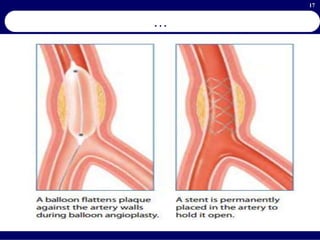
1. Balloon angioplasty
 The catheter is used to insert a special balloon into the
artery. The balloon is inflated and deflated one or more
times to open the artery.
 This is often followed by placement of a stent.
15
Balloon Angioplasty (Cath)
16
…
2. Stenting.
 A wire mesh tube (stent) is inserted into the artery to hold it
open. This device is left in the artery permanently. Your
doctor may advise using a drug-eluting stent.
 This is a stent that releases medication over time to help
keep scar tissue from forming as the artery heals. This may
prevent a new blockage from forming in the same place
(restenosis).
17
…
18
…
19
Pre-procedure Nursing intervention
 Maintain the client on NPO status for at least 8 hr (due to
the risk for aspiration when lying flat for the procedure).
 Assess that the client and family understand the procedure.
 Assess renal function prior to introduction of contrast dye
 Administer pre medications as prescribed.
 Explain the procedure to the patient and its possible side
effects. These are flushing of the face, nausea, urge to
urinate, and chest pain, which are usually reactions to the
dye.
20
…
 Chemistry to assess creatinine, BUN and creatinine
clearance. These are tests to determine kidney function.
 Determine if the patient is allergic to seafood or iodine. If
so, notify the physician immediately because the patient
might be also allergic to the radiopaque dye
 Obtain written consent from the patient. Risks and benefits
of the test need to be explained to the patient before
commencing.
21
Intra procedure Nursing Intervention
 Administer sedatives and analgesia as prescribed.
 Continually monitor vital signs and heart rhythm.
 Be prepared to intervene for dysrhythmias.
 Have resuscitation equipment and emergency
medications readily available.
22
Medical management
 Administer antiplatelet or thrombolytic agents as prescribed
to prevent clot formation and restenosis.
-Aspirin &Heparin
 Administer anxiolytics (Ativan) and analgesia (morphine) as
needed.
 Monitor urine output and administer IV fluids for hydration.
Acts as osmotic diuretic.
 Apply pressure to arterial/venous sites for the prescribed
period of time (varies depending upon the method used for
vessel closure).
 Observe for vagal response (hypotension, bradycardia)
from compression of nerves.
 Apply pressure dressing
23
Post procedure Nursing Interventions
 Assess vital signs every 15 min x 4, every 30 min x 2, every
hour x 4, and then every 4 hr (follow facility protocol).
 Assess the groin site at the same intervals for:
 Bleeding and hematoma formation
 Thrombosis; document pedal pulse, color, temperature
 Assess for bleeding at the injection site since a major artery
has been accessed. If there is bleeding, apply pressure
until bleeding stops.
24
…
 Keep patient on bed rest for 8 hours, so as not to dislodge a
clot from the artery used for the catheter.
 Keep pressure on injection site for 8 hours to ensure
clotting at the site
 If femoral artery is used, keep left leg straight for 8 hours to
minimize risk of dislodging clot.
 If ante cubital fossa used, keep arm straight for 3 hours to
minimize risk of dislodging clot.
 Increase fluid intake to assist the kidneys in excreting the
dye.
25
Complications
 Minor complications includes:
 Temporary pain
 Nausea/ vomiting
 Bleeding, hematoma
 Contrast allergy
 Abnormal heartbeat (arrhythmia)
 Tearing of the artery lining
 Kidney damage or failure
26
…
Major Complications are:
Cardiac Tamponade:
• Cardiac tamponade can result from fluid accumulation in
the pericardial sac.
Restenosis of Treated Vessel
• Clot reformation in the coronary artery can occur
immediately or several weeks after procedure.
27
…
Retroperitoneal Bleeding:
• Bleeding into retroperitoneal space (abdominal cavity
behind the peritoneum) can occur due to femoral artery
puncture.
Myocardial infarction
Embolic events
Death.
28
Reference
1. Brunner_&_Suddarth’s_textbook. (2018). medical surgical
nursing.
2. RN Adult Medical Surgical Nursing 9.0 th Edition.
3. Medical-Surgical-Nursing-Demystified
29

Cardiac Chat.pptx

  • 1.
  • 2.
    2 Session objectives At theend of this session the learner will be able to:  Define Cardiac Catheterization  Define Cardiac Angiography  Explain procedural steps of Cardiac catheterization  List Nursing Intervention during cardiac catheterization and cardiac angiography
  • 3.
    3 Cardiac Catheterization  Isan invasive procedure used to examine the coronary arteries and intracardiac structures, as well as to measure cardiac output, intracardiac pressures, and oxygenation.  A diagnostic procedure in which a tube is inserted into a blood vessel under local anesthetic and threaded through to the chambers of the heart to monitor blood flow, blood pressure, blood chemistry and the output of the heart, and to take a sample of heart tissue..
  • 4.
    4 …  The techniqueis used to diagnose congenital heart disease and coronary artery disease.  Another application is in the diagnosis and treatment of valvular disease in the heart.  It is used to examine the function of the cardiac valves and arteries, as well as the cardiac muscle.
  • 5.
    5 …  It isalso used to treat certain heart conditions. During cardiac catheterization, a long thin tube called a catheter is inserted in an artery or vein in the groin, neck, or arm and threaded through the blood vessels to the heart.  The procedure also includes taking X-ray scans of the coronary arteries that transport blood to the cardiac muscle.
  • 6.
    6 Indication  Unstable anginaand ECG changes (T wave inversion, ST segment elevation, depression)  Confirm and determine location and extent of heart disease.  CAD  Congenital Heart Disease
  • 7.
    7 Purpose of CardiacCatheterization  To locate coronary arteries that were narrowed or blocked due to plaque buildup.  To evaluate or confirm the presence of valve disease and evaluate heart muscle function.  To perform an arterial angioplasty to open up narrowed or blocked segments of an artery.  To measure the oxygen content in the four chambers of your heart.  To locate congenital defects in the cardiac valves or between heart chambers.  To remove a small piece of heart tissue to examine it under a microscope (biopsy).  To take X-rays to evaluate the blockage in the coronary arteries.
  • 8.
    8 How its Performed? 1.Thepatient is given an injection of local anesthetic to the area of needle puncture site. 2. A long thin tube called a catheter is inserted into the patient’s blood vessels through the groin or arm. 3. The catheter reaches the arteries of the heart. 4. A video screen will show the position of the catheter as it is threaded through the blood vessels and to the heart. 5. When the catheter is in place, a small amount of dye is injected so that the coronary arteries can be seen more clearly. 6. When a catheter is used to inject a dye that can be seen on X-rays, the procedure is called angiography.
  • 9.
  • 10.
    10 Cardiac Angiography  Angiographyinvolves taking x-ray pictures of blood vessels.  These x-rays can show the location and severity of blockages in the vessels. This can help in forming a plan to open or bypass these blockages.  Coronary angiography is a way of taking x-ray pictures of the arteries in the heart.  X-ray dye is injected into the arteries through the catheter.
  • 11.
    11 … • This allowsthem to show up on x-rays. You may feel a warm flush as the dye reaches your bloodstream. • Several images are then taken, showing the locations of any blockages. • Your doctor may ask you to hold your breath or to cough. As pictures are taken, the lights may be dimmed and the patieant may hear the noise of the camera.
  • 12.
  • 13.
  • 14.
    14 After opening thearteries 1. Balloon angioplasty  The catheter is used to insert a special balloon into the artery. The balloon is inflated and deflated one or more times to open the artery.  This is often followed by placement of a stent.
  • 15.
  • 16.
    16 … 2. Stenting.  Awire mesh tube (stent) is inserted into the artery to hold it open. This device is left in the artery permanently. Your doctor may advise using a drug-eluting stent.  This is a stent that releases medication over time to help keep scar tissue from forming as the artery heals. This may prevent a new blockage from forming in the same place (restenosis).
  • 17.
  • 18.
  • 19.
    19 Pre-procedure Nursing intervention Maintain the client on NPO status for at least 8 hr (due to the risk for aspiration when lying flat for the procedure).  Assess that the client and family understand the procedure.  Assess renal function prior to introduction of contrast dye  Administer pre medications as prescribed.  Explain the procedure to the patient and its possible side effects. These are flushing of the face, nausea, urge to urinate, and chest pain, which are usually reactions to the dye.
  • 20.
    20 …  Chemistry toassess creatinine, BUN and creatinine clearance. These are tests to determine kidney function.  Determine if the patient is allergic to seafood or iodine. If so, notify the physician immediately because the patient might be also allergic to the radiopaque dye  Obtain written consent from the patient. Risks and benefits of the test need to be explained to the patient before commencing.
  • 21.
    21 Intra procedure NursingIntervention  Administer sedatives and analgesia as prescribed.  Continually monitor vital signs and heart rhythm.  Be prepared to intervene for dysrhythmias.  Have resuscitation equipment and emergency medications readily available.
  • 22.
    22 Medical management  Administerantiplatelet or thrombolytic agents as prescribed to prevent clot formation and restenosis. -Aspirin &Heparin  Administer anxiolytics (Ativan) and analgesia (morphine) as needed.  Monitor urine output and administer IV fluids for hydration. Acts as osmotic diuretic.  Apply pressure to arterial/venous sites for the prescribed period of time (varies depending upon the method used for vessel closure).  Observe for vagal response (hypotension, bradycardia) from compression of nerves.  Apply pressure dressing
  • 23.
    23 Post procedure NursingInterventions  Assess vital signs every 15 min x 4, every 30 min x 2, every hour x 4, and then every 4 hr (follow facility protocol).  Assess the groin site at the same intervals for:  Bleeding and hematoma formation  Thrombosis; document pedal pulse, color, temperature  Assess for bleeding at the injection site since a major artery has been accessed. If there is bleeding, apply pressure until bleeding stops.
  • 24.
    24 …  Keep patienton bed rest for 8 hours, so as not to dislodge a clot from the artery used for the catheter.  Keep pressure on injection site for 8 hours to ensure clotting at the site  If femoral artery is used, keep left leg straight for 8 hours to minimize risk of dislodging clot.  If ante cubital fossa used, keep arm straight for 3 hours to minimize risk of dislodging clot.  Increase fluid intake to assist the kidneys in excreting the dye.
  • 25.
    25 Complications  Minor complicationsincludes:  Temporary pain  Nausea/ vomiting  Bleeding, hematoma  Contrast allergy  Abnormal heartbeat (arrhythmia)  Tearing of the artery lining  Kidney damage or failure
  • 26.
    26 … Major Complications are: CardiacTamponade: • Cardiac tamponade can result from fluid accumulation in the pericardial sac. Restenosis of Treated Vessel • Clot reformation in the coronary artery can occur immediately or several weeks after procedure.
  • 27.
    27 … Retroperitoneal Bleeding: • Bleedinginto retroperitoneal space (abdominal cavity behind the peritoneum) can occur due to femoral artery puncture. Myocardial infarction Embolic events Death.
  • 28.
    28 Reference 1. Brunner_&_Suddarth’s_textbook. (2018).medical surgical nursing. 2. RN Adult Medical Surgical Nursing 9.0 th Edition. 3. Medical-Surgical-Nursing-Demystified
  • 29.