TREMATODA  Fasciolopsis buski
Introduction Fasciolopsis buski  lives in the small intestine of humans and pigs.  Measuring up to 80 mm in length largest trematodes found in humans Geographic Distribution: Asia and the Indian subcontinent, especially in areas where humans raise pigs and consume freshwater plants.   As with many other parasites that infect humans, pigs serve as a reservoir host Can cause Fascioslopsiasis
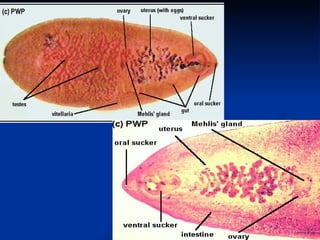
MORPHOLOGY : ADULT  The adult flukes range in size: 20 to 75 mm by 8 to 20 mm.  No cephalic cone, acetabulum larger than oral sucker.  Testis posterior & branched. Attach themselves to the tissues of the small intestine of the host by means of ventral suckers; the sites of attachment may later ulcerate and form abscesses.
 
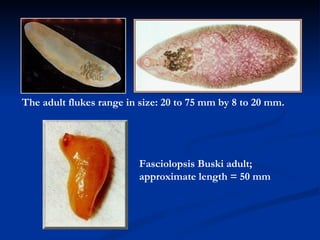
The adult flukes range in size: 20 to 75 mm by 8 to 20 mm.  Fasciolopsis Buski adult; approximate length = 50 mm
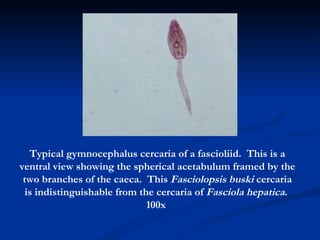
Typical gymnocephalus cercaria of a fascioliid.  This is a ventral view showing the spherical acetabulum framed by the two branches of the caeca.  This  Fasciolopsis buski  cercaria is indistinguishable from the cercaria of  Fasciola   hepatica .  100x
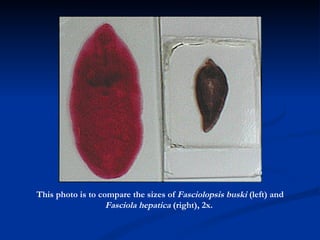
This photo is to compare the sizes of  Fasciolopsis buski  (left) and  Fasciola hepatica  (right), 2x.
Egg is practically indistinguishable from those of  Fasciola hepatica .  The eggs are ellipsoidal, with a thin shell, and a usually small, indistinct operculum, range in size: 130 to 159 µm by 78 to 98 µm. MORPHOLOGY : EGG
 
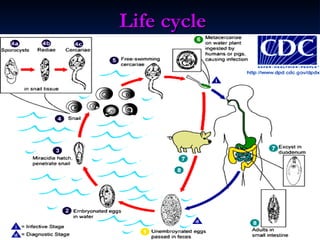
Life cycle
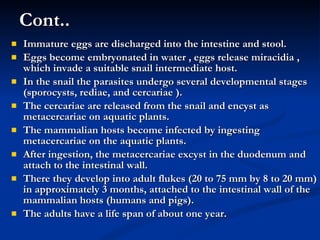
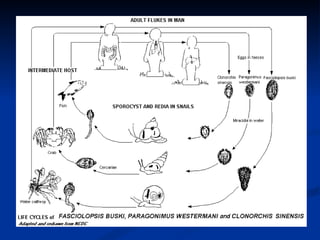
Cont.. Immature eggs are discharged into the intestine and stool. Eggs become embryonated in water , eggs release miracidia , which invade a suitable snail intermediate host.  In the snail the parasites undergo several developmental stages (sporocysts, rediae, and cercariae ).  The cercariae are released from the snail and encyst as metacercariae on aquatic plants.  The mammalian hosts become infected by ingesting metacercariae on the aquatic plants.  After ingestion, the metacercariae excyst in the duodenum and attach to the intestinal wall. There they develop into adult flukes (20 to 75 mm by 8 to 20 mm) in approximately 3 months, attached to the intestinal wall of the mammalian hosts (humans and pigs). The adults have a life span of about one year.
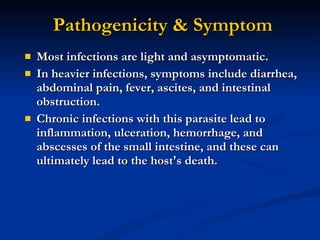
Pathogenicity & Symptom Most infections are light and asymptomatic.  In heavier infections, symptoms include diarrhea, abdominal pain, fever, ascites, and intestinal obstruction.  Chronic infections with this parasite lead to inflammation, ulceration, hemorrhage, and abscesses of the small intestine, and these can ultimately lead to the host's death.
Laboratory Diagnosis  Microscopic identification of eggs, or more rarely of the adult flukes, in the stool or vomitus is the basis of specific diagnosis.  The eggs are indistinguishable from those of  Fasciola hepatica . Treatment  : Praziquantel
 
NEXT:  Paragonimus westermani

F.buski

  • 1.
  • 2.
    Introduction Fasciolopsis buski lives in the small intestine of humans and pigs. Measuring up to 80 mm in length largest trematodes found in humans Geographic Distribution: Asia and the Indian subcontinent, especially in areas where humans raise pigs and consume freshwater plants. As with many other parasites that infect humans, pigs serve as a reservoir host Can cause Fascioslopsiasis
  • 3.
    MORPHOLOGY : ADULT The adult flukes range in size: 20 to 75 mm by 8 to 20 mm. No cephalic cone, acetabulum larger than oral sucker. Testis posterior & branched. Attach themselves to the tissues of the small intestine of the host by means of ventral suckers; the sites of attachment may later ulcerate and form abscesses.
  • 4.
  • 5.
    The adult flukesrange in size: 20 to 75 mm by 8 to 20 mm. Fasciolopsis Buski adult; approximate length = 50 mm
  • 6.
    Typical gymnocephalus cercariaof a fascioliid.  This is a ventral view showing the spherical acetabulum framed by the two branches of the caeca.  This Fasciolopsis buski cercaria is indistinguishable from the cercaria of Fasciola hepatica .  100x
  • 7.
    This photo isto compare the sizes of Fasciolopsis buski (left) and Fasciola hepatica (right), 2x.
  • 8.
    Egg is practicallyindistinguishable from those of Fasciola hepatica . The eggs are ellipsoidal, with a thin shell, and a usually small, indistinct operculum, range in size: 130 to 159 µm by 78 to 98 µm. MORPHOLOGY : EGG
  • 9.
  • 10.
  • 11.
    Cont.. Immature eggsare discharged into the intestine and stool. Eggs become embryonated in water , eggs release miracidia , which invade a suitable snail intermediate host. In the snail the parasites undergo several developmental stages (sporocysts, rediae, and cercariae ). The cercariae are released from the snail and encyst as metacercariae on aquatic plants. The mammalian hosts become infected by ingesting metacercariae on the aquatic plants. After ingestion, the metacercariae excyst in the duodenum and attach to the intestinal wall. There they develop into adult flukes (20 to 75 mm by 8 to 20 mm) in approximately 3 months, attached to the intestinal wall of the mammalian hosts (humans and pigs). The adults have a life span of about one year.
  • 12.
    Pathogenicity & SymptomMost infections are light and asymptomatic. In heavier infections, symptoms include diarrhea, abdominal pain, fever, ascites, and intestinal obstruction. Chronic infections with this parasite lead to inflammation, ulceration, hemorrhage, and abscesses of the small intestine, and these can ultimately lead to the host's death.
  • 13.
    Laboratory Diagnosis Microscopic identification of eggs, or more rarely of the adult flukes, in the stool or vomitus is the basis of specific diagnosis. The eggs are indistinguishable from those of Fasciola hepatica . Treatment : Praziquantel
  • 14.
  • 15.

Editor's Notes

  • #2 FiFi Faridz BioMedical Science