ANALYSIS OF SULPHONAMIDES
12/15/20161 VIKAS COLLEGE OF PHARMACY
BY
@@@ Mr.S @@@
Pharmaceutical Analysis & Quality Assurance,
Vikas College Of Pharmacy,
Vissannapeta.
CONTENTS
12/15/20162
 INTRODUCTION
 CLASSIFICATION
 MECHANISM OF ACTION
 METHOD OF ANALYSIS
 CONCLUSION
 REFERENCES
VIKAS COLLEGE OF PHARMACY
Introduction
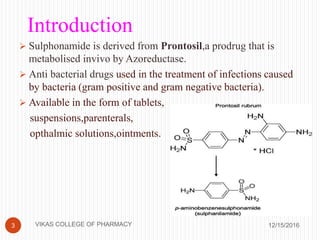
 Sulphonamide is derived from Prontosil,a prodrug that is
metabolised invivo by Azoreductase.
 Anti bacterial drugs used in the treatment of infections caused
by bacteria (gram positive and gram negative bacteria).
 Available in the form of tablets,
suspensions,parenterals,
opthalmic solutions,ointments.
12/15/20163 VIKAS COLLEGE OF PHARMACY
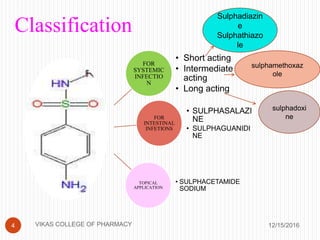
Classification
12/15/20164
FOR
SYSTEMIC
INFECTIO
N
• Short acting
• Intermediate
acting
• Long acting
FOR
INTESTINAL
INFETIONS
• SULPHASALAZI
NE
• SULPHAGUANIDI
NE
TOPICAL
APPLICATION
• SULPHACETAMIDE
SODIUM
Sulphadiazin
e
Sulphathiazo
le
sulphamethoxaz
ole
sulphadoxi
ne
VIKAS COLLEGE OF PHARMACY
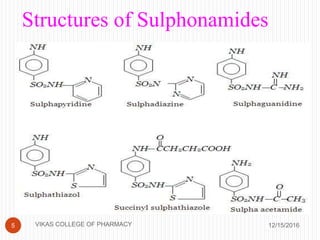
Structures of Sulphonamides
12/15/20165 VIKAS COLLEGE OF PHARMACY
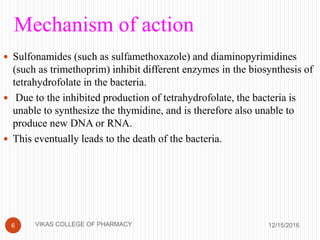
Mechanism of action
12/15/20166
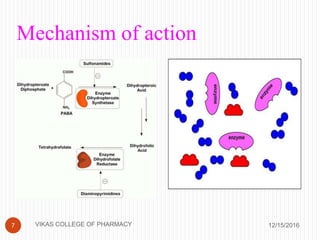
 Sulfonamides (such as sulfamethoxazole) and diaminopyrimidines
(such as trimethoprim) inhibit different enzymes in the biosynthesis of
tetrahydrofolate in the bacteria.
 Due to the inhibited production of tetrahydrofolate, the bacteria is
unable to synthesize the thymidine, and is therefore also unable to
produce new DNA or RNA.
 This eventually leads to the death of the bacteria.
VIKAS COLLEGE OF PHARMACY
Mechanism of action
12/15/20167 VIKAS COLLEGE OF PHARMACY
Analytical methods for sulfadrugs
Titrimetric method :
a)Diazotization titration
b)Nonaqueous titration
c)Argentometric titration
UV-spectrophotometry
Colorimetry
Chromatography
Fluorimetry 12/15/20168 VIKAS COLLEGE OF PHARMACY
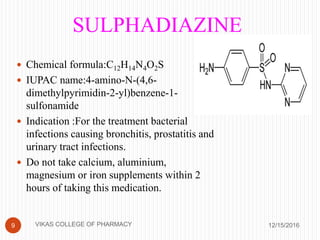
SULPHADIAZINE
12/15/20169
 Chemical formula:C12H14N4O2S
 IUPAC name:4-amino-N-(4,6-
dimethylpyrimidin-2-yl)benzene-1-
sulfonamide
 Indication :For the treatment bacterial
infections causing bronchitis, prostatitis and
urinary tract infections.
 Do not take calcium, aluminium,
magnesium or iron supplements within 2
hours of taking this medication.
VIKAS COLLEGE OF PHARMACY
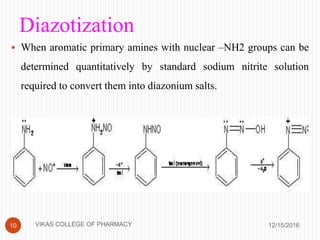
Diazotization
 When aromatic primary amines with nuclear –NH2 groups can be
determined quantitatively by standard sodium nitrite solution
required to convert them into diazonium salts.
12/15/201610 VIKAS COLLEGE OF PHARMACY
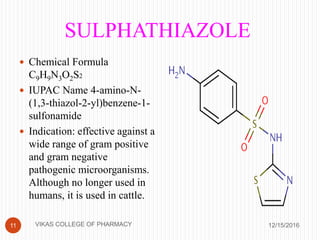
SULPHATHIAZOLE
12/15/201611
 Chemical Formula
C9H9N3O2S2
 IUPAC Name 4-amino-N-
(1,3-thiazol-2-yl)benzene-1-
sulfonamide
 Indication: effective against a
wide range of gram positive
and gram negative
pathogenic microorganisms.
Although no longer used in
humans, it is used in cattle.
VIKAS COLLEGE OF PHARMACY
Non-Aqueous Titrations
 For determination of weak acids and weak bases
 TYPES
a. Acidimetry in non –aqueous titration
b. Alkalimetry in non –aqueous titration
 The sulfonamides contain weak acid group, so we are using
alkalimetry in NAT.
In these titration:
 Titrants used :Sodium methoxide,potassium methoxide,Lithium
methoxide.
12/15/201612 VIKAS COLLEGE OF PHARMACY
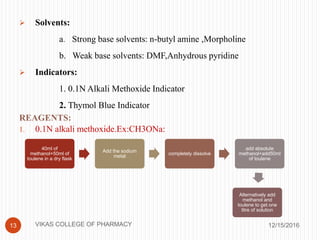
 Solvents:
a. Strong base solvents: n-butyl amine ,Morpholine
b. Weak base solvents: DMF,Anhydrous pyridine
 Indicators:
1. 0.1N Alkali Methoxide Indicator
2. Thymol Blue Indicator
REAGENTS:
1. 0.1N alkali methoxide.Ex:CH3ONa:
12/15/201613
40ml of
methanol+50ml of
toulene in a dry flask
Add the sodium
metal
completely dissolve
add absolute
methanol+add50ml
of toulene
Alternatively add
methanol and
toulene to get one
litre of solution
VIKAS COLLEGE OF PHARMACY
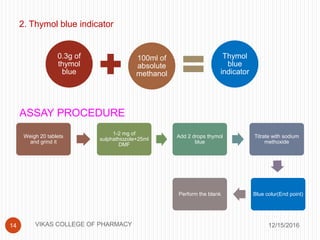
ASSAY PROCEDURE
12/15/201614
Weigh 20 tablets
and grind it
1-2 mg of
sulphathiozole+25ml
DMF
Add 2 drops thymol
blue
Titrate with sodium
methoxide
Blue colur(End point)Perform the blank
0.3g of
thymol
blue
100ml of
absolute
methanol
Thymol
blue
indicator
2. Thymol blue indicator
VIKAS COLLEGE OF PHARMACY
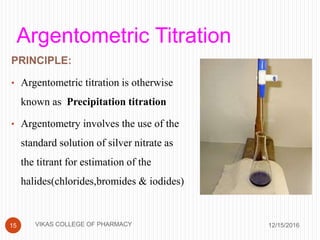
Argentometric Titration
PRINCIPLE:
• Argentometric titration is otherwise
known as Precipitation titration
• Argentometry involves the use of the
standard solution of silver nitrate as
the titrant for estimation of the
halides(chlorides,bromides & iodides)
12/15/201615 VIKAS COLLEGE OF PHARMACY
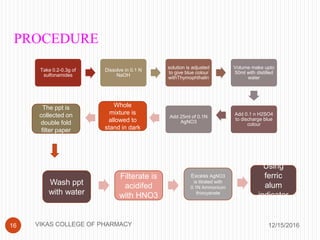
PROCEDURE
12/15/201616
Take 0.2-0.3g of
sulfonamides
Dissolve in 0.1 N
NaOH
solution is adjusted
to give blue colour
withThymophthalin
Volume make upto
50ml with distilled
water
Add 0.1 n H2SO4
to discharge blue
colour
Add 25ml of 0.1N
AgNO3
Whole
mixture is
allowed to
stand in dark
The ppt is
collected on
double fold
filter paper
Wash ppt
with water
Filterate is
acidifed
with HNO3
Excess AgNO3
is titrated with
0.1N Ammonium
thiocyanate
Using
ferric
alum
indicator
VIKAS COLLEGE OF PHARMACY
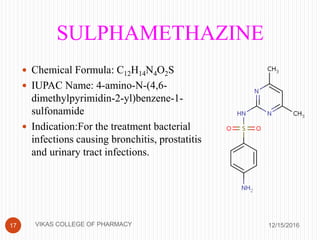
SULPHAMETHAZINE
12/15/201617
 Chemical Formula: C12H14N4O2S
 IUPAC Name: 4-amino-N-(4,6-
dimethylpyrimidin-2-yl)benzene-1-
sulfonamide
 Indication:For the treatment bacterial
infections causing bronchitis, prostatitis
and urinary tract infections.
VIKAS COLLEGE OF PHARMACY
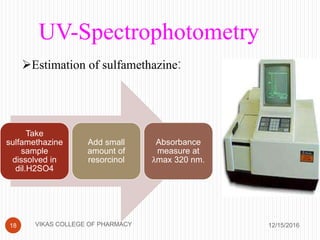
UV-Spectrophotometry
Estimation of sulfamethazine:
12/15/201618
Take
sulfamethazine
sample
dissolved in
dil.H2SO4
Add small
amount of
resorcinol
Absorbance
measure at
λmax 320 nm.
VIKAS COLLEGE OF PHARMACY
12/15/201619
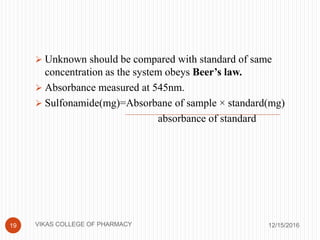
 Unknown should be compared with standard of same
concentration as the system obeys Beer’s law.
 Absorbance measured at 545nm.
 Sulfonamide(mg)=Absorbane of sample × standard(mg)
absorbance of standard
VIKAS COLLEGE OF PHARMACY
Colorimetry
12/15/201620
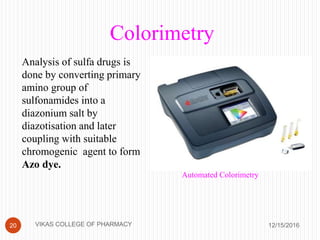
Analysis of sulfa drugs is
done by converting primary
amino group of
sulfonamides into a
diazonium salt by
diazotisation and later
coupling with suitable
chromogenic agent to form
Azo dye.
Automated Colorimetry
VIKAS COLLEGE OF PHARMACY
12/15/201621
Chromogenic Reagents
1.Para dimethyl amino benzaldehyde method
2.Diazotisation followed by coupling with BM Reagent
3.α-1,2-naphthaquinone-4-sulphonate sodium(folin’s reagent)
4.Thiobarbituric acid method
5.α-napthol method
VIKAS COLLEGE OF PHARMACY
PDAB (Para Dimethyl Amino Benzaldehyde) method
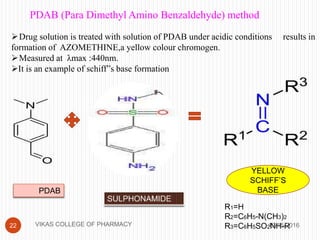
Drug solution is treated with solution of PDAB under acidic conditions results in
formation of AZOMETHINE,a yellow colour chromogen.
Measured at λmax :440nm.
It is an example of schiff”s base formation
22
R1=H
R2=C6H5-N(CH3)2
R3=C6H5SO2NH-R
YELLOW
SCHIFF’S
BASEPDAB
12/15/2016VIKAS COLLEGE OF PHARMACY
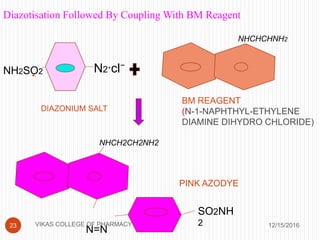
Diazotisation Followed By Coupling With BM Reagent
NH2SO2
DIAZONIUM SALT
N2⁺cl⁻
NHCHCHNH2
NHCH2CH2NH2
SO2NH
2
BM REAGENT
(N-1-NAPHTHYL-ETHYLENE
DIAMINE DIHYDRO CHLORIDE)
N=N
12/15/201623
PINK AZODYE
VIKAS COLLEGE OF PHARMACY
CHROMATOGRAPHIC METHOD
12/15/201624
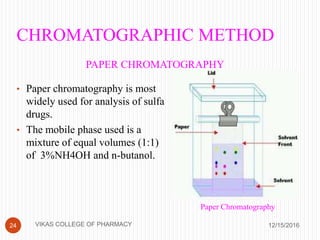
• Paper chromatography is most
widely used for analysis of sulfa
drugs.
• The mobile phase used is a
mixture of equal volumes (1:1)
of 3%NH4OH and n-butanol.
PAPER CHROMATOGRAPHY
Paper Chromatography
VIKAS COLLEGE OF PHARMACY
12/15/201625
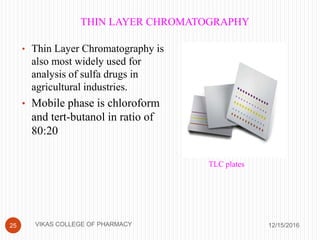
• Thin Layer Chromatography is
also most widely used for
analysis of sulfa drugs in
agricultural industries.
• Mobile phase is chloroform
and tert-butanol in ratio of
80:20
THIN LAYER CHROMATOGRAPHY
TLC plates
VIKAS COLLEGE OF PHARMACY
FLUORIMETRY
12/15/201626
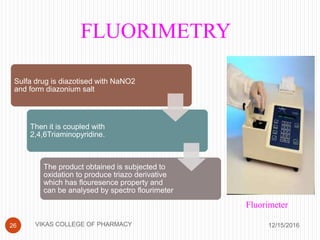
Sulfa drug is diazotised with NaNO2
and form diazonium salt
Then it is coupled with
2,4,6Triaminopyridine.
The product obtained is subjected to
oxidation to produce triazo derivative
which has flouresence property and
can be analysed by spectro flourimeter
Fluorimeter
VIKAS COLLEGE OF PHARMACY
CONCLUSION
I here by conclude that there is a much
necessity for the study of analytical methods of
Sulphonamides as they are widely used class of
drugs as Anti bacterial agents……..
12/15/201627 VIKAS COLLEGE OF PHARMACY
REFERENCES
• The Indian Pharmacopoeia1996
• P. D. Sethi, “Quantitative Analysis of Drugs in Pharmaceutical
Formulations”,.
• B. Morelli, J. Pharm. Biomed. Anal.,1989, 7, 577.
• P. B. Issopoulos, Acta. Pharm. Hung.,1992, 6, 3138.
• M. Knochen, J. Giglio and B.F. Reis, J. Pharm. Biomed. Anal., 2003, 33,
191.
• K.A Connors :Text book of Pharmaceutical Analysis,Third
edition,Page no:(62-63
• Higuchi,Beckmman&Hassan :Pharmaceutical Analysis,second
editiom,Page no:(137-157)
• V.N Rajasekharan,Text book of Pharmaceutical In Organic
Chemistry,Page no(126-128)
12/15/201628 VIKAS COLLEGE OF PHARMACY
12/15/201629 VIKAS COLLEGE OF PHARMACY

Analysis of sulfonamides

  • 1.
    ANALYSIS OF SULPHONAMIDES 12/15/20161VIKAS COLLEGE OF PHARMACY BY @@@ Mr.S @@@ Pharmaceutical Analysis & Quality Assurance, Vikas College Of Pharmacy, Vissannapeta.
  • 2.
    CONTENTS 12/15/20162  INTRODUCTION  CLASSIFICATION MECHANISM OF ACTION  METHOD OF ANALYSIS  CONCLUSION  REFERENCES VIKAS COLLEGE OF PHARMACY
  • 3.
    Introduction  Sulphonamide isderived from Prontosil,a prodrug that is metabolised invivo by Azoreductase.  Anti bacterial drugs used in the treatment of infections caused by bacteria (gram positive and gram negative bacteria).  Available in the form of tablets, suspensions,parenterals, opthalmic solutions,ointments. 12/15/20163 VIKAS COLLEGE OF PHARMACY
  • 4.
    Classification 12/15/20164 FOR SYSTEMIC INFECTIO N • Short acting •Intermediate acting • Long acting FOR INTESTINAL INFETIONS • SULPHASALAZI NE • SULPHAGUANIDI NE TOPICAL APPLICATION • SULPHACETAMIDE SODIUM Sulphadiazin e Sulphathiazo le sulphamethoxaz ole sulphadoxi ne VIKAS COLLEGE OF PHARMACY
  • 5.
    Structures of Sulphonamides 12/15/20165VIKAS COLLEGE OF PHARMACY
  • 6.
    Mechanism of action 12/15/20166 Sulfonamides (such as sulfamethoxazole) and diaminopyrimidines (such as trimethoprim) inhibit different enzymes in the biosynthesis of tetrahydrofolate in the bacteria.  Due to the inhibited production of tetrahydrofolate, the bacteria is unable to synthesize the thymidine, and is therefore also unable to produce new DNA or RNA.  This eventually leads to the death of the bacteria. VIKAS COLLEGE OF PHARMACY
  • 7.
    Mechanism of action 12/15/20167VIKAS COLLEGE OF PHARMACY
  • 8.
    Analytical methods forsulfadrugs Titrimetric method : a)Diazotization titration b)Nonaqueous titration c)Argentometric titration UV-spectrophotometry Colorimetry Chromatography Fluorimetry 12/15/20168 VIKAS COLLEGE OF PHARMACY
  • 9.
    SULPHADIAZINE 12/15/20169  Chemical formula:C12H14N4O2S IUPAC name:4-amino-N-(4,6- dimethylpyrimidin-2-yl)benzene-1- sulfonamide  Indication :For the treatment bacterial infections causing bronchitis, prostatitis and urinary tract infections.  Do not take calcium, aluminium, magnesium or iron supplements within 2 hours of taking this medication. VIKAS COLLEGE OF PHARMACY
  • 10.
    Diazotization  When aromaticprimary amines with nuclear –NH2 groups can be determined quantitatively by standard sodium nitrite solution required to convert them into diazonium salts. 12/15/201610 VIKAS COLLEGE OF PHARMACY
  • 11.
    SULPHATHIAZOLE 12/15/201611  Chemical Formula C9H9N3O2S2 IUPAC Name 4-amino-N- (1,3-thiazol-2-yl)benzene-1- sulfonamide  Indication: effective against a wide range of gram positive and gram negative pathogenic microorganisms. Although no longer used in humans, it is used in cattle. VIKAS COLLEGE OF PHARMACY
  • 12.
    Non-Aqueous Titrations  Fordetermination of weak acids and weak bases  TYPES a. Acidimetry in non –aqueous titration b. Alkalimetry in non –aqueous titration  The sulfonamides contain weak acid group, so we are using alkalimetry in NAT. In these titration:  Titrants used :Sodium methoxide,potassium methoxide,Lithium methoxide. 12/15/201612 VIKAS COLLEGE OF PHARMACY
  • 13.
     Solvents: a. Strongbase solvents: n-butyl amine ,Morpholine b. Weak base solvents: DMF,Anhydrous pyridine  Indicators: 1. 0.1N Alkali Methoxide Indicator 2. Thymol Blue Indicator REAGENTS: 1. 0.1N alkali methoxide.Ex:CH3ONa: 12/15/201613 40ml of methanol+50ml of toulene in a dry flask Add the sodium metal completely dissolve add absolute methanol+add50ml of toulene Alternatively add methanol and toulene to get one litre of solution VIKAS COLLEGE OF PHARMACY
  • 14.
    ASSAY PROCEDURE 12/15/201614 Weigh 20tablets and grind it 1-2 mg of sulphathiozole+25ml DMF Add 2 drops thymol blue Titrate with sodium methoxide Blue colur(End point)Perform the blank 0.3g of thymol blue 100ml of absolute methanol Thymol blue indicator 2. Thymol blue indicator VIKAS COLLEGE OF PHARMACY
  • 15.
    Argentometric Titration PRINCIPLE: • Argentometrictitration is otherwise known as Precipitation titration • Argentometry involves the use of the standard solution of silver nitrate as the titrant for estimation of the halides(chlorides,bromides & iodides) 12/15/201615 VIKAS COLLEGE OF PHARMACY
  • 16.
    PROCEDURE 12/15/201616 Take 0.2-0.3g of sulfonamides Dissolvein 0.1 N NaOH solution is adjusted to give blue colour withThymophthalin Volume make upto 50ml with distilled water Add 0.1 n H2SO4 to discharge blue colour Add 25ml of 0.1N AgNO3 Whole mixture is allowed to stand in dark The ppt is collected on double fold filter paper Wash ppt with water Filterate is acidifed with HNO3 Excess AgNO3 is titrated with 0.1N Ammonium thiocyanate Using ferric alum indicator VIKAS COLLEGE OF PHARMACY
  • 17.
    SULPHAMETHAZINE 12/15/201617  Chemical Formula:C12H14N4O2S  IUPAC Name: 4-amino-N-(4,6- dimethylpyrimidin-2-yl)benzene-1- sulfonamide  Indication:For the treatment bacterial infections causing bronchitis, prostatitis and urinary tract infections. VIKAS COLLEGE OF PHARMACY
  • 18.
    UV-Spectrophotometry Estimation of sulfamethazine: 12/15/201618 Take sulfamethazine sample dissolvedin dil.H2SO4 Add small amount of resorcinol Absorbance measure at λmax 320 nm. VIKAS COLLEGE OF PHARMACY
  • 19.
    12/15/201619  Unknown shouldbe compared with standard of same concentration as the system obeys Beer’s law.  Absorbance measured at 545nm.  Sulfonamide(mg)=Absorbane of sample × standard(mg) absorbance of standard VIKAS COLLEGE OF PHARMACY
  • 20.
    Colorimetry 12/15/201620 Analysis of sulfadrugs is done by converting primary amino group of sulfonamides into a diazonium salt by diazotisation and later coupling with suitable chromogenic agent to form Azo dye. Automated Colorimetry VIKAS COLLEGE OF PHARMACY
  • 21.
    12/15/201621 Chromogenic Reagents 1.Para dimethylamino benzaldehyde method 2.Diazotisation followed by coupling with BM Reagent 3.α-1,2-naphthaquinone-4-sulphonate sodium(folin’s reagent) 4.Thiobarbituric acid method 5.α-napthol method VIKAS COLLEGE OF PHARMACY
  • 22.
    PDAB (Para DimethylAmino Benzaldehyde) method Drug solution is treated with solution of PDAB under acidic conditions results in formation of AZOMETHINE,a yellow colour chromogen. Measured at λmax :440nm. It is an example of schiff”s base formation 22 R1=H R2=C6H5-N(CH3)2 R3=C6H5SO2NH-R YELLOW SCHIFF’S BASEPDAB 12/15/2016VIKAS COLLEGE OF PHARMACY
  • 23.
    Diazotisation Followed ByCoupling With BM Reagent NH2SO2 DIAZONIUM SALT N2⁺cl⁻ NHCHCHNH2 NHCH2CH2NH2 SO2NH 2 BM REAGENT (N-1-NAPHTHYL-ETHYLENE DIAMINE DIHYDRO CHLORIDE) N=N 12/15/201623 PINK AZODYE VIKAS COLLEGE OF PHARMACY
  • 24.
    CHROMATOGRAPHIC METHOD 12/15/201624 • Paperchromatography is most widely used for analysis of sulfa drugs. • The mobile phase used is a mixture of equal volumes (1:1) of 3%NH4OH and n-butanol. PAPER CHROMATOGRAPHY Paper Chromatography VIKAS COLLEGE OF PHARMACY
  • 25.
    12/15/201625 • Thin LayerChromatography is also most widely used for analysis of sulfa drugs in agricultural industries. • Mobile phase is chloroform and tert-butanol in ratio of 80:20 THIN LAYER CHROMATOGRAPHY TLC plates VIKAS COLLEGE OF PHARMACY
  • 26.
    FLUORIMETRY 12/15/201626 Sulfa drug isdiazotised with NaNO2 and form diazonium salt Then it is coupled with 2,4,6Triaminopyridine. The product obtained is subjected to oxidation to produce triazo derivative which has flouresence property and can be analysed by spectro flourimeter Fluorimeter VIKAS COLLEGE OF PHARMACY
  • 27.
    CONCLUSION I here byconclude that there is a much necessity for the study of analytical methods of Sulphonamides as they are widely used class of drugs as Anti bacterial agents…….. 12/15/201627 VIKAS COLLEGE OF PHARMACY
  • 28.
    REFERENCES • The IndianPharmacopoeia1996 • P. D. Sethi, “Quantitative Analysis of Drugs in Pharmaceutical Formulations”,. • B. Morelli, J. Pharm. Biomed. Anal.,1989, 7, 577. • P. B. Issopoulos, Acta. Pharm. Hung.,1992, 6, 3138. • M. Knochen, J. Giglio and B.F. Reis, J. Pharm. Biomed. Anal., 2003, 33, 191. • K.A Connors :Text book of Pharmaceutical Analysis,Third edition,Page no:(62-63 • Higuchi,Beckmman&Hassan :Pharmaceutical Analysis,second editiom,Page no:(137-157) • V.N Rajasekharan,Text book of Pharmaceutical In Organic Chemistry,Page no(126-128) 12/15/201628 VIKAS COLLEGE OF PHARMACY
  • 29.

Editor's Notes

  • #17 procedure: Take 0.2-0.3g of sulfonamides Dissolve in 0.1 N NaOH SOLUTION IS ADJUSTED TO GIVE BLUE COLOUR WITH THYMOPHTHALINE Volume make upto 50ml with distilled water Add 0.1 n H2SO4 to discharge blue colour Add 25ml of 0.1N AgNO3 Whole mixture is allowed to stand in dark The ppt is collected on double fold filter paper Wash ppt with water Filterate is acidify with HNO3 Excess AgNO3 is titrated with 0.1N AMMONIUM THIOCYNATE USING Ferric alum indicator
  • #19 Take sulfamethizine sample dissolved in dil.H2SO4 Add small amount of resorcinol Absofbance measure at 320 nm.
  • #22 Para dimethyl amino benzaldehyde method Brotton-marshall reagentαα 1,2-naphthaquinone-4-su lphonate sodium Thiobarbituric acid method α-napthol method Diazotisation followed by addition of alkali
  • #23 1)Drug solution is treated with solution of PDAB under acidic conditions results in formation of yellow colour chromogen with λmax 440nm. 2)It is an example of schiff”s base formation
  • #24 N2+cl- SO2NH2 N=N NHCH2CH2NH2 BM REAGENT
  • #27 . Then it is coupled with 2,4,6-Triaminopyridine. The product obtained in the above reaction is subjected to oxidation to produce triazo derivative which has flouresence property and can be analysed by spectro flourimetre.