Analysis
Of
Diuretics
Presented by
Sheik. Lalbasha
Maharajah's college of pharmacy
Poolbaugh,
Vizianagram,
Andhrapradesh,535002.
CONTENTS
Introduction
Classification
Analytical Methods
Spectro photometric Methods
HPLC Methods
Titrimetric Methods
Uses
References
INTRODUCTION
o Diuretics, any drug that increases the flow of urine. Diuretics promote the
removal from the body of excess water, salts, poisons, and accumulated
metabolic products, such as urea.
o They serve to rid the body of excess fluid (edema) that accumulates in the
tissues owing to various disease states.
o There are many types of diuretics, but most act by decreasing the amount of
fluid that is reabsorbed by the tubules of the kidneys, whence the fluid
passes back into the blood.
o The most widely used diuretics, the benzothiadiazides (e.g., chlorothiazide)
o They are more convenient than some other diuretics in that they can be
taken orally in the form of pills. These drugs are also used to reduce high
blood pressure(hypertension).
CLASSIFICATION
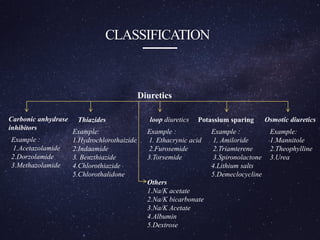
Diuretics
Carbonic anhydrase
inhibitors
Thiazides loop diuretics Potassium sparing Osmotic diuretics
Example :
1.Acetazolamide
2.Dorzolamide
3.Methazolamide
Example:
1.Hydrochlorothaizide
2.Indaamide
3. Benzthiazide
4.Chlorothiazide
5.Chlorothalidone
Example :
1. Ethacrynic acid
2.Furosemide
3.Torsemide
Example :
1. Amiloride
2.Triamterene
3.Spironolactone
4.Lithium salts
5.Demeclocycline
Example:
1.Mannitole
2.Theophylline
3.Urea
Others
1.Na/K acetate
2.Na/K bicarbonate
3.Na/K Acetate
4.Albumin
5.Dextrose
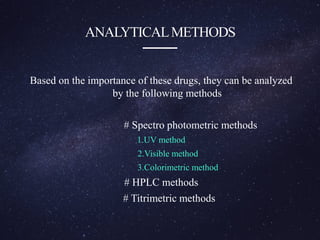
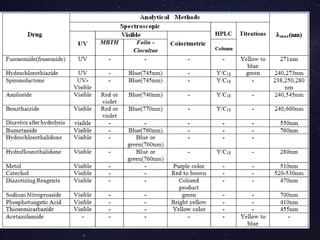
ANALYTICALMETHODS
Based on the importance of these drugs, they can be analyzed
by the following methods
# Spectro photometric methods
1.UV method
2.Visible method
3.Colorimetric method
# HPLC methods
# Titrimetric methods
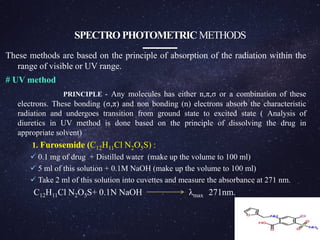
SPECTROPHOTOMETRIC METHODS
These methods are based on the principle of absorption of the radiation within the
range of visible or UV range.
# UV method
PRINCIPLE - Any molecules has either n,π,σ or a combination of these
electrons. These bonding (σ,π) and non bonding (n) electrons absorb the characteristic
radiation and undergoes transition from ground state to excited state ( Analysis of
diuretics in UV method is done based on the principle of dissolving the drug in
appropriate solvent)
1. Furosemide (C12H11Cl N2O5S) :
 0.1 mg of drug + Distilled water (make up the volume to 100 ml)
 5 ml of this solution + 0.1M NaOH (make up the volume to 100 ml)
 Take 2 ml of this solution into cuvettes and measure the absorbance at 271 nm.
C12H11Cl N2O5S+ 0.1N NaOH λmax 271nm.
Furosemide
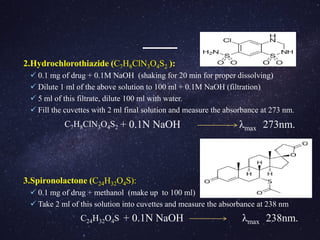
2.Hydrochlorothiazide (C7H8ClN3O4S2 ):
 0.1 mg of drug + 0.1M NaOH (shaking for 20 min for proper dissolving)
 Dilute 1 ml of the above solution to 100 ml + 0.1M NaOH (filtration)
 5 ml of this filtrate, dilute 100 ml with water.
 Fill the cuvettes with 2 ml final solution and measure the absorbance at 273 nm.
+ 0.1N NaOH λmax 273nm.
3.Spironolactone (C24H32O4S):
 0.1 mg of drug + methanol (make up to 100 ml)
 Take 2 ml of this solution into cuvettes and measure the absorbance at 238 nm
+ 0.1N NaOH λmax 238nm.
C7H8ClN3O4S2
C24H32O4S
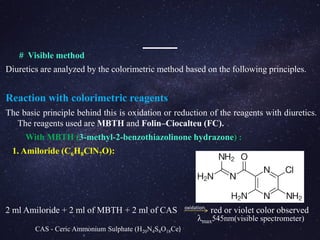
# Visible method
Diuretics are analyzed by the colorimetric method based on the following principles.
Reaction with colorimetric reagents
The basic principle behind this is oxidation or reduction of the reagents with diuretics.
The reagents used are MBTH and Folin–Ciocalteu (FC).
With MBTH (3-methyl-2-benzothiazolinone hydrazone) :
1. Amiloride (C6H8ClN7O):
2 ml Amiloride + 2 ml of MBTH + 2 ml of CAS red or violet color observed
CAS - Ceric Ammonium Sulphate (H20N4S4O18Ce)
oxidation
λmax545nm(visible spectrometer)
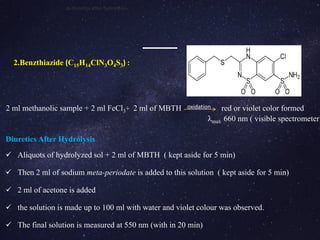
2.Benzthiazide (C15H14ClN3O4S3) :
Diuretics After Hydrolysis
 Aliquots of hydrolyzed sol + 2 ml of MBTH ( kept aside for 5 min)
 Then 2 ml of sodium meta-periodate is added to this solution ( kept aside for 5 min)
 2 ml of acetone is added
 the solution is made up to 100 ml with water and violet colour was observed.
 The final solution is measured at 550 nm (with in 20 min)
2 ml methanolic sample + 2 ml FeCl3+ 2 ml of MBTH red or violet color formed
a.diuretics after hydrolysis:
λmax 660 nm ( visible spectrometer)
oxidation
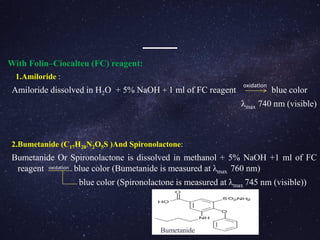
With Folin–Ciocalteu (FC) reagent:
1.Amiloride :
Amiloride dissolved in H2O + 5% NaOH + 1 ml of FC reagent blue color
λmax 740 nm (visible)
2.Bumetanide (C17H20N2O5S )And Spironolactone:
Bumetanide Or Spironolactone is dissolved in methanol + 5% NaOH +1 ml of FC
reagent blue color (Bumetanide is measured at λmax 760 nm)
blue color (Spironolactone is measured at λmax 745 nm (visible))
Bumetanide
oxidation
oxidation
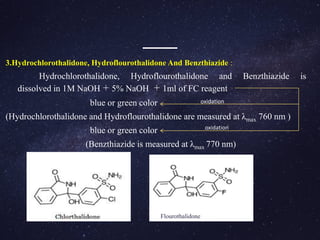
3.Hydrochlorothalidone, Hydroflourothalidone And Benzthiazide :
Hydrochlorothalidone, Hydroflourothalidone and Benzthiazide is
dissolved in 1M NaOH + 5% NaOH + 1ml of FC reagent
blue or green color
(Hydrochlorothalidone and Hydroflourothalidone are measured at λmax 760 nm )
blue or green color
(Benzthiazide is measured at λmax 770 nm)
Flourothalidone
oxidation
oxidation
# Colorimetric Methods
1.Metol (p-N-methyl amino phenol sulphate) [(C7H10NO)2SO4 ]:
p-N-methyl benzoquinoneimine is resulted from the reaction between metol and
sodium meta- periodate
 15 ml of pH 3.0 buffer solution is taken and 2.5 ml of periodate solution is added (25 ml
flask).
 To this solution, aliquot of hydrolysis product of furosemide is added along with 2.5 ml
of catechol solution.
 The final solution is made up to 100 ml with distilled water and kept aside for 15 min.
finally purple coloured charge transfer complex was formed.
 The purple colour solution is measured at λmax 510 nm using visible spectrometer.
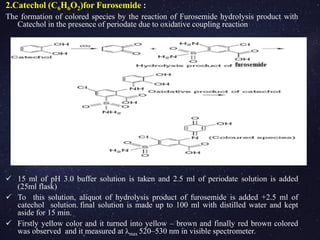
2.Catechol (C6H6O2)for Furosemide :
The formation of colored species by the reaction of Furosemide hydrolysis product with
Catechol in the presence of periodate due to oxidative coupling reaction
 15 ml of pH 3.0 buffer solution is taken and 2.5 ml of periodate solution is added
(25ml flask)
 To this solution, aliquot of hydrolysis product of furosemide is added +2.5 ml of
catechol solution. final solution is made up to 100 ml with distilled water and kept
aside for 15 min.
 Firstly yellow color and it turned into yellow – brown and finally red brown colored
was observed and it measured at λmax 520–530 nm in visible spectrometer.
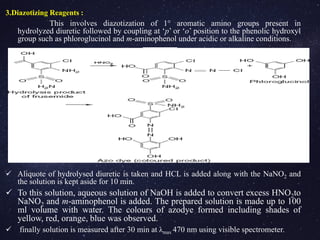
3.Diazotizing Reagents :
This involves diazotization of 1° aromatic amino groups present in
hydrolyzed diuretic followed by coupling at ‘p’ or ‘o’ position to the phenolic hydroxyl
group such as phloroglucinol and m-aminophenol under acidic or alkaline conditions.
 Aliquote of hydrolysed diuretic is taken and HCL is added along with the NaNO2 and
the solution is kept aside for 10 min.
 To this solution, aqueous solution of NaOH is added to convert excess HNO2to
NaNO2 and m-aminophenol is added. The prepared solution is made up to 100
ml volume with water. The colours of azodye formed including shades of
yellow, red, orange, blue was observed.
 finally solution is measured after 30 min at λmax 470 nm using visible spectrometer.
4. Sodium nitroprusside(Na2[Fe(CN)5NO]) For Spiranolactone:
Sodium nitroprusside is also called penta cyano nitrosyl ferrate
dihydrate or sodium nitro ferric cyanide.
 To the drug solution, aqueous solution of NaOH is added along with
CH3COOH and alkaline sodium nitroprusside.
 The prepared solution is made up to 100 ml with distilled water within 12
min.
 The obtained green solution is measured at λmax 700 nm(visible)
5. Phosphotungstic acid (24WO3.2H3PO4.48H2O):
Phosphotungstic acid + chloroform, acetic anhydride and Phosphotungstic
acid (mixed well)
Concentrated sulphuric acid is added to the above solution after 3 min
( made up to 100 ml with methanol). Bright yellow colored solution
measured at λmax 410 nm (visible spectrometer)
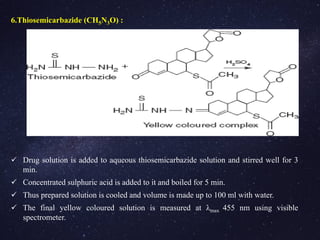
6.Thiosemicarbazide (CH5N3O) :
 Drug solution is added to aqueous thiosemicarbazide solution and stirred well for 3
min.
 Concentrated sulphuric acid is added to it and boiled for 5 min.
 Thus prepared solution is cooled and volume is made up to 100 ml with water.
 The final yellow coloured solution is measured at λmax 455 nm using visible
spectrometer.
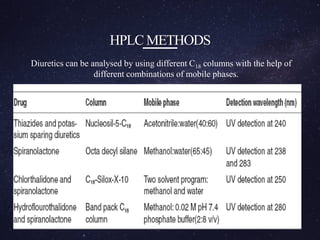
HPLC METHODS
Diuretics can be analysed by using different C18 columns with the help of
different combinations of mobile phases.
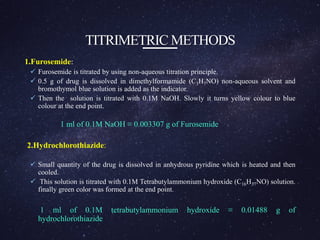
TITRIMETRIC METHODS
1.Furosemide:
 Furosemide is titrated by using non-aqueous titration principle.
 0.5 g of drug is dissolved in dimethylformamide (C3H7NO) non-aqueous solvent and
bromothymol blue solution is added as the indicator.
 Then the solution is titrated with 0.1M NaOH. Slowly it turns yellow colour to blue
colour at the end point.
1 ml of 0.1M NaOH ≡ 0.003307 g of Furosemide
2.Hydrochlorothiazide:
 Small quantity of the drug is dissolved in anhydrous pyridine which is heated and then
cooled.
 This solution is titrated with 0.1M Tetrabutylammonium hydroxide (C16H37NO) solution.
finally green color was formed at the end point.
1 ml of 0.1M tetrabutylammonium hydroxide ≡ 0.01488 g of
hydrochlorothiazide
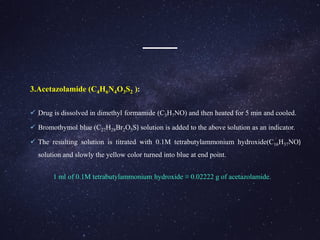
3.Acetazolamide (C4H6N4O3S2 ):
 Drug is dissolved in dimethyl formamide (C3H7NO) and then heated for 5 min and cooled.
 Bromothymol blue (C27H28Br2O5S) solution is added to the above solution as an indicator.
 The resulting solution is titrated with 0.1M tetrabutylammonium hydroxide(C16H37NO)
solution and slowly the yellow color turned into blue at end point.
1 ml of 0.1M tetrabutylammonium hydroxide ≡ 0.02222 g of acetazolamide.
USES
 Treatment of high blood pressure.
 Treatment of the fluid retention( including heart failure, kidney
failure, cirrhosis).
 Treatment of the heart failure( Spironolactone and Eplerenone).
 Prevention of calcium kidney stones.
 Treatment of renal tubular acidosis.
REFERENCES
Textbook of pharmaceutical analysis
by P.D.Chaithanya sudha
Indian Pharmacopeia 2007
Analysis of diuretics

Analysis of diuretics

  • 1.
    Analysis Of Diuretics Presented by Sheik. Lalbasha Maharajah'scollege of pharmacy Poolbaugh, Vizianagram, Andhrapradesh,535002.
  • 2.
    CONTENTS Introduction Classification Analytical Methods Spectro photometricMethods HPLC Methods Titrimetric Methods Uses References
  • 3.
    INTRODUCTION o Diuretics, anydrug that increases the flow of urine. Diuretics promote the removal from the body of excess water, salts, poisons, and accumulated metabolic products, such as urea. o They serve to rid the body of excess fluid (edema) that accumulates in the tissues owing to various disease states. o There are many types of diuretics, but most act by decreasing the amount of fluid that is reabsorbed by the tubules of the kidneys, whence the fluid passes back into the blood. o The most widely used diuretics, the benzothiadiazides (e.g., chlorothiazide) o They are more convenient than some other diuretics in that they can be taken orally in the form of pills. These drugs are also used to reduce high blood pressure(hypertension).
  • 4.
    CLASSIFICATION Diuretics Carbonic anhydrase inhibitors Thiazides loopdiuretics Potassium sparing Osmotic diuretics Example : 1.Acetazolamide 2.Dorzolamide 3.Methazolamide Example: 1.Hydrochlorothaizide 2.Indaamide 3. Benzthiazide 4.Chlorothiazide 5.Chlorothalidone Example : 1. Ethacrynic acid 2.Furosemide 3.Torsemide Example : 1. Amiloride 2.Triamterene 3.Spironolactone 4.Lithium salts 5.Demeclocycline Example: 1.Mannitole 2.Theophylline 3.Urea Others 1.Na/K acetate 2.Na/K bicarbonate 3.Na/K Acetate 4.Albumin 5.Dextrose
  • 5.
    ANALYTICALMETHODS Based on theimportance of these drugs, they can be analyzed by the following methods # Spectro photometric methods 1.UV method 2.Visible method 3.Colorimetric method # HPLC methods # Titrimetric methods
  • 6.
    SPECTROPHOTOMETRIC METHODS These methodsare based on the principle of absorption of the radiation within the range of visible or UV range. # UV method PRINCIPLE - Any molecules has either n,π,σ or a combination of these electrons. These bonding (σ,π) and non bonding (n) electrons absorb the characteristic radiation and undergoes transition from ground state to excited state ( Analysis of diuretics in UV method is done based on the principle of dissolving the drug in appropriate solvent) 1. Furosemide (C12H11Cl N2O5S) :  0.1 mg of drug + Distilled water (make up the volume to 100 ml)  5 ml of this solution + 0.1M NaOH (make up the volume to 100 ml)  Take 2 ml of this solution into cuvettes and measure the absorbance at 271 nm. C12H11Cl N2O5S+ 0.1N NaOH λmax 271nm. Furosemide
  • 7.
    2.Hydrochlorothiazide (C7H8ClN3O4S2 ): 0.1 mg of drug + 0.1M NaOH (shaking for 20 min for proper dissolving)  Dilute 1 ml of the above solution to 100 ml + 0.1M NaOH (filtration)  5 ml of this filtrate, dilute 100 ml with water.  Fill the cuvettes with 2 ml final solution and measure the absorbance at 273 nm. + 0.1N NaOH λmax 273nm. 3.Spironolactone (C24H32O4S):  0.1 mg of drug + methanol (make up to 100 ml)  Take 2 ml of this solution into cuvettes and measure the absorbance at 238 nm + 0.1N NaOH λmax 238nm. C7H8ClN3O4S2 C24H32O4S
  • 8.
    # Visible method Diureticsare analyzed by the colorimetric method based on the following principles. Reaction with colorimetric reagents The basic principle behind this is oxidation or reduction of the reagents with diuretics. The reagents used are MBTH and Folin–Ciocalteu (FC). With MBTH (3-methyl-2-benzothiazolinone hydrazone) : 1. Amiloride (C6H8ClN7O): 2 ml Amiloride + 2 ml of MBTH + 2 ml of CAS red or violet color observed CAS - Ceric Ammonium Sulphate (H20N4S4O18Ce) oxidation λmax545nm(visible spectrometer)
  • 9.
    2.Benzthiazide (C15H14ClN3O4S3) : DiureticsAfter Hydrolysis  Aliquots of hydrolyzed sol + 2 ml of MBTH ( kept aside for 5 min)  Then 2 ml of sodium meta-periodate is added to this solution ( kept aside for 5 min)  2 ml of acetone is added  the solution is made up to 100 ml with water and violet colour was observed.  The final solution is measured at 550 nm (with in 20 min) 2 ml methanolic sample + 2 ml FeCl3+ 2 ml of MBTH red or violet color formed a.diuretics after hydrolysis: λmax 660 nm ( visible spectrometer) oxidation
  • 10.
    With Folin–Ciocalteu (FC)reagent: 1.Amiloride : Amiloride dissolved in H2O + 5% NaOH + 1 ml of FC reagent blue color λmax 740 nm (visible) 2.Bumetanide (C17H20N2O5S )And Spironolactone: Bumetanide Or Spironolactone is dissolved in methanol + 5% NaOH +1 ml of FC reagent blue color (Bumetanide is measured at λmax 760 nm) blue color (Spironolactone is measured at λmax 745 nm (visible)) Bumetanide oxidation oxidation
  • 11.
    3.Hydrochlorothalidone, Hydroflourothalidone AndBenzthiazide : Hydrochlorothalidone, Hydroflourothalidone and Benzthiazide is dissolved in 1M NaOH + 5% NaOH + 1ml of FC reagent blue or green color (Hydrochlorothalidone and Hydroflourothalidone are measured at λmax 760 nm ) blue or green color (Benzthiazide is measured at λmax 770 nm) Flourothalidone oxidation oxidation
  • 12.
    # Colorimetric Methods 1.Metol(p-N-methyl amino phenol sulphate) [(C7H10NO)2SO4 ]: p-N-methyl benzoquinoneimine is resulted from the reaction between metol and sodium meta- periodate  15 ml of pH 3.0 buffer solution is taken and 2.5 ml of periodate solution is added (25 ml flask).  To this solution, aliquot of hydrolysis product of furosemide is added along with 2.5 ml of catechol solution.  The final solution is made up to 100 ml with distilled water and kept aside for 15 min. finally purple coloured charge transfer complex was formed.  The purple colour solution is measured at λmax 510 nm using visible spectrometer.
  • 13.
    2.Catechol (C6H6O2)for Furosemide: The formation of colored species by the reaction of Furosemide hydrolysis product with Catechol in the presence of periodate due to oxidative coupling reaction  15 ml of pH 3.0 buffer solution is taken and 2.5 ml of periodate solution is added (25ml flask)  To this solution, aliquot of hydrolysis product of furosemide is added +2.5 ml of catechol solution. final solution is made up to 100 ml with distilled water and kept aside for 15 min.  Firstly yellow color and it turned into yellow – brown and finally red brown colored was observed and it measured at λmax 520–530 nm in visible spectrometer.
  • 14.
    3.Diazotizing Reagents : Thisinvolves diazotization of 1° aromatic amino groups present in hydrolyzed diuretic followed by coupling at ‘p’ or ‘o’ position to the phenolic hydroxyl group such as phloroglucinol and m-aminophenol under acidic or alkaline conditions.  Aliquote of hydrolysed diuretic is taken and HCL is added along with the NaNO2 and the solution is kept aside for 10 min.  To this solution, aqueous solution of NaOH is added to convert excess HNO2to NaNO2 and m-aminophenol is added. The prepared solution is made up to 100 ml volume with water. The colours of azodye formed including shades of yellow, red, orange, blue was observed.  finally solution is measured after 30 min at λmax 470 nm using visible spectrometer.
  • 15.
    4. Sodium nitroprusside(Na2[Fe(CN)5NO])For Spiranolactone: Sodium nitroprusside is also called penta cyano nitrosyl ferrate dihydrate or sodium nitro ferric cyanide.  To the drug solution, aqueous solution of NaOH is added along with CH3COOH and alkaline sodium nitroprusside.  The prepared solution is made up to 100 ml with distilled water within 12 min.  The obtained green solution is measured at λmax 700 nm(visible) 5. Phosphotungstic acid (24WO3.2H3PO4.48H2O): Phosphotungstic acid + chloroform, acetic anhydride and Phosphotungstic acid (mixed well) Concentrated sulphuric acid is added to the above solution after 3 min ( made up to 100 ml with methanol). Bright yellow colored solution measured at λmax 410 nm (visible spectrometer)
  • 16.
    6.Thiosemicarbazide (CH5N3O) : Drug solution is added to aqueous thiosemicarbazide solution and stirred well for 3 min.  Concentrated sulphuric acid is added to it and boiled for 5 min.  Thus prepared solution is cooled and volume is made up to 100 ml with water.  The final yellow coloured solution is measured at λmax 455 nm using visible spectrometer.
  • 17.
    HPLC METHODS Diuretics canbe analysed by using different C18 columns with the help of different combinations of mobile phases.
  • 18.
    TITRIMETRIC METHODS 1.Furosemide:  Furosemideis titrated by using non-aqueous titration principle.  0.5 g of drug is dissolved in dimethylformamide (C3H7NO) non-aqueous solvent and bromothymol blue solution is added as the indicator.  Then the solution is titrated with 0.1M NaOH. Slowly it turns yellow colour to blue colour at the end point. 1 ml of 0.1M NaOH ≡ 0.003307 g of Furosemide 2.Hydrochlorothiazide:  Small quantity of the drug is dissolved in anhydrous pyridine which is heated and then cooled.  This solution is titrated with 0.1M Tetrabutylammonium hydroxide (C16H37NO) solution. finally green color was formed at the end point. 1 ml of 0.1M tetrabutylammonium hydroxide ≡ 0.01488 g of hydrochlorothiazide
  • 19.
    3.Acetazolamide (C4H6N4O3S2 ): Drug is dissolved in dimethyl formamide (C3H7NO) and then heated for 5 min and cooled.  Bromothymol blue (C27H28Br2O5S) solution is added to the above solution as an indicator.  The resulting solution is titrated with 0.1M tetrabutylammonium hydroxide(C16H37NO) solution and slowly the yellow color turned into blue at end point. 1 ml of 0.1M tetrabutylammonium hydroxide ≡ 0.02222 g of acetazolamide.
  • 20.
    USES  Treatment ofhigh blood pressure.  Treatment of the fluid retention( including heart failure, kidney failure, cirrhosis).  Treatment of the heart failure( Spironolactone and Eplerenone).  Prevention of calcium kidney stones.  Treatment of renal tubular acidosis.
  • 22.
    REFERENCES Textbook of pharmaceuticalanalysis by P.D.Chaithanya sudha Indian Pharmacopeia 2007