Seminar on study of physico-chemical
methods and instrumental method analysis of
pharmaceutical dosage forms
Submitted by:
Sharath H N
M. Pharma 1st year
Dept. Of Pharmaceutical
Analysis
Content
Physico-chemical methods and instrumental method analysis of
pharmaceutical dosage forms
• Sulphonamides
• Barbiturates
• Adrenergic drugs
• Antitubercular drugs
• Diuretics
INTRODUCTION
• Sulphonamides:
• These are the drugs or chemical substances or
chemotherapeutic drugs which are used to inhibit the growth
of microorganisms without damaging host tissue.
Eg: sulphacetamide,sulphaguanidine,sulphanilamide
Sulphonamides are derived from prontosil, a prodrug that is
metabolised invivo by Azo-reductase.
These are available in the form of tablets, suspensions, parentals,
ophthalmic solutions,ointments.
CLASSIFICATION
• For systematic infection
• Short acting: sulphadiazine, sulphathiazine
• Intermediate acting:sulphamethoxazole
• Long acting: sulphadoxine
• For intestinal infection
• Sulphasalazine
• For topical application
• sulphacetamide
• Analyitical methods of sulphonamides
• Titrimetric methods
• Diazotization reactions
• Non aqueous titrations
• Argetometric titrations
• UV spectrometry
• Colourimetry
• Flourimetry
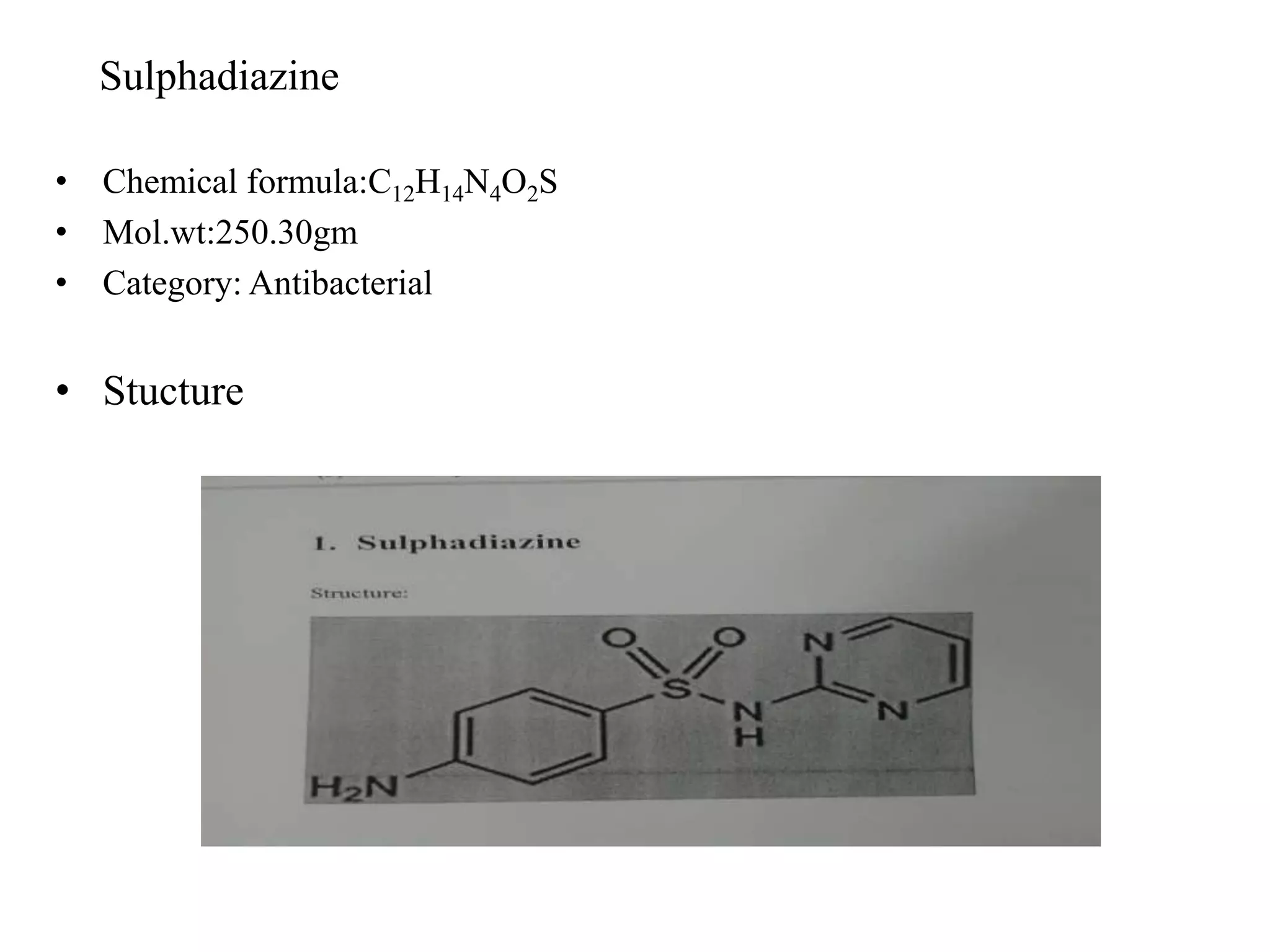
Sulphadiazine
• Chemical formula:C12H14N4O2S
• Mol.wt:250.30gm
• Category: Antibacterial
• Stucture
Analytical methods
• Diazotization reactions: It is commonly used for the determination
of aromic amino groups in industry
• Principle:
• When aromatic primary amines with nuclear –NH2 groups can be
determined quantitatively by standard sodium nitrate solution
required to convert them in diazonium salts. since the formation of
diazotization compounds by diazotization reaction , these method is
called Diazotization reaction.
• Aromatic primary amines react with sodium nitrate in acid solution
(i.e. Nitrous acid) to form diazonium salt.
• CHEMICAL REACTION
• C6H5NH2+HCL > C6H5N2CL+NACL+2H2O
• NaNO2+HCL > HNO2 + NACL
• KI + HCL > HI +KCL
• 2HI + HNO2 > I2 +2NO + 2H20
• The iodine liberated reacts with starch to form a blue colour
• ANALYTICAL METHODS
• COLOURIMETRIC ESTIMATION
• PRINCIPLE: Primary aromatic amines react with HCL+
NANO2 to form diazonium salt.The salt react with BMR
reagent to form azo dye.
From stock soln B Pipette out 0.5
ml in 5 diff TT
• Then add 1ml of NaNO2 + 1ml
ammonium sulphamate+1ml
BMR
• Make up the volume with 10ml
DW then visulize the intensity at
530nm using colourimetry.
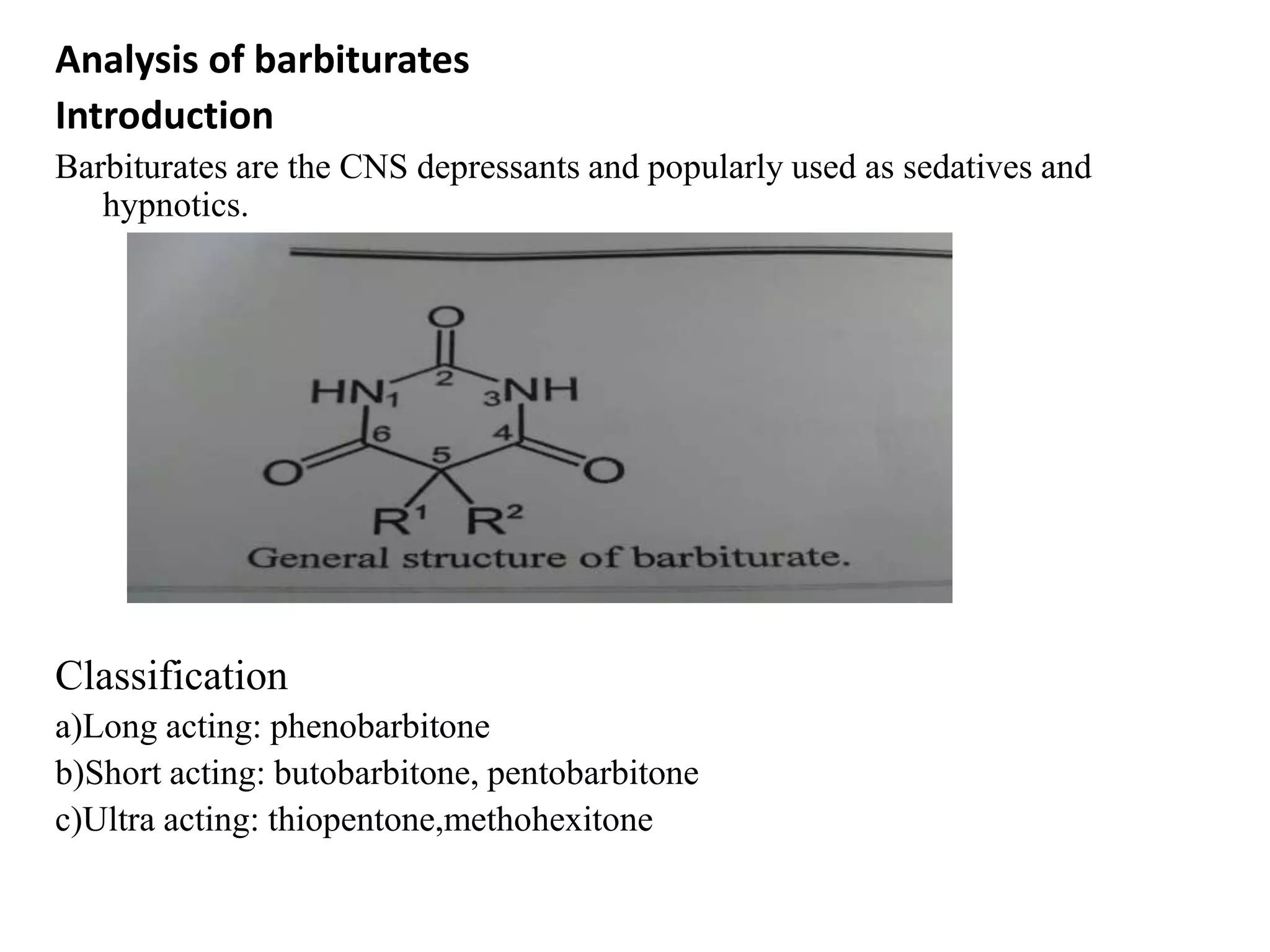
Analysis of barbiturates
Introduction
Barbiturates are the CNS depressants and popularly used as sedatives and
hypnotics.
Classification
a)Long acting: phenobarbitone
b)Short acting: butobarbitone, pentobarbitone
c)Ultra acting: thiopentone,methohexitone
Mechanism of action
GABA
barb.potentiates
opening of cl- channel.
At high conc:
Directly increase cl- conductance
Inhibit ca++ dependant release of neurotran smittor
At high conc:
Depress voltage sensitive Na and K channels.
Analysis of barbiturates
Physical properties:
Description: colorless or white crystalline power, odourless
Solubility: soluble in ethanol (95%)& in ether, sparingly in
chloroform, very slightly in water.
Chemical methods:
1. Non –aqueous titration
2. Gravimetry
3. Acid- base titration
4. Bromination
5. Parri reaction
6. Hydroxamic acid method
Non-aqueous titration:
Principle
Phenobarbitone is a weak acidic and react with ethanolic
sodium hydroxide in the presence of pyridine.
Phenobarbitone+2NaOH phenobarbitone sod.
Procedure:
• Weigh accurately 0.1g of drug and dissolve in 5ml of
pyridine
• Add 0.2ml of thymolpthalein solution
• Ten add 10ml of silver nitrate pyridine reagent
• Titrate with 0.1M ethanolic NaOH until blue colour is
obtained & perform blank
1ml of 0.1 NaOH= 0.01161g of phenobarbitone
Assay:
• Weigh accurately about 0.15g, dissolve in 5ml of H2O, add
2ml of 1M H2SO4& extract with 4 quantities, each of 10ml
of CHCl3.
• Filter CHCl3 extracts, evaporate the filtrate to dryness and
dissolve the residue in 30ml 0f DMF, previously
neutralized with 0.1m lithium methoxide.
• Titrate with 0.1m lithium methoxide, using 1 drop of
0.2%w/v solution of thymol blue in methanol as indicator,
until blue colour is obtained.
• Each ml of 0.1M Li. Methoxide=0.02423g of thiopentone.
INSTRUMENTAL METHODS:
Chromatographic method:
 Thin layer chromatography
 HPLC
 Colorimetric estimation
Thin layer chromatography:
Adsorbent: silica gel (mixed layers(silica gel- G +alumina =
1:1))
Sample:
Material is extracted with ethanol on water bath: after
evaporating off the ethanol, residue is taken in H2O, the
solution is acidified with tartaric acid, barbituric acids are
extracted with ether & aliquot is applied on thin layer.
Solvent:
Neutral and basic mixtures are used.
Eg: CHCl3: acetone (90:10)
CHCl3: ether(75:25)
Detection:
Nonspecifically on fluorescent layers (silicagel GF 254).
Combined spray reagent of mercuric salt&
diphenylcarbazone solution.
Mercurous nitrate reagent.
ADRENERGIC DRUGS:
These are the drugs which with actions similar to that of
”Adrenaline or sympathetic stimulation”
These drugs are also called as “sympathomimetics”
Types
Direct sympathomimetics
They act directly as agonists on α and/ or β- adrenoreceptors
Eg: adrenaline, nor- adrenaline, isoprenaline, phenylephrine
etc.
Indirect sympathomimetics
They act on adrenergic neurone to release nor- adrenaline
which acts on the adrenoreceptors.
Eg: tyramine.etc.
Mixed action sympathomimetics
They act directly as well as indirectly
Eg: ephedrine, amphetamine etc.
XYLOMETAZOLINE HYDROCHLORIDE:
Molecular formula:C16H24N2.HCl
Chemical name:2[4-tert-butyl 2,6- dimethylbenzyl]- 2-
imidazoline monohydrochloride.
Molecular weight:280.84
Appearance: white crystaline and odourless substance.
Solubility: soluble in methanol& ethanol in 3% in water.
Methods of analysis:
• Colorimetry
• Liquid chromatography
• Gas chromatography
• Infrared spectroscopy
• Colorimetry:
The official assay method for determination of xylometazoline
hydrochloride in the nasal solution dosage form is reported in
USP.
The free base is extracted into dichloro methane, evaporated into
dryness, redissolved in ethanol, made alkaline and reacted with
sodium nitro ferricyanide. The colour thus developed is
measured at 565 nm.
Antitubercular drugs
Introduction:
These are caused by myco bacterium tuberculosis used in treatment of
chronic granulo matous disease called tuberculosis.
They mainly contain amino group based on functional group, scientists
proposed different analytical methods.
Classification
1. First line drugs ex: isoniazid, rifampicin, streptomycin, ethambutanol
2. Second line drugs ex: ethionamide. Para amino salicylic acid,
vincomycin sulphate.
• Isoniazid :
physical methods:
Description: colourless crystals
Solubility: freely soluble in water, sparingly soluble in ethanol,
slightly soluble in chloroform.
Melting point: it melts at 170-174o C
Chemical methods:
Dissolve 0.1 gm sample in 2ml of water , add warm solution of
0.1gm vanillin in 10 ml water. Allow to stand for two minutes,
yellow ppt is formed.
Assay: weigh 0.25gm of sample , dissolve in sufficient water. Add
20ml Hcl , 0.2gm potassium bromide. Titrate with 0.016M
potassium bromate using methyl red solution as indicator. End
point is red to yellow.
Instrumental method of analysis:
Chromatography methods:
TLC , colorimetry , infrared spectroscopy.
Thin layer chromatography:
adsorbant : silica gel GF 254
Mobile phase: chloroform, methanol (9:1)
Plate is coated with silica gel GF 254 , apply samples of 10µl in
different concentration 0.010% w/v and 2.0 w/v which are
dissolved in acetone.
After removal of plate allow it to dry in air and examine this
spot and calculate Rf value.
Concentration of sample can be determined by densitometer.
• Diuretics
Introduction :
Diuretics are first discovered in 1957 and its usage regulated
in 1960.
These are drtugs which cause a net loss of sodium and water
in urine.
CLASSIFICATION:
Loop diuretics: Furosemide
Thiazide diuretics: Hydrochlorothiazide
Potassium sparing diuretics: spiranolactone
Carbonic anhydrase inhibitors: acetazolamide
Osmatic diuretics: mannitol , glycerol
• Furosemide:
• Structure
• IUPAC : 4- chloro – N – furfuryl -5 – sulphamoyl anthranilic
acid.
• Method of analysis of furosemide:
• Titrimetric method
• Spectrophotometric method: UV method, colorimetric
method
• Chromatographic method: HPLC method
Titrimetric method:
Dissolve 0.5gm of furosemide in 40 ml of dimethyl formamide
titrate with o.1N NaoH using bromothymol blue solution as
indicator. Repeat the operation with furosemide. The
diffrence between the titration represents the NaoH
required.
• Colorimetric method:
Furosemide + butyl amine + cobalt chloride and acetic acid,
dissolve in anhydrous methanol. Blue color is formed .
Measure the absorbance at 570nm.
• Reference:
• Qualitative analysis of drugs in pharmaceutical
formulations, 3rd Edition by P.D.Sethi
• Higuchi,Buchman,Pharmaceutical
Analysis,2nd Edition.
• The indian pharmacopeia 1996
• Internet source
physicochemical and instrumental method analysis of pharmaceutical dosage forms,

physicochemical and instrumental method analysis of pharmaceutical dosage forms,

  • 1.
    Seminar on studyof physico-chemical methods and instrumental method analysis of pharmaceutical dosage forms Submitted by: Sharath H N M. Pharma 1st year Dept. Of Pharmaceutical Analysis
  • 2.
    Content Physico-chemical methods andinstrumental method analysis of pharmaceutical dosage forms • Sulphonamides • Barbiturates • Adrenergic drugs • Antitubercular drugs • Diuretics
  • 3.
    INTRODUCTION • Sulphonamides: • Theseare the drugs or chemical substances or chemotherapeutic drugs which are used to inhibit the growth of microorganisms without damaging host tissue. Eg: sulphacetamide,sulphaguanidine,sulphanilamide Sulphonamides are derived from prontosil, a prodrug that is metabolised invivo by Azo-reductase. These are available in the form of tablets, suspensions, parentals, ophthalmic solutions,ointments.
  • 4.
    CLASSIFICATION • For systematicinfection • Short acting: sulphadiazine, sulphathiazine • Intermediate acting:sulphamethoxazole • Long acting: sulphadoxine • For intestinal infection • Sulphasalazine • For topical application • sulphacetamide
  • 5.
    • Analyitical methodsof sulphonamides • Titrimetric methods • Diazotization reactions • Non aqueous titrations • Argetometric titrations • UV spectrometry • Colourimetry • Flourimetry
  • 6.
    Sulphadiazine • Chemical formula:C12H14N4O2S •Mol.wt:250.30gm • Category: Antibacterial • Stucture
  • 7.
    Analytical methods • Diazotizationreactions: It is commonly used for the determination of aromic amino groups in industry • Principle: • When aromatic primary amines with nuclear –NH2 groups can be determined quantitatively by standard sodium nitrate solution required to convert them in diazonium salts. since the formation of diazotization compounds by diazotization reaction , these method is called Diazotization reaction. • Aromatic primary amines react with sodium nitrate in acid solution (i.e. Nitrous acid) to form diazonium salt.
  • 8.
    • CHEMICAL REACTION •C6H5NH2+HCL > C6H5N2CL+NACL+2H2O • NaNO2+HCL > HNO2 + NACL • KI + HCL > HI +KCL • 2HI + HNO2 > I2 +2NO + 2H20 • The iodine liberated reacts with starch to form a blue colour
  • 9.
    • ANALYTICAL METHODS •COLOURIMETRIC ESTIMATION • PRINCIPLE: Primary aromatic amines react with HCL+ NANO2 to form diazonium salt.The salt react with BMR reagent to form azo dye. From stock soln B Pipette out 0.5 ml in 5 diff TT • Then add 1ml of NaNO2 + 1ml ammonium sulphamate+1ml BMR • Make up the volume with 10ml DW then visulize the intensity at 530nm using colourimetry.
  • 10.
    Analysis of barbiturates Introduction Barbituratesare the CNS depressants and popularly used as sedatives and hypnotics. Classification a)Long acting: phenobarbitone b)Short acting: butobarbitone, pentobarbitone c)Ultra acting: thiopentone,methohexitone
  • 11.
    Mechanism of action GABA barb.potentiates openingof cl- channel. At high conc: Directly increase cl- conductance Inhibit ca++ dependant release of neurotran smittor At high conc: Depress voltage sensitive Na and K channels.
  • 12.
    Analysis of barbiturates Physicalproperties: Description: colorless or white crystalline power, odourless Solubility: soluble in ethanol (95%)& in ether, sparingly in chloroform, very slightly in water. Chemical methods: 1. Non –aqueous titration 2. Gravimetry 3. Acid- base titration 4. Bromination 5. Parri reaction 6. Hydroxamic acid method
  • 13.
    Non-aqueous titration: Principle Phenobarbitone isa weak acidic and react with ethanolic sodium hydroxide in the presence of pyridine. Phenobarbitone+2NaOH phenobarbitone sod. Procedure: • Weigh accurately 0.1g of drug and dissolve in 5ml of pyridine • Add 0.2ml of thymolpthalein solution • Ten add 10ml of silver nitrate pyridine reagent • Titrate with 0.1M ethanolic NaOH until blue colour is obtained & perform blank
  • 14.
    1ml of 0.1NaOH= 0.01161g of phenobarbitone Assay: • Weigh accurately about 0.15g, dissolve in 5ml of H2O, add 2ml of 1M H2SO4& extract with 4 quantities, each of 10ml of CHCl3. • Filter CHCl3 extracts, evaporate the filtrate to dryness and dissolve the residue in 30ml 0f DMF, previously neutralized with 0.1m lithium methoxide. • Titrate with 0.1m lithium methoxide, using 1 drop of 0.2%w/v solution of thymol blue in methanol as indicator, until blue colour is obtained. • Each ml of 0.1M Li. Methoxide=0.02423g of thiopentone.
  • 15.
    INSTRUMENTAL METHODS: Chromatographic method: Thin layer chromatography  HPLC  Colorimetric estimation Thin layer chromatography: Adsorbent: silica gel (mixed layers(silica gel- G +alumina = 1:1)) Sample: Material is extracted with ethanol on water bath: after evaporating off the ethanol, residue is taken in H2O, the solution is acidified with tartaric acid, barbituric acids are extracted with ether & aliquot is applied on thin layer.
  • 16.
    Solvent: Neutral and basicmixtures are used. Eg: CHCl3: acetone (90:10) CHCl3: ether(75:25) Detection: Nonspecifically on fluorescent layers (silicagel GF 254). Combined spray reagent of mercuric salt& diphenylcarbazone solution. Mercurous nitrate reagent.
  • 17.
    ADRENERGIC DRUGS: These arethe drugs which with actions similar to that of ”Adrenaline or sympathetic stimulation” These drugs are also called as “sympathomimetics”
  • 18.
    Types Direct sympathomimetics They actdirectly as agonists on α and/ or β- adrenoreceptors Eg: adrenaline, nor- adrenaline, isoprenaline, phenylephrine etc. Indirect sympathomimetics They act on adrenergic neurone to release nor- adrenaline which acts on the adrenoreceptors. Eg: tyramine.etc.
  • 19.
    Mixed action sympathomimetics Theyact directly as well as indirectly Eg: ephedrine, amphetamine etc. XYLOMETAZOLINE HYDROCHLORIDE: Molecular formula:C16H24N2.HCl Chemical name:2[4-tert-butyl 2,6- dimethylbenzyl]- 2- imidazoline monohydrochloride. Molecular weight:280.84 Appearance: white crystaline and odourless substance. Solubility: soluble in methanol& ethanol in 3% in water.
  • 20.
    Methods of analysis: •Colorimetry • Liquid chromatography • Gas chromatography • Infrared spectroscopy • Colorimetry: The official assay method for determination of xylometazoline hydrochloride in the nasal solution dosage form is reported in USP. The free base is extracted into dichloro methane, evaporated into dryness, redissolved in ethanol, made alkaline and reacted with sodium nitro ferricyanide. The colour thus developed is measured at 565 nm.
  • 21.
    Antitubercular drugs Introduction: These arecaused by myco bacterium tuberculosis used in treatment of chronic granulo matous disease called tuberculosis. They mainly contain amino group based on functional group, scientists proposed different analytical methods. Classification 1. First line drugs ex: isoniazid, rifampicin, streptomycin, ethambutanol 2. Second line drugs ex: ethionamide. Para amino salicylic acid, vincomycin sulphate.
  • 22.
    • Isoniazid : physicalmethods: Description: colourless crystals Solubility: freely soluble in water, sparingly soluble in ethanol, slightly soluble in chloroform. Melting point: it melts at 170-174o C Chemical methods: Dissolve 0.1 gm sample in 2ml of water , add warm solution of 0.1gm vanillin in 10 ml water. Allow to stand for two minutes, yellow ppt is formed. Assay: weigh 0.25gm of sample , dissolve in sufficient water. Add 20ml Hcl , 0.2gm potassium bromide. Titrate with 0.016M potassium bromate using methyl red solution as indicator. End point is red to yellow.
  • 23.
    Instrumental method ofanalysis: Chromatography methods: TLC , colorimetry , infrared spectroscopy. Thin layer chromatography: adsorbant : silica gel GF 254 Mobile phase: chloroform, methanol (9:1) Plate is coated with silica gel GF 254 , apply samples of 10µl in different concentration 0.010% w/v and 2.0 w/v which are dissolved in acetone. After removal of plate allow it to dry in air and examine this spot and calculate Rf value. Concentration of sample can be determined by densitometer.
  • 24.
    • Diuretics Introduction : Diureticsare first discovered in 1957 and its usage regulated in 1960. These are drtugs which cause a net loss of sodium and water in urine. CLASSIFICATION: Loop diuretics: Furosemide Thiazide diuretics: Hydrochlorothiazide Potassium sparing diuretics: spiranolactone Carbonic anhydrase inhibitors: acetazolamide Osmatic diuretics: mannitol , glycerol
  • 25.
    • Furosemide: • Structure •IUPAC : 4- chloro – N – furfuryl -5 – sulphamoyl anthranilic acid.
  • 26.
    • Method ofanalysis of furosemide: • Titrimetric method • Spectrophotometric method: UV method, colorimetric method • Chromatographic method: HPLC method Titrimetric method: Dissolve 0.5gm of furosemide in 40 ml of dimethyl formamide titrate with o.1N NaoH using bromothymol blue solution as indicator. Repeat the operation with furosemide. The diffrence between the titration represents the NaoH required.
  • 27.
    • Colorimetric method: Furosemide+ butyl amine + cobalt chloride and acetic acid, dissolve in anhydrous methanol. Blue color is formed . Measure the absorbance at 570nm.
  • 28.
    • Reference: • Qualitativeanalysis of drugs in pharmaceutical formulations, 3rd Edition by P.D.Sethi • Higuchi,Buchman,Pharmaceutical Analysis,2nd Edition. • The indian pharmacopeia 1996 • Internet source