DEVAANSH SYNGLE
2nd MBBS
SGRRIM&HS
}  It is a major antiepileptic drug
}  Not a CNS depressant
}  Abolition of tonic phase of maximal electroshock
seizures
}  With no effect on or prolongation of clonic phase
}  Limits spread of seizure activity
• Membrane stabilising effect –prevents repetitive
detonation of normal brain cells during
depolarization shift.
• Achieved by prolonging the inactivated stage of
voltage sensitive neuronal sodium channel.
• As a result high frequency discharges are inhibited
Goodman and Gilman's Manual of Pharmacology and Therapeutics 2nd edition
• Reduction in calcium influx
• Inhibition of glutamate
• Facilitation of GABA responses
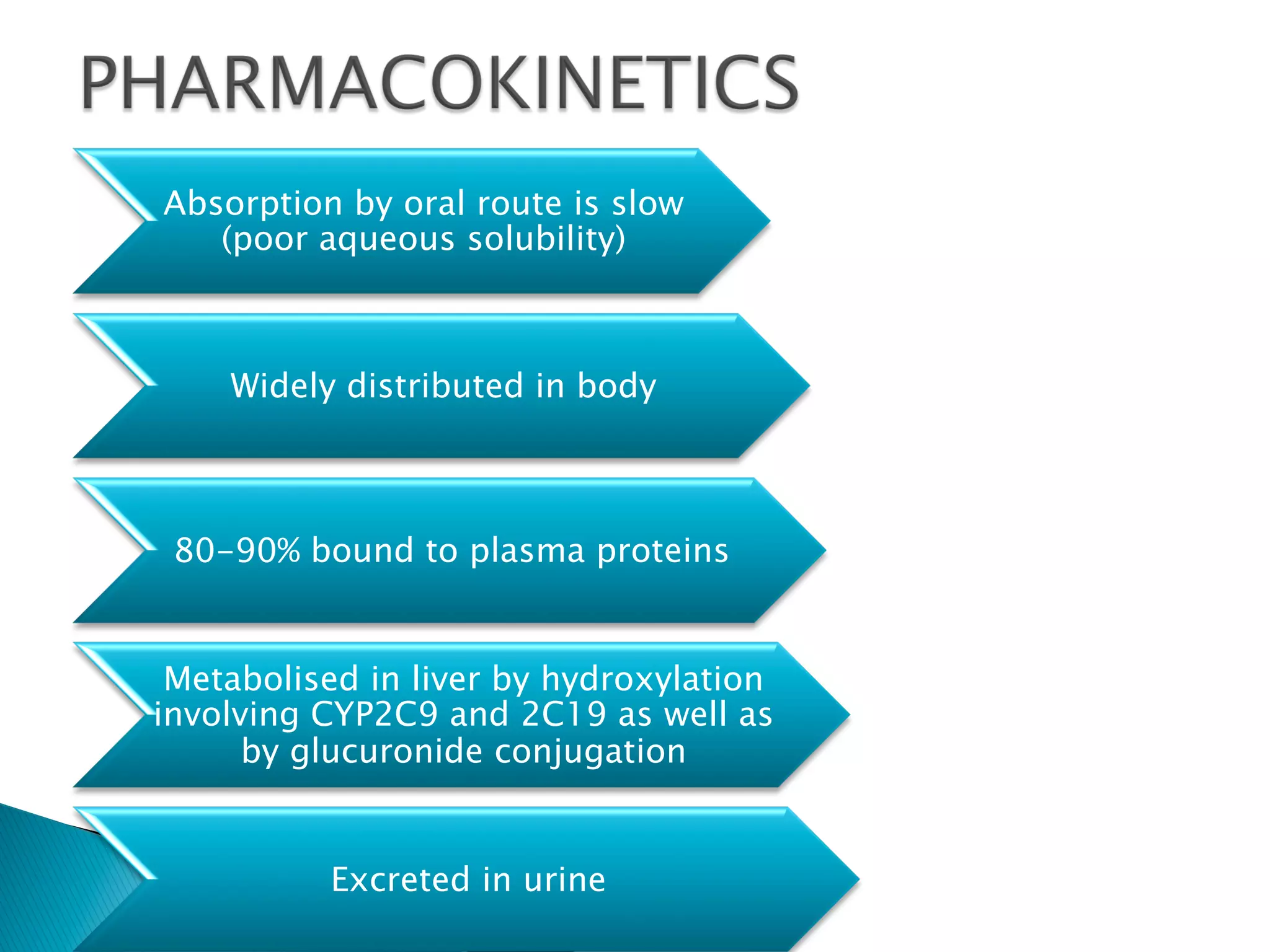
Absorption by oral route is slow
(poor aqueous solubility)
Widely distributed in body
80-90% bound to plasma proteins
Metabolised in liver by hydroxylation
involving CYP2C9 and 2C19 as well as
by glucuronide conjugation
Excreted in urine
The kinetics of
metabolism is
capacity limited
Small increments
in dose produce
disproportionately
high plasma
concentrations.
The plasma half life
progressively increases
when plasma
concentration rises above
10 µg/ml because
metabolising enzymes
get saturated.
Epilepsy
}  First or second choice drug for partial and generalized tonic-
clonic seizures.
}  Fosphenytoin is drug of choice for the emergency treatment
of status epilepticus.
}  (Absence, myoclonic and akinetic seizures may worsen in
patientstreated with phenytoin).
}  For seizure prophylaxis
Peripheral neuropathy
}  One of the earliest drugs used
Trigeminal neuralgias
}  Trigeminal neuralgia – 2nd to carbamazepine
Cardiac arrhythmias
}  Mainly used when arrhythmias are due to digitoxicity
PHENYTOIN: MECHANSIM OF ACTION , PHARMACOKINETICS &THERAPEUTIC INDICATIONS

PHENYTOIN: MECHANSIM OF ACTION , PHARMACOKINETICS & THERAPEUTIC INDICATIONS

  • 1.
  • 2.
    }  It isa major antiepileptic drug }  Not a CNS depressant }  Abolition of tonic phase of maximal electroshock seizures }  With no effect on or prolongation of clonic phase }  Limits spread of seizure activity
  • 3.
    • Membrane stabilising effect–prevents repetitive detonation of normal brain cells during depolarization shift. • Achieved by prolonging the inactivated stage of voltage sensitive neuronal sodium channel. • As a result high frequency discharges are inhibited Goodman and Gilman's Manual of Pharmacology and Therapeutics 2nd edition
  • 4.
    • Reduction in calciuminflux • Inhibition of glutamate • Facilitation of GABA responses
  • 5.
    Absorption by oralroute is slow (poor aqueous solubility) Widely distributed in body 80-90% bound to plasma proteins Metabolised in liver by hydroxylation involving CYP2C9 and 2C19 as well as by glucuronide conjugation Excreted in urine
  • 6.
    The kinetics of metabolismis capacity limited Small increments in dose produce disproportionately high plasma concentrations. The plasma half life progressively increases when plasma concentration rises above 10 µg/ml because metabolising enzymes get saturated.
  • 7.
    Epilepsy }  First orsecond choice drug for partial and generalized tonic- clonic seizures. }  Fosphenytoin is drug of choice for the emergency treatment of status epilepticus. }  (Absence, myoclonic and akinetic seizures may worsen in patientstreated with phenytoin). }  For seizure prophylaxis Peripheral neuropathy }  One of the earliest drugs used Trigeminal neuralgias }  Trigeminal neuralgia – 2nd to carbamazepine Cardiac arrhythmias }  Mainly used when arrhythmias are due to digitoxicity