DEPRESSION
Presented By
Vaibhav S. Khodke
Bpharm 4th year
A
Presentation on
Rajarshri shuhu college of pharmacy,
Buldhana
Vaibhav s. Khodke
A)Exogenous Depression:-This usually follow
traumatic events like Death of family members, loss
of love, Divorce etc
Temporary depression and autorecovery is
seen with respect to time .emotional support and
psychotherapy usually facillitate the recovery.
B)endogenous Depression :- it is not associated with
any apparent precipitating event and usually due to
certain biochemical alteration.The appropriate drug
treatment can being prompt relief.
 persistently sad, anxious, or empty moods
 loss of pleasure in usual activities (anhedonia)
 feelings of helplessness, guilt, or worthlessness
 crying, hopelessness, or persistent pessimism
 fatigue or decreased energy
 loss of memory, concentration, or decision-
making capability
 restlessness, irritability
 sleep disturbances
 change in appetite or weight
 thoughts of suicide or death, or suicide
attempts
Vaibhav s. Khodke
 Physical illness
 Harmonal Change
 Drug induced depression
 genetic
 Environment
 personality
 biochemical factor
1. Psychotherapy
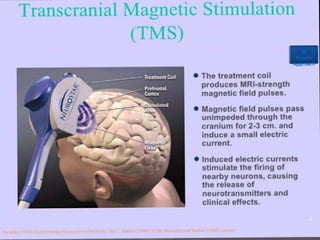
2. Electroconvulsive therapy
3. Natural alternatives
4. Medication
 SSRIs
 MAOIs
 TCAs
 SNRIs
 NDRIs
 TeCAs
 Psycotherapy/talk therapy – especially
useful when combined with meds. Goal is to
teach good coping skills for every day
stressors
 ECT – electric shock is applied to scalp
through electrodes, results in seizure in the
brain. Fast and effecitve in patients with
depression or suicidal thoughts (good for
suicide bc doesn’t have the same delayed
onset as meds). Usually given up to three
times a week for two to four weeks
 Monoamine oxidase inhibitors (MAOIs)
 Tricyclic antidepressants (TCAs)
 Selective serotonin reuptake inhibitors (SSRIs)
 Serotonin-norepinephrine reuptake inhibitors
(SNRIs)
 Amongst the first Antidepressants
 Include:
- Phenelzine
- Tranylcypromine
- Isocarboxazid
- Moclobemide
- Pargyline
 Onset of antidepressant effect is delayed for
2-4 weeks.
 MAOIs increase the levels of released serotonin,
norepinephrine and dopamine by
 blocking the enzyme that breaks them down (via
oxidation) in the presynaptic neurons.
norepinephrine norepinephrine
aldehyde
ammonia
Monoamine Oxidase (MAO) – Two Subtypes
MAO-A:Metabolizes serotonin, norepinephrine, dopamine, tyramine
MAO-B: Metabolizes dopamine and phenethylamine
MAOIs - a partial list
Isocarboxazid (Marplan®) - Non-selective MAO-A/MAO-B inhibitor
Moclobemide (Aurorix®, Manerix®) – Selective MAO-A inhibitor
Selegiline (Deprenyl®, Eldepryl®, Emsam®) – Selective MAO-B inhibitor
1- Hypotension: After MAO inhibition, other amines such as
dopamine are able to accumulate in peripheral sympathetic nerve
terminals and displace vesicular NA, thus reducing NA release
and sympathetic activity (sympathetic block).
2- Antimuscarinic effects (atropine-like side-effects):
Dry mouth
blurred vision
Urinary retention
3- CNS stimulation:
Insomnia
Tremors
Excitement
Convulsions
4- Weight gain: associated with increased appetite
• TCAs are the oldest class of antidepressant
drugs
• They have characteristic three-ring nucleus
• The first TCAs discovered was Imipramine
 Imipramine Desipramine
 Clomipramine Amitriptyline
 Nortriptyline Doxepin
 Trimipramine
TETRACYCLIC ANTIDEPRESSANTS
 Maprotiline
 Amoxapine
Imipramine
(Tofranil)
TRICYCLIC ANTIDEPRESSANTS
(TCAs)
MECHANISM OF ACTION of TCAs:
• All tricyclics block reuptake pumps for both
5HT and NE in nerve terminals by competing
for binding site of the transport protein
 So ↑ conc. of NE & serotonin in the synaptic cleft
& at the receptor site
 Facilitation of NE & serotonin transmission ----
improves symptoms of depression
• Some have more potency for inhibition of 5HT
uptake pump; clomipramine, imipramine,
amitryptyline
• Others have more potency for inhibition of NE
uptake pump: nortriptyline, desipramine
.
1- Elevate mood
2- Improve mental alertness
3- Increase physical activity
# The antidepressant effect may develop after several
weeks of continued treatment ( 2 - 3 weeks)
4- In non-depressed patients They cause
sedation, confusion
- Fluoxetine (prozac)
- Fluvoxamine
- Paroxetine
- Sertraline
- Citalopram
- Escitalopram
 The SSRIs are currently the most widely utilized
class of antidepressants in clinical practice.
 They act within the brain to increase the amount of
the neurotransmitter, serotonin
(5-hydroxytryptamine or 5-HT), in the synaptic gap
by inhibiting its re-uptake.
 SSRIs are described as 'selective' because they
affect only the reuptake pumps responsible for
serotonin, as opposed to earlier antidepressants,
which affect other monoamine neurotransmitters
as well. Because of this, SSRIs lack some of the
side effects of the more general drugs.
 Advantages
- The Most commonly prescribed antidepressants
- Lacks cardiovascular and anticholinergic side effects compared
to TCA
- In contrast to MAOI, they do not cause ‘cheese’ reaction
- Safer (low risk of overdose)
- Acute toxicity is less than that of MAOI or TCA
Adverse effects of SSRIs:
 GIT symptoms: Nausea vomiting & diarrhea.
 Changes in appetite ---weight loss/ gain.
 Sleep disturbances: Drowsiness with Fluvoxamine.
 Anxiety & Tremors.
 Sexual dysfunction: Loss of libido
 Serotonin norepinephrine reuptake
inhibitors (SNRIs) are a class of
antidepressant used in the treatment of
clinical depression and other affective
disorders.
 They act upon two neurotransmitters in the
brain that are known to play an important
part in mood, namely, 5HT and NE. This can
be contrasted with the more widely-used
selective serotonin reuptake inhibitors
(SSRIs), which act only on serotonin.
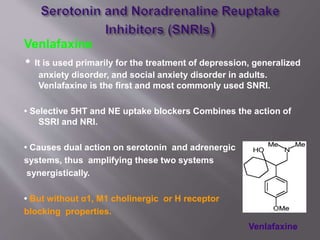
Venlafaxine
• It is used primarily for the treatment of depression, generalized
anxiety disorder, and social anxiety disorder in adults.
Venlafaxine is the first and most commonly used SNRI.
• Selective 5HT and NE uptake blockers Combines the action of
SSRI and NRI.
• Causes dual action on serotonin and adrenergic
systems, thus amplifying these two systems
synergistically.
• But without α1, M1 cholinergic or H receptor
blocking properties.
Venlafaxine
 These are a class of antidepressants that are not really
categorized as a special group of antidepressants.
 The only antidepressant in this group is Bupropion
(Wellbutrin), which is an antidepressant of the
aminoketone class, chemically unrelated to tricyclics or
SSRIs.

Bupropion is a selective catecholamine
(norepinephrine and dopamine) reuptake inhibitor.
It has only a small effect on serotonin reuptake. It
does not inhibit MAO.
 Stimulation through electrodes placed on
either side of the head with the patient
anaesthetized, paralysed with a NMB drugs
to avoid physical injury and artificially
ventilated
 Response rates 60-80 %
 The most effective treatment
for severe suicidal depression
 DISADVANTAGES
Confusion, Memory loss lasting
for days or weeks
Vaibhav s. Khodke

Depression vsk

  • 1.
    DEPRESSION Presented By Vaibhav S.Khodke Bpharm 4th year A Presentation on Rajarshri shuhu college of pharmacy, Buldhana
  • 2.
  • 3.
    A)Exogenous Depression:-This usuallyfollow traumatic events like Death of family members, loss of love, Divorce etc Temporary depression and autorecovery is seen with respect to time .emotional support and psychotherapy usually facillitate the recovery. B)endogenous Depression :- it is not associated with any apparent precipitating event and usually due to certain biochemical alteration.The appropriate drug treatment can being prompt relief.
  • 4.
     persistently sad,anxious, or empty moods  loss of pleasure in usual activities (anhedonia)  feelings of helplessness, guilt, or worthlessness  crying, hopelessness, or persistent pessimism  fatigue or decreased energy  loss of memory, concentration, or decision- making capability  restlessness, irritability  sleep disturbances  change in appetite or weight  thoughts of suicide or death, or suicide attempts
  • 5.
  • 8.
     Physical illness Harmonal Change  Drug induced depression  genetic  Environment  personality  biochemical factor
  • 9.
    1. Psychotherapy 2. Electroconvulsivetherapy 3. Natural alternatives 4. Medication  SSRIs  MAOIs  TCAs  SNRIs  NDRIs  TeCAs
  • 10.
     Psycotherapy/talk therapy– especially useful when combined with meds. Goal is to teach good coping skills for every day stressors  ECT – electric shock is applied to scalp through electrodes, results in seizure in the brain. Fast and effecitve in patients with depression or suicidal thoughts (good for suicide bc doesn’t have the same delayed onset as meds). Usually given up to three times a week for two to four weeks
  • 12.
     Monoamine oxidaseinhibitors (MAOIs)  Tricyclic antidepressants (TCAs)  Selective serotonin reuptake inhibitors (SSRIs)  Serotonin-norepinephrine reuptake inhibitors (SNRIs)
  • 15.
     Amongst thefirst Antidepressants  Include: - Phenelzine - Tranylcypromine - Isocarboxazid - Moclobemide - Pargyline  Onset of antidepressant effect is delayed for 2-4 weeks.
  • 16.
     MAOIs increasethe levels of released serotonin, norepinephrine and dopamine by  blocking the enzyme that breaks them down (via oxidation) in the presynaptic neurons. norepinephrine norepinephrine aldehyde ammonia
  • 17.
    Monoamine Oxidase (MAO)– Two Subtypes MAO-A:Metabolizes serotonin, norepinephrine, dopamine, tyramine MAO-B: Metabolizes dopamine and phenethylamine MAOIs - a partial list Isocarboxazid (Marplan®) - Non-selective MAO-A/MAO-B inhibitor Moclobemide (Aurorix®, Manerix®) – Selective MAO-A inhibitor Selegiline (Deprenyl®, Eldepryl®, Emsam®) – Selective MAO-B inhibitor
  • 18.
    1- Hypotension: AfterMAO inhibition, other amines such as dopamine are able to accumulate in peripheral sympathetic nerve terminals and displace vesicular NA, thus reducing NA release and sympathetic activity (sympathetic block). 2- Antimuscarinic effects (atropine-like side-effects): Dry mouth blurred vision Urinary retention 3- CNS stimulation: Insomnia Tremors Excitement Convulsions 4- Weight gain: associated with increased appetite
  • 19.
    • TCAs arethe oldest class of antidepressant drugs • They have characteristic three-ring nucleus • The first TCAs discovered was Imipramine  Imipramine Desipramine  Clomipramine Amitriptyline  Nortriptyline Doxepin  Trimipramine TETRACYCLIC ANTIDEPRESSANTS  Maprotiline  Amoxapine Imipramine (Tofranil) TRICYCLIC ANTIDEPRESSANTS (TCAs)
  • 20.
    MECHANISM OF ACTIONof TCAs: • All tricyclics block reuptake pumps for both 5HT and NE in nerve terminals by competing for binding site of the transport protein  So ↑ conc. of NE & serotonin in the synaptic cleft & at the receptor site  Facilitation of NE & serotonin transmission ---- improves symptoms of depression • Some have more potency for inhibition of 5HT uptake pump; clomipramine, imipramine, amitryptyline • Others have more potency for inhibition of NE uptake pump: nortriptyline, desipramine .
  • 21.
    1- Elevate mood 2-Improve mental alertness 3- Increase physical activity # The antidepressant effect may develop after several weeks of continued treatment ( 2 - 3 weeks) 4- In non-depressed patients They cause sedation, confusion
  • 22.
    - Fluoxetine (prozac) -Fluvoxamine - Paroxetine - Sertraline - Citalopram - Escitalopram
  • 23.
     The SSRIsare currently the most widely utilized class of antidepressants in clinical practice.  They act within the brain to increase the amount of the neurotransmitter, serotonin (5-hydroxytryptamine or 5-HT), in the synaptic gap by inhibiting its re-uptake.  SSRIs are described as 'selective' because they affect only the reuptake pumps responsible for serotonin, as opposed to earlier antidepressants, which affect other monoamine neurotransmitters as well. Because of this, SSRIs lack some of the side effects of the more general drugs.
  • 24.
     Advantages - TheMost commonly prescribed antidepressants - Lacks cardiovascular and anticholinergic side effects compared to TCA - In contrast to MAOI, they do not cause ‘cheese’ reaction - Safer (low risk of overdose) - Acute toxicity is less than that of MAOI or TCA Adverse effects of SSRIs:  GIT symptoms: Nausea vomiting & diarrhea.  Changes in appetite ---weight loss/ gain.  Sleep disturbances: Drowsiness with Fluvoxamine.  Anxiety & Tremors.  Sexual dysfunction: Loss of libido
  • 25.
     Serotonin norepinephrinereuptake inhibitors (SNRIs) are a class of antidepressant used in the treatment of clinical depression and other affective disorders.  They act upon two neurotransmitters in the brain that are known to play an important part in mood, namely, 5HT and NE. This can be contrasted with the more widely-used selective serotonin reuptake inhibitors (SSRIs), which act only on serotonin.
  • 26.
    Venlafaxine • It isused primarily for the treatment of depression, generalized anxiety disorder, and social anxiety disorder in adults. Venlafaxine is the first and most commonly used SNRI. • Selective 5HT and NE uptake blockers Combines the action of SSRI and NRI. • Causes dual action on serotonin and adrenergic systems, thus amplifying these two systems synergistically. • But without α1, M1 cholinergic or H receptor blocking properties. Venlafaxine
  • 27.
     These area class of antidepressants that are not really categorized as a special group of antidepressants.  The only antidepressant in this group is Bupropion (Wellbutrin), which is an antidepressant of the aminoketone class, chemically unrelated to tricyclics or SSRIs.  Bupropion is a selective catecholamine (norepinephrine and dopamine) reuptake inhibitor. It has only a small effect on serotonin reuptake. It does not inhibit MAO.
  • 29.
     Stimulation throughelectrodes placed on either side of the head with the patient anaesthetized, paralysed with a NMB drugs to avoid physical injury and artificially ventilated  Response rates 60-80 %  The most effective treatment for severe suicidal depression  DISADVANTAGES Confusion, Memory loss lasting for days or weeks
  • 32.