ANTI - DEPRESSANTS
PRESENTED BY:
NIKHITA KAREN D’SOUZA
M. PHARM (2022-2024)
KLE COLLEGE OF PHARMACY,
BELAGAVI
DEFINITION
• Depression: It is mental health disorder characterized by persistently depressed mood or loss of
interest in activities, causing significant impairment in daily life. Possible causes include a
combination of biological, psychological and social sources of distress. Increasingly, research
suggests that these factors may cause changes in brain function, including altered activity of
certain neural circuits in the brain.
• Antidepressants: They are a class of medication used to treat major depressive disorder,
some anxiety disorders, some chronic pain conditions, and to help manage some addictions.
•Feelings of sadness, tearfulness, emptiness or hopelessness
•Angry outbursts, irritability or frustration, even over small matters
•Loss of interest or pleasure in most or all normal activities, such as sex, hobbies or sports
•Sleep disturbances, including insomnia or sleeping too much
•Tiredness and lack of energy, so even small tasks take extra effort
•Reduced appetite and weight loss or increased cravings for food and weight gain
•Anxiety, agitation or restlessness
•Slowed thinking, speaking or body movements
•Feelings of worthlessness or guilt, fixating on past failures or self-blame
•Trouble thinking, concentrating, making decisions and remembering things
•Frequent or recurrent thoughts of death, suicidal thoughts, suicide attempts or suicide.
SYMPTOMS
CLASSIFICATION OF ANTI-DEPRESSANTS
1. SELECTIVE SEROTININ REUPTAKE INHIBITORS (SSRIs): fluoxetine, paroxetine, escitalopram,
sertraline, citalopram, fluvoxamine
2. SEROTININ NORADRENALIN REUPTAKE INHIBITORS (SNRIs): duloxetine, venlafaxine,
desvenlafaxine, milnacipran, levomilnacipran
3. TRICYCLIC ANTIDEPRESSANTS (TCA): amitriptyline, nortriptyline, desipramine, clomipramine,
nortriptyline, doxepin
4. MONO AMINE OXIDASE INHIBITORS (MAOI): Phenelzine, selegiline, meclobemide
5. ATYPICAL ANTIDEPRESSANTS: Bupropion, Nefazodone, vortixetine, trazodone, mirtazapine
SELECTIVE SEROTININ REUPTAKE INHIBITORS (SSRIs):
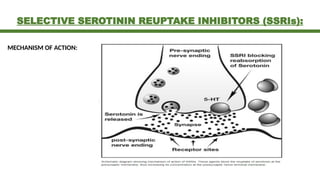
MECHANISM OF ACTION:
They block the reabsorption (reuptake) of serotonin into neurons. This makes more serotonin
available to improve transmission of messages between neurons. SSRIs are called selective
because they mainly affect serotonin, not other neurotransmitters.
COMMON SIDE EFFECTS: Feeling agitated, shaky, anxious, constipation or diarrhea, blurred
vision, dizziness, dry mouth, insomnia and headaches.
RARE SIDE EFFECTS: Bruising or bleeding easily, vomiting blood, confusion, movement problems
like stiffness, inability to urinate and hallucinations.
CONTRAINDICATIONS: Pregnancy, breastfeeding, operating machines or
driving, children below 18 and St. John’s wort.
USES:
• Generalised anxiety disorder (GAD)
• Obsessive compulsive disorder (OCD) - Fluvoxamine, Fluoxetine
• Panic disorder
• Severe phobias, such as agoraphobia and social phobia
• Bulimia - Fluoxetine
• Post-traumatic stress disorder (PTSD) - Sertraline
• Ssris can sometimes be used to treat other conditions, such as premenstrual
syndrome (PMS) - Citalopram
• Fibromyalgia and irritable bowel syndrome (IBS) - Citalopram
SEROTININ AND NORADRENALIN REUPTAKE INHIBITORS
(SNRIs):
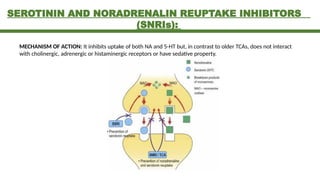
MECHANISM OF ACTION: It inhibits uptake of both NA and 5-HT but, in contrast to older TCAs, does not interact
with cholinergic, adrenergic or histaminergic receptors or have sedative property.
SIDE EFFECCTS:
nausea, changes in appetite, muscle weakness, tremor, agitation, heart palpitations,
increased blood pressure, increased heart rate, headache, difficulty urinating, dizziness,
insomnia, sleepiness, dry mouth, excessive sweating, constipation, fluid retention, especially
in older adults, impotence and withdrawal reaction on discontinuation.
CONTRAINDICATIONS:
1. It is contraindicated in eating disorders and in bipolar illness – Bupropion
2. Postural hypotension, conduction disturbances and arrhythmias can occur, especially in
patients with heart disease - Amineptine
USES:
1. A faster onset of action is claimed.
2. Mood changes and hot flushes in menopausal syndrome, some anxiety and eating
disorders are also benefited - Venlafaxine.
3. Mild anxiolytic effect has been noted and it has benefited cases of OCD – Duloxetine
4. Supresses panic attacks - Mianserin
TRICYCLIC ANTIDEPRESSANTS (TCA):
MECHANISM OF ACTION:
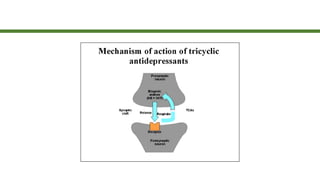
• The TCAs and related drugs inhibit NET and SERT which mediate active reuptake
of biogenic amines NA and 5-HT into their respective neurons and thus potentiate
them.
• It has been proposed that TCAs indirectly facilitate dopaminergic transmission in
forebrain that may add to the mood elevating action. Reuptake inhibition results in
increased concentration of the amines in the synaptic cleft in both CNS and
periphery.
SIDE EFFECTS:
1. Amitriptyline and Dosulpin are particularly dangerous in overdose; higher incidence of
arrhythmia is reported with them.
2. Increased appetite and weight gain is noted with most TCAs and trazodone.
3. Some patients receiving any antidepressant may abruptly ‘switch over’ to a dysphoric
agitated state or to mania. Most likely, these are cases of bipolar depression, the other pole
being unmasked by the antidepressant.
4. Seizure threshold is lowered—fits may be precipitated, especially in children.
5. Rashes and jaundice due to hypersensitivity are rare. Mianserin is more hepatotoxic.
CONTRAINDICATION:
Amitriptyline should not be used if there is a history of QTc prolongation, arrhythmias, recent
myocardial infarction, or heart failure.
USES:
1. Tricyclic antidepressants (TCAs) are sometimes used to treat bedwetting in children, if other
treatments have not worked. They can help relax the muscles of the bladder. This increases
bladder capacity and reduces the urge to urinate.
2. Used to treat OCD.
3. In low doses, they are used to treat migraines.
4. Used to treat panic disorder.
MONO AMINE OXIDASE INHIBITORS (MAOI):
MECHANISM OF ACTION:
MAO is a mitochondrial enzyme involved in the oxidative deamination of biogenic amines (Adr, NA,
DA, 5-HT). Two isoenzyme forms of MAO have been identified. They are
a) MAO-A: Preferentially deaminates 5-HT and NA, and is inhibited by Clorgyline, Moclobemide.
b) MAO-B: Preferentially deaminates Phenylethylamine and is inhibited by Selegiline.
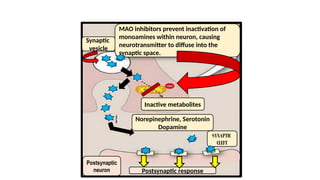
MAO inhibitors prevent inactivation of
monoamines within neuron, causing
neurotransmitter to diffuse into the
synaptic space.
Synaptic
vesicle
Inactive metabolites
Norepinephrine, Serotonin
Dopamine
Postsynaptic
neuron Postsynaptic response
SYNAPTIC
CLEFT
SIDE EFFECTS
Because of side effects and safety concerns, MAOIs are most often tried when other
antidepressants don't work.
The most common side effects of MAOIs include:
• Dry mouth
• Nausea, diarrhea or constipation
• Headache
• Drowsiness
• Insomnia
• Dizziness or lightheadedness
•Skin reaction at the patch site
Other possible side effects include:
•Involuntary muscle jerks
•Low blood pressure
•Reduced sexual desire or difficulty reaching orgasm
•Weight gain
•Difficulty starting a urine flow
•Muscle cramps
•Prickling or tingling sensation in the skin (paresthesia)
CONTRAINDICATION:
Should not be given to teenagers because it causes suicidal thoughts.
ATYPICAL ANTIDEPRESSANTS:
MECHANISM OF ACTION:
Mianserin - It is unique in not inhibiting either NA or 5-HT uptake; but blocks
presynaptic α2 receptors thereby increasing release and turnover of NA in brain which
may be responsible for the antidepressant effect. Antagonistic action at 5-HT2, 5-HT1c
as well as H1 receptors
Mirtazapine - This antidepressant acts by a novel mechanism, viz. blocks α2 auto-
(on NA neurones) and hetero- (on 5-HT neurones) receptors enhancing both NA and 5-
HT release. Selective enhancement of antidepressive 5-HT1 receptor action is
achieved by concurrent blockade of 5-HT2 and 5-HT3 receptors which are held
responsible for some of the adverse effects of high serotonergic tone. Accordingly, it
has been labelled as “noradrenergic and specific serotonergic antidepressant”
(NaSSA).
Bupropion - This inhibitor of DA and NA uptake has excitant rather than sedative
property. It is metabolized into an amphetamine like compound which can cause
presynaptic release of DA and NA.
Tianeptine - This antidepressant is reported to increase rather than inhibit 5-HT
uptake, and is neither sedative nor stimulant.
Amineptine - Like tianeptine it enhances 5-HT uptake, and has antidepressant
property.
Trazodone - It is the first atypical antidepressant; less efficiently blocks 5-HT uptake
and has prominent α adrenergic and weak 5-HT2 antagonistic actions. The latter may
contribute to its antidepressant effect
USES:
1. Mild anxiolytic effect has been noted and it has benefited cases of OCD – Trazodone.
2. Relieves associated anxiety and suppresses panic attacks. – Mianserin
3. It is marketed as an aid to smoking cessation. In clinical trials it has been found to yield
higher smoking abstinence and quitting rates than placebo and equivalent to nicotine
replacement – Bupropion
4. Used to treat anxiodepressive states, particularly with psychosomatic symptoms, as well as
in endogenous depression - Tianeptine
SIDE EFFECTS:
1. Due to α1 adrenergic blocking, postural hypotention is caused.
2. Seizures are caused in over-dose – Mianserin
3. Increased appetite and weight gain is frequent- Mirtazapine
CONTRAINDICATION:
4. Contraindicated in patients with heart disease.
5. Contraindicated in post-menopausal women.
6. It is contraindicated in eating disorders and in bipolar illness - Bupropion
REFERENCE:
 K.D. Tripathi
 https://www.researchgate.net/figure/Mechanism-of-action-of-the-SNRIs-TCAs-and-SSRIs-
Adapted-from-Stevens-33-SNRI_fig1_334469284
 https://www.medscape.org/viewarticle/413110_3
 www.medscape.org
 Monoamine Oxidase Inhibitors (MAOIs) (slideshare.net)
 ubmed.ncbi.nlm.nih.gov/10333980/
 smosis.org/learn/Atypical_antidepressants

anti depressants.pptxxxxxxxxxxxxxxxxxxxxxxxxx

  • 1.
    ANTI - DEPRESSANTS PRESENTEDBY: NIKHITA KAREN D’SOUZA M. PHARM (2022-2024) KLE COLLEGE OF PHARMACY, BELAGAVI
  • 2.
    DEFINITION • Depression: Itis mental health disorder characterized by persistently depressed mood or loss of interest in activities, causing significant impairment in daily life. Possible causes include a combination of biological, psychological and social sources of distress. Increasingly, research suggests that these factors may cause changes in brain function, including altered activity of certain neural circuits in the brain. • Antidepressants: They are a class of medication used to treat major depressive disorder, some anxiety disorders, some chronic pain conditions, and to help manage some addictions.
  • 3.
    •Feelings of sadness,tearfulness, emptiness or hopelessness •Angry outbursts, irritability or frustration, even over small matters •Loss of interest or pleasure in most or all normal activities, such as sex, hobbies or sports •Sleep disturbances, including insomnia or sleeping too much •Tiredness and lack of energy, so even small tasks take extra effort •Reduced appetite and weight loss or increased cravings for food and weight gain •Anxiety, agitation or restlessness •Slowed thinking, speaking or body movements •Feelings of worthlessness or guilt, fixating on past failures or self-blame •Trouble thinking, concentrating, making decisions and remembering things •Frequent or recurrent thoughts of death, suicidal thoughts, suicide attempts or suicide. SYMPTOMS
  • 4.
    CLASSIFICATION OF ANTI-DEPRESSANTS 1.SELECTIVE SEROTININ REUPTAKE INHIBITORS (SSRIs): fluoxetine, paroxetine, escitalopram, sertraline, citalopram, fluvoxamine 2. SEROTININ NORADRENALIN REUPTAKE INHIBITORS (SNRIs): duloxetine, venlafaxine, desvenlafaxine, milnacipran, levomilnacipran 3. TRICYCLIC ANTIDEPRESSANTS (TCA): amitriptyline, nortriptyline, desipramine, clomipramine, nortriptyline, doxepin 4. MONO AMINE OXIDASE INHIBITORS (MAOI): Phenelzine, selegiline, meclobemide 5. ATYPICAL ANTIDEPRESSANTS: Bupropion, Nefazodone, vortixetine, trazodone, mirtazapine
  • 5.
    SELECTIVE SEROTININ REUPTAKEINHIBITORS (SSRIs): MECHANISM OF ACTION:
  • 6.
    MECHANISM OF ACTION: Theyblock the reabsorption (reuptake) of serotonin into neurons. This makes more serotonin available to improve transmission of messages between neurons. SSRIs are called selective because they mainly affect serotonin, not other neurotransmitters. COMMON SIDE EFFECTS: Feeling agitated, shaky, anxious, constipation or diarrhea, blurred vision, dizziness, dry mouth, insomnia and headaches. RARE SIDE EFFECTS: Bruising or bleeding easily, vomiting blood, confusion, movement problems like stiffness, inability to urinate and hallucinations.
  • 7.
    CONTRAINDICATIONS: Pregnancy, breastfeeding,operating machines or driving, children below 18 and St. John’s wort. USES: • Generalised anxiety disorder (GAD) • Obsessive compulsive disorder (OCD) - Fluvoxamine, Fluoxetine • Panic disorder • Severe phobias, such as agoraphobia and social phobia • Bulimia - Fluoxetine • Post-traumatic stress disorder (PTSD) - Sertraline • Ssris can sometimes be used to treat other conditions, such as premenstrual syndrome (PMS) - Citalopram • Fibromyalgia and irritable bowel syndrome (IBS) - Citalopram
  • 8.
    SEROTININ AND NORADRENALINREUPTAKE INHIBITORS (SNRIs): MECHANISM OF ACTION: It inhibits uptake of both NA and 5-HT but, in contrast to older TCAs, does not interact with cholinergic, adrenergic or histaminergic receptors or have sedative property.
  • 9.
    SIDE EFFECCTS: nausea, changesin appetite, muscle weakness, tremor, agitation, heart palpitations, increased blood pressure, increased heart rate, headache, difficulty urinating, dizziness, insomnia, sleepiness, dry mouth, excessive sweating, constipation, fluid retention, especially in older adults, impotence and withdrawal reaction on discontinuation. CONTRAINDICATIONS: 1. It is contraindicated in eating disorders and in bipolar illness – Bupropion 2. Postural hypotension, conduction disturbances and arrhythmias can occur, especially in patients with heart disease - Amineptine
  • 10.
    USES: 1. A fasteronset of action is claimed. 2. Mood changes and hot flushes in menopausal syndrome, some anxiety and eating disorders are also benefited - Venlafaxine. 3. Mild anxiolytic effect has been noted and it has benefited cases of OCD – Duloxetine 4. Supresses panic attacks - Mianserin
  • 11.
    TRICYCLIC ANTIDEPRESSANTS (TCA): MECHANISMOF ACTION: • The TCAs and related drugs inhibit NET and SERT which mediate active reuptake of biogenic amines NA and 5-HT into their respective neurons and thus potentiate them. • It has been proposed that TCAs indirectly facilitate dopaminergic transmission in forebrain that may add to the mood elevating action. Reuptake inhibition results in increased concentration of the amines in the synaptic cleft in both CNS and periphery.
  • 13.
    SIDE EFFECTS: 1. Amitriptylineand Dosulpin are particularly dangerous in overdose; higher incidence of arrhythmia is reported with them. 2. Increased appetite and weight gain is noted with most TCAs and trazodone. 3. Some patients receiving any antidepressant may abruptly ‘switch over’ to a dysphoric agitated state or to mania. Most likely, these are cases of bipolar depression, the other pole being unmasked by the antidepressant. 4. Seizure threshold is lowered—fits may be precipitated, especially in children. 5. Rashes and jaundice due to hypersensitivity are rare. Mianserin is more hepatotoxic.
  • 14.
    CONTRAINDICATION: Amitriptyline should notbe used if there is a history of QTc prolongation, arrhythmias, recent myocardial infarction, or heart failure. USES: 1. Tricyclic antidepressants (TCAs) are sometimes used to treat bedwetting in children, if other treatments have not worked. They can help relax the muscles of the bladder. This increases bladder capacity and reduces the urge to urinate. 2. Used to treat OCD. 3. In low doses, they are used to treat migraines. 4. Used to treat panic disorder.
  • 15.
    MONO AMINE OXIDASEINHIBITORS (MAOI): MECHANISM OF ACTION: MAO is a mitochondrial enzyme involved in the oxidative deamination of biogenic amines (Adr, NA, DA, 5-HT). Two isoenzyme forms of MAO have been identified. They are a) MAO-A: Preferentially deaminates 5-HT and NA, and is inhibited by Clorgyline, Moclobemide. b) MAO-B: Preferentially deaminates Phenylethylamine and is inhibited by Selegiline.
  • 16.
    MAO inhibitors preventinactivation of monoamines within neuron, causing neurotransmitter to diffuse into the synaptic space. Synaptic vesicle Inactive metabolites Norepinephrine, Serotonin Dopamine Postsynaptic neuron Postsynaptic response SYNAPTIC CLEFT
  • 17.
    SIDE EFFECTS Because ofside effects and safety concerns, MAOIs are most often tried when other antidepressants don't work. The most common side effects of MAOIs include: • Dry mouth • Nausea, diarrhea or constipation • Headache • Drowsiness • Insomnia • Dizziness or lightheadedness
  • 18.
    •Skin reaction atthe patch site Other possible side effects include: •Involuntary muscle jerks •Low blood pressure •Reduced sexual desire or difficulty reaching orgasm •Weight gain •Difficulty starting a urine flow •Muscle cramps •Prickling or tingling sensation in the skin (paresthesia) CONTRAINDICATION: Should not be given to teenagers because it causes suicidal thoughts.
  • 19.
    ATYPICAL ANTIDEPRESSANTS: MECHANISM OFACTION: Mianserin - It is unique in not inhibiting either NA or 5-HT uptake; but blocks presynaptic α2 receptors thereby increasing release and turnover of NA in brain which may be responsible for the antidepressant effect. Antagonistic action at 5-HT2, 5-HT1c as well as H1 receptors Mirtazapine - This antidepressant acts by a novel mechanism, viz. blocks α2 auto- (on NA neurones) and hetero- (on 5-HT neurones) receptors enhancing both NA and 5- HT release. Selective enhancement of antidepressive 5-HT1 receptor action is achieved by concurrent blockade of 5-HT2 and 5-HT3 receptors which are held responsible for some of the adverse effects of high serotonergic tone. Accordingly, it has been labelled as “noradrenergic and specific serotonergic antidepressant” (NaSSA).
  • 20.
    Bupropion - Thisinhibitor of DA and NA uptake has excitant rather than sedative property. It is metabolized into an amphetamine like compound which can cause presynaptic release of DA and NA. Tianeptine - This antidepressant is reported to increase rather than inhibit 5-HT uptake, and is neither sedative nor stimulant. Amineptine - Like tianeptine it enhances 5-HT uptake, and has antidepressant property. Trazodone - It is the first atypical antidepressant; less efficiently blocks 5-HT uptake and has prominent α adrenergic and weak 5-HT2 antagonistic actions. The latter may contribute to its antidepressant effect
  • 21.
    USES: 1. Mild anxiolyticeffect has been noted and it has benefited cases of OCD – Trazodone. 2. Relieves associated anxiety and suppresses panic attacks. – Mianserin 3. It is marketed as an aid to smoking cessation. In clinical trials it has been found to yield higher smoking abstinence and quitting rates than placebo and equivalent to nicotine replacement – Bupropion 4. Used to treat anxiodepressive states, particularly with psychosomatic symptoms, as well as in endogenous depression - Tianeptine
  • 22.
    SIDE EFFECTS: 1. Dueto α1 adrenergic blocking, postural hypotention is caused. 2. Seizures are caused in over-dose – Mianserin 3. Increased appetite and weight gain is frequent- Mirtazapine CONTRAINDICATION: 4. Contraindicated in patients with heart disease. 5. Contraindicated in post-menopausal women. 6. It is contraindicated in eating disorders and in bipolar illness - Bupropion
  • 23.
    REFERENCE:  K.D. Tripathi https://www.researchgate.net/figure/Mechanism-of-action-of-the-SNRIs-TCAs-and-SSRIs- Adapted-from-Stevens-33-SNRI_fig1_334469284  https://www.medscape.org/viewarticle/413110_3  www.medscape.org  Monoamine Oxidase Inhibitors (MAOIs) (slideshare.net)  ubmed.ncbi.nlm.nih.gov/10333980/  smosis.org/learn/Atypical_antidepressants