ANTIDEPRESSANTS:
Depression is one of the most treatable mental illness.
Prepared & Presented by
SAHARISH KHALIQ(203)
DEPRESSION
It is a mental illnesses characterized by
pathological changes in mood, loss of
interest or pleasure, feelings of guilt or low
self-worth, disturbed sleep or appetite, low
energy, and poor concentration .
It can be severe and some times Fatal.
Symptoms
Depressed mood most of the day…
Markedly diminished interest or
pleasure
Significant weight loss /gain
Insomnia or hypersomnia
Agitation
 Fatigue or loss of energy
Symptoms
Change in appetite
Lack of concentration
Poor self esteem
Thought of suicide or death.
Types of Depression
Major depression
Chronic depression (Dysthymia)
Atypical depression
Bipolar disorder/Manic depression
Seasonal depression (SAD)
Mechanism Of Depression
Depression is associated with changes in the level of
neurotransmitters in the brain that help nerve cells
to communicate.E.x Serotonin,Dopamine,Nor
epinephrine
The level can be influenced by physical
illness,genetics,substance abuse,diet,hormonal
chnages, brain injuries or social circumstances.
ANTIDEPRESSANTS
Drug which enhance alertness and may result in an
increased output of behaviour.
Potentiate directly or indirectly the action of
• Dopamine
• Serotonin
• Nor adrenaline
The purpose of antidepressants is to increase the
neurotransmitters in the synapse.
ANTIDEPRESSANTS
They are used for the relief of symptoms of
moderate and severe depression.
Antidepressants are taken for atleast 4-6
months.
They can be used alone or in combination
with other medications
Types of Antidepressants
 Tricyclic anti-depressants (TCAs).
Monoamine oxidase inhibitors (MAOIs).
Selective serotonin reuptake inhibitors (SSRIs)
Atypical anti-depressants (Others)
TRICYCLIC ANTIDEPRESSANTS
They have been employed in drug therapy since the
late 1950s.
Largest group of drug agents used for the treatment
of depression.
Referred as “ tri cyclic ” compounds –three rings.
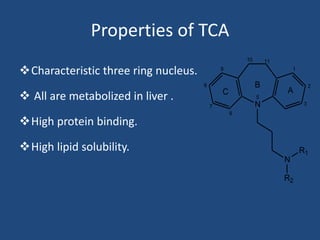
Properties of TCA
Characteristic three ring nucleus.
 All are metabolized in liver .
High protein binding.
High lipid solubility.
N
N
R1
R2
A
B
C
1
2
37
5
6
8
9
10 11
Classification of TCA
Imipramine
Amytriptiline
Desipramine
Nortriptyline
Protryptyline
Doxepin
MECHANISM OF ACTION
Inhibit the re-uptake of neurotransmitters.
They inhibit serotonin,nor epinephrine or dopamine
reuptake at pre synaptic nerve terminals thus lead to
increased concentration of these transmitters in the
synaptic cleft.
 Takes up to 4 weeks for all TCA antidepressants to
have an effect.
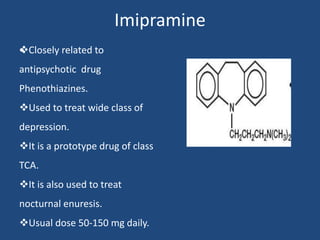
Imipramine
•Closely related to
antipsychotic drug
Phenothiazines.
Used to treat wide class of
depression.
It is a prototype drug of class
TCA.
It is also used to treat
nocturnal enuresis.
Usual dose 50-150 mg daily.
Therapeutic Uses
Severe major depression
Phobic and panic anxiety disorders
Neuropathic pain
Obsessive compulsive disorder (OCD)
Nocturnal enuresis; Imipramine has been used to control
bed-wetting in children (older than six years) by causing
contraction of the internal sphincter of the bladder.
Adverse Effects
 Dry mouth
Constipation
Blurred vision
 Mydriasis
 Metallic taste
 Urine retention
Drowsiness
Sedation
weight gain
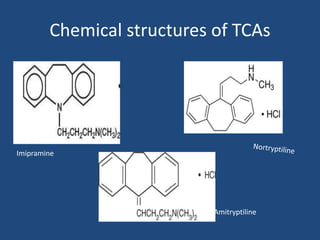
Chemical structures of TCAs
Imipramine
Amitryptiline
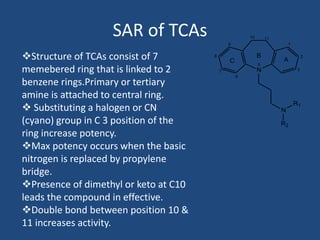
SAR of TCAs
N
N
R1
R2
A
B
C
1
2
37
5
6
8
9
10 11
Structure of TCAs consist of 7
memebered ring that is linked to 2
benzene rings.Primary or tertiary
amine is attached to central ring.
 Substituting a halogen or CN
(cyano) group in C 3 position of the
ring increase potency.
Max potency occurs when the basic
nitrogen is replaced by propylene
bridge.
Presence of dimethyl or keto at C10
leads the compound in effective.
Double bond between position 10 &
11 increases activity.
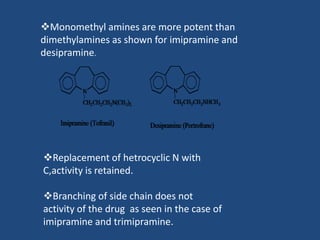
Monomethyl amines are more potent than
dimethylamines as shown for imipramine and
desipramine.
Replacement of hetrocyclic N with
C,activity is retained.
Branching of side chain does not
activity of the drug as seen in the case of
imipramine and trimipramine.
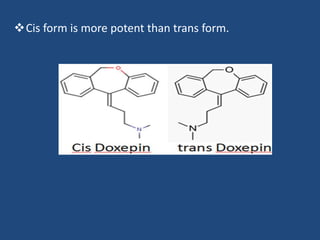
Cis form is more potent than trans form.
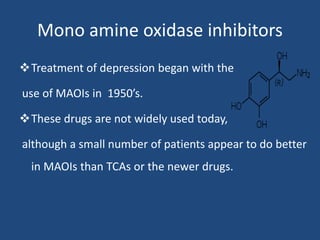
Mono amine oxidase inhibitors
Treatment of depression began with the
use of MAOIs in 1950’s.
These drugs are not widely used today,
although a small number of patients appear to do better
in MAOIs than TCAs or the newer drugs.
Properties
Are readily absorbed from GI tract
 Widely distributed throughout the body.
May have active metabolites, inactivated by
acetylation.
Effects persist even after these drugs are no
longer detectable in plasma (1-3 weeks)
Classification of MAOIs
Phenelzine
Isocarboxacid
Tranylcypromine
Mechanism of action of MAOIs
MAO is a mitochondrial enzyme found in
nerve and other tissues.
Monoamine oxidase breaks down
norepinephrine, serotonin, and dopamine.
When monoamine oxidase is inhibited,
norepinephrine, serotonin, and dopamine
are not broken down, increasing the
concentration of all three neurotransmitters
in the brain.
MAOIs may reversibly or irreversibly inactivate
the enzymes by making stable complexes with
the enzymes,permitting neurotransmitter
molecules to escape degradation and accumulate
within synaptic cleft.
This may cause activation of nor epinephrine and
serotonin receptors responsible for anti
depressant action.
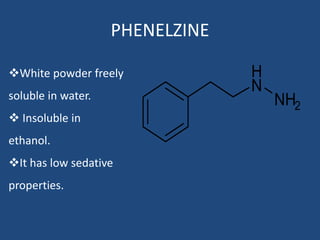
PHENELZINE
NH2
H
N
White powder freely
soluble in water.
 Insoluble in
ethanol.
It has low sedative
properties.
Therapeutic Uses
 Indicated for depressed patients who are
unresponsive or allergic to TCAs.
 Patient with low psychomotor activity.
 Treatment of phobic states
Adverse Effects
Drowsiness/Fatigue
Constipation
Nausea
Diarrhea
Dizziness
Low blood pressure
Lightheadedness,
Decreased urine output
Sleep disturbances
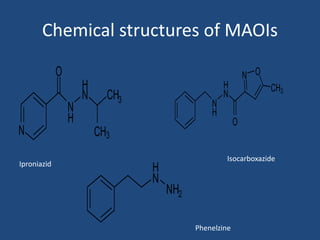
Chemical structures of MAOIs
CH3
N O
O
H
N
N
H
CH3
CH3
H
N
N
H
O
N
NH2
H
N
Isocarboxazide
Phenelzine
Iproniazid
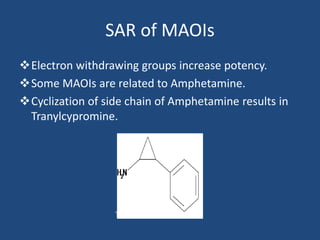
SAR of MAOIs
Electron withdrawing groups increase potency.
Some MAOIs are related to Amphetamine.
Cyclization of side chain of Amphetamine results in
Tranylcypromine.
TRANYLCYPROMINE
Selective Serotonin Reuptake
Inhibitors
A group of chemically unique drugs
More modern group of drugs in use.
 1st drug fluoxetine available in 1988.
 Safest antidepressant for use.
Properties
Good absorption after oral administration
Important biotransformation in the liver
Long half-lives of elimination(s)
 fluoxetine (T1/2=50h)
Drug mostly excreted from kidney.
Few drugs are excreted from feaces.
Mechanism of action
Inhibition of serotonin reuptake into the presynaptic
cell, increasing the level of serotonin leading to
greater post synaptic neuronal activity.
They do not have significant effect on Nor
epinephrine & Dopamine.
They typically take 2 to 12 weeks to produce
improvement in mood.
Classification of SSRIs
 Fluoxetine
Sertraline
Paroxetine
Fluvoxamine
Escitalopram
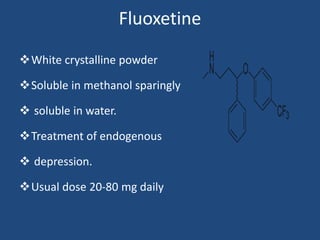
Fluoxetine
White crystalline powder
Soluble in methanol sparingly
 soluble in water.
Treatment of endogenous
 depression.
Usual dose 20-80 mg daily
Therapeutic Uses
 Depression
 Obsessive compulsive disorder (the only indication for
fluvoxamine )
 Panic disorder
 Generalized anxiety
 Premenstrual dysphoric disorder
 Bulimia nervosa (only fluoxetine is approved for this last
indication)
Adverse Effects
Anxiety
Insomnia
Agitation
Sexual dysfunction.
Weight gain.
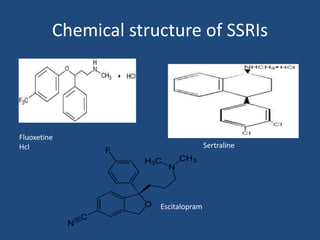
Chemical structure of SSRIs
Fluoxetine
Hcl Sertraline
Escitalopram
SAR of SSRIs
Mono substitution in para position of phenoxy group
by electron withdrawing group results gain in 5HT
selective inhibition
But
bi-substitution
or mono-substitution at other places or
use of electron donating group
causes loss in selective inhibition
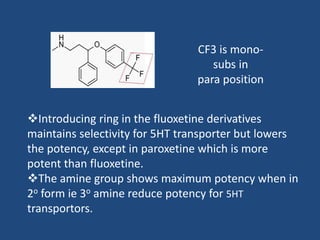
CF3 is mono-
subs in
para position
Introducing ring in the fluoxetine derivatives
maintains selectivity for 5HT transporter but lowers
the potency, except in paroxetine which is more
potent than fluoxetine.
The amine group shows maximum potency when in
2o form ie 3o amine reduce potency for 5HT
transportors.
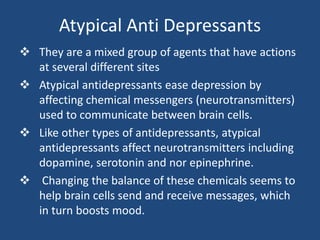
Atypical Anti Depressants
 They are a mixed group of agents that have actions
at several different sites
 Atypical antidepressants ease depression by
affecting chemical messengers (neurotransmitters)
used to communicate between brain cells.
 Like other types of antidepressants, atypical
antidepressants affect neurotransmitters including
dopamine, serotonin and nor epinephrine.
 Changing the balance of these chemicals seems to
help brain cells send and receive messages, which
in turn boosts mood.
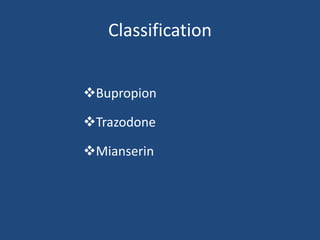
Classification
Bupropion
Trazodone
Mianserin
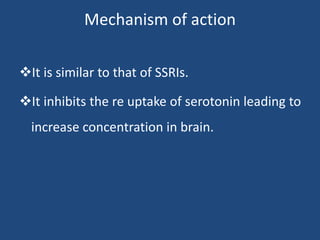
Mechanism of action
It is similar to that of SSRIs.
It inhibits the re uptake of serotonin leading to
increase concentration in brain.
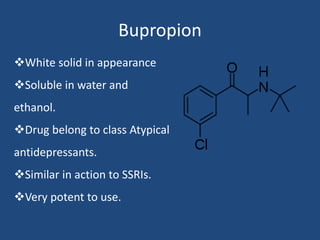
Bupropion
White solid in appearance
Soluble in water and
ethanol.
Drug belong to class Atypical
antidepressants.
Similar in action to SSRIs.
Very potent to use.
Therapeutic Uses
Atypical antidepressants are frequently used in
patients with major depression who have inadequate
responses or intolerable side effects during first-line
treatment with selective serotonin reuptake
inhibitors (SSRIs)
 Atypical antidepressants are often first-line
treatment if the drug has a desirable characteristic
(eg, sexual side effects and weight gain occur less
often with bupropion than SSRIs).
Adverse Effects
Anxiety
Restlesness
Blurred vision
Constipation
Agitation
Dry mouth
Nausea
Discontinution of Antidepressants
Antidepressants should be gradually tapered
and should not be abruptly discontinued.
Abruptly stopping an antidepressant in some
patients can cause discontinuation syndrome.
Conclusion
Depression is a serious condition that often can be
effectively treated with available therapies. Side
effects and drug interactions are barriers to
successful treatment. Some side effects of
antidepressants resolve with continued use while
other side effects can be managed by dose reduction
or adding other therapies. Appropriate management
of side effects and avoidance of drugs that may
interact with antidepressants may improve the
success of antidepressant therapy.

ANTIDEPRESSANTS

  • 1.
    ANTIDEPRESSANTS: Depression is oneof the most treatable mental illness. Prepared & Presented by SAHARISH KHALIQ(203)
  • 2.
    DEPRESSION It is amental illnesses characterized by pathological changes in mood, loss of interest or pleasure, feelings of guilt or low self-worth, disturbed sleep or appetite, low energy, and poor concentration . It can be severe and some times Fatal.
  • 3.
    Symptoms Depressed mood mostof the day… Markedly diminished interest or pleasure Significant weight loss /gain Insomnia or hypersomnia Agitation  Fatigue or loss of energy
  • 4.
    Symptoms Change in appetite Lackof concentration Poor self esteem Thought of suicide or death.
  • 5.
    Types of Depression Majordepression Chronic depression (Dysthymia) Atypical depression Bipolar disorder/Manic depression Seasonal depression (SAD)
  • 6.
    Mechanism Of Depression Depressionis associated with changes in the level of neurotransmitters in the brain that help nerve cells to communicate.E.x Serotonin,Dopamine,Nor epinephrine The level can be influenced by physical illness,genetics,substance abuse,diet,hormonal chnages, brain injuries or social circumstances.
  • 7.
    ANTIDEPRESSANTS Drug which enhancealertness and may result in an increased output of behaviour. Potentiate directly or indirectly the action of • Dopamine • Serotonin • Nor adrenaline The purpose of antidepressants is to increase the neurotransmitters in the synapse.
  • 8.
    ANTIDEPRESSANTS They are usedfor the relief of symptoms of moderate and severe depression. Antidepressants are taken for atleast 4-6 months. They can be used alone or in combination with other medications
  • 9.
    Types of Antidepressants Tricyclic anti-depressants (TCAs). Monoamine oxidase inhibitors (MAOIs). Selective serotonin reuptake inhibitors (SSRIs) Atypical anti-depressants (Others)
  • 10.
    TRICYCLIC ANTIDEPRESSANTS They havebeen employed in drug therapy since the late 1950s. Largest group of drug agents used for the treatment of depression. Referred as “ tri cyclic ” compounds –three rings.
  • 11.
    Properties of TCA Characteristicthree ring nucleus.  All are metabolized in liver . High protein binding. High lipid solubility. N N R1 R2 A B C 1 2 37 5 6 8 9 10 11
  • 12.
  • 13.
    MECHANISM OF ACTION Inhibitthe re-uptake of neurotransmitters. They inhibit serotonin,nor epinephrine or dopamine reuptake at pre synaptic nerve terminals thus lead to increased concentration of these transmitters in the synaptic cleft.  Takes up to 4 weeks for all TCA antidepressants to have an effect.
  • 14.
    Imipramine •Closely related to antipsychoticdrug Phenothiazines. Used to treat wide class of depression. It is a prototype drug of class TCA. It is also used to treat nocturnal enuresis. Usual dose 50-150 mg daily.
  • 15.
    Therapeutic Uses Severe majordepression Phobic and panic anxiety disorders Neuropathic pain Obsessive compulsive disorder (OCD) Nocturnal enuresis; Imipramine has been used to control bed-wetting in children (older than six years) by causing contraction of the internal sphincter of the bladder.
  • 16.
    Adverse Effects  Drymouth Constipation Blurred vision  Mydriasis  Metallic taste  Urine retention Drowsiness Sedation weight gain
  • 17.
    Chemical structures ofTCAs Imipramine Amitryptiline
  • 18.
    SAR of TCAs N N R1 R2 A B C 1 2 37 5 6 8 9 1011 Structure of TCAs consist of 7 memebered ring that is linked to 2 benzene rings.Primary or tertiary amine is attached to central ring.  Substituting a halogen or CN (cyano) group in C 3 position of the ring increase potency. Max potency occurs when the basic nitrogen is replaced by propylene bridge. Presence of dimethyl or keto at C10 leads the compound in effective. Double bond between position 10 & 11 increases activity.
  • 19.
    Monomethyl amines aremore potent than dimethylamines as shown for imipramine and desipramine. Replacement of hetrocyclic N with C,activity is retained. Branching of side chain does not activity of the drug as seen in the case of imipramine and trimipramine.
  • 20.
    Cis form ismore potent than trans form.
  • 21.
    Mono amine oxidaseinhibitors Treatment of depression began with the use of MAOIs in 1950’s. These drugs are not widely used today, although a small number of patients appear to do better in MAOIs than TCAs or the newer drugs.
  • 22.
    Properties Are readily absorbedfrom GI tract  Widely distributed throughout the body. May have active metabolites, inactivated by acetylation. Effects persist even after these drugs are no longer detectable in plasma (1-3 weeks)
  • 23.
  • 24.
    Mechanism of actionof MAOIs MAO is a mitochondrial enzyme found in nerve and other tissues. Monoamine oxidase breaks down norepinephrine, serotonin, and dopamine. When monoamine oxidase is inhibited, norepinephrine, serotonin, and dopamine are not broken down, increasing the concentration of all three neurotransmitters in the brain.
  • 25.
    MAOIs may reversiblyor irreversibly inactivate the enzymes by making stable complexes with the enzymes,permitting neurotransmitter molecules to escape degradation and accumulate within synaptic cleft. This may cause activation of nor epinephrine and serotonin receptors responsible for anti depressant action.
  • 26.
    PHENELZINE NH2 H N White powder freely solublein water.  Insoluble in ethanol. It has low sedative properties.
  • 27.
    Therapeutic Uses  Indicatedfor depressed patients who are unresponsive or allergic to TCAs.  Patient with low psychomotor activity.  Treatment of phobic states
  • 28.
    Adverse Effects Drowsiness/Fatigue Constipation Nausea Diarrhea Dizziness Low bloodpressure Lightheadedness, Decreased urine output Sleep disturbances
  • 29.
    Chemical structures ofMAOIs CH3 N O O H N N H CH3 CH3 H N N H O N NH2 H N Isocarboxazide Phenelzine Iproniazid
  • 30.
    SAR of MAOIs Electronwithdrawing groups increase potency. Some MAOIs are related to Amphetamine. Cyclization of side chain of Amphetamine results in Tranylcypromine. TRANYLCYPROMINE
  • 31.
    Selective Serotonin Reuptake Inhibitors Agroup of chemically unique drugs More modern group of drugs in use.  1st drug fluoxetine available in 1988.  Safest antidepressant for use.
  • 32.
    Properties Good absorption afteroral administration Important biotransformation in the liver Long half-lives of elimination(s)  fluoxetine (T1/2=50h) Drug mostly excreted from kidney. Few drugs are excreted from feaces.
  • 33.
    Mechanism of action Inhibitionof serotonin reuptake into the presynaptic cell, increasing the level of serotonin leading to greater post synaptic neuronal activity. They do not have significant effect on Nor epinephrine & Dopamine. They typically take 2 to 12 weeks to produce improvement in mood.
  • 34.
    Classification of SSRIs Fluoxetine Sertraline Paroxetine Fluvoxamine Escitalopram
  • 35.
    Fluoxetine White crystalline powder Solublein methanol sparingly  soluble in water. Treatment of endogenous  depression. Usual dose 20-80 mg daily
  • 36.
    Therapeutic Uses  Depression Obsessive compulsive disorder (the only indication for fluvoxamine )  Panic disorder  Generalized anxiety  Premenstrual dysphoric disorder  Bulimia nervosa (only fluoxetine is approved for this last indication)
  • 37.
  • 38.
    Chemical structure ofSSRIs Fluoxetine Hcl Sertraline Escitalopram
  • 39.
    SAR of SSRIs Monosubstitution in para position of phenoxy group by electron withdrawing group results gain in 5HT selective inhibition But bi-substitution or mono-substitution at other places or use of electron donating group causes loss in selective inhibition
  • 40.
    CF3 is mono- subsin para position Introducing ring in the fluoxetine derivatives maintains selectivity for 5HT transporter but lowers the potency, except in paroxetine which is more potent than fluoxetine. The amine group shows maximum potency when in 2o form ie 3o amine reduce potency for 5HT transportors.
  • 41.
    Atypical Anti Depressants They are a mixed group of agents that have actions at several different sites  Atypical antidepressants ease depression by affecting chemical messengers (neurotransmitters) used to communicate between brain cells.  Like other types of antidepressants, atypical antidepressants affect neurotransmitters including dopamine, serotonin and nor epinephrine.  Changing the balance of these chemicals seems to help brain cells send and receive messages, which in turn boosts mood.
  • 42.
  • 43.
    Mechanism of action Itis similar to that of SSRIs. It inhibits the re uptake of serotonin leading to increase concentration in brain.
  • 44.
    Bupropion White solid inappearance Soluble in water and ethanol. Drug belong to class Atypical antidepressants. Similar in action to SSRIs. Very potent to use.
  • 45.
    Therapeutic Uses Atypical antidepressantsare frequently used in patients with major depression who have inadequate responses or intolerable side effects during first-line treatment with selective serotonin reuptake inhibitors (SSRIs)  Atypical antidepressants are often first-line treatment if the drug has a desirable characteristic (eg, sexual side effects and weight gain occur less often with bupropion than SSRIs).
  • 46.
  • 47.
    Discontinution of Antidepressants Antidepressantsshould be gradually tapered and should not be abruptly discontinued. Abruptly stopping an antidepressant in some patients can cause discontinuation syndrome.
  • 48.
    Conclusion Depression is aserious condition that often can be effectively treated with available therapies. Side effects and drug interactions are barriers to successful treatment. Some side effects of antidepressants resolve with continued use while other side effects can be managed by dose reduction or adding other therapies. Appropriate management of side effects and avoidance of drugs that may interact with antidepressants may improve the success of antidepressant therapy.