
GOMBERG-BACHMANN REACTION
AND
ULLMANN REACTION
GOMBERG-BACHMANN REACTION
AND
ULLMANN REACTION
GOMBERG-BACHMANN REACTION
AND
ULLMANN REACTION
GOMBERG-
BACHMANN
REACTION
AND
ULLMANN
REACTION
GOMBERG-BACHMANN
REACTION
AND
ULLMANN
REACTION
GOMBERG-BACHMANN REACTION AND ULLMANN REACTION
GOMBERG-BACHMANN
REACTION
AND
ULLMANN
REACTION
GOMBERG-BACHMANN REACTION
AND
ULLMANN REACTION
GOMBERG-BACHMANN REACTION
AND
ULLMANN REACTION
GOMBERG-BACHMANN
REACTION
AND
ULLMANN
REACTION
GOMBERG-BACHMANN
REACTION
AND
ULLMANN
REACTION
GOMBERG-BACHMANN
REACTION
AND
ULLMANN
REACTION
GOMBERG-BACHMANN REACTION AND ULLMANN REACTION
Presented By:
K. Muthu Kannan
II M.Sc.,Chemistry
S.B.K.College
Aruppukottai-626101
CONTENTS
 Introduction
 How reaction will undergo
 Mechanism
 Exercise problems
 Applications
 Introduction
 How reaction will undergo
 Mechanism
 Exercise problems
 Applications
GOMBERG – BECHMANN REACTION ULLMANN REACTION
GOMBERG–BECHMANN
REACTION
INTRODUCTION
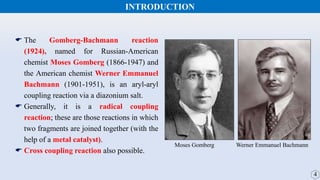
 The Gomberg-Bachmann reaction
(1924), named for Russian-American
chemist Moses Gomberg (1866-1947) and
the American chemist Werner Emmanuel
Bachmann (1901-1951), is an aryl-aryl
coupling reaction via a diazonium salt.
 Generally, it is a radical coupling
reaction; these are those reactions in which
two fragments are joined together (with the
help of a metal catalyst).
 Cross coupling reaction also possible.
Moses Gomberg Werner Emmanuel Bachmann
HOW REACTION WILL UNDERGO
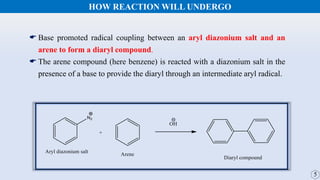
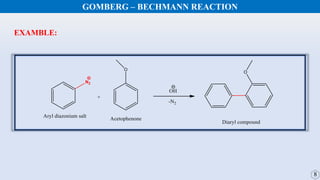
 Base promoted radical coupling between an aryl diazonium salt and an
arene to form a diaryl compound.
 The arene compound (here benzene) is reacted with a diazonium salt in the
presence of a base to provide the diaryl through an intermediate aryl radical.
MECHANISM OF GOMBERG – BECHMANN REACTION
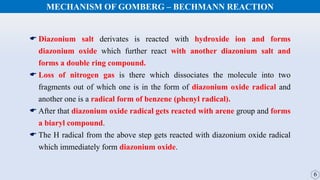
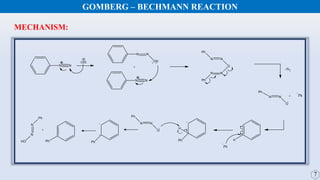
 Diazonium salt derivates is reacted with hydroxide ion and forms
diazonium oxide which further react with another diazonium salt and
forms a double ring compound.
 Loss of nitrogen gas is there which dissociates the molecule into two
fragments out of which one is in the form of diazonium oxide radical and
another one is a radical form of benzene (phenyl radical).
 After that diazonium oxide radical gets reacted with arene group and forms
a biaryl compound.
 The H radical from the above step gets reacted with diazonium oxide radical
which immediately form diazonium oxide.
GOMBERG – BECHMANN REACTION
MECHANISM:
GOMBERG – BECHMANN REACTION
EXAMBLE:
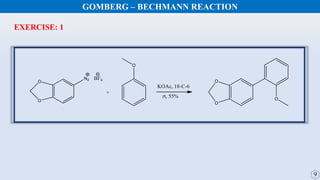
EXERCISE: 1
GOMBERG – BECHMANN REACTION
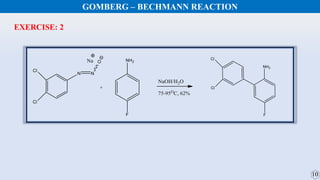
EXERCISE: 2
GOMBERG – BECHMANN REACTION
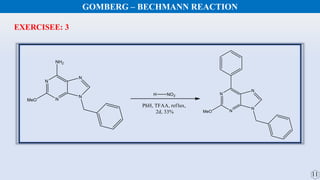
EXERCISEE: 3
GOMBERG – BECHMANN REACTION
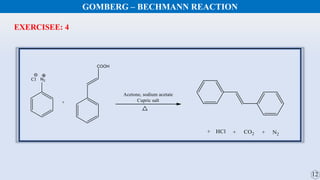
EXERCISEE: 4
GOMBERG – BECHMANN REACTION
APPLICATIONS
 Coupling reactions are routinely employed in the preparation of
pharmaceutical products.
 For the production of various natural products, coupling reactions are
used.
 Cross-coupling reactions are used for the preparation of monomers and
polymers.
ULLMANN REACTION
INTRODUCTION
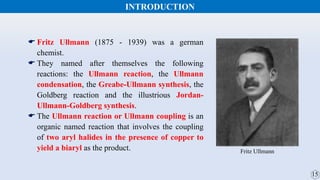
 Fritz Ullmann (1875 - 1939) was a german
chemist.
 They named after themselves the following
reactions: the Ullmann reaction, the Ullmann
condensation, the Greabe-Ullmann synthesis, the
Goldberg reaction and the illustrious Jordan-
Ullmann-Goldberg synthesis.
 The Ullmann reaction or Ullmann coupling is an
organic named reaction that involves the coupling
of two aryl halides in the presence of copper to
yield a biaryl as the product. Fritz Ullmann
HOW REACTION WILL UNDERGO
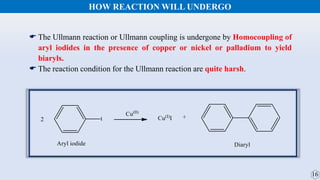
 The Ullmann reaction or Ullmann coupling is undergone by Homocoupling of
aryl iodides in the presence of copper or nickel or palladium to yield
biaryls.
 The reaction condition for the Ullmann reaction are quite harsh.
MECHANISM OF ULLMANN REACTION
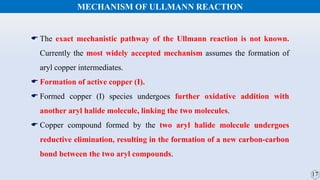
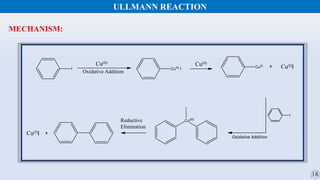
 The exact mechanistic pathway of the Ullmann reaction is not known.
Currently the most widely accepted mechanism assumes the formation of
aryl copper intermediates.
 Formation of active copper (I).
 Formed copper (I) species undergoes further oxidative addition with
another aryl halide molecule, linking the two molecules.
 Copper compound formed by the two aryl halide molecule undergoes
reductive elimination, resulting in the formation of a new carbon-carbon
bond between the two aryl compounds.
ULLMANN REACTION
MECHANISM:
Oxidative Addition
Cu(0)
Oxidative Addition
Cu(0)
+ Cu(I)I
Reductive
Elimination
+
Cu(I)I
ULLMANN REACTION
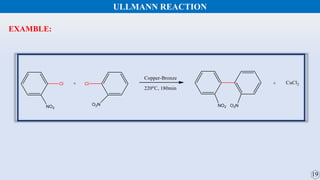
EXAMBLE:
ULLMANN REACTION
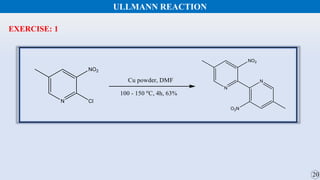
EXERCISE: 1
ULLMANN REACTION
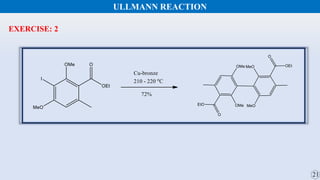
EXERCISE: 2
ULLMANN REACTION
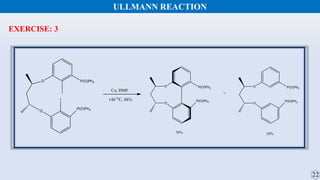
EXERCISE: 3
ULLMANN REACTION
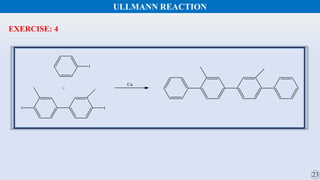
EXERCISE: 4
ULLMANN REACTION
EXERCISE: 5
APPLICATIONS
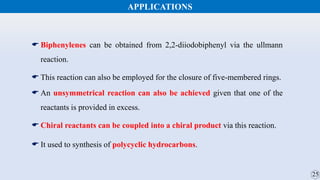
 Biphenylenes can be obtained from 2,2-diiodobiphenyl via the ullmann
reaction.
 This reaction can also be employed for the closure of five-membered rings.
 An unsymmetrical reaction can also be achieved given that one of the
reactants is provided in excess.
 Chiral reactants can be coupled into a chiral product via this reaction.
 It used to synthesis of polycyclic hydrocarbons.
REFERENCES
 Name reactions - A collection of detailed
mechanism and synthetic applications, fifth
edition by Jie Jack Li.
 Strategic applications of named reactions in
organic synthesis by Laszlo Kurti and Barbara
Czako.
 Organic chemistry volume one by I.L.Finar.
 https://en.wikipedia.org/wiki/Gomberg%E2%80
%93Bachmann_reaction#:~:text=The%20Gomb
erg%E2%80%93Bachmann%20reaction%2C%2
0named,reaction%20via%20a%20diazonium%2
0salt.
 https://en.wikipedia.org/wiki/Moses_Gomberg#/
media/File:Gombergm01.jpg
 https://alchetron.com/Werner-Emmanuel-
Bachmann
 https://www.vedantu.com/question-
answer/explain-gomberg-reaction-with-
mechanism-class-12-chemistry-cbse-
5fd23e9c7182ee79763f5a4a
 https://www.vedantu.com/chemistry/coupling-
reaction
 https://en.wikipedia.org/wiki/Ullmann_reaction
 https://en.wikipedia.org/wiki/Fritz_Ullmann
 https://www.geni.com/photo/view/60000000239
66131829?album_type=photos_of_me&photo_i
d=6000000023966468824
 https://byjus.com/chemistry/ullmann-reaction/
 Ullmann Reaction and Gomberg - Bechmann Reaction

Ullmann Reaction and Gomberg - Bechmann Reaction

  • 1.
    GOMBERG-BACHMANN REACTION AND ULLMANN REACTION GOMBERG-BACHMANNREACTION AND ULLMANN REACTION GOMBERG-BACHMANN REACTION AND ULLMANN REACTION GOMBERG- BACHMANN REACTION AND ULLMANN REACTION GOMBERG-BACHMANN REACTION AND ULLMANN REACTION GOMBERG-BACHMANN REACTION AND ULLMANN REACTION GOMBERG-BACHMANN REACTION AND ULLMANN REACTION GOMBERG-BACHMANN REACTION AND ULLMANN REACTION GOMBERG-BACHMANN REACTION AND ULLMANN REACTION GOMBERG-BACHMANN REACTION AND ULLMANN REACTION GOMBERG-BACHMANN REACTION AND ULLMANN REACTION GOMBERG-BACHMANN REACTION AND ULLMANN REACTION GOMBERG-BACHMANN REACTION AND ULLMANN REACTION Presented By: K. Muthu Kannan II M.Sc.,Chemistry S.B.K.College Aruppukottai-626101
  • 2.
    CONTENTS  Introduction  Howreaction will undergo  Mechanism  Exercise problems  Applications  Introduction  How reaction will undergo  Mechanism  Exercise problems  Applications GOMBERG – BECHMANN REACTION ULLMANN REACTION
  • 3.
  • 4.
    INTRODUCTION  The Gomberg-Bachmannreaction (1924), named for Russian-American chemist Moses Gomberg (1866-1947) and the American chemist Werner Emmanuel Bachmann (1901-1951), is an aryl-aryl coupling reaction via a diazonium salt.  Generally, it is a radical coupling reaction; these are those reactions in which two fragments are joined together (with the help of a metal catalyst).  Cross coupling reaction also possible. Moses Gomberg Werner Emmanuel Bachmann
  • 5.
    HOW REACTION WILLUNDERGO  Base promoted radical coupling between an aryl diazonium salt and an arene to form a diaryl compound.  The arene compound (here benzene) is reacted with a diazonium salt in the presence of a base to provide the diaryl through an intermediate aryl radical.
  • 6.
    MECHANISM OF GOMBERG– BECHMANN REACTION  Diazonium salt derivates is reacted with hydroxide ion and forms diazonium oxide which further react with another diazonium salt and forms a double ring compound.  Loss of nitrogen gas is there which dissociates the molecule into two fragments out of which one is in the form of diazonium oxide radical and another one is a radical form of benzene (phenyl radical).  After that diazonium oxide radical gets reacted with arene group and forms a biaryl compound.  The H radical from the above step gets reacted with diazonium oxide radical which immediately form diazonium oxide.
  • 7.
    GOMBERG – BECHMANNREACTION MECHANISM:
  • 8.
    GOMBERG – BECHMANNREACTION EXAMBLE:
  • 9.
    EXERCISE: 1 GOMBERG –BECHMANN REACTION
  • 10.
    EXERCISE: 2 GOMBERG –BECHMANN REACTION
  • 11.
    EXERCISEE: 3 GOMBERG –BECHMANN REACTION
  • 12.
    EXERCISEE: 4 GOMBERG –BECHMANN REACTION
  • 13.
    APPLICATIONS  Coupling reactionsare routinely employed in the preparation of pharmaceutical products.  For the production of various natural products, coupling reactions are used.  Cross-coupling reactions are used for the preparation of monomers and polymers.
  • 14.
  • 15.
    INTRODUCTION  Fritz Ullmann(1875 - 1939) was a german chemist.  They named after themselves the following reactions: the Ullmann reaction, the Ullmann condensation, the Greabe-Ullmann synthesis, the Goldberg reaction and the illustrious Jordan- Ullmann-Goldberg synthesis.  The Ullmann reaction or Ullmann coupling is an organic named reaction that involves the coupling of two aryl halides in the presence of copper to yield a biaryl as the product. Fritz Ullmann
  • 16.
    HOW REACTION WILLUNDERGO  The Ullmann reaction or Ullmann coupling is undergone by Homocoupling of aryl iodides in the presence of copper or nickel or palladium to yield biaryls.  The reaction condition for the Ullmann reaction are quite harsh.
  • 17.
    MECHANISM OF ULLMANNREACTION  The exact mechanistic pathway of the Ullmann reaction is not known. Currently the most widely accepted mechanism assumes the formation of aryl copper intermediates.  Formation of active copper (I).  Formed copper (I) species undergoes further oxidative addition with another aryl halide molecule, linking the two molecules.  Copper compound formed by the two aryl halide molecule undergoes reductive elimination, resulting in the formation of a new carbon-carbon bond between the two aryl compounds.
  • 18.
    ULLMANN REACTION MECHANISM: Oxidative Addition Cu(0) OxidativeAddition Cu(0) + Cu(I)I Reductive Elimination + Cu(I)I
  • 19.
  • 20.
  • 21.
  • 22.
  • 23.
  • 24.
  • 25.
    APPLICATIONS  Biphenylenes canbe obtained from 2,2-diiodobiphenyl via the ullmann reaction.  This reaction can also be employed for the closure of five-membered rings.  An unsymmetrical reaction can also be achieved given that one of the reactants is provided in excess.  Chiral reactants can be coupled into a chiral product via this reaction.  It used to synthesis of polycyclic hydrocarbons.
  • 26.
    REFERENCES  Name reactions- A collection of detailed mechanism and synthetic applications, fifth edition by Jie Jack Li.  Strategic applications of named reactions in organic synthesis by Laszlo Kurti and Barbara Czako.  Organic chemistry volume one by I.L.Finar.  https://en.wikipedia.org/wiki/Gomberg%E2%80 %93Bachmann_reaction#:~:text=The%20Gomb erg%E2%80%93Bachmann%20reaction%2C%2 0named,reaction%20via%20a%20diazonium%2 0salt.  https://en.wikipedia.org/wiki/Moses_Gomberg#/ media/File:Gombergm01.jpg  https://alchetron.com/Werner-Emmanuel- Bachmann  https://www.vedantu.com/question- answer/explain-gomberg-reaction-with- mechanism-class-12-chemistry-cbse- 5fd23e9c7182ee79763f5a4a  https://www.vedantu.com/chemistry/coupling- reaction  https://en.wikipedia.org/wiki/Ullmann_reaction  https://en.wikipedia.org/wiki/Fritz_Ullmann  https://www.geni.com/photo/view/60000000239 66131829?album_type=photos_of_me&photo_i d=6000000023966468824  https://byjus.com/chemistry/ullmann-reaction/

Editor's Notes

  • #5 The net reaction sequence is the connection of carbon skeletons of both fragments. Thus this reaction sequence is a coupling reaction.(joining of two chemical species)
  • #10 Ortho product is 55% only, remaining are para product.
  • #11 Fulorine has more –I, hence ortho position(near with fluorine) radical is not stable.
  • #12 TFAA – Trifluoroacetic anhydride - SOLVENT F3C-COO-CO-CF3
  • #13 Acetone - solvent Sodium acetate – base Cupric salt – metal catalyst
  • #23 DMF – dimethylforamide N(CH3)2CHO
  • #26 Closure ring – ring closing takes place. Unsymmetrical reaction – exercise 4. takes iodobenene 2mole and biaryl 1mole