
BULK & SOLUTION
Polymerization
PRESENTED BY :
K. MUTHU KANNAN
II M.Sc., Chemistry
S.B.K.College
Aruppukottai-626101
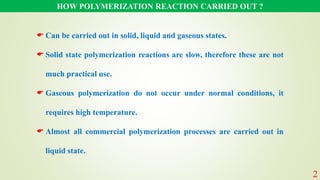
 Can be carried out in solid, liquid and gaseous states.
 Solid state polymerization reactions are slow, therefore these are not
much practical use.
 Gaseous polymerization do not occur under normal conditions, it
requires high temperature.
 Almost all commercial polymerization processes are carried out in
liquid state.
2
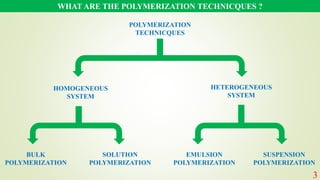
HOW POLYMERIZATION REACTION CARRIED OUT ?
BULK
POLYMERIZATION
SOLUTION
POLYMERIZATION
EMULSION
POLYMERIZATION
SUSPENSION
POLYMERIZATION
HOMOGENEOUS
SYSTEM
HETEROGENEOUS
SYSTEM
POLYMERIZATION
TECHNICQUES
3
WHAT ARE THE POLYMERIZATION TECHNICQUES ?
BULK POLYMERIZATION
4
BULK POLYMERIZATION
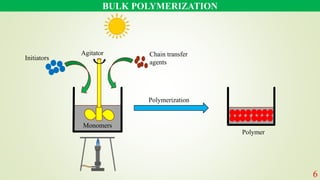
 In mass polymerization, the whole system remains in a homogeneous
phase, because the monomer is taken in the liquid state, the initiator is
dissolved in the monomer and the chain transfer agent (if used to control
the molecular weight) is also dissolved in the monomer liquid.
 The reaction mixture is heated or exposed to a UV radiation source for
initiating the polymerization and is kept on a rotatory shaker for proper
mixing the mass and uniform heat transfer.
 Only the initiator and the chain transfer agent is used therefore, the product
formed has a high degree of purity, i.e., without any contamination of
reactant components.
5
BULK POLYMERIZATION
6
Polymerization
Polymer
Monomers
Initiators
Chain transfer
agents
Agitator
ADVANTAGES
 It is quite simple and requires simple equipment.
 Direct utility of the polymer with no isolation requirement.
 Polymers are of high purity obtained.
 Minimum chances of contamination.
 No requirement of additives other than the initiators and the chain
transfer agent.
 Excellent colour and clarity can be obtained.
7
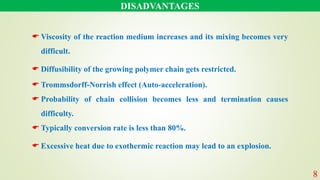
DISADVANTAGES
 Viscosity of the reaction medium increases and its mixing becomes very
difficult.
 Diffusibility of the growing polymer chain gets restricted.
 Trommsdorff-Norrish effect (Auto-acceleration).
 Probability of chain collision becomes less and termination causes
difficulty.
 Typically conversion rate is less than 80%.
 Excessive heat due to exothermic reaction may lead to an explosion.
8
APPLICATIONS
9
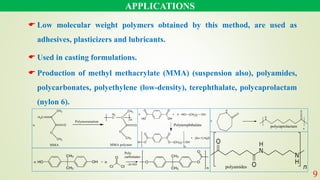
 Low molecular weight polymers obtained by this method, are used as
adhesives, plasticizers and lubricants.
 Used in casting formulations.
 Production of methyl methacrylate (MMA) (suspension also), polyamides,
polycarbonates, polyethylene (low-density), terephthalate, polycaprolactam
(nylon 6).
polyamides
Polyterephthalate polycaprolactam
Poly
carbonates
SOLUTION
POLYMERIZATION
10
SOLUTION POLYMERIZATION
11
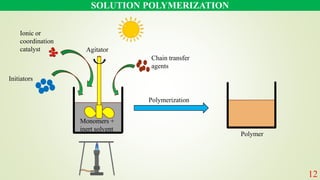
 The whole system is in a homogeneous phase, because the monomer, chain
transfer agent (if used) and initiator are dissolved in an inert suitable
solvent, while the ionic or coordination catalysts can either be dissolved
or suspended in the solvent medium.
 The temperature is easily controlled because of the fact that the monomers
are dissolved in solvent and the upper limit of the whole system depends
upon the boiling point of the solvent.
 After the reaction is over the polymer is used as such in the form of
polymer solution or isolated by evaporating the solvent.
SOLUTION POLYMERIZATION
12
Polymerization
Polymer
Monomers +
inert solvent
Initiators
Chain transfer
agents
Agitator
Ionic or
coordination
catalyst
ADVANTAGES
13
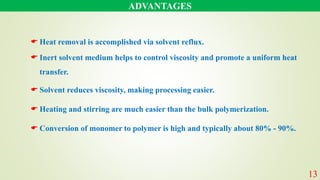
 Heat removal is accomplished via solvent reflux.
 Inert solvent medium helps to control viscosity and promote a uniform heat
transfer.
 Solvent reduces viscosity, making processing easier.
 Heating and stirring are much easier than the bulk polymerization.
 Conversion of monomer to polymer is high and typically about 80% - 90%.
DISADVANTAGES
14
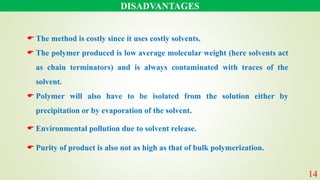
 The method is costly since it uses costly solvents.
 The polymer produced is low average molecular weight (here solvents act
as chain terminators) and is always contaminated with traces of the
solvent.
 Polymer will also have to be isolated from the solution either by
precipitation or by evaporation of the solvent.
 Environmental pollution due to solvent release.
 Purity of product is also not as high as that of bulk polymerization.
APPLICATIONS
15
 Production of polyacrylonitrile by free-radical polymerization and also
polyisobutylene by cationic polymerization.
 Exclusively used in the production of block co-polymers.
 In the solution form, it can be directly used as adhesives and coatings.
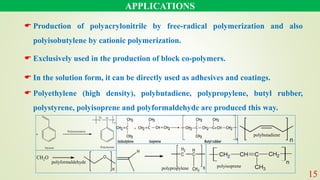
 Polyethylene (high density), polybutadiene, polypropylene, butyl rubber,
polystyrene, polyisoprene and polyformaldehyde are produced this way.
polypropylene
polyformaldehyde
polyisoprene
polybutadiene
QUESTIONS
16
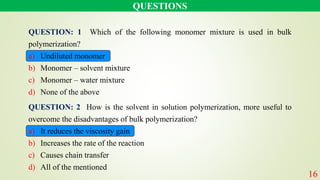
QUESTION: 1 Which of the following monomer mixture is used in bulk
polymerization?
a) Undiluted monomer
b) Monomer – solvent mixture
c) Monomer – water mixture
d) None of the above
QUESTION: 2 How is the solvent in solution polymerization, more useful to
overcome the disadvantages of bulk polymerization?
a) It reduces the viscosity gain
b) Increases the rate of the reaction
c) Causes chain transfer
d) All of the mentioned
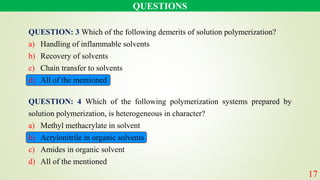
QUESTION: 3 Which of the following demerits of solution polymerization?
a) Handling of inflammable solvents
b) Recovery of solvents
c) Chain transfer to solvents
d) All of the mentioned
QUESTIONS
QUESTION: 4 Which of the following polymerization systems prepared by
solution polymerization, is heterogeneous in character?
a) Methyl methacrylate in solvent
b) Acrylonitrile in organic solvents
c) Amides in organic solvent
d) All of the mentioned
17
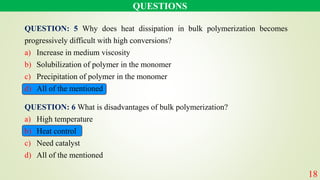
QUESTION: 5 Why does heat dissipation in bulk polymerization becomes
progressively difficult with high conversions?
a) Increase in medium viscosity
b) Solubilization of polymer in the monomer
c) Precipitation of polymer in the monomer
d) All of the mentioned
QUESTIONS
18
QUESTION: 6 What is disadvantages of bulk polymerization?
a) High temperature
b) Heat control
c) Need catalyst
d) All of the mentioned
REFERENCES
 Organic polymer chemistry (2nd edition) by K.J.SAUNDERS
 Polymer chemistry (2010 edition) by Alka L. Gupta
 https://www.researchgate.net/publication/330304320_Solution_Bulk_polyme
rization
 https://en.wikipedia.org/wiki/Bulk_polymerization#:~:text=Bulk%20polymer
ization%20or%20mass%20polymerization,the%20mixture%20becomes%20
more%20viscous.
 https://youtu.be/-5xwKbtThzY
 https://saylordotorg.github.io/text_general-chemistry-principles-patterns-and-
applications-v1.0/s16-08-polymeric-solids.html
 https://youtu.be/RPwsHgeuL10
 https://gacbe.ac.in/pdf/ematerial/18BCH35S-U4.pdf
 https://www.sanfoundry.com/polymer-engineering-questions-answers-
techniques-polymerization1/
 https://www.sanfoundry.com/unit-processes-questions-answers-methods-
polymerization/
19
Bulk and Solution Polymerization

Bulk and Solution Polymerization

  • 1.
    BULK & SOLUTION Polymerization PRESENTEDBY : K. MUTHU KANNAN II M.Sc., Chemistry S.B.K.College Aruppukottai-626101
  • 2.
     Can becarried out in solid, liquid and gaseous states.  Solid state polymerization reactions are slow, therefore these are not much practical use.  Gaseous polymerization do not occur under normal conditions, it requires high temperature.  Almost all commercial polymerization processes are carried out in liquid state. 2 HOW POLYMERIZATION REACTION CARRIED OUT ?
  • 3.
  • 4.
  • 5.
    BULK POLYMERIZATION  Inmass polymerization, the whole system remains in a homogeneous phase, because the monomer is taken in the liquid state, the initiator is dissolved in the monomer and the chain transfer agent (if used to control the molecular weight) is also dissolved in the monomer liquid.  The reaction mixture is heated or exposed to a UV radiation source for initiating the polymerization and is kept on a rotatory shaker for proper mixing the mass and uniform heat transfer.  Only the initiator and the chain transfer agent is used therefore, the product formed has a high degree of purity, i.e., without any contamination of reactant components. 5
  • 6.
  • 7.
    ADVANTAGES  It isquite simple and requires simple equipment.  Direct utility of the polymer with no isolation requirement.  Polymers are of high purity obtained.  Minimum chances of contamination.  No requirement of additives other than the initiators and the chain transfer agent.  Excellent colour and clarity can be obtained. 7
  • 8.
    DISADVANTAGES  Viscosity ofthe reaction medium increases and its mixing becomes very difficult.  Diffusibility of the growing polymer chain gets restricted.  Trommsdorff-Norrish effect (Auto-acceleration).  Probability of chain collision becomes less and termination causes difficulty.  Typically conversion rate is less than 80%.  Excessive heat due to exothermic reaction may lead to an explosion. 8
  • 9.
    APPLICATIONS 9  Low molecularweight polymers obtained by this method, are used as adhesives, plasticizers and lubricants.  Used in casting formulations.  Production of methyl methacrylate (MMA) (suspension also), polyamides, polycarbonates, polyethylene (low-density), terephthalate, polycaprolactam (nylon 6). polyamides Polyterephthalate polycaprolactam Poly carbonates
  • 10.
  • 11.
    SOLUTION POLYMERIZATION 11  Thewhole system is in a homogeneous phase, because the monomer, chain transfer agent (if used) and initiator are dissolved in an inert suitable solvent, while the ionic or coordination catalysts can either be dissolved or suspended in the solvent medium.  The temperature is easily controlled because of the fact that the monomers are dissolved in solvent and the upper limit of the whole system depends upon the boiling point of the solvent.  After the reaction is over the polymer is used as such in the form of polymer solution or isolated by evaporating the solvent.
  • 12.
    SOLUTION POLYMERIZATION 12 Polymerization Polymer Monomers + inertsolvent Initiators Chain transfer agents Agitator Ionic or coordination catalyst
  • 13.
    ADVANTAGES 13  Heat removalis accomplished via solvent reflux.  Inert solvent medium helps to control viscosity and promote a uniform heat transfer.  Solvent reduces viscosity, making processing easier.  Heating and stirring are much easier than the bulk polymerization.  Conversion of monomer to polymer is high and typically about 80% - 90%.
  • 14.
    DISADVANTAGES 14  The methodis costly since it uses costly solvents.  The polymer produced is low average molecular weight (here solvents act as chain terminators) and is always contaminated with traces of the solvent.  Polymer will also have to be isolated from the solution either by precipitation or by evaporation of the solvent.  Environmental pollution due to solvent release.  Purity of product is also not as high as that of bulk polymerization.
  • 15.
    APPLICATIONS 15  Production ofpolyacrylonitrile by free-radical polymerization and also polyisobutylene by cationic polymerization.  Exclusively used in the production of block co-polymers.  In the solution form, it can be directly used as adhesives and coatings.  Polyethylene (high density), polybutadiene, polypropylene, butyl rubber, polystyrene, polyisoprene and polyformaldehyde are produced this way. polypropylene polyformaldehyde polyisoprene polybutadiene
  • 16.
    QUESTIONS 16 QUESTION: 1 Whichof the following monomer mixture is used in bulk polymerization? a) Undiluted monomer b) Monomer – solvent mixture c) Monomer – water mixture d) None of the above QUESTION: 2 How is the solvent in solution polymerization, more useful to overcome the disadvantages of bulk polymerization? a) It reduces the viscosity gain b) Increases the rate of the reaction c) Causes chain transfer d) All of the mentioned
  • 17.
    QUESTION: 3 Whichof the following demerits of solution polymerization? a) Handling of inflammable solvents b) Recovery of solvents c) Chain transfer to solvents d) All of the mentioned QUESTIONS QUESTION: 4 Which of the following polymerization systems prepared by solution polymerization, is heterogeneous in character? a) Methyl methacrylate in solvent b) Acrylonitrile in organic solvents c) Amides in organic solvent d) All of the mentioned 17
  • 18.
    QUESTION: 5 Whydoes heat dissipation in bulk polymerization becomes progressively difficult with high conversions? a) Increase in medium viscosity b) Solubilization of polymer in the monomer c) Precipitation of polymer in the monomer d) All of the mentioned QUESTIONS 18 QUESTION: 6 What is disadvantages of bulk polymerization? a) High temperature b) Heat control c) Need catalyst d) All of the mentioned
  • 19.
    REFERENCES  Organic polymerchemistry (2nd edition) by K.J.SAUNDERS  Polymer chemistry (2010 edition) by Alka L. Gupta  https://www.researchgate.net/publication/330304320_Solution_Bulk_polyme rization  https://en.wikipedia.org/wiki/Bulk_polymerization#:~:text=Bulk%20polymer ization%20or%20mass%20polymerization,the%20mixture%20becomes%20 more%20viscous.  https://youtu.be/-5xwKbtThzY  https://saylordotorg.github.io/text_general-chemistry-principles-patterns-and- applications-v1.0/s16-08-polymeric-solids.html  https://youtu.be/RPwsHgeuL10  https://gacbe.ac.in/pdf/ematerial/18BCH35S-U4.pdf  https://www.sanfoundry.com/polymer-engineering-questions-answers- techniques-polymerization1/  https://www.sanfoundry.com/unit-processes-questions-answers-methods- polymerization/ 19

Editor's Notes

  • #6 Chain transfer agents- thiols, dodecyl mercaptan (DDM) , CCl4. or modifiers or regulators. It is free radical or ionic polymeraaisation….depends on selected initiators. Initiators - Alkali metals , organic radical anions, alkyl or aryl lithium reagent n-C4H9Li, Grignard reagent. Alkyl aluminium AlR3.
  • #8 Additives – colour, degradation, UV exposure, flexcibility, glossiness, stabilizers, plasticizer, lubricants and flame retardants.
  • #9 Polymer molecule spread over the small small balls ,,,hence termination is less possible… Norrish Effect – volatile compounds not evaporated . Byproduct such as water which is common for condensation reaction.
  • #10 Plasticizer – to convert pvc a rigid plastic to soft, flexcible and elastic. Casting – the process in which liquid polymer is poured into mould it contains a hollow cavity of the desired shape size. Styrene and vinyl chloride also prepared by this method with less yield than solution. Bisphenol name for carbonate reactant. Product diphenyl carbonate.
  • #16 Butyl rubber – isobutylene (CH2=C(CH3)2) Block co polymers – contains more than one type of structural units. A-A-A-A-A-B-B-B-B-A-A-A-A-B-B-B-B-B
  • #17 Butyl rubber – isobutylene (CH2=C(CH3)2) Block co polymers -
  • #18 Acrylonitrile in water or any organic solvent in not able to dissolve the polymer being formed and so the system becomes heterogeneous.