Psychotherapeutic Agents

      Sedative-Hypnotic Drugs
          Antidepressants
         Mood Stabilizers


                                1
Psychotherapeutic Agents

1. What does it mean when a drug has a sedative
   effect?

2. What is the difference between sedation and
   hypnosis?

3. What are the level of anxiety?


                                                  2
States Affected by Sedative-
         Hypnotics
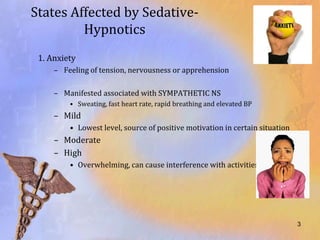
 1. Anxiety
     – Feeling of tension, nervousness or apprehension

     – Manifested associated with SYMPATHETIC NS
         • Sweating, fast heart rate, rapid breathing and elevated BP
     – Mild
         • Lowest level, source of positive motivation in certain situation
     – Moderate
     – High
         • Overwhelming, can cause interference with activities of daily living


                                                                              3
States Affected by Sedative-Hypnotics

2. Sedation
    – loss of awareness and reaction to environmental stimuli

   – Diminished physical & mental response

   – Drugs can be administered to sedate client
      • Irritable and restless


                                                          4
States Affected by Sedative-Hypnotics

3. Hypnosis
  – Extreme state of sedation in which the person
    no longer sense or reacts to incoming stimuli

  – Effective hypnotics act on the RAS and block
    the brain’s response to incoming stimuli


                                               5
Sedative-Hypnotic Drugs


     Benzodiazepines

      Barbiturates
                          6
Benzodiazepines

•   Alprazolam
•   Clonazepam (Klonopin)
•   Diazepam (Valium)
•   Lorazepam (Ativan)
•   Chlordiazepoxide (Librium)


                                 7
Benzodiazepines
Action:
• Act on limbic system and RAS to enhance the action of gamma-
   aminobutyric acid (GABA)

• GABA = inhibitory neurotransmitter

   – depress neuronal function at multiple sites in the CNS


   – Also promote sleep by affecting cortical areas and sleep-wakefulness cycle


   – Muscle relaxation thru effects on supraspinal motor areas =cerebellum


                                                                              8
Benzodiazepines
Indications:
• Drug of choice for anxiety and insomnia
• Anxiety disorders
• Alcohol withdrawal
• Hyperexcitability & agitation

• Short-acting are administered through IM
   – Preop to sedate the client
   – Before short diagnostic procedures
   – For induction of general anesthesia


                                             9
Benzodiazepines

Pharmacokinetics:
• GI peak of 30min-2h
• Readily cross blood-brain barrier to reach
  intended sites
• Metabolized by liver
• Excreted in urine


                                          10
Benzodiazepines
Contraindications:
• Psychosis = can exacerbate sedation,
• Acute narrow glaucoma
• Shock
• Coma
• Acute alcoholic intoxication
• Pregnancy cause
   –   cleft palate,
   –   inguinal hernia,
   –   cardiac defects,
   –   microcephaly,
   –   pyloric stenosis during 1st trim
                                          11
Benzodiazepines

Caution:
• Elderly & debilitated clients
     = renal/liver dysfunction


                                  12
Benzodiazepines
Adverse Effects:
• CNS depression
   – Drowsiness
   – Lightheadedness
   – Incoordination and difficulty concentrating
• Anterograde amnesia (impaired recall of recent
  events)
• Paradoxical (opposite) responses:
   –   Insomnia
   –   Excitation
   –   Euphoria
   –   rage

                                                   13
Benzodiazepines
Adverse Effects
• Severe respiratory depression with IV use
Note:
  Substantial respiratory depression can result from combining
          oral benzodiazepine + other CNS depressants

                 Prolong use=physical dependence

                      Withdrawal symptoms:
        panic, delirium, HPN, muscle twitches & convulsion


                                                                 14
Barbiturates

•   Amobarbital (Amytal)
•   Butabarbital sodium (Butisol)
•   Pentobarbital (Barbilixir, Luminal sodium)
•   Secobarbital (Seconal)


                                           15
Barbiturates
Actions:
• Bind with GABA receptors to enhance inhibitory functions

• Are general CNS depressants that inhibit neuronal
  impulse conduction in ascending RAS

• Depress cerebral cortex

• Alter cerebellar function and depress motor output


                                                       16
Barbiturates
Indications:

• LONG ACTING (phenobarbital & mephobarbital)
   – Control seizures in epilepsy


• INTERMEDIATE ACTING (amobarbital, aprobarbital)
   – Use in maintaining long periods of sleep


• SHORT-ACTING (thiopental sodium)
   – Used as general anesthetic


                                                17
Barbiturates

Pharmacokinetics:

• Absorption : well in 20-60mins
• Metabolism: liver
• Distribution: lipid-soluble, readily cross placenta
  & enter breastmilk
• Elimination: kidney


                                                  18
Barbiturates

Contraindications:
• +allergy to any barbiturate
• Previous hx of addiction to sedative-hypnotic
  drugs
• Hepatic impairement
• Respiratory distress
• Pregnancy


                                                  19
Barbiturates

Adverse Effects:
• With increasing dosage, responses range from sedation – sleep –
  general anesthesia

• Can ↓BP & HR; toxic dose lead to shock

• They stimulate hepatic enzymes that can accelerate their own
  metabolism and that of other drugs

• Prolonged used=physical dependence


                                                                    20
Sedative-Hypnotic Drugs
General Nursing Considerations:
• Do not administer intra-arterially
   – Serious arteriospasm and gangrene can occur
• Do not mix IV drugs in solution with other drugs
   – To avoid drug-drug interxn
• Parenteral forms should be the last resort, only if oral forms are
  not available
   – Oral less likely cause AE
• Give IV medications slowly
   – Rapid administration can cause cardiac problems


                                                               21
Sedative-Hypnotic Drugs

General Nursing Considerations:

• Maintain client who receive parenteral benzodiazepines in bed
  for a period of 3 hrs

• Monitor hepatic & renal functions, CBC during long therapy

• Taper dosage gradually after long-term therapy, esp in epileptic
  client
   – Abrupt withdrawal could trigger seizures


                                                               22
Sedative-Hypnotic Drugs

General Nursing Considerations:

• Prepare emergency life support facilities in case of
  severe respiratory depression

• Provide comfort measures to help client tolerate drug
  effects
   – Small, frequent meal
   – Consume drug with food


                                                     23
Anti-Depressant Agents


                         24
Major Depression Disorder

• Characterized by:
  – Low mood
  – Low self-esteem
  – Loss of interest or pleasure in normally
    enjoyable activities


• Commit suicide


                                               25
Biogenic Amine Theory of Depression

• Depression results from a deficiency in biogenic amines:
   – norepinephrine, dopamine and serotonin


• Norepinephrine
   – Alertness & energy, anxiety, attention and interest in life
• Serotonin
   – Anxiety, obsession and compulsion
• Dopamine
   – Attention, motivation, pleasure and reward and interest in life


                                                                   26
Biogenic Amine Theory of Depression

• Deficiency of these neurotransmitter may be caused by:

   – Breakdown by monoamine oxidase to be recycled or restored in
     neuron

   – Rapid or sudden abnormal electrical discharges from the brain

   – Increase in # or sensitivity of postsynaptic receptors


                                                                27
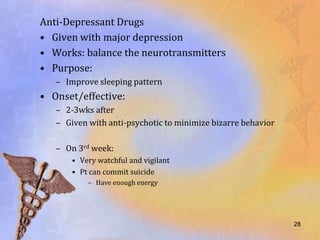
Anti-Depressant Drugs
• Given with major depression
• Works: balance the neurotransmitters
• Purpose:
   – Improve sleeping pattern
• Onset/effective:
   – 2-3wks after
   – Given with anti-psychotic to minimize bizarre behavior

   – On 3rd week:
       • Very watchful and vigilant
       • Pt can commit suicide
           – Have enough energy


                                                              28
Classification of
Anti-Depressants

       TCA
      MAOI
      SSRI
     Atypical

                     29
1. Tricyclic Anti-Depressants (TCA)

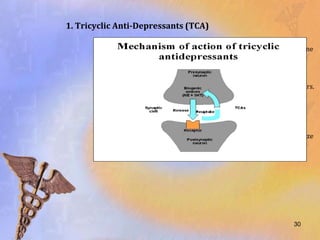
        •   TCAs inhibit uptake at presynaptic junction of the norepinephrine
            and serotonin

        •   results in the accumulation of these neurotransmitter in the
            synaptic cleft and increased stimulation of postsynaptic receptors.

        •   asserts that depression stems from a deficiency in monoamine-
            mediated transmission.

        •   Elevate mood, increase alertness, improve appetite and normalize
            sleep patterns.


                                                                        30
1. Tricyclic Anti-Depressants (TCA)

• Preferred drug for major depression.

• Therapeutic effect: 1-3 wks

• Full relief of symptoms: 1-2mos

• Tx of enuresis in children >6yo due to its anticholinergic
  effects


                                                         31
1. Tricyclic Anti-Depressants (TCA)


• Amitriptyline HCl
• Desipramine HCl
• Imipramine HCl (Tofranil)


                                          32
1. Tricyclic Anti-Depressants (TCA)

Contraindications:
• Recent MI
   – Reinfarction can occur


• Undergone myelography within prev 24h or in the next
  24h

• Should not be taken with MAOI
   – Severe HYPERPYRETIC CRISIS with severe convulsion
   – Elevated BP and death


                                                         33
1. Tricyclic Anti-Depressants (TCA)

Caution:
• With cardiovascular disorders
• Hx of seizures
  – Seizure threshold may decreased
• Renal and liver disease


                                           34
Adverse Effects:
• ORTHOSTATIC HYPOTENSION = most serious

• Anticholinergic effects
    –   Dry mouth
    –   blurred vision
    –   Photophobia
    –   constipation
    –   urinary hesitancy
    –   Tachycardia


• Sedation

• Dysrhythmias = slows heart conduction

• Lowers seizure threshold

                                           35
1. Tricyclic Anti-Depressants (TCA)

                   Note:

       NO MILK/MILK PRODUCTS
Contain tryptophan = precursor of serotonin


                                            36
Examples of TCAs
  (3 SISTERS):

      PAM ELLOR
       ELA VIL
  T   OFRA NIL


                   37
2. Monoamine Oxidase Inhibitors

• MAO is an enzyme found in liver, intestinal wall and
  terminals of monoamine-containing neurons

• Function:
   – convert norepinephrine, serotonin and dopamine into inactive
     products

   – In intestine, MAO serves to inactivate tyramine and other biogenic
     amines in food


                                                                 38
2. Monoamine Oxidase Inhibitors


• Isocarboxazid (Marplan)
• Phenelzine (Nardil)
• Tranylcypromine (Pamate)


                                       39
2. Monoamine Oxidase Inhibitors

Action:
• Irreversibly inhibit MAO

• Preventing the inactivation of neurotransmitters.

• Allows accumulation of such chemicals in
  postsynaptic receptors


                                               40
2. Monoamine Oxidase Inhibitors

Indications:

• Depression
• Bulimia
• Obsessive-Compulsive disorders


                                       41
2. Monoamine Oxidase Inhibitors

Contraindications:
• + allergy to MAOI
• Pheochromocytoma
   – Tumor of adrenal gland
   – Sudden ↑norepinephrine = HYPERTENSIVE CRISIS
      • 1st sign: pounding occipital headache
      • Give REGITINE (antidote)
• Cardiovascular dse
• Scheduled for myelography w/in past 24h to next 48h =
  reaction to dye


                                                    42
2. Monoamine Oxidase Inhibitors

Caution:
• Psyche pt = lead to overstimulation/manic
  phase

• Seizure disorders & hyperthyroidism =
  exacerbate stimulation of drug


                                          43
2. Monoamine Oxidase Inhibitors

Adverse Effect
• In contrast to TCA, MAOI cause direct CNS
  stimulation
  – Excessive stimulation produce:
     • anxiety
     • Agitation
     • Hypo/hypermania
• Orthostatic hypotension
                                         44
MAOI + TYRAMINE
                    not compatible
             Cause HYPERTENSIVE CRISIS

Special Nursing Consideration:
• NO TYRAMINE RICH FOOD
  –   Processed foods
  –   Fermented foods
  –   Preserved foods
  –   Ex. Use of yeast, cheese, f.sausage, aged fish and meat

  – Give WHITE wine & cheese (cottage)
                                                         45
Examples of MAOI:

      PA RNATE
      MA RPLAN
      NA RDIL


                    46
3. Selective Serotonin Reuptake Inhibitors
                    (SSRI)
• Block the reuptake of serotonin into the
  nerve terminal of the CNS

• Enhancing its transmission at the
  serotonergic synapse


                                             47
3. Selective Serotonin Reuptake Inhibitors
                    (SSRI)
Indications:
• Major depression
• Anxiety disorders:
  –   Obsessive-compulsive
  –   Panic
  –   Phobias
  –   Posttraumatic stress disorders


                                         48
3. Selective Serotonin Reuptake Inhibitors
                    (SSRI)
• Fluoxetin (Prozac, Sarafem)
• Paroxetine (Paxil)
• Sertraline (Zoloft)


                                         49
3. Selective Serotonin Reuptake Inhibitors
                    (SSRI)
Contraindications:
• + allergy to drugs
• Pregnancy and lactation

Caution:
• Impaired renal/liver functions


                                         50
Adverse Effects:
• ↑ Serotonin levels
   –   Headache
   –   Drowsiness
   –   Insomnia
   –   Tremors
   –   Agitation
   –   Seizures
• GU
   –   Painful menstruation
   –   Cystitis
   –   SEXUAL DYSFUNCTION
   –   IMPOTENCE


                              51
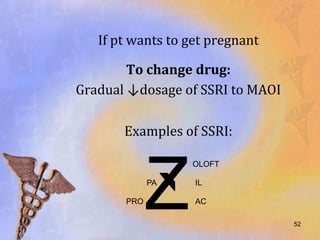
If pt wants to get pregnant

        To change drug:
Gradual ↓dosage of SSRI to MAOI

       Examples of SSRI:


             Z
                  OLOFT

             PA    IL

       PRO         AC

                                  52
4. Atypical Antidepressants

• Also called second-generation antidepressants

• Affect 1 or 2 of the 3 neurotransmitters (serotonin, dopamine&
  norepinephrine)

• Used in treating depression who do not respond to other
  antidepressants

• Examples:
    – bupropion (Wellbutrin)
    – amoxapine (Asendin)
    – nefazodone (Serzone)


                                                                   53
Anti-Depressants
General Nursing Considerations:

• Maintain initial dosage for 4-8wks to achieve full
  therapeutic effect.
• Maintain suicide precaution for severely depressed
  clients
• Monitor BP and PR on regular schedule; q4
• Instruct to avoid sudden change in position
   – to prevent orthostatic hypotension
• Advise to avoid hazardous activities if sedation is
  prominent


                                                        54
Anti-Depressants

General Nursing Considerations:

• Encourage to undergo ECG prior and during tx

• Instruct not to abruptly stop taking the drug. Dosage
  should be gradually decreased

• Encourage client who wants to get pregnant to consult
  HCP about possible teratogenic effects of the drug on
  fetus.


                                                          55
Anti-Depressants

General Nursing Considerations:

• Take drug with food if GI upset occurs.

• Advise that antidepressants may be taken at bedtime to
  decrease the dangers from the sedative effect


                                                      56
Mood Stabilizers
  (ANTI-MANIA)

   Tx for Bipolar disorder
(Manic-Depressive Disorders)
           Lithium
        Valproic acid
       Carbamazepine
                               57
1. Lithium
Actions:
• Alters sodium transmission in nerve and muscle cells
• Inhibit release of norepinephrine and dopamine but not serotonin

• In manic client, lithium reduces euphoria & hyperactivity

• Antimanic effect begins at 5-7days after onset of tx
• Full benefit: 2-3 wks


                                                                58
1. Lithium

• Lithium
  –   Carbolith
  –   Duralith
  –   Eskalith
  –   Lithonate


                               59
1. Lithium

Indications:

• Controlling acute manic episodes in Bipolar
  disorder

• Long-term prophylaxis against recurrence of
  mania and depression


                                                60
1. Lithium

Pharmacokinetics

• Absorption: oral
• Distribution: all tissues & body fluids
• Elimination: kidney

• Short half-life due to rapid renal excretion.


                                                  61
1. Lithium

• Renal excretion is affected by blood levels of sodium.

• Lithium excretion is reduced when blood levels of sodium
  are low.

• Thus, toxicity happens when there is not enough sodium
  in the blood

• Dehydration will cause lithium to remain in
  kidneys, accumulation can lead to toxicity

                                                           62
1. Lithium

• Therapeutic level:
  – 0.8-1.4 mEq/L


• >1.4mEq/L = toxic


                                 63
1. Lithium

Contraindications:

•   + hypersensitivity
•   Pregnancy and lactation
•   Renal/cardiac disease
•   Hx of leukemia
•   Metabolic disorders (Na++ depletion, dehydration
    and diuretic use)


                                                  64
1. Lithium

Cautions:

• Any condition that could alter Na++ level
  – Diarrhea
  – Excessive sweating
  – Infection with fever


                                          65
1. Lithium
Adverse Effects:

<1.5mEq/L:
• Lethargy
• Slurred speech
• Muscle weakness
• Fine tremor
• Polyuria – renal toxicity

1.5-2.0mEq/L
• Increased intensity s/sx
• ECG changes                 66
1. Lithium

Adverse Effects:

2.0-2.5 mEq/L
• Ataxia
• Clonic movements
• Hyperreflexia
• Seizure
• Cardio effects: severe ECG changes & hypotension
• Large output of diluted urine secondary to renal toxicity
• Fatalities = pulmo toxicity


                                                              67
1. Lithium

Adverse Effect:

>2.5 mEq/L
• Complex multi-organ toxicity = death


                                         68
1. Lithium
Special Nursing Considerations:

1.    Draw samples immediately before the next dose (8-12hrs after
      previous dose)

2.    Advise to maintain adequate fluid intake
     –   2-3L/day initially
     –   1-2L/day maintenance


3.    advise to maintain adequate Na++ intake and to avoid
      crash diets that affect physical and mental health


                                                                 69
1. Lithium

Special Nursing Considerations:

4. Can be taken with meals
   –    to decrease gastric irritation


5. Therapeutic effect will be observed after 1-2 weeks


6. Advice client who are planning to conceive to consult with HCP about
    possible teratogenic effects on fetus


                                                                   70
2. Valproic Acid

Action:
• Control symptoms in acute manic episodes

• Can provide prophylaxis against recurrent episodes of mania
  and depression

• Has higher therapeutic index than lithium and more desirable
  side effects


                                                           71
2. Valproic Acid

Action:

• Increases levels of GABA in brain, resulting to decreased
  seizure activity

• Starting dosage in adult:
   – 250mg, tid


• Maintenance 1000-2500mg/day


                                                        72
2. Valproic Acid

• Depakene-syrup
• Depacon-injection


                                73
2. Valproic Acid
Adverse Effects:

• GI
    –   N&V
    –   Diarrhea
    –   Dyspepsia
    –   Indigestion
    –   Depakote = to minimize these effects


• Blood dyscrasia:
    – Thrombocytopenia
    – Leucopenia


• Hepatotoxicity
                                               74
2. Valproic Acid

Special Nursing Consideration:


• Monitor for dev’t:
   –   Sore throat
   –   Fever
   –   Purpura
   –   Jaundice
   –   Excessive and progressive weakness


                                            75
3. Carbamazepine

• Like lithium, reduces symptoms of manic and depressive
  episodes

• Preferred for
   – with mixed mania/rapid-cycling bipolar disorder


• For tx of acute manic episodes, dosage increases

• Maximum dosage: 1600-2000mg/day


                                                       76
3. Carbamazepine

• Carbatrol
• Tegretol
• Epitol


                                 77
• Hematologic effects:
  –   Leucopenia
  –   Anemia
  –   Thrombocytopenia
  –   Aplastic anemia


                         78
Case Analysis
M.H, 38 years old, was started on oral lorazepam for her anxiety attacks.
  Four days after, she calls the clinic complaining that the dose must
  not be high enough because she reports that her symptoms of anxiety
  have been increased. She feels euphoric and excited for no reason and
  she has difficulty falling asleep.

a.   What is the therapeutic action of lorazepam?
b.   What is your assessment of the client’s problem?
c.   What will be your nursing interventions at this time?


                                                                   79

PHARMA-PSYCHOTHERAPEUTIC AGENTS

  • 1.
    Psychotherapeutic Agents Sedative-Hypnotic Drugs Antidepressants Mood Stabilizers 1
  • 2.
    Psychotherapeutic Agents 1. Whatdoes it mean when a drug has a sedative effect? 2. What is the difference between sedation and hypnosis? 3. What are the level of anxiety? 2
  • 3.
    States Affected bySedative- Hypnotics 1. Anxiety – Feeling of tension, nervousness or apprehension – Manifested associated with SYMPATHETIC NS • Sweating, fast heart rate, rapid breathing and elevated BP – Mild • Lowest level, source of positive motivation in certain situation – Moderate – High • Overwhelming, can cause interference with activities of daily living 3
  • 4.
    States Affected bySedative-Hypnotics 2. Sedation – loss of awareness and reaction to environmental stimuli – Diminished physical & mental response – Drugs can be administered to sedate client • Irritable and restless 4
  • 5.
    States Affected bySedative-Hypnotics 3. Hypnosis – Extreme state of sedation in which the person no longer sense or reacts to incoming stimuli – Effective hypnotics act on the RAS and block the brain’s response to incoming stimuli 5
  • 6.
    Sedative-Hypnotic Drugs Benzodiazepines Barbiturates 6
  • 7.
    Benzodiazepines • Alprazolam • Clonazepam (Klonopin) • Diazepam (Valium) • Lorazepam (Ativan) • Chlordiazepoxide (Librium) 7
  • 8.
    Benzodiazepines Action: • Act onlimbic system and RAS to enhance the action of gamma- aminobutyric acid (GABA) • GABA = inhibitory neurotransmitter – depress neuronal function at multiple sites in the CNS – Also promote sleep by affecting cortical areas and sleep-wakefulness cycle – Muscle relaxation thru effects on supraspinal motor areas =cerebellum 8
  • 9.
    Benzodiazepines Indications: • Drug ofchoice for anxiety and insomnia • Anxiety disorders • Alcohol withdrawal • Hyperexcitability & agitation • Short-acting are administered through IM – Preop to sedate the client – Before short diagnostic procedures – For induction of general anesthesia 9
  • 10.
    Benzodiazepines Pharmacokinetics: • GI peakof 30min-2h • Readily cross blood-brain barrier to reach intended sites • Metabolized by liver • Excreted in urine 10
  • 11.
    Benzodiazepines Contraindications: • Psychosis =can exacerbate sedation, • Acute narrow glaucoma • Shock • Coma • Acute alcoholic intoxication • Pregnancy cause – cleft palate, – inguinal hernia, – cardiac defects, – microcephaly, – pyloric stenosis during 1st trim 11
  • 12.
    Benzodiazepines Caution: • Elderly &debilitated clients = renal/liver dysfunction 12
  • 13.
    Benzodiazepines Adverse Effects: • CNSdepression – Drowsiness – Lightheadedness – Incoordination and difficulty concentrating • Anterograde amnesia (impaired recall of recent events) • Paradoxical (opposite) responses: – Insomnia – Excitation – Euphoria – rage 13
  • 14.
    Benzodiazepines Adverse Effects • Severerespiratory depression with IV use Note: Substantial respiratory depression can result from combining oral benzodiazepine + other CNS depressants Prolong use=physical dependence Withdrawal symptoms: panic, delirium, HPN, muscle twitches & convulsion 14
  • 15.
    Barbiturates • Amobarbital (Amytal) • Butabarbital sodium (Butisol) • Pentobarbital (Barbilixir, Luminal sodium) • Secobarbital (Seconal) 15
  • 16.
    Barbiturates Actions: • Bind withGABA receptors to enhance inhibitory functions • Are general CNS depressants that inhibit neuronal impulse conduction in ascending RAS • Depress cerebral cortex • Alter cerebellar function and depress motor output 16
  • 17.
    Barbiturates Indications: • LONG ACTING(phenobarbital & mephobarbital) – Control seizures in epilepsy • INTERMEDIATE ACTING (amobarbital, aprobarbital) – Use in maintaining long periods of sleep • SHORT-ACTING (thiopental sodium) – Used as general anesthetic 17
  • 18.
    Barbiturates Pharmacokinetics: • Absorption :well in 20-60mins • Metabolism: liver • Distribution: lipid-soluble, readily cross placenta & enter breastmilk • Elimination: kidney 18
  • 19.
    Barbiturates Contraindications: • +allergy toany barbiturate • Previous hx of addiction to sedative-hypnotic drugs • Hepatic impairement • Respiratory distress • Pregnancy 19
  • 20.
    Barbiturates Adverse Effects: • Withincreasing dosage, responses range from sedation – sleep – general anesthesia • Can ↓BP & HR; toxic dose lead to shock • They stimulate hepatic enzymes that can accelerate their own metabolism and that of other drugs • Prolonged used=physical dependence 20
  • 21.
    Sedative-Hypnotic Drugs General NursingConsiderations: • Do not administer intra-arterially – Serious arteriospasm and gangrene can occur • Do not mix IV drugs in solution with other drugs – To avoid drug-drug interxn • Parenteral forms should be the last resort, only if oral forms are not available – Oral less likely cause AE • Give IV medications slowly – Rapid administration can cause cardiac problems 21
  • 22.
    Sedative-Hypnotic Drugs General NursingConsiderations: • Maintain client who receive parenteral benzodiazepines in bed for a period of 3 hrs • Monitor hepatic & renal functions, CBC during long therapy • Taper dosage gradually after long-term therapy, esp in epileptic client – Abrupt withdrawal could trigger seizures 22
  • 23.
    Sedative-Hypnotic Drugs General NursingConsiderations: • Prepare emergency life support facilities in case of severe respiratory depression • Provide comfort measures to help client tolerate drug effects – Small, frequent meal – Consume drug with food 23
  • 24.
  • 25.
    Major Depression Disorder •Characterized by: – Low mood – Low self-esteem – Loss of interest or pleasure in normally enjoyable activities • Commit suicide 25
  • 26.
    Biogenic Amine Theoryof Depression • Depression results from a deficiency in biogenic amines: – norepinephrine, dopamine and serotonin • Norepinephrine – Alertness & energy, anxiety, attention and interest in life • Serotonin – Anxiety, obsession and compulsion • Dopamine – Attention, motivation, pleasure and reward and interest in life 26
  • 27.
    Biogenic Amine Theoryof Depression • Deficiency of these neurotransmitter may be caused by: – Breakdown by monoamine oxidase to be recycled or restored in neuron – Rapid or sudden abnormal electrical discharges from the brain – Increase in # or sensitivity of postsynaptic receptors 27
  • 28.
    Anti-Depressant Drugs • Givenwith major depression • Works: balance the neurotransmitters • Purpose: – Improve sleeping pattern • Onset/effective: – 2-3wks after – Given with anti-psychotic to minimize bizarre behavior – On 3rd week: • Very watchful and vigilant • Pt can commit suicide – Have enough energy 28
  • 29.
    Classification of Anti-Depressants TCA MAOI SSRI Atypical 29
  • 30.
    1. Tricyclic Anti-Depressants(TCA) • TCAs inhibit uptake at presynaptic junction of the norepinephrine and serotonin • results in the accumulation of these neurotransmitter in the synaptic cleft and increased stimulation of postsynaptic receptors. • asserts that depression stems from a deficiency in monoamine- mediated transmission. • Elevate mood, increase alertness, improve appetite and normalize sleep patterns. 30
  • 31.
    1. Tricyclic Anti-Depressants(TCA) • Preferred drug for major depression. • Therapeutic effect: 1-3 wks • Full relief of symptoms: 1-2mos • Tx of enuresis in children >6yo due to its anticholinergic effects 31
  • 32.
    1. Tricyclic Anti-Depressants(TCA) • Amitriptyline HCl • Desipramine HCl • Imipramine HCl (Tofranil) 32
  • 33.
    1. Tricyclic Anti-Depressants(TCA) Contraindications: • Recent MI – Reinfarction can occur • Undergone myelography within prev 24h or in the next 24h • Should not be taken with MAOI – Severe HYPERPYRETIC CRISIS with severe convulsion – Elevated BP and death 33
  • 34.
    1. Tricyclic Anti-Depressants(TCA) Caution: • With cardiovascular disorders • Hx of seizures – Seizure threshold may decreased • Renal and liver disease 34
  • 35.
    Adverse Effects: • ORTHOSTATICHYPOTENSION = most serious • Anticholinergic effects – Dry mouth – blurred vision – Photophobia – constipation – urinary hesitancy – Tachycardia • Sedation • Dysrhythmias = slows heart conduction • Lowers seizure threshold 35
  • 36.
    1. Tricyclic Anti-Depressants(TCA) Note: NO MILK/MILK PRODUCTS Contain tryptophan = precursor of serotonin 36
  • 37.
    Examples of TCAs (3 SISTERS): PAM ELLOR ELA VIL T OFRA NIL 37
  • 38.
    2. Monoamine OxidaseInhibitors • MAO is an enzyme found in liver, intestinal wall and terminals of monoamine-containing neurons • Function: – convert norepinephrine, serotonin and dopamine into inactive products – In intestine, MAO serves to inactivate tyramine and other biogenic amines in food 38
  • 39.
    2. Monoamine OxidaseInhibitors • Isocarboxazid (Marplan) • Phenelzine (Nardil) • Tranylcypromine (Pamate) 39
  • 40.
    2. Monoamine OxidaseInhibitors Action: • Irreversibly inhibit MAO • Preventing the inactivation of neurotransmitters. • Allows accumulation of such chemicals in postsynaptic receptors 40
  • 41.
    2. Monoamine OxidaseInhibitors Indications: • Depression • Bulimia • Obsessive-Compulsive disorders 41
  • 42.
    2. Monoamine OxidaseInhibitors Contraindications: • + allergy to MAOI • Pheochromocytoma – Tumor of adrenal gland – Sudden ↑norepinephrine = HYPERTENSIVE CRISIS • 1st sign: pounding occipital headache • Give REGITINE (antidote) • Cardiovascular dse • Scheduled for myelography w/in past 24h to next 48h = reaction to dye 42
  • 43.
    2. Monoamine OxidaseInhibitors Caution: • Psyche pt = lead to overstimulation/manic phase • Seizure disorders & hyperthyroidism = exacerbate stimulation of drug 43
  • 44.
    2. Monoamine OxidaseInhibitors Adverse Effect • In contrast to TCA, MAOI cause direct CNS stimulation – Excessive stimulation produce: • anxiety • Agitation • Hypo/hypermania • Orthostatic hypotension 44
  • 45.
    MAOI + TYRAMINE not compatible Cause HYPERTENSIVE CRISIS Special Nursing Consideration: • NO TYRAMINE RICH FOOD – Processed foods – Fermented foods – Preserved foods – Ex. Use of yeast, cheese, f.sausage, aged fish and meat – Give WHITE wine & cheese (cottage) 45
  • 46.
    Examples of MAOI: PA RNATE MA RPLAN NA RDIL 46
  • 47.
    3. Selective SerotoninReuptake Inhibitors (SSRI) • Block the reuptake of serotonin into the nerve terminal of the CNS • Enhancing its transmission at the serotonergic synapse 47
  • 48.
    3. Selective SerotoninReuptake Inhibitors (SSRI) Indications: • Major depression • Anxiety disorders: – Obsessive-compulsive – Panic – Phobias – Posttraumatic stress disorders 48
  • 49.
    3. Selective SerotoninReuptake Inhibitors (SSRI) • Fluoxetin (Prozac, Sarafem) • Paroxetine (Paxil) • Sertraline (Zoloft) 49
  • 50.
    3. Selective SerotoninReuptake Inhibitors (SSRI) Contraindications: • + allergy to drugs • Pregnancy and lactation Caution: • Impaired renal/liver functions 50
  • 51.
    Adverse Effects: • ↑Serotonin levels – Headache – Drowsiness – Insomnia – Tremors – Agitation – Seizures • GU – Painful menstruation – Cystitis – SEXUAL DYSFUNCTION – IMPOTENCE 51
  • 52.
    If pt wantsto get pregnant To change drug: Gradual ↓dosage of SSRI to MAOI Examples of SSRI: Z OLOFT PA IL PRO AC 52
  • 53.
    4. Atypical Antidepressants •Also called second-generation antidepressants • Affect 1 or 2 of the 3 neurotransmitters (serotonin, dopamine& norepinephrine) • Used in treating depression who do not respond to other antidepressants • Examples: – bupropion (Wellbutrin) – amoxapine (Asendin) – nefazodone (Serzone) 53
  • 54.
    Anti-Depressants General Nursing Considerations: •Maintain initial dosage for 4-8wks to achieve full therapeutic effect. • Maintain suicide precaution for severely depressed clients • Monitor BP and PR on regular schedule; q4 • Instruct to avoid sudden change in position – to prevent orthostatic hypotension • Advise to avoid hazardous activities if sedation is prominent 54
  • 55.
    Anti-Depressants General Nursing Considerations: •Encourage to undergo ECG prior and during tx • Instruct not to abruptly stop taking the drug. Dosage should be gradually decreased • Encourage client who wants to get pregnant to consult HCP about possible teratogenic effects of the drug on fetus. 55
  • 56.
    Anti-Depressants General Nursing Considerations: •Take drug with food if GI upset occurs. • Advise that antidepressants may be taken at bedtime to decrease the dangers from the sedative effect 56
  • 57.
    Mood Stabilizers (ANTI-MANIA) Tx for Bipolar disorder (Manic-Depressive Disorders) Lithium Valproic acid Carbamazepine 57
  • 58.
    1. Lithium Actions: • Alterssodium transmission in nerve and muscle cells • Inhibit release of norepinephrine and dopamine but not serotonin • In manic client, lithium reduces euphoria & hyperactivity • Antimanic effect begins at 5-7days after onset of tx • Full benefit: 2-3 wks 58
  • 59.
    1. Lithium • Lithium – Carbolith – Duralith – Eskalith – Lithonate 59
  • 60.
    1. Lithium Indications: • Controllingacute manic episodes in Bipolar disorder • Long-term prophylaxis against recurrence of mania and depression 60
  • 61.
    1. Lithium Pharmacokinetics • Absorption:oral • Distribution: all tissues & body fluids • Elimination: kidney • Short half-life due to rapid renal excretion. 61
  • 62.
    1. Lithium • Renalexcretion is affected by blood levels of sodium. • Lithium excretion is reduced when blood levels of sodium are low. • Thus, toxicity happens when there is not enough sodium in the blood • Dehydration will cause lithium to remain in kidneys, accumulation can lead to toxicity 62
  • 63.
    1. Lithium • Therapeuticlevel: – 0.8-1.4 mEq/L • >1.4mEq/L = toxic 63
  • 64.
    1. Lithium Contraindications: • + hypersensitivity • Pregnancy and lactation • Renal/cardiac disease • Hx of leukemia • Metabolic disorders (Na++ depletion, dehydration and diuretic use) 64
  • 65.
    1. Lithium Cautions: • Anycondition that could alter Na++ level – Diarrhea – Excessive sweating – Infection with fever 65
  • 66.
    1. Lithium Adverse Effects: <1.5mEq/L: •Lethargy • Slurred speech • Muscle weakness • Fine tremor • Polyuria – renal toxicity 1.5-2.0mEq/L • Increased intensity s/sx • ECG changes 66
  • 67.
    1. Lithium Adverse Effects: 2.0-2.5mEq/L • Ataxia • Clonic movements • Hyperreflexia • Seizure • Cardio effects: severe ECG changes & hypotension • Large output of diluted urine secondary to renal toxicity • Fatalities = pulmo toxicity 67
  • 68.
    1. Lithium Adverse Effect: >2.5mEq/L • Complex multi-organ toxicity = death 68
  • 69.
    1. Lithium Special NursingConsiderations: 1. Draw samples immediately before the next dose (8-12hrs after previous dose) 2. Advise to maintain adequate fluid intake – 2-3L/day initially – 1-2L/day maintenance 3. advise to maintain adequate Na++ intake and to avoid crash diets that affect physical and mental health 69
  • 70.
    1. Lithium Special NursingConsiderations: 4. Can be taken with meals – to decrease gastric irritation 5. Therapeutic effect will be observed after 1-2 weeks 6. Advice client who are planning to conceive to consult with HCP about possible teratogenic effects on fetus 70
  • 71.
    2. Valproic Acid Action: •Control symptoms in acute manic episodes • Can provide prophylaxis against recurrent episodes of mania and depression • Has higher therapeutic index than lithium and more desirable side effects 71
  • 72.
    2. Valproic Acid Action: •Increases levels of GABA in brain, resulting to decreased seizure activity • Starting dosage in adult: – 250mg, tid • Maintenance 1000-2500mg/day 72
  • 73.
    2. Valproic Acid •Depakene-syrup • Depacon-injection 73
  • 74.
    2. Valproic Acid AdverseEffects: • GI – N&V – Diarrhea – Dyspepsia – Indigestion – Depakote = to minimize these effects • Blood dyscrasia: – Thrombocytopenia – Leucopenia • Hepatotoxicity 74
  • 75.
    2. Valproic Acid SpecialNursing Consideration: • Monitor for dev’t: – Sore throat – Fever – Purpura – Jaundice – Excessive and progressive weakness 75
  • 76.
    3. Carbamazepine • Likelithium, reduces symptoms of manic and depressive episodes • Preferred for – with mixed mania/rapid-cycling bipolar disorder • For tx of acute manic episodes, dosage increases • Maximum dosage: 1600-2000mg/day 76
  • 77.
    3. Carbamazepine • Carbatrol •Tegretol • Epitol 77
  • 78.
    • Hematologic effects: – Leucopenia – Anemia – Thrombocytopenia – Aplastic anemia 78
  • 79.
    Case Analysis M.H, 38years old, was started on oral lorazepam for her anxiety attacks. Four days after, she calls the clinic complaining that the dose must not be high enough because she reports that her symptoms of anxiety have been increased. She feels euphoric and excited for no reason and she has difficulty falling asleep. a. What is the therapeutic action of lorazepam? b. What is your assessment of the client’s problem? c. What will be your nursing interventions at this time? 79
Editor's Notes

  • #68 Ataxia=loss of muscle coordination