CHEMISTRY CLASS XII
UNIT 13
ORGANIC COMPOUNDS CONTAINING NITROGEN
PART- I AMINES
OUTLINE
 Introduction
Structure of amine
Classification of amine
Nomenclature of amine
Method of Preparation of amines
Physical Properties of amines
Chemical properties of amines
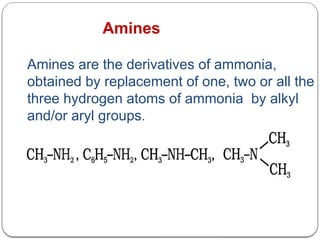
Amines are the derivatives of ammonia,
obtained by replacement of one, two or all the
three hydrogen atoms of ammonia by alkyl
and/or aryl groups.
Amines
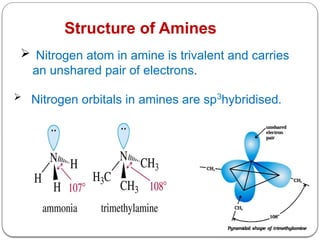
Structure of Amines
 Nitrogen atom in amine is trivalent and carries
an unshared pair of electrons.
 Nitrogen orbitals in amines are sp3
hybridised.
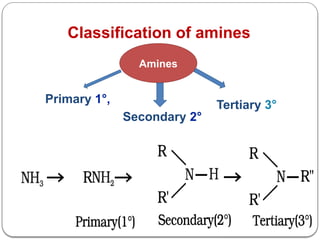
Classification of amines
Primary 1°,
Amines
Secondary 2°
Tertiary 3°
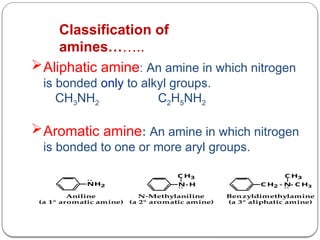
Aliphatic amine: An amine in which nitrogen
is bonded only to alkyl groups.
CH3NH2 C2H5NH2
Aromatic amine: An amine in which nitrogen
is bonded to one or more aryl groups.
Classification of
amines……..
Aniline
(a 1° aromatic amine)
N-Methylaniline
(a 2° aromatic amine)
Benzyldimethylamine
(a 3° aliphatic amine)
NH2 N- H C H2 - N- C H3
C H3 C H3
:
:
:
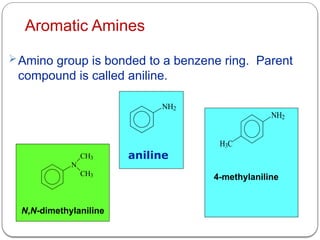
Aromatic Amines
Amino group is bonded to a benzene ring. Parent
compound is called aniline.
NH2
aniline
N
CH3
CH3
N,N-dimethylaniline
NH2
H3C
4-methylaniline
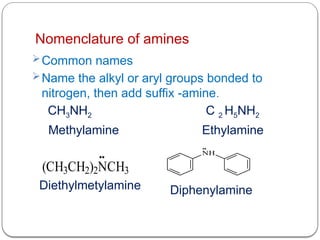
Nomenclature of amines
Common names
Name the alkyl or aryl groups bonded to
nitrogen, then add suffix -amine.
CH3NH2 C 2 H5NH2
Methylamine Ethylamine
(CH3CH2)2NCH3
NH
Diphenylamine
Diethylmetylamine
Nomenclature
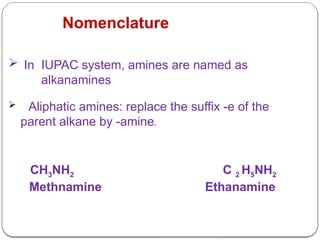
 In IUPAC system, amines are named as
alkanamines
 Aliphatic amines: replace the suffix -e of the
parent alkane by -amine.
CH3NH2 C 2 H5NH2
Methnamine Ethanamine
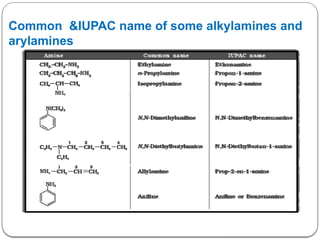
Common &IUPAC name of some alkylamines and
arylamines
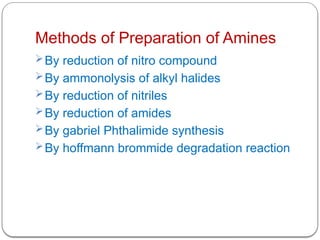
Methods of Preparation of Amines
By reduction of nitro compound
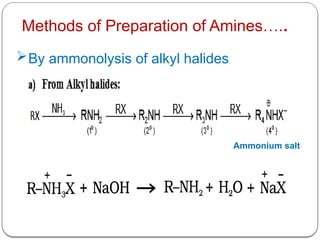
By ammonolysis of alkyl halides
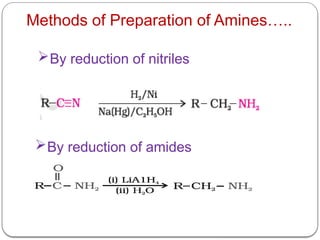
By reduction of nitriles
By reduction of amides
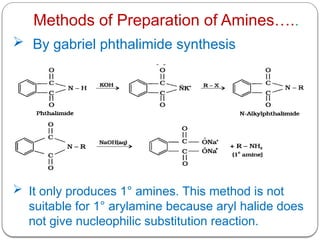
By gabriel Phthalimide synthesis
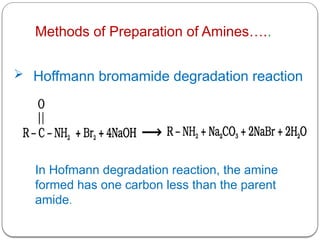
By hoffmann brommide degradation reaction
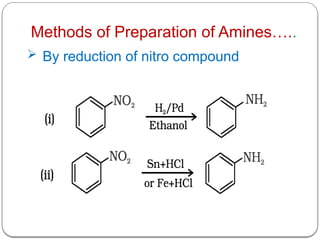
Methods of Preparation of Amines…..
 By reduction of nitro compound
Ammonium salt
By ammonolysis of alkyl halides
Methods of Preparation of Amines…..
By reduction of nitriles
By reduction of amides
 It only produces 1° amines. This method is not
suitable for 1° arylamine because aryl halide does
not give nucleophilic substitution reaction.
 By gabriel phthalimide synthesis
Methods of Preparation of Amines…..
In Hofmann degradation reaction, the amine
formed has one carbon less than the parent
amide.
 Hoffmann bromamide degradation reaction
Methods of Preparation of Amines…..
Physical Properties of Amines
 The lower aliphatic amines are gases with
fishy smell
 Amines with fewer than five carbons are
water-soluble
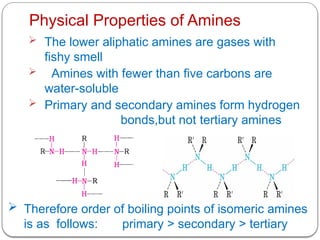
 Primary and secondary amines form hydrogen
bonds,but not tertiary amines
 Therefore order of boiling points of isomeric amines
is as follows: primary > secondary > tertiary
Chemical Reactions of Amines
Basicity of amines
Lone pair of electrons on nitrogen can accept a
proton from an acid.
Alkyl amines are usually stronger bases than
ammonia.
 Increasing the number of alkyl groups decreases
solvation of ion, but increases the availability of
lone pair on nitrogen atom.
Basicity of Amines…….
.
.
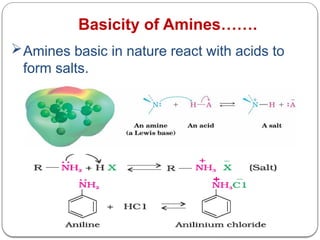
Amines basic in nature react with acids to
form salts.
Basicity of Amines………
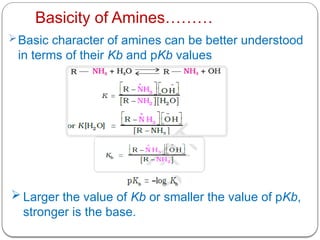
Basic character of amines can be better understood
in terms of their Kb and pKb values
 Larger the value of Kb or smaller the value of pKb,
stronger is the base.
Basicity of Amines………
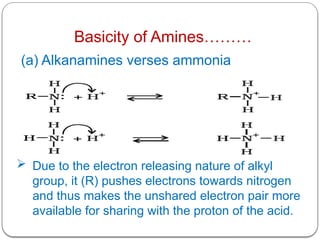
(a) Alkanamines verses ammonia
 Due to the electron releasing nature of alkyl
group, it (R) pushes electrons towards nitrogen
and thus makes the unshared electron pair more
available for sharing with the proton of the acid.
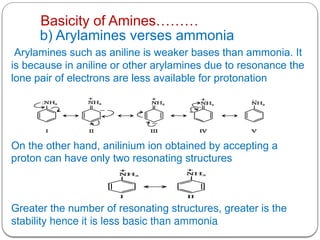
b) Arylamines verses ammonia
Arylamines such as aniline is weaker bases than ammonia. It
is because in aniline or other arylamines due to resonance the
lone pair of electrons are less available for protonation
Basicity of Amines………
On the other hand, anilinium ion obtained by accepting a
proton can have only two resonating structures
Greater the number of resonating structures, greater is the
stability hence it is less basic than ammonia
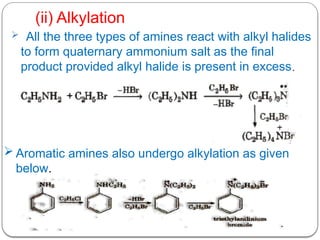
(ii) Alkylation
 All the three types of amines react with alkyl halides
to form quaternary ammonium salt as the final
product provided alkyl halide is present in excess.
 Aromatic amines also undergo alkylation as given
below.
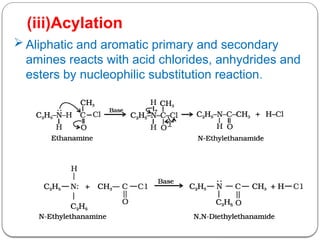
 Aliphatic and aromatic primary and secondary
amines reacts with acid chlorides, anhydrides and
esters by nucleophilic substitution reaction.
(iii)Acylation
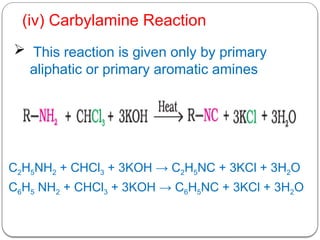
 This reaction is given only by primary
aliphatic or primary aromatic amines
C2H5NH2 + CHCl3 + 3KOH → C2H5NC + 3KCl + 3H2O
C6H5 NH2 + CHCl3 + 3KOH → C6H5NC + 3KCl + 3H2O
(iv) Carbylamine Reaction
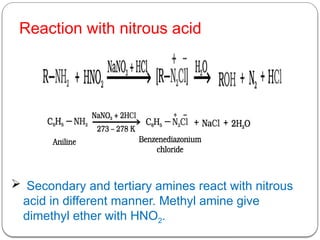
Reaction with nitrous acid
 Secondary and tertiary amines react with nitrous
acid in different manner. Methyl amine give
dimethyl ether with HNO2.
(vi)Reaction with benzensulphonyl chloride
[Hinsberg reagent]
 The reaction of benzenesulphonyl chloride with
primary amine yield N-ethyl benzenesulphonyl
amide.
Tertiary amines does not react with benzenesulphonyl
chloride.
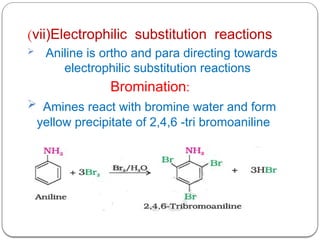
(vii)Electrophilic substitution reactions
 Aniline is ortho and para directing towards
electrophilic substitution reactions
Bromination:
 Amines react with bromine water and form
yellow precipitate of 2,4,6 -tri bromoaniline
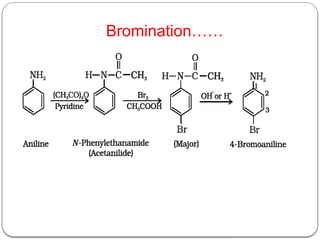
Bromination……
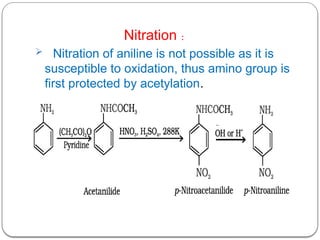
Nitration :
 Nitration of aniline is not possible as it is
susceptible to oxidation, thus amino group is
first protected by acetylation.
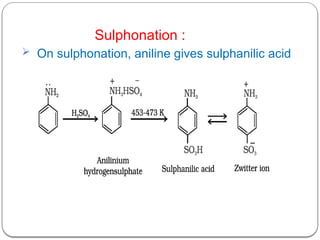
Sulphonation :
 On sulphonation, aniline gives sulphanilic acid
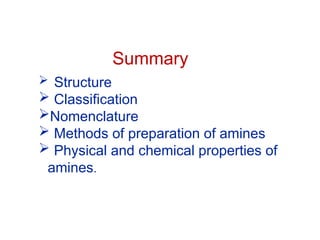
Summary
R O PUNE
 Structure
 Classification
Nomenclature
 Methods of preparation of amines
 Physical and chemical properties of
amines.
HOME WORK
1.Writes short notes on the following
(i) Carbylamine reaction
(ii) Hoffman bromamide reaction
(iii) Gabriel phthalimide synthesis.
2. Aniline is less basic than ammonia.Why?
3. How will you convert aniline in to p-bromo aniline

1313 Amines 1.pptx

  • 1.
    CHEMISTRY CLASS XII UNIT13 ORGANIC COMPOUNDS CONTAINING NITROGEN PART- I AMINES
  • 2.
    OUTLINE  Introduction Structure ofamine Classification of amine Nomenclature of amine Method of Preparation of amines Physical Properties of amines Chemical properties of amines
  • 3.
    Amines are thederivatives of ammonia, obtained by replacement of one, two or all the three hydrogen atoms of ammonia by alkyl and/or aryl groups. Amines
  • 4.
    Structure of Amines Nitrogen atom in amine is trivalent and carries an unshared pair of electrons.  Nitrogen orbitals in amines are sp3 hybridised.
  • 5.
    Classification of amines Primary1°, Amines Secondary 2° Tertiary 3°
  • 6.
    Aliphatic amine: Anamine in which nitrogen is bonded only to alkyl groups. CH3NH2 C2H5NH2 Aromatic amine: An amine in which nitrogen is bonded to one or more aryl groups. Classification of amines…….. Aniline (a 1° aromatic amine) N-Methylaniline (a 2° aromatic amine) Benzyldimethylamine (a 3° aliphatic amine) NH2 N- H C H2 - N- C H3 C H3 C H3 : : :
  • 7.
    Aromatic Amines Amino groupis bonded to a benzene ring. Parent compound is called aniline. NH2 aniline N CH3 CH3 N,N-dimethylaniline NH2 H3C 4-methylaniline
  • 8.
    Nomenclature of amines Commonnames Name the alkyl or aryl groups bonded to nitrogen, then add suffix -amine. CH3NH2 C 2 H5NH2 Methylamine Ethylamine (CH3CH2)2NCH3 NH Diphenylamine Diethylmetylamine
  • 9.
    Nomenclature  In IUPACsystem, amines are named as alkanamines  Aliphatic amines: replace the suffix -e of the parent alkane by -amine. CH3NH2 C 2 H5NH2 Methnamine Ethanamine
  • 10.
    Common &IUPAC nameof some alkylamines and arylamines
  • 11.
    Methods of Preparationof Amines By reduction of nitro compound By ammonolysis of alkyl halides By reduction of nitriles By reduction of amides By gabriel Phthalimide synthesis By hoffmann brommide degradation reaction
  • 12.
    Methods of Preparationof Amines…..  By reduction of nitro compound
  • 13.
    Ammonium salt By ammonolysisof alkyl halides Methods of Preparation of Amines…..
  • 14.
    Methods of Preparationof Amines….. By reduction of nitriles By reduction of amides
  • 15.
     It onlyproduces 1° amines. This method is not suitable for 1° arylamine because aryl halide does not give nucleophilic substitution reaction.  By gabriel phthalimide synthesis Methods of Preparation of Amines…..
  • 16.
    In Hofmann degradationreaction, the amine formed has one carbon less than the parent amide.  Hoffmann bromamide degradation reaction Methods of Preparation of Amines…..
  • 17.
    Physical Properties ofAmines  The lower aliphatic amines are gases with fishy smell  Amines with fewer than five carbons are water-soluble  Primary and secondary amines form hydrogen bonds,but not tertiary amines  Therefore order of boiling points of isomeric amines is as follows: primary > secondary > tertiary
  • 18.
    Chemical Reactions ofAmines Basicity of amines Lone pair of electrons on nitrogen can accept a proton from an acid. Alkyl amines are usually stronger bases than ammonia.  Increasing the number of alkyl groups decreases solvation of ion, but increases the availability of lone pair on nitrogen atom.
  • 19.
    Basicity of Amines……. . . Aminesbasic in nature react with acids to form salts.
  • 20.
    Basicity of Amines……… Basiccharacter of amines can be better understood in terms of their Kb and pKb values  Larger the value of Kb or smaller the value of pKb, stronger is the base.
  • 21.
    Basicity of Amines……… (a)Alkanamines verses ammonia  Due to the electron releasing nature of alkyl group, it (R) pushes electrons towards nitrogen and thus makes the unshared electron pair more available for sharing with the proton of the acid.
  • 22.
    b) Arylamines versesammonia Arylamines such as aniline is weaker bases than ammonia. It is because in aniline or other arylamines due to resonance the lone pair of electrons are less available for protonation Basicity of Amines……… On the other hand, anilinium ion obtained by accepting a proton can have only two resonating structures Greater the number of resonating structures, greater is the stability hence it is less basic than ammonia
  • 23.
    (ii) Alkylation  Allthe three types of amines react with alkyl halides to form quaternary ammonium salt as the final product provided alkyl halide is present in excess.  Aromatic amines also undergo alkylation as given below.
  • 24.
     Aliphatic andaromatic primary and secondary amines reacts with acid chlorides, anhydrides and esters by nucleophilic substitution reaction. (iii)Acylation
  • 25.
     This reactionis given only by primary aliphatic or primary aromatic amines C2H5NH2 + CHCl3 + 3KOH → C2H5NC + 3KCl + 3H2O C6H5 NH2 + CHCl3 + 3KOH → C6H5NC + 3KCl + 3H2O (iv) Carbylamine Reaction
  • 26.
    Reaction with nitrousacid  Secondary and tertiary amines react with nitrous acid in different manner. Methyl amine give dimethyl ether with HNO2.
  • 27.
    (vi)Reaction with benzensulphonylchloride [Hinsberg reagent]  The reaction of benzenesulphonyl chloride with primary amine yield N-ethyl benzenesulphonyl amide. Tertiary amines does not react with benzenesulphonyl chloride.
  • 28.
    (vii)Electrophilic substitution reactions Aniline is ortho and para directing towards electrophilic substitution reactions Bromination:  Amines react with bromine water and form yellow precipitate of 2,4,6 -tri bromoaniline
  • 29.
  • 30.
    Nitration :  Nitrationof aniline is not possible as it is susceptible to oxidation, thus amino group is first protected by acetylation.
  • 31.
    Sulphonation :  Onsulphonation, aniline gives sulphanilic acid
  • 32.
    Summary R O PUNE Structure  Classification Nomenclature  Methods of preparation of amines  Physical and chemical properties of amines.
  • 33.
    HOME WORK 1.Writes shortnotes on the following (i) Carbylamine reaction (ii) Hoffman bromamide reaction (iii) Gabriel phthalimide synthesis. 2. Aniline is less basic than ammonia.Why? 3. How will you convert aniline in to p-bromo aniline