8/27/2016 VATSAL N SHAH 1
Welcome !
Presented By Vatsal
Shah
IU1241090055
INDUSUNIVERSITY
Electronics &
Communication Dept.
5th Semester
PresentationTRANSMITTER
AND
VATSAL N SHAH8/27/2016 2
on
VATSAL N SHAH8/27/2016 3
CONTAINT
• Amplitude modulation
• What is Modulation ?
• How does the signal transmitted?
• SIMPLE AM TRANSMITTER CIRCUIT
• ABOUT THE CIRCUIT
• FM Transmitter
• Introduction
• Circuit Diagram
• Working Principle
• Pros & Cons
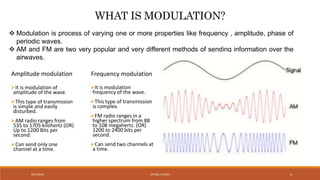
WHAT IS MODULATION?
 Modulation is process of varying one or more properties like frequency , amplitude, phase of
periodic waves.
 AM and FM are two very popular and very different methods of sending information over the
airwaves.
Amplitude modulation Frequency modulation
It is modulation
frequency of the wave.
This type of transmission
is complex.
FM radio ranges in a
higher spectrum from 88
to 108 megahertz. (OR)
1200 to 2400 bits per
second.
Can send two channels at
a time.
It is modulation of
amplitude of the wave.
This type of transmission
is simple and easily
disturbed.
AM radio ranges from
535 to 1705 kilohertz (OR)
Up to 1200 Bits per
second.
Can send only one
channel at a time.
VATSAL N SHAH8/27/2016 4
Amplitude Modulation
 Amplitude modulation is a technique used in electronic communication, most commonly for
transmitting information via a radio carrier wave.
 AM works by varying the strength of the transmitted signal in relation to the information being
sent.
 In AM, a radio wave known as the "carrier" or "carrier wave" is modulated in amplitude by the
signal that is to be transmitted.
 It is used in both analog and digital communication.
 Range of modulator is small as compared to FM.
VATSAL N SHAH8/27/2016 5
How does the signal transmitted?
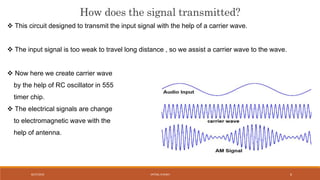
 This circuit designed to transmit the input signal with the help of a carrier wave.
 The input signal is too weak to travel long distance , so we assist a carrier wave to the wave.
 Now here we create carrier wave
by the help of RC oscillator in 555
timer chip.
 The electrical signals are change
to electromagnetic wave with the
help of antenna.
VATSAL N SHAH8/27/2016 6
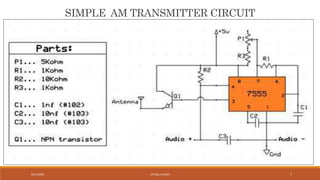
SIMPLE AM TRANSMITTER CIRCUIT
VATSAL N SHAH8/27/2016 7
ABOUT THE CIRCUIT
 Potentiometers are commonly used to control electrical devices such as volume controls
on audio equipment.
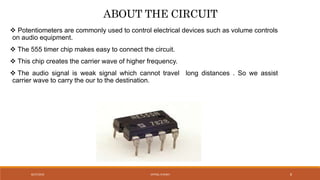
 The 555 timer chip makes easy to connect the circuit.
 This chip creates the carrier wave of higher frequency.
 The audio signal is weak signal which cannot travel long distances . So we assist
carrier wave to carry the our to the destination.
VATSAL N SHAH8/27/2016 8
8/27/2016 VATSAL N SHAH 9
FM Transmitter
VATSAL N SHAH8/27/2016 10
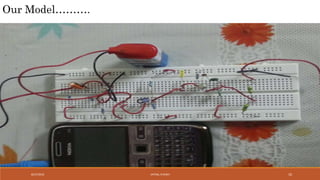
Our Model……….
Introduction
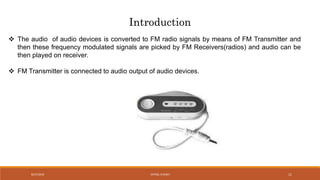
 The audio of audio devices is converted to FM radio signals by means of FM Transmitter and
then these frequency modulated signals are picked by FM Receivers(radios) and audio can be
then played on receiver.
 FM Transmitter is connected to audio output of audio devices.
VATSAL N SHAH8/27/2016 11
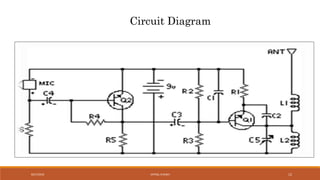
Circuit Diagram
VATSAL N SHAH8/27/2016 12
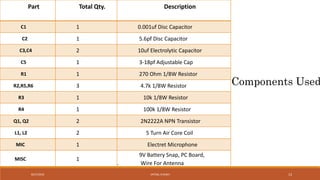
Components Used
Part Total Qty. Description
C1 1 0.001uf Disc Capacitor
C2 1 5.6pf Disc Capacitor
C3,C4 2 10uf Electrolytic Capacitor
C5 1 3-18pf Adjustable Cap
R1 1 270 Ohm 1/8W Resistor
R2,R5,R6 3 4.7k 1/8W Resistor
R3 1 10k 1/8W Resistor
R4 1 100k 1/8W Resistor
Q1, Q2 2 2N2222A NPN Transistor
L1, L2 2 5 Turn Air Core Coil
MIC 1 Electret Microphone
MISC 1
9V Battery Snap, PC Board,
. Wire For Antenna
VATSAL N SHAH8/27/2016 13
8/27/2016 VATSAL N SHAH 14
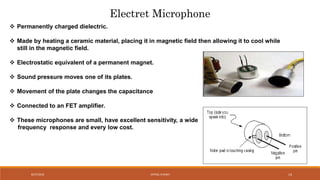
 Permanently charged dielectric.
 Made by heating a ceramic material, placing it in magnetic field then allowing it to cool while
still in the magnetic field.
 Electrostatic equivalent of a permanent magnet.
 Sound pressure moves one of its plates.
 Movement of the plate changes the capacitance
 Connected to an FET amplifier.
 These microphones are small, have excellent sensitivity, a wide
frequency response and every low cost.
Electret Microphone
8/27/2016 VATSAL N SHAH 15
First amplification stage
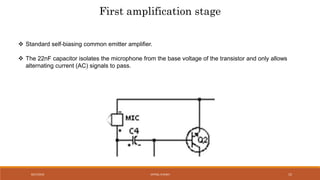
 Standard self-biasing common emitter amplifier.
 The 22nF capacitor isolates the microphone from the base voltage of the transistor and only allows
alternating current (AC) signals to pass.
Working Principle
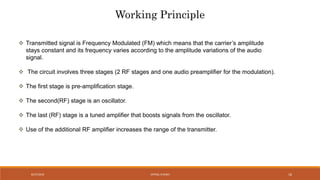
 Transmitted signal is Frequency Modulated (FM) which means that the carrier’s amplitude
stays constant and its frequency varies according to the amplitude variations of the audio
signal.
 The circuit involves three stages (2 RF stages and one audio preamplifier for the modulation).
 The first stage is pre-amplification stage.
 The second(RF) stage is an oscillator.
 The last (RF) stage is a tuned amplifier that boosts signals from the oscillator.
 Use of the additional RF amplifier increases the range of the transmitter.
VATSAL N SHAH8/27/2016 16
Pros & Cons
 Audio signal can be broadcasted on any FM frequency from 87.5 to 108.0 MHz by this
transmitter.
 An FM transmitter can be made to plug into the headphone jack or output port of a
portable audio or video device, such as a CD player, portable media player, or satellite
radio system. The sound is then broadcast through the transmitter, and plays through
an FM broadcast band frequency.
Pros
VATSAL N SHAH8/27/2016 17
Pros & Cons Cont.…
 But….most devices on the market typically have a short range of up to 100 feet (30 metres) with any
average radio (up to about 300 feet (100 metres) with a very good radio under perfect conditions) .
 The output power of FM Transmitters is very low so when it comes to use in areas where large number
of other radio signals are present. It becomes unsuitable because strong FM signals can bleed over
into neighbouring frequencies making the frequencies unusable with the transmitter.
Cons
VATSAL N SHAH8/27/2016 18
VATSAL N SHAH8/27/2016 19

Am fm transmitter

  • 1.
    8/27/2016 VATSAL NSHAH 1 Welcome ! Presented By Vatsal Shah IU1241090055 INDUSUNIVERSITY Electronics & Communication Dept. 5th Semester
  • 2.
  • 3.
    VATSAL N SHAH8/27/20163 CONTAINT • Amplitude modulation • What is Modulation ? • How does the signal transmitted? • SIMPLE AM TRANSMITTER CIRCUIT • ABOUT THE CIRCUIT • FM Transmitter • Introduction • Circuit Diagram • Working Principle • Pros & Cons
  • 4.
    WHAT IS MODULATION? Modulation is process of varying one or more properties like frequency , amplitude, phase of periodic waves.  AM and FM are two very popular and very different methods of sending information over the airwaves. Amplitude modulation Frequency modulation It is modulation frequency of the wave. This type of transmission is complex. FM radio ranges in a higher spectrum from 88 to 108 megahertz. (OR) 1200 to 2400 bits per second. Can send two channels at a time. It is modulation of amplitude of the wave. This type of transmission is simple and easily disturbed. AM radio ranges from 535 to 1705 kilohertz (OR) Up to 1200 Bits per second. Can send only one channel at a time. VATSAL N SHAH8/27/2016 4
  • 5.
    Amplitude Modulation  Amplitudemodulation is a technique used in electronic communication, most commonly for transmitting information via a radio carrier wave.  AM works by varying the strength of the transmitted signal in relation to the information being sent.  In AM, a radio wave known as the "carrier" or "carrier wave" is modulated in amplitude by the signal that is to be transmitted.  It is used in both analog and digital communication.  Range of modulator is small as compared to FM. VATSAL N SHAH8/27/2016 5
  • 6.
    How does thesignal transmitted?  This circuit designed to transmit the input signal with the help of a carrier wave.  The input signal is too weak to travel long distance , so we assist a carrier wave to the wave.  Now here we create carrier wave by the help of RC oscillator in 555 timer chip.  The electrical signals are change to electromagnetic wave with the help of antenna. VATSAL N SHAH8/27/2016 6
  • 7.
    SIMPLE AM TRANSMITTERCIRCUIT VATSAL N SHAH8/27/2016 7
  • 8.
    ABOUT THE CIRCUIT Potentiometers are commonly used to control electrical devices such as volume controls on audio equipment.  The 555 timer chip makes easy to connect the circuit.  This chip creates the carrier wave of higher frequency.  The audio signal is weak signal which cannot travel long distances . So we assist carrier wave to carry the our to the destination. VATSAL N SHAH8/27/2016 8
  • 9.
    8/27/2016 VATSAL NSHAH 9 FM Transmitter
  • 10.
    VATSAL N SHAH8/27/201610 Our Model……….
  • 11.
    Introduction  The audioof audio devices is converted to FM radio signals by means of FM Transmitter and then these frequency modulated signals are picked by FM Receivers(radios) and audio can be then played on receiver.  FM Transmitter is connected to audio output of audio devices. VATSAL N SHAH8/27/2016 11
  • 12.
    Circuit Diagram VATSAL NSHAH8/27/2016 12
  • 13.
    Components Used Part TotalQty. Description C1 1 0.001uf Disc Capacitor C2 1 5.6pf Disc Capacitor C3,C4 2 10uf Electrolytic Capacitor C5 1 3-18pf Adjustable Cap R1 1 270 Ohm 1/8W Resistor R2,R5,R6 3 4.7k 1/8W Resistor R3 1 10k 1/8W Resistor R4 1 100k 1/8W Resistor Q1, Q2 2 2N2222A NPN Transistor L1, L2 2 5 Turn Air Core Coil MIC 1 Electret Microphone MISC 1 9V Battery Snap, PC Board, . Wire For Antenna VATSAL N SHAH8/27/2016 13
  • 14.
    8/27/2016 VATSAL NSHAH 14  Permanently charged dielectric.  Made by heating a ceramic material, placing it in magnetic field then allowing it to cool while still in the magnetic field.  Electrostatic equivalent of a permanent magnet.  Sound pressure moves one of its plates.  Movement of the plate changes the capacitance  Connected to an FET amplifier.  These microphones are small, have excellent sensitivity, a wide frequency response and every low cost. Electret Microphone
  • 15.
    8/27/2016 VATSAL NSHAH 15 First amplification stage  Standard self-biasing common emitter amplifier.  The 22nF capacitor isolates the microphone from the base voltage of the transistor and only allows alternating current (AC) signals to pass.
  • 16.
    Working Principle  Transmittedsignal is Frequency Modulated (FM) which means that the carrier’s amplitude stays constant and its frequency varies according to the amplitude variations of the audio signal.  The circuit involves three stages (2 RF stages and one audio preamplifier for the modulation).  The first stage is pre-amplification stage.  The second(RF) stage is an oscillator.  The last (RF) stage is a tuned amplifier that boosts signals from the oscillator.  Use of the additional RF amplifier increases the range of the transmitter. VATSAL N SHAH8/27/2016 16
  • 17.
    Pros & Cons Audio signal can be broadcasted on any FM frequency from 87.5 to 108.0 MHz by this transmitter.  An FM transmitter can be made to plug into the headphone jack or output port of a portable audio or video device, such as a CD player, portable media player, or satellite radio system. The sound is then broadcast through the transmitter, and plays through an FM broadcast band frequency. Pros VATSAL N SHAH8/27/2016 17
  • 18.
    Pros & ConsCont.…  But….most devices on the market typically have a short range of up to 100 feet (30 metres) with any average radio (up to about 300 feet (100 metres) with a very good radio under perfect conditions) .  The output power of FM Transmitters is very low so when it comes to use in areas where large number of other radio signals are present. It becomes unsuitable because strong FM signals can bleed over into neighbouring frequencies making the frequencies unusable with the transmitter. Cons VATSAL N SHAH8/27/2016 18
  • 19.