Presented by :
Samadrita Banik
ST. GEORGE COLLEGE
M.Sc Microbiology
Allomyces is a genus of fungi in the
family Blastocladiaceae. It was circumscribed by
British mycologist Edwin John Butler in 1911.
Species in the genus have a polycentric thallus
and reproduce asexually by zoospores that have
a whiplash-like flagella. They are mostly isolated
from soils in tropical countries, commonly in
ponds, rice fields, and slow-moving rivers.
 Phylum : Chytridiomycota
 Division : Blastocladiomycota
 Class : Blasdiomycetes
 Order : Blastocladies
 Genus : Allomyces
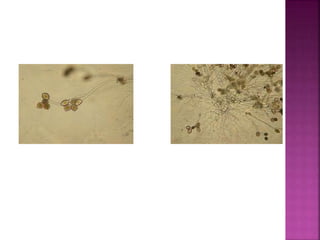
Allomyces thalli consist of a cylindrical
trunk-like basal cell that gives rise to
well-developed, highly branched rhizoids
that anchor the thallus to the substrate.
The trunk-like basal cell also gives rise to
numerous dichotomously branched side
branches that terminate as either
resistant sporangia, zoosporangia, or
gametangia depending on the life cycle
stage. Septa are sometimes present,

especially at the base of reproductive
organs.
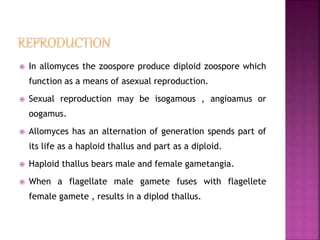
 The thallus in all the species is hyphal and is called the
mycelium. It is filamentous and attached to the substratum
by a tuft of delicate but well formed, branched rhizoidal
hyphae constituting the rhizoidal system.
 From the latter arises a single stout (strong and thick) but
slender hypha forming the lower trunk-like portion.
 In Allomyces they are not formed in conjunction with cell
division. The hyphae are thus multinucleate and coenocytic.
 The septa in Allomyces are often referred to as false septa
because they do not completely separate the protoplasm of
adjacent somatic segments.
 In allomyces the zoospore produce diploid zoospore which
function as a means of asexual reproduction.
 Sexual reproduction may be isogamous , angioamus or
oogamus.
 Allomyces has an alternation of generation spends part of
its life as a haploid thallus and part as a diploid.
 Haploid thallus bears male and female gametangia.
 When a flagellate male gamete fuses with flagellete
female gamete , results in a diplod thallus.
Allomyces species seem to have a global
distribution and are readily isolated from
soils and waters by baiting with a sterile
seed. Species of Allomyces can be
parasitized by Catenaria allomyces, Rozella
allomyces, and Olpidium allomycetos.
Allomyces

Allomyces

  • 1.
    Presented by : SamadritaBanik ST. GEORGE COLLEGE M.Sc Microbiology
  • 2.
    Allomyces is agenus of fungi in the family Blastocladiaceae. It was circumscribed by British mycologist Edwin John Butler in 1911. Species in the genus have a polycentric thallus and reproduce asexually by zoospores that have a whiplash-like flagella. They are mostly isolated from soils in tropical countries, commonly in ponds, rice fields, and slow-moving rivers.
  • 3.
     Phylum :Chytridiomycota  Division : Blastocladiomycota  Class : Blasdiomycetes  Order : Blastocladies  Genus : Allomyces
  • 4.
    Allomyces thalli consistof a cylindrical trunk-like basal cell that gives rise to well-developed, highly branched rhizoids that anchor the thallus to the substrate. The trunk-like basal cell also gives rise to numerous dichotomously branched side branches that terminate as either resistant sporangia, zoosporangia, or gametangia depending on the life cycle stage. Septa are sometimes present, especially at the base of reproductive organs.
  • 6.
     The thallusin all the species is hyphal and is called the mycelium. It is filamentous and attached to the substratum by a tuft of delicate but well formed, branched rhizoidal hyphae constituting the rhizoidal system.  From the latter arises a single stout (strong and thick) but slender hypha forming the lower trunk-like portion.  In Allomyces they are not formed in conjunction with cell division. The hyphae are thus multinucleate and coenocytic.  The septa in Allomyces are often referred to as false septa because they do not completely separate the protoplasm of adjacent somatic segments.
  • 8.
     In allomycesthe zoospore produce diploid zoospore which function as a means of asexual reproduction.  Sexual reproduction may be isogamous , angioamus or oogamus.  Allomyces has an alternation of generation spends part of its life as a haploid thallus and part as a diploid.  Haploid thallus bears male and female gametangia.  When a flagellate male gamete fuses with flagellete female gamete , results in a diplod thallus.
  • 9.
    Allomyces species seemto have a global distribution and are readily isolated from soils and waters by baiting with a sterile seed. Species of Allomyces can be parasitized by Catenaria allomyces, Rozella allomyces, and Olpidium allomycetos.