Submitted by : Sameeha Jain
Registration Number : 19BMIN010
Subject : Mycology
Subject Code : BMI012A
Phycomycetes
Algal fungi
General Features
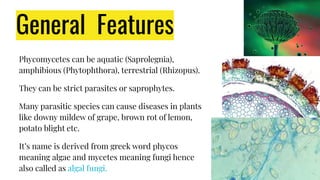
Phycomycetes can be aquatic (Saprolegnia),
amphibious (Phytophthora), terrestrial (Rhizopus).
They can be strict parasites or saprophytes.
Many parasitic species can cause diseases in plants
like downy mildew of grape, brown rot of lemon,
potato blight etc.
It’s name is derived from greek word phycos
meaning algae and mycetes meaning fungi hence
also called as algal fungi.
Characteristics
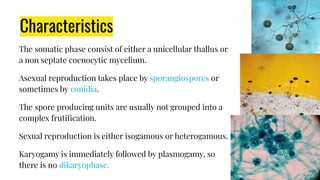
The somatic phase consist of either a unicellular thallus or
a non septate coenocytic mycelium.
Asexual reproduction takes place by sporangiospores or
sometimes by conidia.
The spore producing units are usually not grouped into a
complex frutification.
Sexual reproduction is either isogamous or heterogamous.
Karyogamy is immediately followed by plasmogamy, so
there is no dikaryophase.
Characteristics
The thallus in simple aquatic forms is unicellular and
microscopic.
In most advanced forms thallus is fixed to the
substratum by a few thin hair like structures called
rhizoids.
The coenocytic thallus is holocarpic.
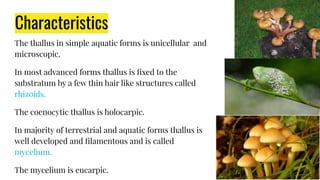
In majority of terrestrial and aquatic forms thallus is
well developed and filamentous and is called
mycelium.
The mycelium is eucarpic.
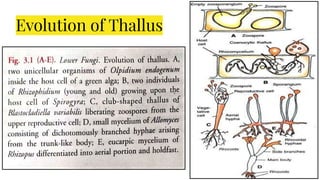
Evolution of Thallus
Reproduction
Reproduction
Aseual reproduction occur by the
means of following spores in
phycomycetes:
❏ Sporangiospores
❏ Zoospore
❏ Aplanospore
❏ Conidia
❏ Chlamydospore
❏ Oidia
Asexual Type
Sporangiospores
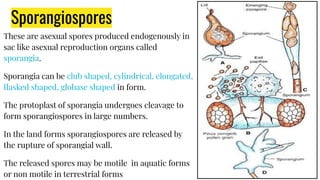
These are asexual spores produced endogenously in
sac like asexual reproduction organs called
sporangia.
Sporangia can be club shaped, cylindrical, elongated,
flasked shaped, globase shaped in form.
The protoplast of sporangia undergoes cleavage to
form sporangiospores in large numbers.
In the land forms sporangiospores are released by
the rupture of sporangial wall.
The released spores may be motile in aquatic forms
or non motile in terrestrial forms
Zoospores
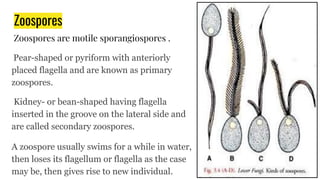
Zoospores are motile sporangiospores .
Pear-shaped or pyriform with anteriorly
placed flagella and are known as primary
zoospores.
Kidney- or bean-shaped having flagella
inserted in the groove on the lateral side and
are called secondary zoospores.
A zoospore usually swims for a while in water,
then loses its flagellum or flagella as the case
may be, then gives rise to new individual.
Aplanospores
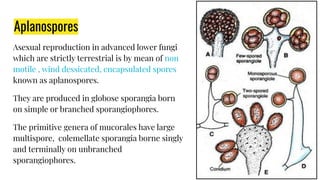
Asexual reproduction in advanced lower fungi
which are strictly terrestrial is by mean of non
motile , wind dessicated, encapsulated spores
known as aplanospores.
They are produced in globose sporangia born
on simple or branched sporangiophores.
The primitive genera of mucorales have large
multispore, colemellate sporangia borne singly
and terminally on unbranched
sporangiophores.
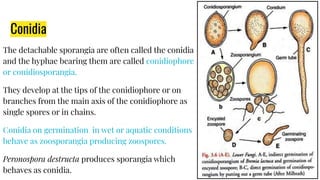
Conidia
The detachable sporangia are often called the conidia
and the hyphae bearing them are called conidiophore
or conidiosporangia.
They develop at the tips of the conidiophore or on
branches from the main axis of the conidiophore as
single spores or in chains.
Conidia on germination in wet or aquatic conditions
behave as zoosporangia producing zoospores.
Peronospora destructa produces sporangia which
behaves as conidia.
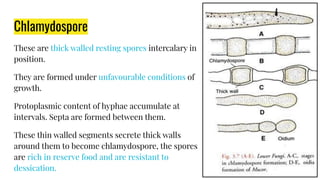
Chlamydospore
These are thick walled resting spores intercalary in
position.
They are formed under unfavourable conditions of
growth.
Protoplasmic content of hyphae accumulate at
intervals. Septa are formed between them.
These thin walled segments secrete thick walls
around them to become chlamydospore, the spores
are rich in reserve food and are resistant to
dessication.
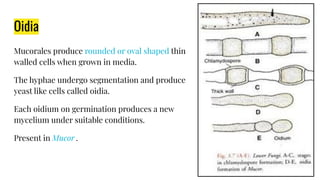
Oidia
Mucorales produce rounded or oval shaped thin
walled cells when grown in media.
The hyphae undergo segmentation and produce
yeast like cells called oidia.
Each oidium on germination produces a new
mycelium under suitable conditions.
Present in Mucor .
Reproduction
Sexual Type
It ranges from isogamy to oogamy
through anisogamy.
The first process in sexual reproduction
is the bringing together of male and
female protoplasts or nuclei in the
same cell. This is called plasmogamy.
Sexual reproduction can occur using 3
methods:
1. Planogametic Copulation
2. Gametangial Contact
3. Gametangial Copulation
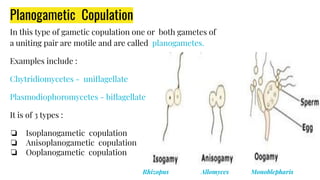
Planogametic Copulation
In this type of gametic copulation one or both gametes of
a uniting pair are motile and are called planogametes.
Examples include :
Chytridiomycetes - uniflagellate
Plasmodiophoromycetes - biflagellate
It is of 3 types :
❏ Isoplanogametic copulation
❏ Anisoplanogametic copulation
❏ Ooplanogametic copulation
Rhizopus Allomyces Monoblepharis
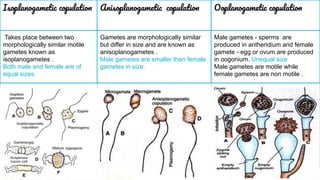
Isoplanogametic copulation Anisoplanogametic copulation Ooplanogametic copulation
Takes place between two
morphologically similar motile
gametes known as
isoplanogametes .
Both male and female are of
equal sizes.
Gametes are morphologically similar
but differ in size and are known as
anisoplanogametes .
Male gametes are smaller than female
gametes in size.
Male gametes - sperms are
produced in antheridium and female
gamete - egg or ovum are produced
in oogonium. Unequal size
Male gametes are motile while
female gametes are non motile .
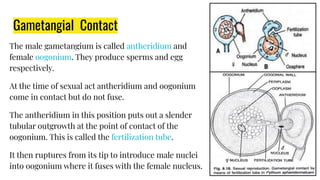
Gametangial Contact
The male gametangium is called antheridium and
female oogonium. They produce sperms and egg
respectively.
At the time of sexual act antheridium and oogonium
come in contact but do not fuse.
The antheridium in this position puts out a slender
tubular outgrowth at the point of contact of the
oogonium. This is called the fertilization tube.
It then ruptures from its tip to introduce male nuclei
into oogonium where it fuses with the female nucleus.
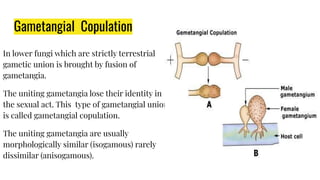
Gametangial Copulation
In lower fungi which are strictly terrestrial
gametic union is brought by fusion of
gametangia.
The uniting gametangia lose their identity in
the sexual act. This type of gametangial union
is called gametangial copulation.
The uniting gametangia are usually
morphologically similar (isogamous) rarely
dissimilar (anisogamous).
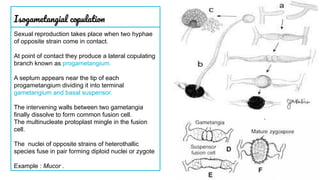
Isogametangial copulation
Sexual reproduction takes place when two hyphae
of opposite strain come in contact.
At point of contact they produce a lateral copulating
branch known as progametangium.
A septum appears near the tip of each
progametangium dividing it into terminal
gametangium and basal suspensor.
The intervening walls between two gametangia
finally dissolve to form common fusion cell.
The multinucleate protoplast mingle in the fusion
cell.
The nuclei of opposite strains of heterothallic
species fuse in pair forming diploid nuclei or zygote
Example : Mucor .
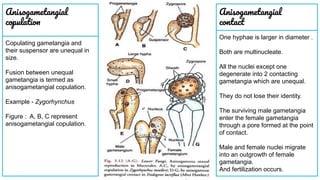
Anisogametangial
copulation
Copulating gametangia and
their suspensor are unequal in
size.
Fusion between unequal
gametangia is termed as
anisogametangial copulation.
Example - Zygorhynchus
Figure : A, B, C represent
anisogametangial copulation.
Anisogametangial
contact
One hyphae is larger in diameter .
Both are multinucleate.
All the nuclei except one
degenerate into 2 contacting
gametangia which are unequal.
They do not lose their identity.
The surviving male gametangia
enter the female gametangia
through a pore formed at the point
of contact.
Male and female nuclei migrate
into an outgrowth of female
gametangia.
And fertilization occurs.
Germination of Zygospore
The diploid content of zygospore undergoes meiosis but meiospores are not
formed.
The zygospore containing haploid protoplasts directly germinate to give rise to
haplomycelium.
The diploid zygospore germinates by putting out a germ tube which grows and
branches to form diplomycelium.
Prior to germination diploid nuclei undergo zygotic meiosis. The resulting
haploid nuclei are fashioned into meiospores.
They are either extruded by rupturing of zygospore wall into a sessile vesicle or
zygospore forms a short exit tube which terminates in a vesicle.
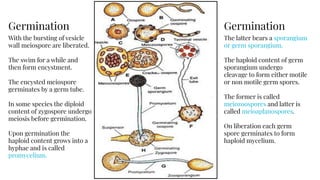
Germination
With the bursting of vesicle
wall meiospore are liberated.
The swim for a while and
then form encystment.
The encysted meiospore
germinates by a germ tube.
In some species the diploid
content of zygospore undergo
meiosis before germination.
Upon germination the
haploid content grows into a
hyphae and is called
promycelium.
Germination
The latter bears a sporangium
or germ sporangium.
The haploid content of germ
sporangium undergo
cleavage to form either motile
or non motile germ spores.
The former is called
meiozoospores and latter is
called meioaplanospores.
On liberation each germ
spore germinates to form
haploid mycelium.
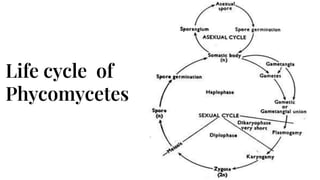
Life cycle of
Phycomycetes
Classification
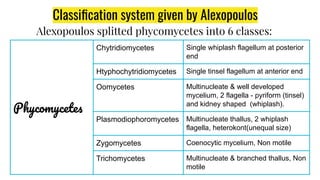
Classification system given by Alexopoulos
Phycomycetes
Chytridiomycetes Single whiplash flagellum at posterior
end
Htyphochytridiomycetes Single tinsel flagellum at anterior end
Oomycetes Multinucleate & well developed
mycelium, 2 flagella - pyriform (tinsel)
and kidney shaped (whiplash).
Plasmodiophoromycetes Multinucleate thallus, 2 whiplash
flagella, heterokont(unequal size)
Zygomycetes Coenocytic mycelium, Non motile
Trichomycetes Multinucleate & branched thallus, Non
motile
Alexopoulos splitted phycomycetes into 6 classes:
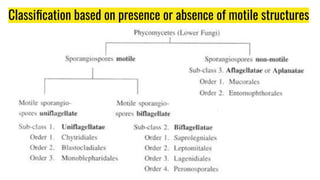
Classification based on presence or absence of motile structures