Presented By
Samadrita Banik
ST. GEORGE COLLEGE
M.Sc Microbiology
1st semester
The oomycetes, also known as “water molds”, are a group of several
hundred organisms that include some of the most devastating plant
pathogens. The diseases they cause include seedling blights,
damping-off, root rots, foliar blights and downy mildews.
Oomycota, phylum of fungus like organisms in the kingdom
Chromista. Oomycetes may occur as saprotrophs (living on decayed
matter) or as parasites living on higher plants and can be aquatic,
amphibious, or terrestrial. The species Phytophthora
infestans famously destroyed Ireland’s potato crop with late blight and
caused the Great Famine of 1845, which resulted in a mass migration
of Irish people to the United States.
 "Oomycota" means "egg fungi", referring to the large round oogonia,
structures containing the female gametes, that are characteristic of
the oomycetes.
 The name "water mold" refers to their earlier classification as fungi
and their preference for conditions of high humidity and running
surface water, which is characteristic for the basal taxa of the
oomycetes.
 Class: Oomycota; Arx, 1967
 Scientific name: Oomycota
 Phylum: Heterokontophyta
 Rank: Class
 Higher classification: Heterokont
 Domain: Eukaryota
The oomycetes rarely have septa , and if they do, they are
scarce,appearing at the bases of sporangia, and sometimes in older
parts of the filaments. Some are unicellular, while others are
filamentous and branching.
 The Saprolegniales are the most widespread. Many break down decaying
matter; others are parasites.
 The Leptomitales have wall thickenings that give their continuous cell body the
appearance of septation. They bear chitin and often reproduce asexually.
 The Rhipidiales use rhizoids to attach their thallus to the bed of stagnant or
polluted water bodies.
 The Albuginales are considered by some authors to be a family (Albuginaceae)
within the Peronosporales, although it has been shown that they are
phylogenetically distinct from this order.
 The Peronosporales too are mainly saprophytic or parasitic on plants, and have
an aseptate, branching form. Many of the most damaging agricultural parasites
belong to this order.
 The Lagenidiales are the most primitive; some are filamentous, others
unicellular; they are generally parasitic.
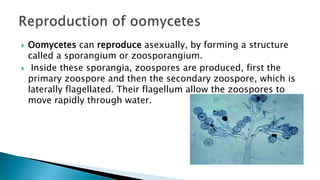
 Oomycetes can reproduce asexually, by forming a structure
called a sporangium or zoosporangium.
 Inside these sporangia, zoospores are produced, first the
primary zoospore and then the secondary zoospore, which is
laterally flagellated. Their flagellum allow the zoospores to
move rapidly through water.
 (i) Most of the members are aquatic but some grow on the soil and the others
attack the shoots of terrestrial plants.
 (ii) The primitive forms are unicellular, whereas the advanced forms have a well-
developed branched, filamentous, and coenocytic mycelium.
 (iii) The cell wall is mainly composed of cellulose-β-glucan and chitin is
altogether absent.
 (iv) In primitive aquatic form, zoosporangia are not well differentiated from
somatic hyphae, whereas in advanced forms distinct zoosprangia are found.
 (v) Some forms also produce non-motile asexual spores, known as conidia.
 (vi) Most of the Oomycetes are eucarpic, but the members of the order
Lagenidiales are holocarpic.
 (vii) The sexual reproduction is of oogamous type. The male and female sex
organs are known as antheridia and oogonia, respectively. The sex organs are
either terminal or intercalary.
 Many terrestrial Oomycetes cause serious plant diseases such as late
blight of potato , downy mildew of grape-wine , white rust of
crucifers , damping off of seedlings and others.
 Late blight of potato and downy mildew of grape-vine are
historically very important. The late blight of potato resulted in Irish
Famine’ in mid-19th century that caused death of millions of people
and Europe. Downy mildew of grape-vine helped Prof. Millardet to
discover the first fungicide called ‘Bordeaux mixture’.
 Many members of this group help understand the evolutionary
migration of fungi from aquatic to terrestrial environments.
Oomycetes

Oomycetes

  • 1.
    Presented By Samadrita Banik ST.GEORGE COLLEGE M.Sc Microbiology 1st semester
  • 2.
    The oomycetes, alsoknown as “water molds”, are a group of several hundred organisms that include some of the most devastating plant pathogens. The diseases they cause include seedling blights, damping-off, root rots, foliar blights and downy mildews.
  • 3.
    Oomycota, phylum offungus like organisms in the kingdom Chromista. Oomycetes may occur as saprotrophs (living on decayed matter) or as parasites living on higher plants and can be aquatic, amphibious, or terrestrial. The species Phytophthora infestans famously destroyed Ireland’s potato crop with late blight and caused the Great Famine of 1845, which resulted in a mass migration of Irish people to the United States.
  • 4.
     "Oomycota" means"egg fungi", referring to the large round oogonia, structures containing the female gametes, that are characteristic of the oomycetes.  The name "water mold" refers to their earlier classification as fungi and their preference for conditions of high humidity and running surface water, which is characteristic for the basal taxa of the oomycetes.
  • 5.
     Class: Oomycota;Arx, 1967  Scientific name: Oomycota  Phylum: Heterokontophyta  Rank: Class  Higher classification: Heterokont  Domain: Eukaryota
  • 6.
    The oomycetes rarelyhave septa , and if they do, they are scarce,appearing at the bases of sporangia, and sometimes in older parts of the filaments. Some are unicellular, while others are filamentous and branching.
  • 7.
     The Saprolegnialesare the most widespread. Many break down decaying matter; others are parasites.  The Leptomitales have wall thickenings that give their continuous cell body the appearance of septation. They bear chitin and often reproduce asexually.  The Rhipidiales use rhizoids to attach their thallus to the bed of stagnant or polluted water bodies.  The Albuginales are considered by some authors to be a family (Albuginaceae) within the Peronosporales, although it has been shown that they are phylogenetically distinct from this order.  The Peronosporales too are mainly saprophytic or parasitic on plants, and have an aseptate, branching form. Many of the most damaging agricultural parasites belong to this order.  The Lagenidiales are the most primitive; some are filamentous, others unicellular; they are generally parasitic.
  • 8.
     Oomycetes canreproduce asexually, by forming a structure called a sporangium or zoosporangium.  Inside these sporangia, zoospores are produced, first the primary zoospore and then the secondary zoospore, which is laterally flagellated. Their flagellum allow the zoospores to move rapidly through water.
  • 9.
     (i) Mostof the members are aquatic but some grow on the soil and the others attack the shoots of terrestrial plants.  (ii) The primitive forms are unicellular, whereas the advanced forms have a well- developed branched, filamentous, and coenocytic mycelium.  (iii) The cell wall is mainly composed of cellulose-β-glucan and chitin is altogether absent.  (iv) In primitive aquatic form, zoosporangia are not well differentiated from somatic hyphae, whereas in advanced forms distinct zoosprangia are found.  (v) Some forms also produce non-motile asexual spores, known as conidia.  (vi) Most of the Oomycetes are eucarpic, but the members of the order Lagenidiales are holocarpic.  (vii) The sexual reproduction is of oogamous type. The male and female sex organs are known as antheridia and oogonia, respectively. The sex organs are either terminal or intercalary.
  • 10.
     Many terrestrialOomycetes cause serious plant diseases such as late blight of potato , downy mildew of grape-wine , white rust of crucifers , damping off of seedlings and others.  Late blight of potato and downy mildew of grape-vine are historically very important. The late blight of potato resulted in Irish Famine’ in mid-19th century that caused death of millions of people and Europe. Downy mildew of grape-vine helped Prof. Millardet to discover the first fungicide called ‘Bordeaux mixture’.  Many members of this group help understand the evolutionary migration of fungi from aquatic to terrestrial environments.