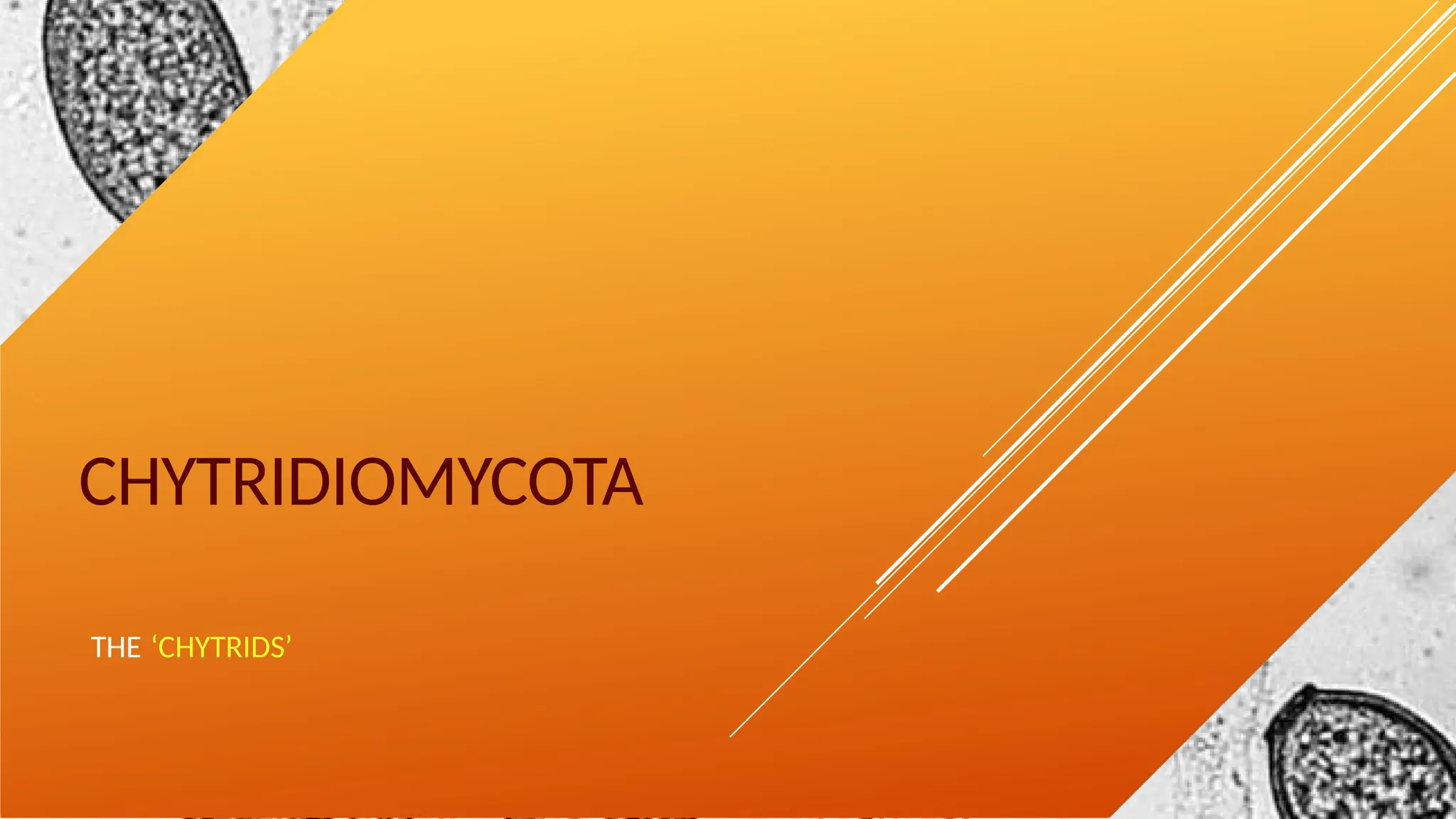
CHYTRIDIOMYCOTA
THE ‘CHYTRIDS’
INTRODUCTION
Fungi of this class are called as ‘Chytrids’
Grow aerobically in soil, mud, water. Though some species inhabits estuaries and sea
Reproduce using zoospores with single whiplash type flagellum; exception- Neocallimastigales
have multiflagella
Many members are saprotrophs i.e. utilizes chitin, keratin and cellulose of plants; whilst species of
Caulochytrium grows as mycoparasite on the mycelium and conidia of terrestrial fungi
terrestrial fungi
Some are biotropic parasite of filamentous algae and diatoms and severely deplete their
growth;
species of Synchytrium and Olpidium are too biotropic parasite but of vascular plants
 Here ‘mya’ means million years ago
 So accordingly it clearly depicts that chytrid have originated from a
separate lineage/ from different ancestors than those of it’s higher
fungi.
 Though the ancestors of ascomycetes and basidiomycetes are
same but chytrids have separate ancestors
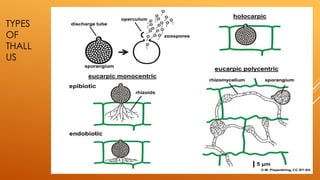
THALLUS STRUCTURE
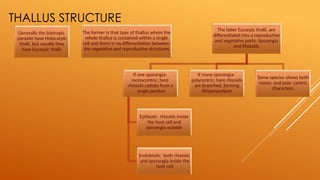
Generally the biotropic
parasite have Holocarpic
thalli, but usually they
have Eucarpic thalli.
The former is that type of thallus where the
whole thallus is contained within a single
cell and there is no differentiation between
the vegetative and reproductive structures
The latter Eucarpic thalli, are
differentiated into a reproductive
and vegetative parts- Sporangia
and Rhizoids.
If one sporangia-
monocentric; here
rhizoids radiate from a
single portion
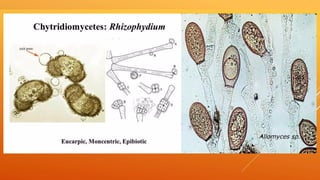
Epibiotic- rhizoids inside
the host cell and
sporangia outside
Endobiotic- both rhizoids
and sporangia inside the
host cell
If many sporangia-
polycentric; here rhizoids
are branched, forming
Rhizomycelium
Some species shows both
mono- and poly- centric
characters.
TYPES
OF
THALL
US
CELL WALL
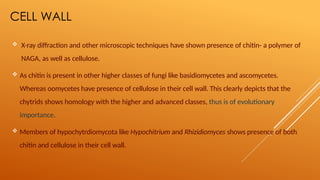
 X-ray diffraction and other microscopic techniques have shown presence of chitin- a polymer of
NAGA, as well as cellulose.
 As chitin is present in other higher classes of fungi like basidiomycetes and ascomycetes.
Whereas oomycetes have presence of cellulose in their cell wall. This clearly depicts that the
chytrids shows homology with the higher and advanced classes, thus is of evolutionary
importance.
 Members of hypochytrdiomycota like Hypochitrium and Rhizidiomyces shows presence of both
chitin and cellulose in their cell wall.
ASEXUAL
REPRODUCTION
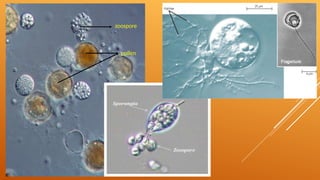
 Zoospore in sporangia
 Autospore in sporangia
 Fragmentation- polycentric and resting spores
 Vegetative stage is generally haploid
THE ZOOSPORE
 Round or pear shaped sac containing one or more exit papillae
 Divided into two types: -
 Inoperculate- no operculum; Olpidium, Cladochytrium etc. where the discharge tubes
penetrates the exterior of the host cell and then dissolves
 Operculate- operculum present i.e. a special line of weakness which breaks open at the tip of
the discharge tube. Eg. Chytridium, Nowakoskiella etc.
 Zoospores are though similar in size but sporangia number and sizes varies within species, thus is
of taxonomic importance.
pollen
zoospore
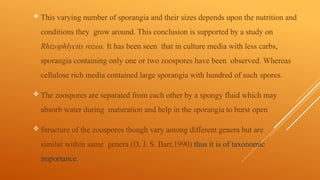
 This varying number of sporangia and their sizes depends upon the nutrition and
conditions they grow around. This conclusion is supported by a study on
Rhizophlyctis rozea. It has been seen that in culture media with less carbs,
sporangia containing only one or two zoospores have been observed. Whereas
cellulose rich media contained large sporangia with hundred of such spores.
 The zoospores are separated from each other by a spongy fluid which may
absorb water during maturation and help in the sporangia to burst open
 Structure of the zoospores though vary among different genera but are
similar within same genera (D. J. S. Barr,1990) thus it is of taxonomic
importance.
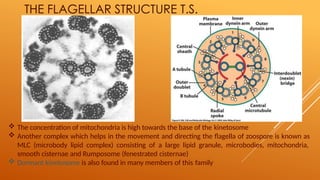
THE FLAGELLAR STRUCTURE T.S.
 The concentration of mitochondria is high towards the base of the kinetosome
 Another complex which helps in the movement and directing the flagella of zoospore is known as
MLC (microbody lipid complex) consisting of a large lipid granule, microbodies, mitochondria,
smooth cisternae and Rumposome (fenestrated cisternae)
 Dormant kinetosome is also found in many members of this family
 The flagella is of whiplash type as similar as those of eukaryotes (study the structure in details of
eukaryotic flagella)
 a smooth membrane enclosing the cylindrical shaft, along with the long axoneme with 9
doublets and two centrally placed singlet microtubular rings
 The flagellum consists of three main portions- the flagellum proper, the kinetosome and the
transitional zone.
 The evolutionary significance of the dormant kinetosome is that, maybe the ancestors of
chytrids
were biflagellate and during the course of evolution they might have lost it
 Sometimes along with the doublets of A- and B- rings there maybe a presence of third ring or the
C- ring of microtubule.
THE ZOOSPORE
GERMINATION:
 Generally the zoospore either absorbs or cut off it’s flagella from their body before encysting
themselves.
 Holocarpic parasites encyst on the host surface and injects its cytoplasmic content inside the host cell
 In monocentric parasites the zoospore forms cyst and develops rhizoids from one point. The cyst itself
matures and enlarges to form zoosporangium. Sometimes prosporangium also develops.
 In polycentric parasites, the zoospores forms limited rhizomycelium, which again later on give rise to
more swollen structure which ultimately gives rise to more rhizomycelium. Germination maybe from
one point monopolar (Chytridiales) and bipolar (Blastocladiales).
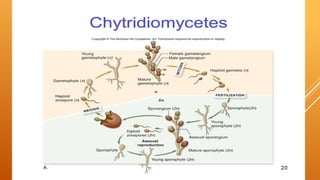
 Isomorphic alternation of generation
 The gametothallic(haploid) and sporothallic(diploid) bodies morphology is same.
 The sexual reproduction are of two types- Gametogamy and Gamentangio-gametangiogamy
 Gametogamy are of: -
 Isogamy
 Anisogamy
 Oogamy
 Somatogamy
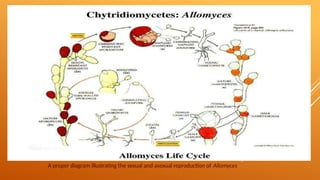
A proper diagram illustrating the sexual and asexual reproduction of Allomyces
 Somatogamy process: -
 Rhizoids from uninucleate contributing thallus together fuses and forms anastomosis.
 Cytoplasm and nuclei from both these contributing thallus comes to the point of anastomosis,
which ultimately becomes a globular resting body
 These resting body is binucleate and full of cytosol causing the contributing thalli to become
empty
 Two nuclei later fuses to form a diploid body which ultimately gives rise to a sporangium which
are not genetically dissimilar than their parents.
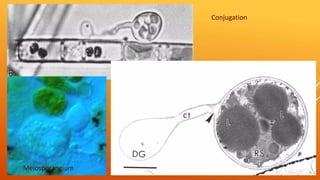
 Conjugation takes place only when a small donor produces a conjugation tube to a larger recipient
gametangium.
 Following the nuclear fusion between the two gametangium, the larger recipient forms a thick
covering outside forming a diploid resting sporangium.
 After maturation the sporangium forms presporangium and gives rise to thin walled
meiosporangium, where obviously the meosis takes place, giving rise to haploid spores.
 A variant of this type of sexual diferrentiation (gametangio-gametangigamy) is seen in
Rhizophydium, where copulation between the gametangium of a rhizoid forming thallus and a
forming thallus and a motile gamete that encyst directly on the gametangium.
 Members of Chytridiomycetes and their hosts: -
 Synchitrium endobioticum- black wart of potato
 Olpidium brassicae- zoospores are vectors for virus causing big vein disease of lettuce
lettuce
 Colleomyces spp.- pathogen of freshwater invertebrates such as copepods and mosquito larvae
mosquito larvae
 Neocallimastigales- present in gut of herbivorous mammals, and feed the herbage

Chytridiomycetes ppt for bsc students .pptx

  • 1.
  • 2.
    INTRODUCTION Fungi of thisclass are called as ‘Chytrids’ Grow aerobically in soil, mud, water. Though some species inhabits estuaries and sea Reproduce using zoospores with single whiplash type flagellum; exception- Neocallimastigales have multiflagella Many members are saprotrophs i.e. utilizes chitin, keratin and cellulose of plants; whilst species of Caulochytrium grows as mycoparasite on the mycelium and conidia of terrestrial fungi terrestrial fungi Some are biotropic parasite of filamentous algae and diatoms and severely deplete their growth; species of Synchytrium and Olpidium are too biotropic parasite but of vascular plants
  • 3.
     Here ‘mya’means million years ago  So accordingly it clearly depicts that chytrid have originated from a separate lineage/ from different ancestors than those of it’s higher fungi.  Though the ancestors of ascomycetes and basidiomycetes are same but chytrids have separate ancestors
  • 4.
    THALLUS STRUCTURE Generally thebiotropic parasite have Holocarpic thalli, but usually they have Eucarpic thalli. The former is that type of thallus where the whole thallus is contained within a single cell and there is no differentiation between the vegetative and reproductive structures The latter Eucarpic thalli, are differentiated into a reproductive and vegetative parts- Sporangia and Rhizoids. If one sporangia- monocentric; here rhizoids radiate from a single portion Epibiotic- rhizoids inside the host cell and sporangia outside Endobiotic- both rhizoids and sporangia inside the host cell If many sporangia- polycentric; here rhizoids are branched, forming Rhizomycelium Some species shows both mono- and poly- centric characters.
  • 5.
  • 7.
    CELL WALL  X-raydiffraction and other microscopic techniques have shown presence of chitin- a polymer of NAGA, as well as cellulose.  As chitin is present in other higher classes of fungi like basidiomycetes and ascomycetes. Whereas oomycetes have presence of cellulose in their cell wall. This clearly depicts that the chytrids shows homology with the higher and advanced classes, thus is of evolutionary importance.  Members of hypochytrdiomycota like Hypochitrium and Rhizidiomyces shows presence of both chitin and cellulose in their cell wall.
  • 8.
    ASEXUAL REPRODUCTION  Zoospore insporangia  Autospore in sporangia  Fragmentation- polycentric and resting spores  Vegetative stage is generally haploid
  • 9.
    THE ZOOSPORE  Roundor pear shaped sac containing one or more exit papillae  Divided into two types: -  Inoperculate- no operculum; Olpidium, Cladochytrium etc. where the discharge tubes penetrates the exterior of the host cell and then dissolves  Operculate- operculum present i.e. a special line of weakness which breaks open at the tip of the discharge tube. Eg. Chytridium, Nowakoskiella etc.  Zoospores are though similar in size but sporangia number and sizes varies within species, thus is of taxonomic importance.
  • 10.
  • 11.
     This varyingnumber of sporangia and their sizes depends upon the nutrition and conditions they grow around. This conclusion is supported by a study on Rhizophlyctis rozea. It has been seen that in culture media with less carbs, sporangia containing only one or two zoospores have been observed. Whereas cellulose rich media contained large sporangia with hundred of such spores.  The zoospores are separated from each other by a spongy fluid which may absorb water during maturation and help in the sporangia to burst open  Structure of the zoospores though vary among different genera but are similar within same genera (D. J. S. Barr,1990) thus it is of taxonomic importance.
  • 12.
    THE FLAGELLAR STRUCTURET.S.  The concentration of mitochondria is high towards the base of the kinetosome  Another complex which helps in the movement and directing the flagella of zoospore is known as MLC (microbody lipid complex) consisting of a large lipid granule, microbodies, mitochondria, smooth cisternae and Rumposome (fenestrated cisternae)  Dormant kinetosome is also found in many members of this family
  • 13.
     The flagellais of whiplash type as similar as those of eukaryotes (study the structure in details of eukaryotic flagella)  a smooth membrane enclosing the cylindrical shaft, along with the long axoneme with 9 doublets and two centrally placed singlet microtubular rings  The flagellum consists of three main portions- the flagellum proper, the kinetosome and the transitional zone.  The evolutionary significance of the dormant kinetosome is that, maybe the ancestors of chytrids were biflagellate and during the course of evolution they might have lost it  Sometimes along with the doublets of A- and B- rings there maybe a presence of third ring or the C- ring of microtubule.
  • 14.
    THE ZOOSPORE GERMINATION:  Generallythe zoospore either absorbs or cut off it’s flagella from their body before encysting themselves.  Holocarpic parasites encyst on the host surface and injects its cytoplasmic content inside the host cell  In monocentric parasites the zoospore forms cyst and develops rhizoids from one point. The cyst itself matures and enlarges to form zoosporangium. Sometimes prosporangium also develops.  In polycentric parasites, the zoospores forms limited rhizomycelium, which again later on give rise to more swollen structure which ultimately gives rise to more rhizomycelium. Germination maybe from one point monopolar (Chytridiales) and bipolar (Blastocladiales).
  • 15.
     Isomorphic alternationof generation  The gametothallic(haploid) and sporothallic(diploid) bodies morphology is same.  The sexual reproduction are of two types- Gametogamy and Gamentangio-gametangiogamy  Gametogamy are of: -  Isogamy  Anisogamy  Oogamy  Somatogamy
  • 16.
    A proper diagramillustrating the sexual and asexual reproduction of Allomyces
  • 17.
     Somatogamy process:-  Rhizoids from uninucleate contributing thallus together fuses and forms anastomosis.  Cytoplasm and nuclei from both these contributing thallus comes to the point of anastomosis, which ultimately becomes a globular resting body  These resting body is binucleate and full of cytosol causing the contributing thalli to become empty  Two nuclei later fuses to form a diploid body which ultimately gives rise to a sporangium which are not genetically dissimilar than their parents.
  • 18.
     Conjugation takesplace only when a small donor produces a conjugation tube to a larger recipient gametangium.  Following the nuclear fusion between the two gametangium, the larger recipient forms a thick covering outside forming a diploid resting sporangium.  After maturation the sporangium forms presporangium and gives rise to thin walled meiosporangium, where obviously the meosis takes place, giving rise to haploid spores.  A variant of this type of sexual diferrentiation (gametangio-gametangigamy) is seen in Rhizophydium, where copulation between the gametangium of a rhizoid forming thallus and a forming thallus and a motile gamete that encyst directly on the gametangium.
  • 21.
     Members ofChytridiomycetes and their hosts: -  Synchitrium endobioticum- black wart of potato  Olpidium brassicae- zoospores are vectors for virus causing big vein disease of lettuce lettuce  Colleomyces spp.- pathogen of freshwater invertebrates such as copepods and mosquito larvae mosquito larvae  Neocallimastigales- present in gut of herbivorous mammals, and feed the herbage