ALKALOIDS
INTRODUCTION
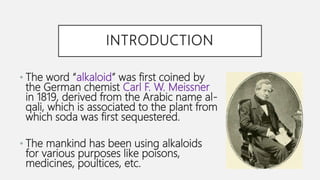
• The word “alkaloid” was first coined by
the German chemist Carl F. W. Meissner
in 1819, derived from the Arabic name al-
qali, which is associated to the plant from
which soda was first sequestered.
• The mankind has been using alkaloids
for various purposes like poisons,
medicines, poultices, etc.
WHAT ARE ALKALOIDS?
• An alkaloid is a nitrogenous organic molecule
that has a pharmacological effect on humans and
animals.
• They are a class of compounds which typically
contain nitrogen and have complex ring
structures.
• They occur naturally in seed bearing plants and
are found in berries, bark, fruit, roots and leaves.
TYPES OF ALKALOIDS
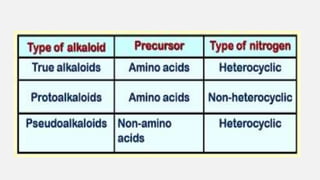
• There are three central types of alkaloids:
1. True alkaloids
2. Protoalkaloids
3. Pseudoalkaloids.
(True alkaloids and protoalkaloids are produced from
amino acids, whereas pseudoalkaloids are not
derived from these compounds.)
TRUE ALKALOIDS
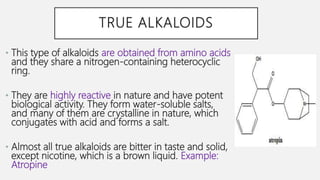
• This type of alkaloids are obtained from amino acids
and they share a nitrogen-containing heterocyclic
ring.
• They are highly reactive in nature and have potent
biological activity. They form water-soluble salts,
and many of them are crystalline in nature, which
conjugates with acid and forms a salt.
• Almost all true alkaloids are bitter in taste and solid,
except nicotine, which is a brown liquid. Example:
Atropine
PROTOALKALOIDS
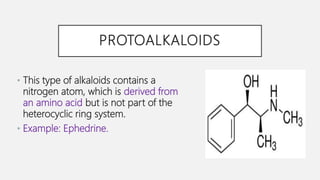
• This type of alkaloids contains a
nitrogen atom, which is derived from
an amino acid but is not part of the
heterocyclic ring system.
• Example: Ephedrine.
PSEUDOALKALOIDS
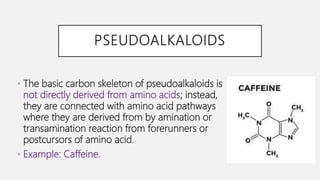
• The basic carbon skeleton of pseudoalkaloids is
not directly derived from amino acids; instead,
they are connected with amino acid pathways
where they are derived from by amination or
transamination reaction from forerunners or
postcursors of amino acid.
• Example: Caffeine.
VINCA
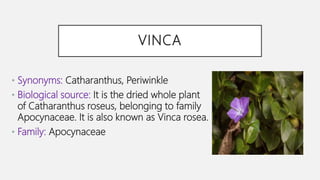
• Synonyms: Catharanthus, Periwinkle
• Biological source: It is the dried whole plant
of Catharanthus roseus, belonging to family
Apocynaceae. It is also known as Vinca rosea.
• Family: Apocynaceae
Macroscopic characteristics:
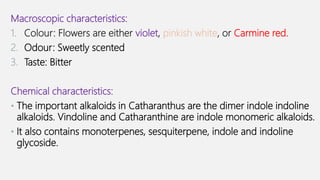
1. Colour: Flowers are either violet, pinkish white, or Carmine red.
2. Odour: Sweetly scented
3. Taste: Bitter
Chemical characteristics:
• The important alkaloids in Catharanthus are the dimer indole indoline
alkaloids. Vindoline and Catharanthine are indole monomeric alkaloids.
• It also contains monoterpenes, sesquiterpene, indole and indoline
glycoside.
USES OF VINCA
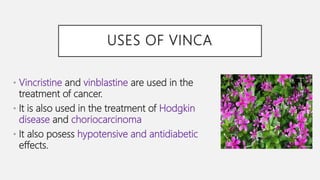
• Vincristine and vinblastine are used in the
treatment of cancer.
• It is also used in the treatment of Hodgkin
disease and choriocarcinoma
• It also posess hypotensive and antidiabetic
effects.
BELLADONNA
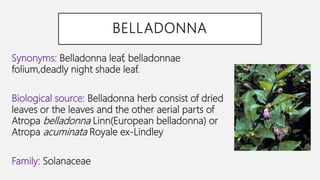
Synonyms: Belladonna leaf, belladonnae
folium,deadly night shade leaf.
Biological source: Belladonna herb consist of dried
leaves or the leaves and the other aerial parts of
Atropa belladonna Linn(European belladonna) or
Atropa acuminata Royale ex-Lindley
Family: Solanaceae
Macroscopic characteristics:
1.Colour:
• Green to brownish green(leaves)
• Purple to yellowish brown (flowers)
• Green to brown (fruits)
2. Odour: Slight and Characteristics
3. Taste: Bitter and Acrid
Chemical constituents:
The total alkaloidal content of the drug is 0.4 to 1% and varies in
different parts of the land,roots(0.6%), stems (0.05%), leaves (0.4%)
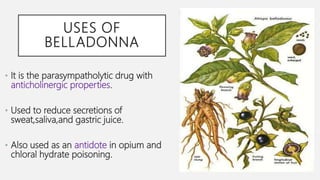
USES OF
BELLADONNA
• It is the parasympatholytic drug with
anticholinergic properties.
• Used to reduce secretions of
sweat,saliva,and gastric juice.
• Also used as an antidote in opium and
chloral hydrate poisoning.
Alkaloids (1)

Alkaloids (1)

  • 1.
  • 2.
    INTRODUCTION • The word“alkaloid” was first coined by the German chemist Carl F. W. Meissner in 1819, derived from the Arabic name al- qali, which is associated to the plant from which soda was first sequestered. • The mankind has been using alkaloids for various purposes like poisons, medicines, poultices, etc.
  • 3.
    WHAT ARE ALKALOIDS? •An alkaloid is a nitrogenous organic molecule that has a pharmacological effect on humans and animals. • They are a class of compounds which typically contain nitrogen and have complex ring structures. • They occur naturally in seed bearing plants and are found in berries, bark, fruit, roots and leaves.
  • 4.
    TYPES OF ALKALOIDS •There are three central types of alkaloids: 1. True alkaloids 2. Protoalkaloids 3. Pseudoalkaloids. (True alkaloids and protoalkaloids are produced from amino acids, whereas pseudoalkaloids are not derived from these compounds.)
  • 5.
    TRUE ALKALOIDS • Thistype of alkaloids are obtained from amino acids and they share a nitrogen-containing heterocyclic ring. • They are highly reactive in nature and have potent biological activity. They form water-soluble salts, and many of them are crystalline in nature, which conjugates with acid and forms a salt. • Almost all true alkaloids are bitter in taste and solid, except nicotine, which is a brown liquid. Example: Atropine
  • 6.
    PROTOALKALOIDS • This typeof alkaloids contains a nitrogen atom, which is derived from an amino acid but is not part of the heterocyclic ring system. • Example: Ephedrine.
  • 7.
    PSEUDOALKALOIDS • The basiccarbon skeleton of pseudoalkaloids is not directly derived from amino acids; instead, they are connected with amino acid pathways where they are derived from by amination or transamination reaction from forerunners or postcursors of amino acid. • Example: Caffeine.
  • 9.
    VINCA • Synonyms: Catharanthus,Periwinkle • Biological source: It is the dried whole plant of Catharanthus roseus, belonging to family Apocynaceae. It is also known as Vinca rosea. • Family: Apocynaceae
  • 10.
    Macroscopic characteristics: 1. Colour:Flowers are either violet, pinkish white, or Carmine red. 2. Odour: Sweetly scented 3. Taste: Bitter Chemical characteristics: • The important alkaloids in Catharanthus are the dimer indole indoline alkaloids. Vindoline and Catharanthine are indole monomeric alkaloids. • It also contains monoterpenes, sesquiterpene, indole and indoline glycoside.
  • 11.
    USES OF VINCA •Vincristine and vinblastine are used in the treatment of cancer. • It is also used in the treatment of Hodgkin disease and choriocarcinoma • It also posess hypotensive and antidiabetic effects.
  • 12.
    BELLADONNA Synonyms: Belladonna leaf,belladonnae folium,deadly night shade leaf. Biological source: Belladonna herb consist of dried leaves or the leaves and the other aerial parts of Atropa belladonna Linn(European belladonna) or Atropa acuminata Royale ex-Lindley Family: Solanaceae
  • 13.
    Macroscopic characteristics: 1.Colour: • Greento brownish green(leaves) • Purple to yellowish brown (flowers) • Green to brown (fruits) 2. Odour: Slight and Characteristics 3. Taste: Bitter and Acrid Chemical constituents: The total alkaloidal content of the drug is 0.4 to 1% and varies in different parts of the land,roots(0.6%), stems (0.05%), leaves (0.4%)
  • 14.
    USES OF BELLADONNA • Itis the parasympatholytic drug with anticholinergic properties. • Used to reduce secretions of sweat,saliva,and gastric juice. • Also used as an antidote in opium and chloral hydrate poisoning.