Occurrence and classification
of Alkaloids
Jasmine Juliet .R
Teaching Assistant
Biotechnology Dept
AC&RI, Madurai.
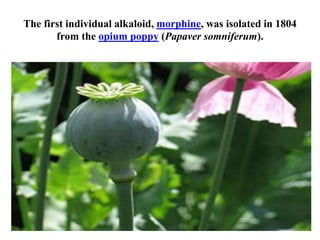
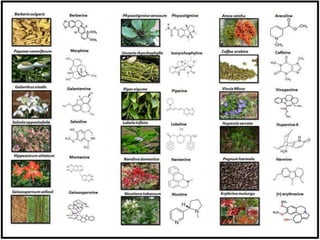
The first individual alkaloid, morphine, was isolated in 1804
from the opium poppy (Papaver somniferum).
Alkaloid - Definition
• Alkaloid is defined as organic products of
natural or synthetic origin which are basic in
nature, and contain one or more nitrogen
atoms, normally heterocyclic nature, and
possess specific physiological actions on
human or animal body, when used in small
quantities.
Alkaloids - History
• “Alkaloids" was introduced in 1819 by the German chemist Carl Friedrich
Wilhelm Meißner, ('ashes of plants').
• The term came into wide use only after the publication, by Oscar
Jacobsen in the 1880s.
• In 1804, the German chemist Friedrich Sertürner isolated from opium,
which he called "morphium“ (Greek god of dreams).
• The term "morphine", used by the French physicist Joseph Louis Gay.
• The first complete synthesis of an alkaloid was achieved in 1886 by the
German chemist Albert Ladenburg (coniine ).
Occurrence of Alkaloids
• Alkaloids are produced by a large variety of organisms
including:
 bacteria,
 fungi,
 plants, and
 animals.
Occurrence of Alkaloids
• Distribution in nature:
• Alkaloids are found:
 in certain types of fungi, such as psilocybin,
 in animals, such as bufotenin in the skin of some toads and
 a number of insects, markedly ants.
 Many marine organisms also contain alkaloids.
• Some amines, such as adrenaline and serotonin, which play an
important role in higher animals, are similar to alkaloids in their
structure and biosynthesis and are sometimes called alkaloids.
Occurrence of Alkaloids
• Distribution in nature:
• Alkaloids are generated by various living organisms, especially by higher
plants – about 10 to 25% of those contain alkaloids.
• Depending on the type of plants, the maximum concentration is observed
 in the leaves (black henbane),
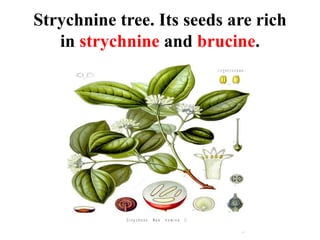
 fruits or seeds (Strychnine tree),
 root (Rauvolfia serpentina) or
 bark (cinchona).
• Furthermore, different tissues of the same plants may contain different
alkaloids.
Distribution and Occurrence
o Rare in lower plants.
o Dicots are more rich in alkaloids than Monocots.
o Families rich in Alkaloids: Apocyanaceae,
Rubiaceae, Solanaceae, and Papavercea.
o Families free from Alkaloids: Rosaceae,
Labiatae.
Distribution and Occurrence
 All parts e.g. Datura
 Barks e.g. Cinchona
 Seeds e.g. Nux vomica
 Roots e.g. Aconite
 Fruits e.g. Black pepper
 Leaves e.g. Tobacco
 Latex e.g. Opium
Strychnine tree. Its seeds are rich
in strychnine and brucine.
Classification of Alkaloids
I. Alkaloids are classified based on similarity of the
carbon skeleton:
 Indole,
isoquinoline, and
 pyridine
Classification of Alkaloids
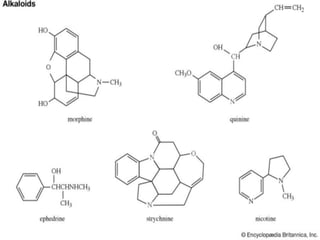
I. Alkaloids are often classified on the basis of their chemical structure.
• Eg: Alkaloids that contain a ring system indole are known as indole
alkaloids.
• On this basis, the principal classes of alkaloids are:
 pyrrolidines, pyridines,
tropanes, pyrrolizidines,
isoquinolines, indoles,
quinolines, terpenoids and steroids.
Classification of Alkaloids
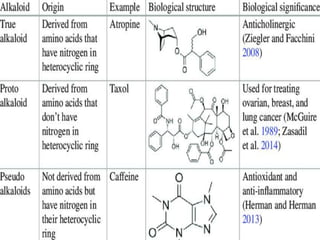
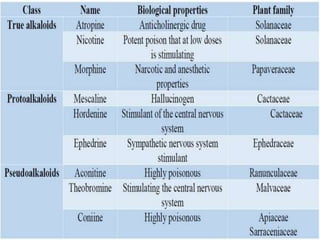
I. Chemical classification:
• The alkaloids are categorised into three divisions.
a. True alkaloids: These have heterocyclic ring with nitrogen and
derived from amino acids.
b. Proto alkaloids: These does not have heterocyclic ring with nitrogen
and derive from amino acids, e.g. colchicine.
c. Pseudo alkaloids: These have heterocyclic ring with nitrogen and
derived from terpenoids or purines but not derived from amino acids.
Classification of Alkaloids
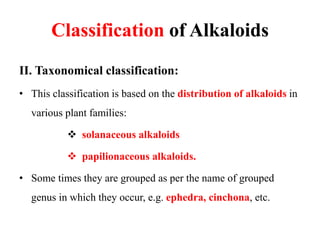
II. Taxonomical classification:
• This classification is based on the distribution of alkaloids in
various plant families:
 solanaceous alkaloids
 papilionaceous alkaloids.
• Some times they are grouped as per the name of grouped
genus in which they occur, e.g. ephedra, cinchona, etc.
Classification of Alkaloids
II. Alternatively, alkaloids can be classified according
to the biological system in which they occur.
• For example, the opium alkaloids occur in the opium
poppy (Papaver somniferum).
Classification of Alkaloids
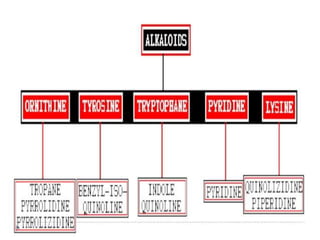
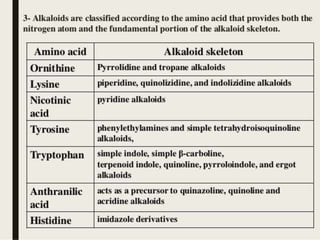
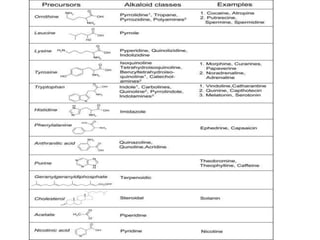
III. Further Alkaloids are classified based on
biochemical precursor:
 ornithine,
 lysine,
 tyrosine,
 tryptophan, etc.,
Classification of Alkaloids
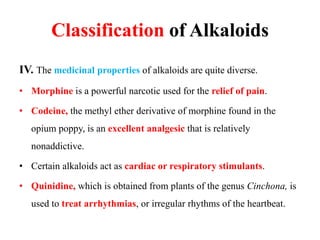
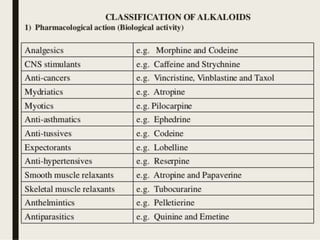
IV. The medicinal properties of alkaloids are quite diverse.
• Morphine is a powerful narcotic used for the relief of pain.
• Codeine, the methyl ether derivative of morphine found in the
opium poppy, is an excellent analgesic that is relatively
nonaddictive.
• Certain alkaloids act as cardiac or respiratory stimulants.
• Quinidine, which is obtained from plants of the genus Cinchona, is
used to treat arrhythmias, or irregular rhythms of the heartbeat.
Occurrence and classification of alkaloids

Occurrence and classification of alkaloids

  • 1.
    Occurrence and classification ofAlkaloids Jasmine Juliet .R Teaching Assistant Biotechnology Dept AC&RI, Madurai.
  • 3.
    The first individualalkaloid, morphine, was isolated in 1804 from the opium poppy (Papaver somniferum).
  • 4.
    Alkaloid - Definition •Alkaloid is defined as organic products of natural or synthetic origin which are basic in nature, and contain one or more nitrogen atoms, normally heterocyclic nature, and possess specific physiological actions on human or animal body, when used in small quantities.
  • 6.
    Alkaloids - History •“Alkaloids" was introduced in 1819 by the German chemist Carl Friedrich Wilhelm Meißner, ('ashes of plants'). • The term came into wide use only after the publication, by Oscar Jacobsen in the 1880s. • In 1804, the German chemist Friedrich Sertürner isolated from opium, which he called "morphium“ (Greek god of dreams). • The term "morphine", used by the French physicist Joseph Louis Gay. • The first complete synthesis of an alkaloid was achieved in 1886 by the German chemist Albert Ladenburg (coniine ).
  • 7.
    Occurrence of Alkaloids •Alkaloids are produced by a large variety of organisms including:  bacteria,  fungi,  plants, and  animals.
  • 8.
    Occurrence of Alkaloids •Distribution in nature: • Alkaloids are found:  in certain types of fungi, such as psilocybin,  in animals, such as bufotenin in the skin of some toads and  a number of insects, markedly ants.  Many marine organisms also contain alkaloids. • Some amines, such as adrenaline and serotonin, which play an important role in higher animals, are similar to alkaloids in their structure and biosynthesis and are sometimes called alkaloids.
  • 9.
    Occurrence of Alkaloids •Distribution in nature: • Alkaloids are generated by various living organisms, especially by higher plants – about 10 to 25% of those contain alkaloids. • Depending on the type of plants, the maximum concentration is observed  in the leaves (black henbane),  fruits or seeds (Strychnine tree),  root (Rauvolfia serpentina) or  bark (cinchona). • Furthermore, different tissues of the same plants may contain different alkaloids.
  • 10.
    Distribution and Occurrence oRare in lower plants. o Dicots are more rich in alkaloids than Monocots. o Families rich in Alkaloids: Apocyanaceae, Rubiaceae, Solanaceae, and Papavercea. o Families free from Alkaloids: Rosaceae, Labiatae.
  • 11.
    Distribution and Occurrence All parts e.g. Datura  Barks e.g. Cinchona  Seeds e.g. Nux vomica  Roots e.g. Aconite  Fruits e.g. Black pepper  Leaves e.g. Tobacco  Latex e.g. Opium
  • 12.
    Strychnine tree. Itsseeds are rich in strychnine and brucine.
  • 13.
    Classification of Alkaloids I.Alkaloids are classified based on similarity of the carbon skeleton:  Indole, isoquinoline, and  pyridine
  • 14.
    Classification of Alkaloids I.Alkaloids are often classified on the basis of their chemical structure. • Eg: Alkaloids that contain a ring system indole are known as indole alkaloids. • On this basis, the principal classes of alkaloids are:  pyrrolidines, pyridines, tropanes, pyrrolizidines, isoquinolines, indoles, quinolines, terpenoids and steroids.
  • 15.
    Classification of Alkaloids I.Chemical classification: • The alkaloids are categorised into three divisions. a. True alkaloids: These have heterocyclic ring with nitrogen and derived from amino acids. b. Proto alkaloids: These does not have heterocyclic ring with nitrogen and derive from amino acids, e.g. colchicine. c. Pseudo alkaloids: These have heterocyclic ring with nitrogen and derived from terpenoids or purines but not derived from amino acids.
  • 18.
    Classification of Alkaloids II.Taxonomical classification: • This classification is based on the distribution of alkaloids in various plant families:  solanaceous alkaloids  papilionaceous alkaloids. • Some times they are grouped as per the name of grouped genus in which they occur, e.g. ephedra, cinchona, etc.
  • 19.
    Classification of Alkaloids II.Alternatively, alkaloids can be classified according to the biological system in which they occur. • For example, the opium alkaloids occur in the opium poppy (Papaver somniferum).
  • 21.
    Classification of Alkaloids III.Further Alkaloids are classified based on biochemical precursor:  ornithine,  lysine,  tyrosine,  tryptophan, etc.,
  • 25.
    Classification of Alkaloids IV.The medicinal properties of alkaloids are quite diverse. • Morphine is a powerful narcotic used for the relief of pain. • Codeine, the methyl ether derivative of morphine found in the opium poppy, is an excellent analgesic that is relatively nonaddictive. • Certain alkaloids act as cardiac or respiratory stimulants. • Quinidine, which is obtained from plants of the genus Cinchona, is used to treat arrhythmias, or irregular rhythms of the heartbeat.