Alkaloids
Secrets of life
Naglaa El sheikh
History
the term “alkaloid” (alkali-like) is commonly used to
designate basic heterocyclic nitrogenous compounds of plant
origin that are physiologically active.
They have many characters:
Basic in nature due to the presence of Nitrogen in their
ring.
Mostly obtained from plant materials.
Have bitter tasting.
Give aprecipitate with heavy metals iodides.
Have high pharmacological and physiological activities.
The names of the alkaloids are obtained in various ways:
1. From the generic name of the plant yielding them,
2. From the specific name of the plant yielding them,
3. From the common name of the drug yielding them,
4. From their physiological activity,
5. From the discoverer,
Classification
True (Typical) alkaloids that are derived from amino acids and have
in a heterocyclic ring.
e.g. Atropine
Protoalkaloids that are derived from amino acids and do not have nitrogen
in a heterocyclic ring.
e.g. Ephedrine
Pseudo alkaloids that are not derived from amino acids but have nitrogen in
a heterocyclic ring.
e.g. Caffeine
Classification based on the ring structure or nucleus
of the chief alkaloid group in the plant drug:
Pyridine- Piperidine Combined
Tropane
Quinoline
Isoquinoline
Indole
Imidazole
Steroid
Alkaloidal amine
Purine
CHARACTERISTICS
They are bitter in taste.
Derived from amino acids
Alkaloids form double salts with compounds of mercury, gold, platinum and
other heavy metals. These salts are obtained as precipitate which are
microcrystallographic.
Most but not all alkaloids possess basic properties owing to the presence of amino nitrogen.
Structurally complex end products of energy- requiring reaction
sequences.
Alkaloids usually contain one nitrogen atom but some may contain 5 nitrogen
atoms such as ergotamine. The nitrogen may exist as a primary amine (RNH2),
secondary amine (R2NH), tertiary amine (RN), or as quaternary.
PROPERTIES OF ALKALOIDS
Insoluble or sparingly soluble in water, but the salts formed on reaction with acids
are usually freely soluble.
Most are crystalline solids although a few are amorphous.
Free alkaloids are usually soluble in ether, chloroform, or other relatively
nonpolar immiscible solvents.
Some alkaloids are liquid because of lacking of oxygen in their molecules.
(e.g. coniine, nicotine, spartenine).
The degree of basicity varies greatly, depending on the structure of the
molecule and the presence and location of other functional groups.
Have high melting points.
Occurrence of Alkaloids
Occur in bacteria (Pseudomonas aeruginosa) and rarely in fungi
(pscilocin from hallucinogenic mushrooms).
Some alkaloids occur in several genera from different species (caffeine)
, but most occur in closely related species.
Some occur in certain families (hyoscyamine), while others occur only
in a specific species (morphine).
Rarely do plants contain more than 1 type of alkaloid.
All alkaloids of one plant will have a common biogenetic origin.
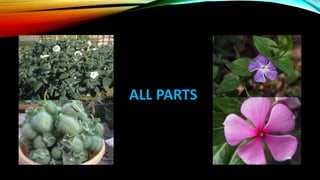
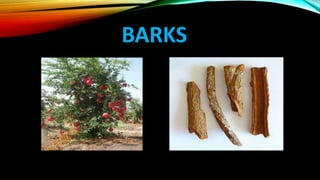
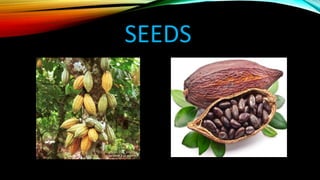
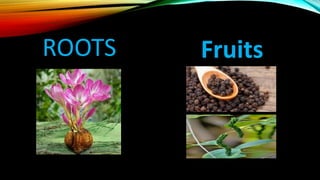
Alkaloids occur in all plant parts, but are usually localized in one organ
(e.g. the bark or seeds).
Within the plant, [alkaloid] can vary widely from part to part – some parts
may contain no alkaloids.
Occasionally, different alkaloids also form in different parts of the plant.
Alkaloid concentrations occur in wide ranges – e.g. Madagascan periwinkle
contains 3g per (anticancer) alkaloids per ton of leaves.
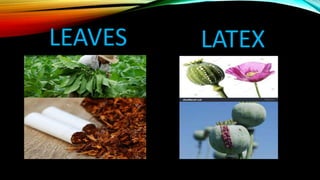
DISTRIBUTION IN
PLANT
ALL PARTS
BARKS
SEEDS
ROOTS Fruits
LEAVES LATEX
Function in Plants
1. Poisonous agents protecting the plant against insects and herbivores.
2. End products of detoxification reactions representing a metabolic
locking up of compounds otherwise harmful to the plant.
3. Regulatory growth factors.
4. Reserve substances capable of supplying nitrogen or other elements
necessary to the plants economy.
Biosynthetic origin
Alkaloids are formed from amino acids, but other precursors, e.g. terpenes
or steroids, are often also built into the final alkaloidal skeleton.
Common amino acid precursors
Phenylalanine
Tyrosine
Tryptophan
Histidine
Anthranilic acid
Lysine
Ornithine
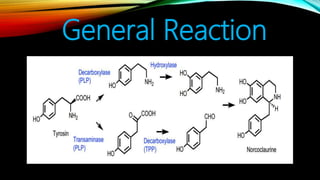
General Reaction
Some of the general reactions that are of particular importance include:
decarboxylation
(removal of carboxyl group or carbon dioxide)
Transamination
(transfer of an amino group from one molecule to another without the
formation Of ammonia) of the amino acids to yield a corresponding
amine or aldehyde.
These can react to form a Schiff base which, in turn can react with carbanion
in a Mannich -type condensation.
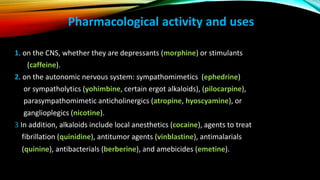
Pharmacological activity and uses
1. on the CNS, whether they are depressants (morphine) or stimulants
(caffeine).
2. on the autonomic nervous system: sympathomimetics (ephedrine)
or sympatholytics (yohimbine, certain ergot alkaloids), (pilocarpine),
parasympathomimetic anticholinergics (atropine, hyoscyamine), or
ganglioplegics (nicotine).
3 In addition, alkaloids include local anesthetics (cocaine), agents to treat
fibrillation (quinidine), antitumor agents (vinblastine), antimalarials
(quinine), antibacterials (berberine), and amebicides (emetine).
Indole Alkaloids
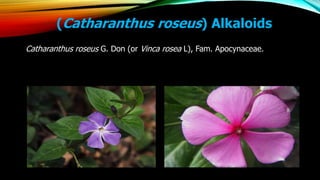
(Catharanthus roseus) Alkaloids
Catharanthus roseus G. Don (or Vinca rosea L), Fam. Apocynaceae.
Classification
1- Monomeric Alkaloids:
These are alkaloids that contain either indole or Idoline
Indole monomers e.g. Catharanthine
Indoline monomers e.g. Vindoline and Vincamine.
2- Dimeric Alkaloids:
Homogenic dimmers: Composed of two indole or indoline
monomers.
Mixed dimmers: One indole and one indoline monomers
e.g. Vincristine and Vinblastine.
Dimeric Alkaloids
Mixed dimmers
These are dimeric alkaloids having indole and indoline (dihydro-indole) nuclei e.g. Vinblastine and
Vincristine.
Vinblastine and Vincristine
They are very important for cancer treatment.
Vincristine is more active but isolated in smaller amounts
Vinblastine. Vinblastine can be converted to vincristine chemically or
by microbial transformation using Streptomyces albogriseolu .
Source: whole plant of Catharanthus roseus or Vinca rosea .
Family: Apocynaceae.
Indole: Vinblastine termed as Catharanthine Dihydroindole alkaloid
Other: ajmalIcine, lochnerine, serpentine and tetrahydroalstonine.
Uses: treatment of Hodgkin's disease (Pseudoleukemia or Lymphatic anaemia)
and carcinoma resistant to other therapy.
USES: Vincristine sulphate: antineoplastic: arrest mitosis at the metaphase, IV:
acute leukemia for children, Hodgkin’s disease, reticulum cell sarcoma,
lymphosarcoma, myosarcoma Vinblastine sulphate: either above
mechanism or by interfering with amino acid metabolism, suppress
immune response Hypotensive & Antidiabetic.
Uses
Vinblastine is used for treatment of Hodgkin's disease
(Pseudoleukemia or Lymphatic anaemia) and carcinoma
resistant to other therapy.
Vincristinehas a cytotoxic effect .It is useful in the
treatment of leukemia in children, small cell lung cancer,
cervical and vaginal cancers.
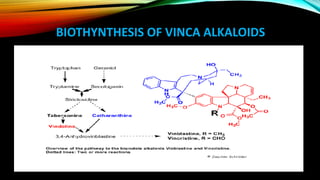
BIOTHYNTHESIS OF VINCA ALKALOIDS
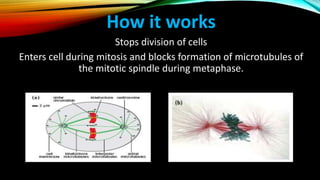
How it works
Stops division of cells
Enters cell during mitosis and blocks formation of microtubules of
the mitotic spindle during metaphase.
References
Aniszewski, Tadeusz (2007). Alkaloids – secrets of life.
Amsterdam:
Orekhov, AP (1955). Chemistry alkaloids (‫الطبعة‬Acad. 2). M.:
USSR.
THANK YOUNaglaa El sheikh

Alkaloids

  • 1.
  • 2.
    History the term “alkaloid”(alkali-like) is commonly used to designate basic heterocyclic nitrogenous compounds of plant origin that are physiologically active. They have many characters: Basic in nature due to the presence of Nitrogen in their ring. Mostly obtained from plant materials. Have bitter tasting. Give aprecipitate with heavy metals iodides. Have high pharmacological and physiological activities.
  • 3.
    The names ofthe alkaloids are obtained in various ways: 1. From the generic name of the plant yielding them, 2. From the specific name of the plant yielding them, 3. From the common name of the drug yielding them, 4. From their physiological activity, 5. From the discoverer,
  • 4.
    Classification True (Typical) alkaloidsthat are derived from amino acids and have in a heterocyclic ring. e.g. Atropine Protoalkaloids that are derived from amino acids and do not have nitrogen in a heterocyclic ring. e.g. Ephedrine Pseudo alkaloids that are not derived from amino acids but have nitrogen in a heterocyclic ring. e.g. Caffeine
  • 5.
    Classification based onthe ring structure or nucleus of the chief alkaloid group in the plant drug: Pyridine- Piperidine Combined Tropane Quinoline Isoquinoline Indole Imidazole Steroid Alkaloidal amine Purine
  • 6.
    CHARACTERISTICS They are bitterin taste. Derived from amino acids Alkaloids form double salts with compounds of mercury, gold, platinum and other heavy metals. These salts are obtained as precipitate which are microcrystallographic. Most but not all alkaloids possess basic properties owing to the presence of amino nitrogen. Structurally complex end products of energy- requiring reaction sequences. Alkaloids usually contain one nitrogen atom but some may contain 5 nitrogen atoms such as ergotamine. The nitrogen may exist as a primary amine (RNH2), secondary amine (R2NH), tertiary amine (RN), or as quaternary.
  • 7.
    PROPERTIES OF ALKALOIDS Insolubleor sparingly soluble in water, but the salts formed on reaction with acids are usually freely soluble. Most are crystalline solids although a few are amorphous. Free alkaloids are usually soluble in ether, chloroform, or other relatively nonpolar immiscible solvents. Some alkaloids are liquid because of lacking of oxygen in their molecules. (e.g. coniine, nicotine, spartenine). The degree of basicity varies greatly, depending on the structure of the molecule and the presence and location of other functional groups. Have high melting points.
  • 8.
    Occurrence of Alkaloids Occurin bacteria (Pseudomonas aeruginosa) and rarely in fungi (pscilocin from hallucinogenic mushrooms). Some alkaloids occur in several genera from different species (caffeine) , but most occur in closely related species. Some occur in certain families (hyoscyamine), while others occur only in a specific species (morphine). Rarely do plants contain more than 1 type of alkaloid.
  • 9.
    All alkaloids ofone plant will have a common biogenetic origin. Alkaloids occur in all plant parts, but are usually localized in one organ (e.g. the bark or seeds). Within the plant, [alkaloid] can vary widely from part to part – some parts may contain no alkaloids. Occasionally, different alkaloids also form in different parts of the plant. Alkaloid concentrations occur in wide ranges – e.g. Madagascan periwinkle contains 3g per (anticancer) alkaloids per ton of leaves.
  • 10.
  • 11.
  • 12.
  • 13.
  • 14.
  • 15.
  • 16.
    Function in Plants 1.Poisonous agents protecting the plant against insects and herbivores. 2. End products of detoxification reactions representing a metabolic locking up of compounds otherwise harmful to the plant. 3. Regulatory growth factors. 4. Reserve substances capable of supplying nitrogen or other elements necessary to the plants economy.
  • 17.
    Biosynthetic origin Alkaloids areformed from amino acids, but other precursors, e.g. terpenes or steroids, are often also built into the final alkaloidal skeleton. Common amino acid precursors Phenylalanine Tyrosine Tryptophan Histidine Anthranilic acid Lysine Ornithine
  • 18.
  • 19.
    Some of thegeneral reactions that are of particular importance include: decarboxylation (removal of carboxyl group or carbon dioxide) Transamination (transfer of an amino group from one molecule to another without the formation Of ammonia) of the amino acids to yield a corresponding amine or aldehyde. These can react to form a Schiff base which, in turn can react with carbanion in a Mannich -type condensation.
  • 21.
    Pharmacological activity anduses 1. on the CNS, whether they are depressants (morphine) or stimulants (caffeine). 2. on the autonomic nervous system: sympathomimetics (ephedrine) or sympatholytics (yohimbine, certain ergot alkaloids), (pilocarpine), parasympathomimetic anticholinergics (atropine, hyoscyamine), or ganglioplegics (nicotine). 3 In addition, alkaloids include local anesthetics (cocaine), agents to treat fibrillation (quinidine), antitumor agents (vinblastine), antimalarials (quinine), antibacterials (berberine), and amebicides (emetine).
  • 22.
  • 23.
    (Catharanthus roseus) Alkaloids Catharanthusroseus G. Don (or Vinca rosea L), Fam. Apocynaceae.
  • 24.
    Classification 1- Monomeric Alkaloids: Theseare alkaloids that contain either indole or Idoline Indole monomers e.g. Catharanthine Indoline monomers e.g. Vindoline and Vincamine. 2- Dimeric Alkaloids: Homogenic dimmers: Composed of two indole or indoline monomers. Mixed dimmers: One indole and one indoline monomers e.g. Vincristine and Vinblastine.
  • 25.
    Dimeric Alkaloids Mixed dimmers Theseare dimeric alkaloids having indole and indoline (dihydro-indole) nuclei e.g. Vinblastine and Vincristine. Vinblastine and Vincristine They are very important for cancer treatment. Vincristine is more active but isolated in smaller amounts Vinblastine. Vinblastine can be converted to vincristine chemically or by microbial transformation using Streptomyces albogriseolu .
  • 26.
    Source: whole plantof Catharanthus roseus or Vinca rosea . Family: Apocynaceae. Indole: Vinblastine termed as Catharanthine Dihydroindole alkaloid Other: ajmalIcine, lochnerine, serpentine and tetrahydroalstonine. Uses: treatment of Hodgkin's disease (Pseudoleukemia or Lymphatic anaemia) and carcinoma resistant to other therapy. USES: Vincristine sulphate: antineoplastic: arrest mitosis at the metaphase, IV: acute leukemia for children, Hodgkin’s disease, reticulum cell sarcoma, lymphosarcoma, myosarcoma Vinblastine sulphate: either above mechanism or by interfering with amino acid metabolism, suppress immune response Hypotensive & Antidiabetic.
  • 27.
    Uses Vinblastine is usedfor treatment of Hodgkin's disease (Pseudoleukemia or Lymphatic anaemia) and carcinoma resistant to other therapy. Vincristinehas a cytotoxic effect .It is useful in the treatment of leukemia in children, small cell lung cancer, cervical and vaginal cancers.
  • 28.
  • 29.
    How it works Stopsdivision of cells Enters cell during mitosis and blocks formation of microtubules of the mitotic spindle during metaphase.
  • 30.
    References Aniszewski, Tadeusz (2007).Alkaloids – secrets of life. Amsterdam: Orekhov, AP (1955). Chemistry alkaloids (‫الطبعة‬Acad. 2). M.: USSR.
  • 31.