ALKALOIDS
Ms. Chandani Prasad
Assistant Professor
DEPARTMENT OF PHARMACOGNOSY & PHYTOCHEMISTRY
MANWATKAR COLLEGE OF PHARMACY, GHODPETH
Purpose Statement
At the end of the class the students will be able to, understand
occurrences, distributions, identification test and function of alkaloids.
Learning Objectives
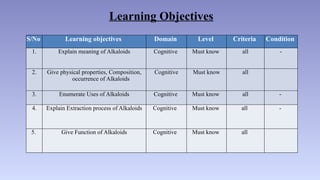
S/No Learning objectives Domain Level Criteria Condition
1. Explain meaning of Alkaloids Cognitive Must know all -
2. Give physical properties, Composition,
occurrence of Alkaloids
Cognitive Must know all
3. Enumerate Uses of Alkaloids Cognitive Must know all -
4. Explain Extraction process of Alkaloids Cognitive Must know all -
5. Give Function of Alkaloids Cognitive Must know all
INTRODUCTION
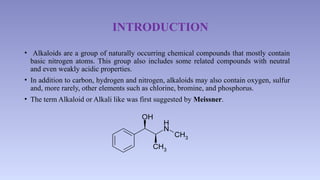
• Alkaloids are a group of naturally occurring chemical compounds that mostly contain
basic nitrogen atoms. This group also includes some related compounds with neutral
and even weakly acidic properties.
• In addition to carbon, hydrogen and nitrogen, alkaloids may also contain oxygen, sulfur
and, more rarely, other elements such as chlorine, bromine, and phosphorus.
• The term Alkaloid or Alkali like was first suggested by Meissner.
• Alkaloids have a wide range of pharmacological activities including antimalarial (e.g.
quinine), antiasthma (e.g. ephedrine), anticancer, antiarrhythmic (e.g. quinidine),
analgesic (e.g. morphine), antibacterial (e.g. chelerythrine), and antihyperglycemic
activities (e.g. piperine).
• One of the oldest known alkaloids is opium, which is an exudate obtained from poppy
(Papaver somniferes).
• The use of opium mixed with wine to induce sleep and it is also used as pain reliever.
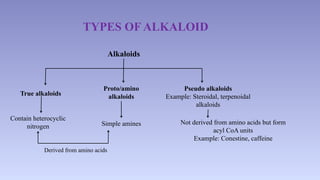
TYPES OF ALKALOID
Alkaloids
True alkaloids
Proto/amino
alkaloids
Pseudo alkaloids
Example: Steroidal, terpenoidal
alkaloids
Contain heterocyclic
nitrogen Simple amines Not derived from amino acids but form
acyl CoA units
Example: Conestine, caffeine
Derived from amino acids
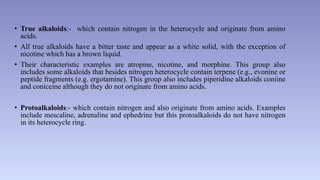
• True alkaloids:- which contain nitrogen in the heterocycle and originate from amino
acids.
• All true alkaloids have a bitter taste and appear as a white solid, with the exception of
nicotine which has a brown liquid.
• Their characteristic examples are atropine, nicotine, and morphine. This group also
includes some alkaloids that besides nitrogen heterocycle contain terpene (e.g., evonine or
peptide fragments (e.g. ergotamine). This group also includes piperidine alkaloids coniine
and coniceine although they do not originate from amino acids.
• Protoalkaloids:- which contain nitrogen and also originate from amino acids. Examples
include mescaline, adrenaline and ephedrine but this protoalkaloids do not have nitrogen
in its heterocycle ring.
• Pseudo alkaloids – alkaloid-like compounds that do not originate from amino acids.
This group includes terpene-like and steroid-like alkaloids, as well as purine-like
alkaloids such as caffeine, theobromine, theacrine and theophylline.
• Those originate from the amino acid phenylalanine, but acquire their nitrogen atom not
from the amino acid but through transamination.
9
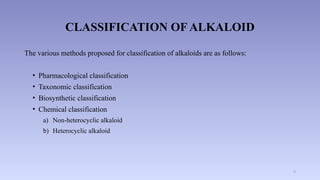
CLASSIFICATION OF ALKALOID
The various methods proposed for classification of alkaloids are as follows:
• Pharmacological classification
• Taxonomic classification
• Biosynthetic classification
• Chemical classification
a) Non-heterocyclic alkaloid
b) Heterocyclic alkaloid
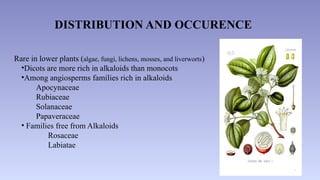
DISTRIBUTION AND OCCURENCE
Rare in lower plants (algae, fungi, lichens, mosses, and liverworts)
•Dicots are more rich in alkaloids than monocots
•Among angiosperms families rich in alkaloids
Apocynaceae
Rubiaceae
Solanaceae
Papaveraceae
• Families free from Alkaloids
Rosaceae
Labiatae
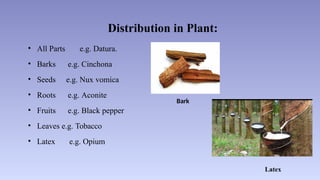
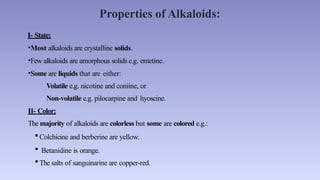
Distribution in Plant:
• All Parts e.g. Datura.
• Barks e.g. Cinchona
• Seeds e.g. Nux vomica
• Roots e.g. Aconite
• Fruits e.g. Black pepper
• Leaves e.g. Tobacco
• Latex e.g. Opium
Bark
Latex
Properties of Alkaloids:
I- State:
•Most alkaloids are crystalline solids.
•Few alkaloids are amorphous solids e.g. emetine.
•Some are liquids that are either:
Volatile e.g. nicotine and coniine, or
Non-volatile e.g. pilocarpine and hyoscine.
II- Color:
The majority of alkaloids are colorless but some are colored e.g.:
 Colchicine and berberine are yellow.
 Betanidine is orange.
 The salts of sanguinarine are copper-red.
III- Solubility:
• Both alkaloidal bases and their salts are soluble in alcohol.
• Generally, the bases are soluble in organic solvents and insoluble in water.
• Salts are usually soluble in water and, insoluble or sparingly soluble in organic solvents.
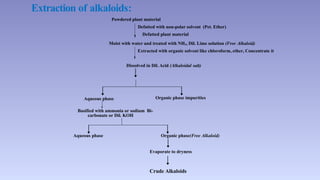
Extraction of alkaloids:
Powdered plant material
Defatted with non-polar solvent (Pet. Ether)
Defatted plant material
Moist with water and treated with NH3, Dil. Lime solution (Free Alkaloid)
Extracted with organic solvent like chloroform, ether, Concentrate it
Dissolved in Dil. Acid (Alkaloidal salt)
Aqueous phase Organic phase impurities
Basified with ammonia or sodium Bi-
carbonate or Dil. KOH
Aqueous phase Organic phase(Free Alkaloid)
Evaporate to dryness
Crude Alkaloids
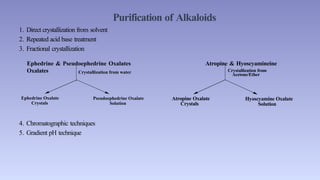
Purification of Alkaloids
4. Chromatographic techniques
5. Gradient pH technique
Crystallization from water
Ephedrine Oxalate
Crystals
Pseudoephedrine Oxalate
Solution
1. Direct crystallization from solvent
2. Repeated acid base treatment
3. Fractional crystallization
Ephedrine & Pseudoephedrine Oxalates Atropine & Hyoscyamineine
Oxalates Crystallization from
Acetone/Ether
Atropine Oxalate
Crystals
Hyoscyamine Oxalate
Solution
16
Following are the few examples of isolation of alkaloids on commercial scale:
• Ergometrine is isolated from ergot sclerotia
• Atropine from Egyptian henbane
• Caffeine from tea leaves
• Vasicine from vasaka leaves
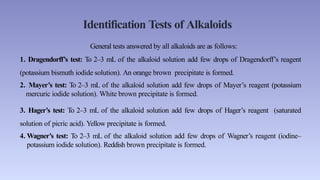
Identification Tests of Alkaloids
General tests answered by all alkaloids are as follows:
1. Dragendorff’s test: To 2–3 mL of the alkaloid solution add few drops of Dragendorff’s reagent
(potassium bismuth iodide solution). An orange brown precipitate is formed.
2. Mayer’s test: To 2–3 mL of the alkaloid solution add few drops of Mayer’s reagent (potassium
mercuric iodide solution). White brown precipitate is formed.
3. Hager’s test: To 2–3 mL of the alkaloid solution add few drops of Hager’s reagent (saturated
solution of picric acid). Yellow precipitate is formed.
4. Wagner’s test: To 2–3 mL of the alkaloid solution add few drops of Wagner’s reagent (iodine–
potassium iodide solution). Reddish brown precipitate is formed.
Function of Alkaloids in plants
 As byproducts of plant metabolism.
 Source of nitrogen in nitrogen deficiency.
 Utilized as source of energy in case of deficiency of carbon dioxide assimilation.
 May act as protective substances against the animal or insect attacks by its bitterness
and toxicity.
 Like hormones, they may function as plant stimulants or regulators in activities like
growth, metabolism and reproduction.
 As detoxicating agents by methylating, condensing, and cyclizing the compounds
whose accumulation might otherwise cause damage to the plant.
Pharmaceutical Applications of Alkaloids
As a medicine, the alkaloids act as life saving drug in some serious disorders like heart
failure, cancer, blood pressure etc
• For eg. Digoxin used for heart failure
• As pesticides and insect repellent
• For research and scientific study
• Vinca alkaloid are used for treatment of leukemia.
• Ergot alkaloid are used in treating migraine.
20
Therapeutic Activity of Alkaloids
• Therapeutic activity of very few are mentioned:
I. Ergot
II. Nux Vomica
III. Rauwolfia
IV. Vinca
V. Opium
• BELLADONNA
• Synonyms:- Belladonna herb; Belladonna leaf; Deadly night shade leaves; Banewort;
Death’s herb, Poison black cherry.
• Biological Source:- Belladonna consists of dried leaves and flowering tops of Atropa
belladonna Linn. (European Belladonna), belonging to family Solanaceae. It contains
about 0.35% of total alkaloids calculated as hyoscyamine.
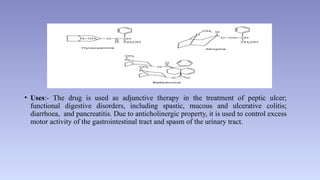
• Chemical constituents:- Belladonna contains 0.3–1.0% total alkaloids, the prominent
base is l-hyoscyamine and other components are atropine, apoatropine, as choline,
belladonnine, cuscohygrine, chrysatropic acid.
• Uses:- The drug is used as adjunctive therapy in the treatment of peptic ulcer;
functional digestive disorders, including spastic, mucous and ulcerative colitis;
diarrhoea, and pancreatitis. Due to anticholinergic property, it is used to control excess
motor activity of the gastrointestinal tract and spasm of the urinary tract.
• EPHEDRA
• Synonyms :- Ma Huang.
• Biological Source:- Ephedra consists of the dried aerial parts of Ephedra gerardiana
Wall, Ephedra sinica Stapf, Ephedra equisetina Bunge, Ephedra nebrodensis Tineo and
other Ephedra species, belonging to family Ephadreaceae.
• Chemical constituents:- Ephedra contains alkaloids Ephedrine (water-soluble salt of an
alkaloid), Norpseudoephedrine (An analog of ephedrine).
• Uses:- Ephedrine is antiallergenic, antiasthmatic, antispasmodic, decongestant, cough
suppressant, stimulant and vasoconstrictor.
Summary
• Alkaloids mean
• Composition, Occurrence of Alkaloids
• Extraction and Pharmaceutical application of Alkaloids
Bibliography
• Gokhale S.B., Kokate C.K., Purohit A.P.,Textbook of Pharmacognosy, Nirali
Prakashan, 45th
edition.
Alkaloids- Definition, Classification, Occurrences, chemical tests

Alkaloids- Definition, Classification, Occurrences, chemical tests

  • 1.
    ALKALOIDS Ms. Chandani Prasad AssistantProfessor DEPARTMENT OF PHARMACOGNOSY & PHYTOCHEMISTRY MANWATKAR COLLEGE OF PHARMACY, GHODPETH
  • 2.
    Purpose Statement At theend of the class the students will be able to, understand occurrences, distributions, identification test and function of alkaloids.
  • 3.
    Learning Objectives S/No Learningobjectives Domain Level Criteria Condition 1. Explain meaning of Alkaloids Cognitive Must know all - 2. Give physical properties, Composition, occurrence of Alkaloids Cognitive Must know all 3. Enumerate Uses of Alkaloids Cognitive Must know all - 4. Explain Extraction process of Alkaloids Cognitive Must know all - 5. Give Function of Alkaloids Cognitive Must know all
  • 4.
    INTRODUCTION • Alkaloids area group of naturally occurring chemical compounds that mostly contain basic nitrogen atoms. This group also includes some related compounds with neutral and even weakly acidic properties. • In addition to carbon, hydrogen and nitrogen, alkaloids may also contain oxygen, sulfur and, more rarely, other elements such as chlorine, bromine, and phosphorus. • The term Alkaloid or Alkali like was first suggested by Meissner.
  • 5.
    • Alkaloids havea wide range of pharmacological activities including antimalarial (e.g. quinine), antiasthma (e.g. ephedrine), anticancer, antiarrhythmic (e.g. quinidine), analgesic (e.g. morphine), antibacterial (e.g. chelerythrine), and antihyperglycemic activities (e.g. piperine). • One of the oldest known alkaloids is opium, which is an exudate obtained from poppy (Papaver somniferes). • The use of opium mixed with wine to induce sleep and it is also used as pain reliever.
  • 6.
    TYPES OF ALKALOID Alkaloids Truealkaloids Proto/amino alkaloids Pseudo alkaloids Example: Steroidal, terpenoidal alkaloids Contain heterocyclic nitrogen Simple amines Not derived from amino acids but form acyl CoA units Example: Conestine, caffeine Derived from amino acids
  • 7.
    • True alkaloids:-which contain nitrogen in the heterocycle and originate from amino acids. • All true alkaloids have a bitter taste and appear as a white solid, with the exception of nicotine which has a brown liquid. • Their characteristic examples are atropine, nicotine, and morphine. This group also includes some alkaloids that besides nitrogen heterocycle contain terpene (e.g., evonine or peptide fragments (e.g. ergotamine). This group also includes piperidine alkaloids coniine and coniceine although they do not originate from amino acids. • Protoalkaloids:- which contain nitrogen and also originate from amino acids. Examples include mescaline, adrenaline and ephedrine but this protoalkaloids do not have nitrogen in its heterocycle ring.
  • 8.
    • Pseudo alkaloids– alkaloid-like compounds that do not originate from amino acids. This group includes terpene-like and steroid-like alkaloids, as well as purine-like alkaloids such as caffeine, theobromine, theacrine and theophylline. • Those originate from the amino acid phenylalanine, but acquire their nitrogen atom not from the amino acid but through transamination.
  • 9.
    9 CLASSIFICATION OF ALKALOID Thevarious methods proposed for classification of alkaloids are as follows: • Pharmacological classification • Taxonomic classification • Biosynthetic classification • Chemical classification a) Non-heterocyclic alkaloid b) Heterocyclic alkaloid
  • 10.
    DISTRIBUTION AND OCCURENCE Rarein lower plants (algae, fungi, lichens, mosses, and liverworts) •Dicots are more rich in alkaloids than monocots •Among angiosperms families rich in alkaloids Apocynaceae Rubiaceae Solanaceae Papaveraceae • Families free from Alkaloids Rosaceae Labiatae
  • 11.
    Distribution in Plant: •All Parts e.g. Datura. • Barks e.g. Cinchona • Seeds e.g. Nux vomica • Roots e.g. Aconite • Fruits e.g. Black pepper • Leaves e.g. Tobacco • Latex e.g. Opium Bark Latex
  • 12.
    Properties of Alkaloids: I-State: •Most alkaloids are crystalline solids. •Few alkaloids are amorphous solids e.g. emetine. •Some are liquids that are either: Volatile e.g. nicotine and coniine, or Non-volatile e.g. pilocarpine and hyoscine. II- Color: The majority of alkaloids are colorless but some are colored e.g.:  Colchicine and berberine are yellow.  Betanidine is orange.  The salts of sanguinarine are copper-red.
  • 13.
    III- Solubility: • Bothalkaloidal bases and their salts are soluble in alcohol. • Generally, the bases are soluble in organic solvents and insoluble in water. • Salts are usually soluble in water and, insoluble or sparingly soluble in organic solvents.
  • 14.
    Extraction of alkaloids: Powderedplant material Defatted with non-polar solvent (Pet. Ether) Defatted plant material Moist with water and treated with NH3, Dil. Lime solution (Free Alkaloid) Extracted with organic solvent like chloroform, ether, Concentrate it Dissolved in Dil. Acid (Alkaloidal salt) Aqueous phase Organic phase impurities Basified with ammonia or sodium Bi- carbonate or Dil. KOH Aqueous phase Organic phase(Free Alkaloid) Evaporate to dryness Crude Alkaloids
  • 15.
    Purification of Alkaloids 4.Chromatographic techniques 5. Gradient pH technique Crystallization from water Ephedrine Oxalate Crystals Pseudoephedrine Oxalate Solution 1. Direct crystallization from solvent 2. Repeated acid base treatment 3. Fractional crystallization Ephedrine & Pseudoephedrine Oxalates Atropine & Hyoscyamineine Oxalates Crystallization from Acetone/Ether Atropine Oxalate Crystals Hyoscyamine Oxalate Solution
  • 16.
    16 Following are thefew examples of isolation of alkaloids on commercial scale: • Ergometrine is isolated from ergot sclerotia • Atropine from Egyptian henbane • Caffeine from tea leaves • Vasicine from vasaka leaves
  • 17.
    Identification Tests ofAlkaloids General tests answered by all alkaloids are as follows: 1. Dragendorff’s test: To 2–3 mL of the alkaloid solution add few drops of Dragendorff’s reagent (potassium bismuth iodide solution). An orange brown precipitate is formed. 2. Mayer’s test: To 2–3 mL of the alkaloid solution add few drops of Mayer’s reagent (potassium mercuric iodide solution). White brown precipitate is formed. 3. Hager’s test: To 2–3 mL of the alkaloid solution add few drops of Hager’s reagent (saturated solution of picric acid). Yellow precipitate is formed. 4. Wagner’s test: To 2–3 mL of the alkaloid solution add few drops of Wagner’s reagent (iodine– potassium iodide solution). Reddish brown precipitate is formed.
  • 18.
    Function of Alkaloidsin plants  As byproducts of plant metabolism.  Source of nitrogen in nitrogen deficiency.  Utilized as source of energy in case of deficiency of carbon dioxide assimilation.  May act as protective substances against the animal or insect attacks by its bitterness and toxicity.  Like hormones, they may function as plant stimulants or regulators in activities like growth, metabolism and reproduction.  As detoxicating agents by methylating, condensing, and cyclizing the compounds whose accumulation might otherwise cause damage to the plant.
  • 19.
    Pharmaceutical Applications ofAlkaloids As a medicine, the alkaloids act as life saving drug in some serious disorders like heart failure, cancer, blood pressure etc • For eg. Digoxin used for heart failure • As pesticides and insect repellent • For research and scientific study • Vinca alkaloid are used for treatment of leukemia. • Ergot alkaloid are used in treating migraine.
  • 20.
    20 Therapeutic Activity ofAlkaloids • Therapeutic activity of very few are mentioned: I. Ergot II. Nux Vomica III. Rauwolfia IV. Vinca V. Opium
  • 21.
    • BELLADONNA • Synonyms:-Belladonna herb; Belladonna leaf; Deadly night shade leaves; Banewort; Death’s herb, Poison black cherry. • Biological Source:- Belladonna consists of dried leaves and flowering tops of Atropa belladonna Linn. (European Belladonna), belonging to family Solanaceae. It contains about 0.35% of total alkaloids calculated as hyoscyamine. • Chemical constituents:- Belladonna contains 0.3–1.0% total alkaloids, the prominent base is l-hyoscyamine and other components are atropine, apoatropine, as choline, belladonnine, cuscohygrine, chrysatropic acid.
  • 22.
    • Uses:- Thedrug is used as adjunctive therapy in the treatment of peptic ulcer; functional digestive disorders, including spastic, mucous and ulcerative colitis; diarrhoea, and pancreatitis. Due to anticholinergic property, it is used to control excess motor activity of the gastrointestinal tract and spasm of the urinary tract.
  • 23.
    • EPHEDRA • Synonyms:- Ma Huang. • Biological Source:- Ephedra consists of the dried aerial parts of Ephedra gerardiana Wall, Ephedra sinica Stapf, Ephedra equisetina Bunge, Ephedra nebrodensis Tineo and other Ephedra species, belonging to family Ephadreaceae. • Chemical constituents:- Ephedra contains alkaloids Ephedrine (water-soluble salt of an alkaloid), Norpseudoephedrine (An analog of ephedrine). • Uses:- Ephedrine is antiallergenic, antiasthmatic, antispasmodic, decongestant, cough suppressant, stimulant and vasoconstrictor.
  • 24.
    Summary • Alkaloids mean •Composition, Occurrence of Alkaloids • Extraction and Pharmaceutical application of Alkaloids
  • 25.
    Bibliography • Gokhale S.B.,Kokate C.K., Purohit A.P.,Textbook of Pharmacognosy, Nirali Prakashan, 45th edition.

Editor's Notes

  • #15 The pH gradient technique is a method used in analytical chemistry to separate solutes or proteins based on their pH