ANTIDIABETICAGENTS
Agents which are used in the treatment of diabetes are called as antidiabetic agents. They
used to lower the blood sugar level in patients suffering from hyperglycaemia. These are also
called as anti-hyperglycaemic agents.
Diabetes mellitus: It is a chronic metabolic disorder which is characterized by
hyperglycaemia (increased blood sugar level). The common symptoms are polydipsia (excess
thirst), polyphagia (excess hunger), and polyurea (excess urination). The classification of
diabetes has been presented in Table-1.
Table-1: Classification of diabetes mellitus
Type-1 (IDDM) Type-2 (NIDDM)
Insulin dependent diabetes mellitus
Juvenile onset diabetes mellitus
Occurs in children
Non-insulin dependent diabetes mellitus
Adult onset diabetes mellitus
Occurs in adults
Pancreatic β-cells are destroyed
No insulin secretion
Less insulin secretion or insulin resistance
(cells don’t respond to insulin)
Treatment: insulin injection Treatment: oral hypoglycaemic agents
Insulin: It is a peptidic hormone secreted by β-cells of pancreas. It was discovered by Banting
& Best in 1921. It regulates metabolism of carbohydrate, lipids and proteins. It decreases
blood sugar level by decreasing gluconeogenesis, increasing glucose uptake and increasing
glycogen synthesis.
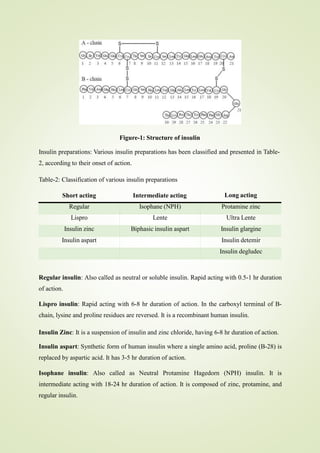
Insulin structure: Its full structure was elucidated by Sanger in 1956. It is a polypeptide
hormone with a molecular weight of 6000 Da. Inside body, the inactive pro-insulin is
converted into active insulin which is composed of 2 chains (A & B). A chain has 21 amino
acid residues, whereas B chain has 30 amino acid residues and both the chains are attached to
each other by 2 disulphide (-S-S-) bonds. The structure of insulin has been depicted in
Figure-1.
Sources of insulin: Bovine, Porcine, Recombinant human insulin
Figure-1: Structure of insulin
Insulin preparations: Various insulin preparations has been classified and presented in Table-
2, according to their onset of action.
Table-2: Classification of various insulin preparations
Short acting Intermediate acting Long acting
Regular Isophane (NPH) Protamine zinc
Lispro Lente Ultra Lente
Insulin zinc Biphasic insulin aspart Insulin glargine
Insulin aspart Insulin detemir
Insulin degludec
Regular insulin: Also called as neutral or soluble insulin. Rapid acting with 0.5-1 hr duration
of action.
Lispro insulin: Rapid acting with 6-8 hr duration of action. In the carboxyl terminal of B-
chain, lysine and proline residues are reversed. It is a recombinant human insulin.
Insulin Zinc: It is a suspension of insulin and zinc chloride, having 6-8 hr duration of action.
Insulin aspart: Synthetic form of human insulin where a single amino acid, proline (B-28) is
replaced by aspartic acid. It has 3-5 hr duration of action.
Isophane insulin: Also called as Neutral Protamine Hagedorn (NPH) insulin. It is
intermediate acting with 18-24 hr duration of action. It is composed of zinc, protamine, and
regular insulin.
Lente insulin: It is intermediate acting with 18-24 hr duration of action. It is composed of
acetate buffer, zinc, and regular insulin.
Biphasic insulin aspart: It is intermediate acting with 24 hr duration of action. It is
composed of 30% soluble insulin aspart and 70% protamine bound insulin aspart.
Protamine zinc insulin: It is composed of insulin, zinc chloride, and protamine. It has
duration of action upto 36 hrs.
Ultra lente insulin: It contains 65% of lente insulin, having duration of action upto 36 hrs.
Insulin glargine: It is obtained by addition of two arginine residues in B-chain carboxy
terminal and by replacement of asparagine with glycine in A-21 position of human insulin. It
has duration of action upto 24 hrs.
Insulin detemir: It is obtained by addition of a fatty acid (myristic acid) to lysine residue in
B-29 position of human insulin. It has duration of action upto 24 hrs.
Insulin degludec: It is obtained by addition of hexadecanedioic acid to lysine residue in B-29
position of human insulin. It has duration of action upto 24 hrs.
Oral hypoglycaemic agents
Sulfonyl ureas: These are the first class of oral hypoglycaemic agents used for treatment of
diabetes. They are also called as insulin secretagogues.
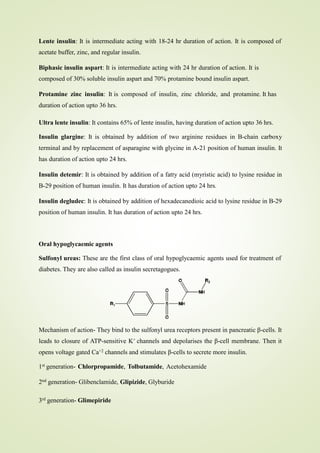
Mechanism of action- They bind to the sulfonyl urea receptors present in pancreatic β-cells. It
leads to closure of ATP-sensitive K+ channels and depolarises the β-cell membrane. Then it
opens voltage gated Ca+2 channels and stimulates β-cells to secrete more insulin.
1st generation- Chlorpropamide, Tolbutamide, Acetohexamide
2nd generation- Glibenclamide, Glipizide, Glyburide
3rd generation- Glimepiride
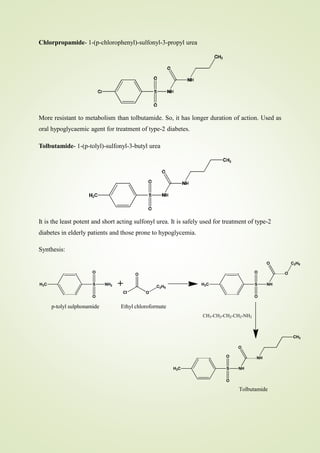
Chlorpropamide- 1-(p-chlorophenyl)-sulfonyl-3-propyl urea
More resistant to metabolism than tolbutamide. So, it has longer duration of action. Used as
oral hypoglycaemic agent for treatment of type-2 diabetes.
Tolbutamide- 1-(p-tolyl)-sulfonyl-3-butyl urea
It is the least potent and short acting sulfonyl urea. It is safely used for treatment of type-2
diabetes in elderly patients and those prone to hypoglycemia.
Synthesis:
S
O
NH
NH
O
H3C
CH3
S NH2
H3C +
Cl
O
O
C2H5
S NH
H3C
O C2H5
O O
O
O
O
CH3-CH2-CH2-CH2-NH2
O
Tolbutamide
p-tolyl sulphonamide Ethyl chloroformate
Glipizide- 1-cyclohexyl-3-[p-[2-[5-methyl pyrazin-2-yl]carboxamido]ethyl]phenyl]-sulfonyl
urea
It has quick onset of action. Used as oral hypoglycaemic agent for treatment of type-2
diabetes.
Glimepiride- 1-[p-[2-[3-ethyl-4-methyl-2-oxo-3-pyrrolin-1-carboxamido]-ethyl]-phenyl]
sulfonyl-3-(p-methyl cyclohexyl) urea
It’s a long acting potent sulfonylurea. Used as oral hypoglycaemic agent for treatment of
type-2 diabetes.
Biguanides: Phenformin, Metformin, Butformin
Mechanism of action- They reduce hepatic gluconeogenesis, decrease intestinal absorption of
glucose, increase glucose uptake and utilization to decrease the blood sugar level. As they
improve the insulin resistance, they are also known as insulin sensitizers.
Metformin- N,N-dimethyl biguanide
Used for treatment of type-2 diabetes in obese patients. Also used for treatment of polycystic
ovarian syndrome.
Thiazolidinediones: Pioglitazone, Rosiglitazone
Mechanism of action- They binds to and stimulates Peroxisome Proliferator Activated
Receptor-γ (PPAR-γ), due to which they are also known as PPAR- γ agonists. They increase
the expression of GLUT-1 & GLUT-4 receptors on cell surface to increase glucose uptake.
They reduce insulin resistance and hepatic gluconeogenesis. They decrease the post-prandial
glucose level and also HbA1c level.
Pioglitazone- 5-[4-[2-[5-ethyl pyridin-2-yl]ethoxy]benzyl]thiazolidin-2,4-dione
Used as oral hypoglycaemic agent for treatment of type-2 diabetes.
Rosiglitazone- 5-[4-[2-[N-methyl-pyridin-2-yl]amino]ethoxy]benzyl]thiazolidin-2,4-dione
Used as oral hypoglycaemic agent for treatment of type-2 diabetes.
Meglitinides: Repaglinide, Nateglinide
Mechanism of action- Same as that of sulfonylureas. They bind to the sulfonyl urea receptors
present in pancreatic β-cells. It leads to closure of ATP-sensitive K+ channels and depolarises
the β-cell membrane. Then it opens voltage gated Ca+2 channels and stimulates β-cells to
secrete more insulin. These agents are also known as insulin secretagogues.
Repaglinide- 2-ethoxy-4-[2-[3-methyl-1-[2-(piperidin-1-yl)phenyl]butylamino]-2-oxo-ethyl]
benzoic acid
It induces fast onset and short-lasting insulin secretion. Administered before each meal to
control post-prandial hyperglycaemia.
Used as oral hypoglycaemic agent for treatment of type-2 diabetes.
Nateglinide- N-[{4-(propan-2-yl)cyclohexyl}carbonyl]-D-phenylalanine
It’s a phenylalanine derivative. Causes faster onset and short-lasting insulin secretion than
repaglinide. Used as oral hypoglycaemic agent for treatment of type-2 diabetes.
Glucosidase inhibitors: Acarbose, Voglibose
Mechanism of action- They delays the absorption and metabolism of carbohydrates by
inhibiting α-glucosidase enzyme found in the brush border epithelium of small intestine. α-
glucosidase helps in hydrolysing polysaccharides and oligosaccharides into monosaccharides
and helps in their absorption. Flatulence and loose motion are the common side effects of this
class of drugs. These drugs produce anti-hyperglycaemic effect but do not produce
hypoglycaemia.
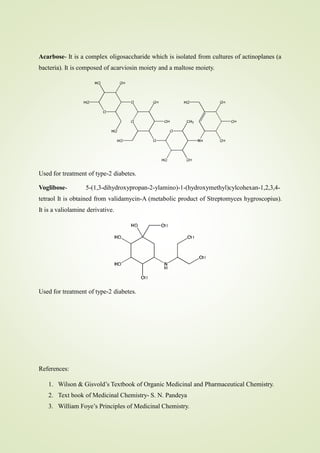
Acarbose- It is a complex oligosaccharide which is isolated from cultures of actinoplanes (a
bacteria). It is composed of acarviosin moiety and a maltose moiety.
Used for treatment of type-2 diabetes.
Voglibose- 5-(1,3-dihydroxypropan-2-ylamino)-1-(hydroxymethyl)cylcohexan-1,2,3,4-
tetraol It is obtained from validamycin-A (metabolic product of Streptomyces hygroscopius).
It is a valiolamine derivative.
Used for treatment of type-2 diabetes.
References:
1. Wilson & Gisvold’s Textbook of Organic Medicinal and Pharmaceutical Chemistry.
2. Text book of Medicinal Chemistry- S. N. Pandeya
3. William Foye’s Principles of Medicinal Chemistry.

Anti-diabetic drugs with structures and uses

  • 1.
    ANTIDIABETICAGENTS Agents which areused in the treatment of diabetes are called as antidiabetic agents. They used to lower the blood sugar level in patients suffering from hyperglycaemia. These are also called as anti-hyperglycaemic agents. Diabetes mellitus: It is a chronic metabolic disorder which is characterized by hyperglycaemia (increased blood sugar level). The common symptoms are polydipsia (excess thirst), polyphagia (excess hunger), and polyurea (excess urination). The classification of diabetes has been presented in Table-1. Table-1: Classification of diabetes mellitus Type-1 (IDDM) Type-2 (NIDDM) Insulin dependent diabetes mellitus Juvenile onset diabetes mellitus Occurs in children Non-insulin dependent diabetes mellitus Adult onset diabetes mellitus Occurs in adults Pancreatic β-cells are destroyed No insulin secretion Less insulin secretion or insulin resistance (cells don’t respond to insulin) Treatment: insulin injection Treatment: oral hypoglycaemic agents Insulin: It is a peptidic hormone secreted by β-cells of pancreas. It was discovered by Banting & Best in 1921. It regulates metabolism of carbohydrate, lipids and proteins. It decreases blood sugar level by decreasing gluconeogenesis, increasing glucose uptake and increasing glycogen synthesis. Insulin structure: Its full structure was elucidated by Sanger in 1956. It is a polypeptide hormone with a molecular weight of 6000 Da. Inside body, the inactive pro-insulin is converted into active insulin which is composed of 2 chains (A & B). A chain has 21 amino acid residues, whereas B chain has 30 amino acid residues and both the chains are attached to each other by 2 disulphide (-S-S-) bonds. The structure of insulin has been depicted in Figure-1. Sources of insulin: Bovine, Porcine, Recombinant human insulin
  • 2.
    Figure-1: Structure ofinsulin Insulin preparations: Various insulin preparations has been classified and presented in Table- 2, according to their onset of action. Table-2: Classification of various insulin preparations Short acting Intermediate acting Long acting Regular Isophane (NPH) Protamine zinc Lispro Lente Ultra Lente Insulin zinc Biphasic insulin aspart Insulin glargine Insulin aspart Insulin detemir Insulin degludec Regular insulin: Also called as neutral or soluble insulin. Rapid acting with 0.5-1 hr duration of action. Lispro insulin: Rapid acting with 6-8 hr duration of action. In the carboxyl terminal of B- chain, lysine and proline residues are reversed. It is a recombinant human insulin. Insulin Zinc: It is a suspension of insulin and zinc chloride, having 6-8 hr duration of action. Insulin aspart: Synthetic form of human insulin where a single amino acid, proline (B-28) is replaced by aspartic acid. It has 3-5 hr duration of action. Isophane insulin: Also called as Neutral Protamine Hagedorn (NPH) insulin. It is intermediate acting with 18-24 hr duration of action. It is composed of zinc, protamine, and regular insulin.
  • 3.
    Lente insulin: Itis intermediate acting with 18-24 hr duration of action. It is composed of acetate buffer, zinc, and regular insulin. Biphasic insulin aspart: It is intermediate acting with 24 hr duration of action. It is composed of 30% soluble insulin aspart and 70% protamine bound insulin aspart. Protamine zinc insulin: It is composed of insulin, zinc chloride, and protamine. It has duration of action upto 36 hrs. Ultra lente insulin: It contains 65% of lente insulin, having duration of action upto 36 hrs. Insulin glargine: It is obtained by addition of two arginine residues in B-chain carboxy terminal and by replacement of asparagine with glycine in A-21 position of human insulin. It has duration of action upto 24 hrs. Insulin detemir: It is obtained by addition of a fatty acid (myristic acid) to lysine residue in B-29 position of human insulin. It has duration of action upto 24 hrs. Insulin degludec: It is obtained by addition of hexadecanedioic acid to lysine residue in B-29 position of human insulin. It has duration of action upto 24 hrs. Oral hypoglycaemic agents Sulfonyl ureas: These are the first class of oral hypoglycaemic agents used for treatment of diabetes. They are also called as insulin secretagogues. Mechanism of action- They bind to the sulfonyl urea receptors present in pancreatic β-cells. It leads to closure of ATP-sensitive K+ channels and depolarises the β-cell membrane. Then it opens voltage gated Ca+2 channels and stimulates β-cells to secrete more insulin. 1st generation- Chlorpropamide, Tolbutamide, Acetohexamide 2nd generation- Glibenclamide, Glipizide, Glyburide 3rd generation- Glimepiride
  • 4.
    Chlorpropamide- 1-(p-chlorophenyl)-sulfonyl-3-propyl urea Moreresistant to metabolism than tolbutamide. So, it has longer duration of action. Used as oral hypoglycaemic agent for treatment of type-2 diabetes. Tolbutamide- 1-(p-tolyl)-sulfonyl-3-butyl urea It is the least potent and short acting sulfonyl urea. It is safely used for treatment of type-2 diabetes in elderly patients and those prone to hypoglycemia. Synthesis: S O NH NH O H3C CH3 S NH2 H3C + Cl O O C2H5 S NH H3C O C2H5 O O O O O CH3-CH2-CH2-CH2-NH2 O Tolbutamide p-tolyl sulphonamide Ethyl chloroformate
  • 5.
    Glipizide- 1-cyclohexyl-3-[p-[2-[5-methyl pyrazin-2-yl]carboxamido]ethyl]phenyl]-sulfonyl urea Ithas quick onset of action. Used as oral hypoglycaemic agent for treatment of type-2 diabetes. Glimepiride- 1-[p-[2-[3-ethyl-4-methyl-2-oxo-3-pyrrolin-1-carboxamido]-ethyl]-phenyl] sulfonyl-3-(p-methyl cyclohexyl) urea It’s a long acting potent sulfonylurea. Used as oral hypoglycaemic agent for treatment of type-2 diabetes. Biguanides: Phenformin, Metformin, Butformin Mechanism of action- They reduce hepatic gluconeogenesis, decrease intestinal absorption of glucose, increase glucose uptake and utilization to decrease the blood sugar level. As they improve the insulin resistance, they are also known as insulin sensitizers. Metformin- N,N-dimethyl biguanide
  • 6.
    Used for treatmentof type-2 diabetes in obese patients. Also used for treatment of polycystic ovarian syndrome. Thiazolidinediones: Pioglitazone, Rosiglitazone Mechanism of action- They binds to and stimulates Peroxisome Proliferator Activated Receptor-γ (PPAR-γ), due to which they are also known as PPAR- γ agonists. They increase the expression of GLUT-1 & GLUT-4 receptors on cell surface to increase glucose uptake. They reduce insulin resistance and hepatic gluconeogenesis. They decrease the post-prandial glucose level and also HbA1c level. Pioglitazone- 5-[4-[2-[5-ethyl pyridin-2-yl]ethoxy]benzyl]thiazolidin-2,4-dione Used as oral hypoglycaemic agent for treatment of type-2 diabetes. Rosiglitazone- 5-[4-[2-[N-methyl-pyridin-2-yl]amino]ethoxy]benzyl]thiazolidin-2,4-dione Used as oral hypoglycaemic agent for treatment of type-2 diabetes. Meglitinides: Repaglinide, Nateglinide Mechanism of action- Same as that of sulfonylureas. They bind to the sulfonyl urea receptors present in pancreatic β-cells. It leads to closure of ATP-sensitive K+ channels and depolarises the β-cell membrane. Then it opens voltage gated Ca+2 channels and stimulates β-cells to secrete more insulin. These agents are also known as insulin secretagogues. Repaglinide- 2-ethoxy-4-[2-[3-methyl-1-[2-(piperidin-1-yl)phenyl]butylamino]-2-oxo-ethyl] benzoic acid
  • 7.
    It induces fastonset and short-lasting insulin secretion. Administered before each meal to control post-prandial hyperglycaemia. Used as oral hypoglycaemic agent for treatment of type-2 diabetes. Nateglinide- N-[{4-(propan-2-yl)cyclohexyl}carbonyl]-D-phenylalanine It’s a phenylalanine derivative. Causes faster onset and short-lasting insulin secretion than repaglinide. Used as oral hypoglycaemic agent for treatment of type-2 diabetes. Glucosidase inhibitors: Acarbose, Voglibose Mechanism of action- They delays the absorption and metabolism of carbohydrates by inhibiting α-glucosidase enzyme found in the brush border epithelium of small intestine. α- glucosidase helps in hydrolysing polysaccharides and oligosaccharides into monosaccharides and helps in their absorption. Flatulence and loose motion are the common side effects of this class of drugs. These drugs produce anti-hyperglycaemic effect but do not produce hypoglycaemia.
  • 8.
    Acarbose- It isa complex oligosaccharide which is isolated from cultures of actinoplanes (a bacteria). It is composed of acarviosin moiety and a maltose moiety. Used for treatment of type-2 diabetes. Voglibose- 5-(1,3-dihydroxypropan-2-ylamino)-1-(hydroxymethyl)cylcohexan-1,2,3,4- tetraol It is obtained from validamycin-A (metabolic product of Streptomyces hygroscopius). It is a valiolamine derivative. Used for treatment of type-2 diabetes. References: 1. Wilson & Gisvold’s Textbook of Organic Medicinal and Pharmaceutical Chemistry. 2. Text book of Medicinal Chemistry- S. N. Pandeya 3. William Foye’s Principles of Medicinal Chemistry.