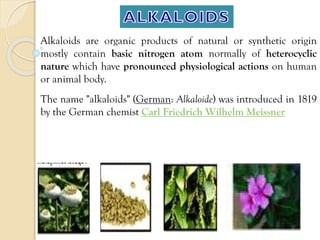
Alkaloids are organic products of natural or synthetic origin
mostly contain basic nitrogen atom normally of heterocyclic
nature which have pronounced physiological actions on human
or animal body.
The name "alkaloids" (German: Alkaloide) was introduced in 1819
by the German chemist Carl Friedrich Wilhelm Meissner
Properties of alkaloids:
 Alkaloids are colourless, crystalline, non-volatile, solids.
(coniine and nicotine are liquids and berberine is yellow)
 The free bases (i.e. alkaloids themselves) are insoluble in water
but soluble in most of the organic solvents.
 Most of the alkaloids are laevorotatory (optically active),
although a few are dextrorotatory (e.g. coniine), while a few are
even optically inactive, viz. papaverine.
 Generally, the alkaloids are bitter in taste and have
pronounced physiological activity.
CLASSIFICATION
A great structural diversity occurs in alkaloids and there is no uniform
classification for alkaloids.
They are often divided into the following major groups:
•True alkaloids: Originate from amino acids and contain N-atom in a
heterocycle. (e.g. atropine, nicotine and morphine). Few exceptions of this
class which beside nitrogen containing heterocycle contain terpene (e.g.
evonine) or peptide fragments (e.g. ergotamine). This group also includes
piperidine alkaloids (e.g. coniine), although they do not originate from
amino acids.
•Protoalkaloids: They also originate from amino acids and in the form of
amino group contain N-atom outside the heterocycle, (e.g. mescaline,
ephedrine).
•Pseudoalkaloids: Their biosynthesis does not start from amino acids.
•Polyamine alkaloids: They are derivatives of putrescin, spermidine and
spermine.
•Peptide and cyclopeptide alkaloids.
•Terpene alkaloids (e.g. aconitine).
•Steroid alkaloids (tomatidine, solanidine).
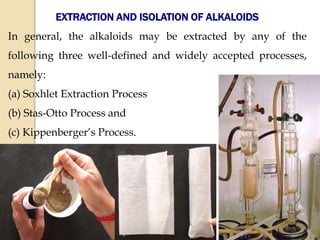
EXTRACTION AND ISOLATION OF ALKALOIDS
In general, the alkaloids may be extracted by any of the
following three well-defined and widely accepted processes,
namely:
(a) Soxhlet Extraction Process
(b) Stas-Otto Process and
(c) Kippenberger’s Process.
a) Soxhlet extraction process
•The most suitable method for alkaloid extraction from powder
plant material with the help of organic solvents is continuous
soxhlet extraction.
•The powdered drug is moistened with dilute ammonia solution
so as to set free base as it exists in salt form.
•The resultant mixture packed loosely in thimble of soxhlet
apparatus.
•The organic solvent pass through powdered drug which allow
deep penetration and possible extraction of alkaloids.
•Once, the extraction is completed, the solvent is filtered and
evaporated in a rotary thin-film evaporator
PURIFICATION/ ISOLATION OF ALKALOIDS
•Extraction with acid solution: Dilute sulphuric acid is always
preferred than hydrochloric acid for general use in the
extraction of alkaloids. Further this acidic solution is made
alkaline with ammonium hydroxide solution to set alkaloid in
free state which is then extracted with an organic solvent.
•Precipitation of Alkaloid with Precipitating Reagent:
Examples: Tannic-acid Complex, Precipitates obtained with
mercuric chloride, gold chloride, platinum tetra chloride,
Mayer’s reagent, Precipitates with nitrogenous acids
• Direct crystallization from solvent: Choice of solvent
depend on solubility of alkaloid drug.
•Various known separation techniques: Partition, ion-
exchange and column chromatography are also used for the
purification of alkaloids.
Synonyms:
Catharanthus, Periwinkle, Vinca rosea
Biological Source:
Vinca consist of dried whole plant of Catharanthus
roseus.
Family: Apocynaceae.
VINCA
The leaves are green in colour,
Flowers are either violet, pinkish white or carmine red
Roots are pale grey in colour.
It has characteristic odour and bitter taste.
Morphology
Geographical source:
It is indigenous to Madagascar. This plant is cultivated in
tropical regions like Africa, Australia, Eastern Europe, South
Florida, India, Taiwan and Thailand.
Chemical constituents:
•More than 400 alkaloids are present in the plant. Indole
alkaloids are the most active chemical constituents of vinca.
•In aerial parts the alkaloids like vinblastine, vincristine,
vindesine, vindeline, tabersonine etc. are present whereas in root
and basal parts contains ajmalicine, vinceine, vineamine, aubasin,
reserpine, catharanthine etc.
•Other alkaloids present in vinca are lochnerine, serpentine,
vinorelbine, tetrahydroalstonine.
•Other than alkaloid vinca posses carbohydrate, flavonoid,
saponin. In lower parts of C. roseus contain rosindin is an
anthocyanin pigment.
R= CH3 Vinblastine sulphate
R= CHO Vincristine sulphate
Uses:
•Vincristine and vinblastine are used for the treatment of various
types of Cancer such Hodgkin's disease, breast cancer, skin cancer
and lymphoblastic leukemia.
•Vinblastine is used for treatment of Hodgkin’s disease and non-
Hodgkin’s lymphomas while vincristine is used principally in the
treatment of acute lymphocytic leukemia.
•Vinca is used in hypertension and as antidiabetic.
•The leaves are bitter and stomachic.
•It also posses an expectorant, astringent and diuretic action.
Rauwolfia
Synonyms:
Rauwolfia root, Snake root, Chhotachand, Sarpgandha.
Biological Source:
It consist of dried roots of Rawolfia serpentina Benth.
Family: Apocynaceae.
Geographical location:
Tropical region of Asia, Africa, Shri lanka, Thialand,
India (U. P., Bihar, Orissa, Tamilnadu).
Colour- Grayish yellow
Odour- Odorless
Taste- Bitter
Size- 10- 15 Cm.
Shape- Sub-cylindrical
Extra feature- Wrinkled surface
Morphology
Chemical constituents
It contains different indole alkaloids
Chief constituent is reserpine
Other indole alkaloids are indoline, indolenine,
oxyindole, pseudo-indoxyl. Ajmaline, rauwolfine,
reserpinine, serpentine, serpentinine.
Other secondary metabolites are phytosterol, resins,
fatty acids etc.
Uses:
Anti-hypertensive, tranquilizer, in cardiac arrhythmia.
CNS depressant, used in anxiety, in bronchitis.
Belladonna herb
Synonym: Belladonna leaf, Deadly night shade
B.S: It consists of dried leaves or the leaves &
other aerial parts of the plant Atropa belladonna
or Atropa acuminata
Family: Solanaceae.
Geographical source:
It is native to Europe, North Africa, and Asia. It is cultivated in
North America, United Kingdom, United States, England,
Germany and Ireland.
Morphology:
C: Yellowish-green; F: Purple
O: Characteristics
T: Bitter
Chemical constituents:
•Belladonna contains tropane alkaloids.
•Roots have up to 1.3%, leaves 1.2%, stalks 0.65%, flowers 0.6%,
ripe berries 0.7%, and seeds 0.4% tropane alkaloids.
•The active agents in belladonna are l- hyoscyamine and atropine
(D, L hyoscyamine).
•It also contains scopoletine (10%), apoatropine, belladonnine,
hyoscine (Scopolamine), pyridine and N-methyl pyrroline.
Uses:
The drug is parasympathetic depressant.
It is used to reduce secretion of sweat, salivary & gastric glands.
It acts as powerful spasmolytic in intestinal colic.
It is valuable antidote in opium, chloral hydrate & muscarine poisoning.
Mydriatic
Synonyms
Crude Opium; Raw Opium; Gum Opium; Afim.
Biological Source:
Opium is the air dried milky latex obtained by incision from
the unripe capsules of Papaver somniferum Linn.
Family: Papaveraceae.
OPIUM
Geographical Source
It is mainly found in Turkey, Russia, Yugoslavia, Tasmania,
India, Pakistan, Iran, Afghanistan, China, Burma, Thailand
and Laos. In India, Opium is cultivated in M.P. (Neemuch)
and U.P. for alkaloidal extraction and seed production.
Morphology
Color: Internal surface is coarsely granular, reddish-brown,
lustrous;
Odour is characteristic;
Taste is bitter
Chemical Constituents
 Opium contains about 35 alkaloids (benzylisoquinoline &
phenanthrene)among which morphine (10–16%) is the most important
base.
 Morphine contains a phenanthrene nucleus.
 The alkaloids are combined with meconic acid.
 The other alkaloids isolated from the drug are codeine (0.8–2.5%),
narcotine, thebaine (0.5–2%), noscapine (4–8%), narceine and papaverine
(0.5–2.5%).
 The drug also contains sugars, sulphates, albuminous compounds,
colouring matter and moisture. In addition to these anisaldehyde, vanillin,
vanillic acid, β-hydroxystyrene, fumaric acid, lactic acid, benzyl alcohol, 2-
hydroxycinchonic acid, phthalic acid, hemipinic acid, meconin
Uses:
 Opiates has analgesic (Pain relief), antitussive (Cough
relief), antidiarrheal (Poop relief) and sedative effects.
 Opium is narcotic, analgesic and sedative action and
used to relieve pain, diarrhoea dysentery and cough..
 Morphine checks peristalsis & contracts the pupil of eye.
Codeine is an expectorant.
 Papaverine has smooth muscle relaxant

Alkaloids.pdf

  • 1.
    Alkaloids are organicproducts of natural or synthetic origin mostly contain basic nitrogen atom normally of heterocyclic nature which have pronounced physiological actions on human or animal body. The name "alkaloids" (German: Alkaloide) was introduced in 1819 by the German chemist Carl Friedrich Wilhelm Meissner
  • 2.
    Properties of alkaloids: Alkaloids are colourless, crystalline, non-volatile, solids. (coniine and nicotine are liquids and berberine is yellow)  The free bases (i.e. alkaloids themselves) are insoluble in water but soluble in most of the organic solvents.  Most of the alkaloids are laevorotatory (optically active), although a few are dextrorotatory (e.g. coniine), while a few are even optically inactive, viz. papaverine.  Generally, the alkaloids are bitter in taste and have pronounced physiological activity.
  • 3.
    CLASSIFICATION A great structuraldiversity occurs in alkaloids and there is no uniform classification for alkaloids. They are often divided into the following major groups: •True alkaloids: Originate from amino acids and contain N-atom in a heterocycle. (e.g. atropine, nicotine and morphine). Few exceptions of this class which beside nitrogen containing heterocycle contain terpene (e.g. evonine) or peptide fragments (e.g. ergotamine). This group also includes piperidine alkaloids (e.g. coniine), although they do not originate from amino acids. •Protoalkaloids: They also originate from amino acids and in the form of amino group contain N-atom outside the heterocycle, (e.g. mescaline, ephedrine). •Pseudoalkaloids: Their biosynthesis does not start from amino acids. •Polyamine alkaloids: They are derivatives of putrescin, spermidine and spermine. •Peptide and cyclopeptide alkaloids. •Terpene alkaloids (e.g. aconitine). •Steroid alkaloids (tomatidine, solanidine).
  • 6.
    EXTRACTION AND ISOLATIONOF ALKALOIDS In general, the alkaloids may be extracted by any of the following three well-defined and widely accepted processes, namely: (a) Soxhlet Extraction Process (b) Stas-Otto Process and (c) Kippenberger’s Process.
  • 7.
    a) Soxhlet extractionprocess •The most suitable method for alkaloid extraction from powder plant material with the help of organic solvents is continuous soxhlet extraction. •The powdered drug is moistened with dilute ammonia solution so as to set free base as it exists in salt form. •The resultant mixture packed loosely in thimble of soxhlet apparatus. •The organic solvent pass through powdered drug which allow deep penetration and possible extraction of alkaloids. •Once, the extraction is completed, the solvent is filtered and evaporated in a rotary thin-film evaporator
  • 8.
    PURIFICATION/ ISOLATION OFALKALOIDS •Extraction with acid solution: Dilute sulphuric acid is always preferred than hydrochloric acid for general use in the extraction of alkaloids. Further this acidic solution is made alkaline with ammonium hydroxide solution to set alkaloid in free state which is then extracted with an organic solvent. •Precipitation of Alkaloid with Precipitating Reagent: Examples: Tannic-acid Complex, Precipitates obtained with mercuric chloride, gold chloride, platinum tetra chloride, Mayer’s reagent, Precipitates with nitrogenous acids • Direct crystallization from solvent: Choice of solvent depend on solubility of alkaloid drug. •Various known separation techniques: Partition, ion- exchange and column chromatography are also used for the purification of alkaloids.
  • 9.
    Synonyms: Catharanthus, Periwinkle, Vincarosea Biological Source: Vinca consist of dried whole plant of Catharanthus roseus. Family: Apocynaceae. VINCA
  • 10.
    The leaves aregreen in colour, Flowers are either violet, pinkish white or carmine red Roots are pale grey in colour. It has characteristic odour and bitter taste. Morphology Geographical source: It is indigenous to Madagascar. This plant is cultivated in tropical regions like Africa, Australia, Eastern Europe, South Florida, India, Taiwan and Thailand.
  • 11.
    Chemical constituents: •More than400 alkaloids are present in the plant. Indole alkaloids are the most active chemical constituents of vinca. •In aerial parts the alkaloids like vinblastine, vincristine, vindesine, vindeline, tabersonine etc. are present whereas in root and basal parts contains ajmalicine, vinceine, vineamine, aubasin, reserpine, catharanthine etc. •Other alkaloids present in vinca are lochnerine, serpentine, vinorelbine, tetrahydroalstonine. •Other than alkaloid vinca posses carbohydrate, flavonoid, saponin. In lower parts of C. roseus contain rosindin is an anthocyanin pigment.
  • 12.
    R= CH3 Vinblastinesulphate R= CHO Vincristine sulphate
  • 13.
    Uses: •Vincristine and vinblastineare used for the treatment of various types of Cancer such Hodgkin's disease, breast cancer, skin cancer and lymphoblastic leukemia. •Vinblastine is used for treatment of Hodgkin’s disease and non- Hodgkin’s lymphomas while vincristine is used principally in the treatment of acute lymphocytic leukemia. •Vinca is used in hypertension and as antidiabetic. •The leaves are bitter and stomachic. •It also posses an expectorant, astringent and diuretic action.
  • 14.
    Rauwolfia Synonyms: Rauwolfia root, Snakeroot, Chhotachand, Sarpgandha. Biological Source: It consist of dried roots of Rawolfia serpentina Benth. Family: Apocynaceae. Geographical location: Tropical region of Asia, Africa, Shri lanka, Thialand, India (U. P., Bihar, Orissa, Tamilnadu).
  • 15.
    Colour- Grayish yellow Odour-Odorless Taste- Bitter Size- 10- 15 Cm. Shape- Sub-cylindrical Extra feature- Wrinkled surface Morphology Chemical constituents It contains different indole alkaloids Chief constituent is reserpine Other indole alkaloids are indoline, indolenine, oxyindole, pseudo-indoxyl. Ajmaline, rauwolfine, reserpinine, serpentine, serpentinine. Other secondary metabolites are phytosterol, resins, fatty acids etc.
  • 16.
    Uses: Anti-hypertensive, tranquilizer, incardiac arrhythmia. CNS depressant, used in anxiety, in bronchitis.
  • 17.
    Belladonna herb Synonym: Belladonnaleaf, Deadly night shade B.S: It consists of dried leaves or the leaves & other aerial parts of the plant Atropa belladonna or Atropa acuminata Family: Solanaceae. Geographical source: It is native to Europe, North Africa, and Asia. It is cultivated in North America, United Kingdom, United States, England, Germany and Ireland. Morphology: C: Yellowish-green; F: Purple O: Characteristics T: Bitter
  • 18.
    Chemical constituents: •Belladonna containstropane alkaloids. •Roots have up to 1.3%, leaves 1.2%, stalks 0.65%, flowers 0.6%, ripe berries 0.7%, and seeds 0.4% tropane alkaloids. •The active agents in belladonna are l- hyoscyamine and atropine (D, L hyoscyamine). •It also contains scopoletine (10%), apoatropine, belladonnine, hyoscine (Scopolamine), pyridine and N-methyl pyrroline. Uses: The drug is parasympathetic depressant. It is used to reduce secretion of sweat, salivary & gastric glands. It acts as powerful spasmolytic in intestinal colic. It is valuable antidote in opium, chloral hydrate & muscarine poisoning. Mydriatic
  • 19.
    Synonyms Crude Opium; RawOpium; Gum Opium; Afim. Biological Source: Opium is the air dried milky latex obtained by incision from the unripe capsules of Papaver somniferum Linn. Family: Papaveraceae. OPIUM
  • 20.
    Geographical Source It ismainly found in Turkey, Russia, Yugoslavia, Tasmania, India, Pakistan, Iran, Afghanistan, China, Burma, Thailand and Laos. In India, Opium is cultivated in M.P. (Neemuch) and U.P. for alkaloidal extraction and seed production. Morphology Color: Internal surface is coarsely granular, reddish-brown, lustrous; Odour is characteristic; Taste is bitter
  • 21.
    Chemical Constituents  Opiumcontains about 35 alkaloids (benzylisoquinoline & phenanthrene)among which morphine (10–16%) is the most important base.  Morphine contains a phenanthrene nucleus.  The alkaloids are combined with meconic acid.  The other alkaloids isolated from the drug are codeine (0.8–2.5%), narcotine, thebaine (0.5–2%), noscapine (4–8%), narceine and papaverine (0.5–2.5%).  The drug also contains sugars, sulphates, albuminous compounds, colouring matter and moisture. In addition to these anisaldehyde, vanillin, vanillic acid, β-hydroxystyrene, fumaric acid, lactic acid, benzyl alcohol, 2- hydroxycinchonic acid, phthalic acid, hemipinic acid, meconin
  • 22.
    Uses:  Opiates hasanalgesic (Pain relief), antitussive (Cough relief), antidiarrheal (Poop relief) and sedative effects.  Opium is narcotic, analgesic and sedative action and used to relieve pain, diarrhoea dysentery and cough..  Morphine checks peristalsis & contracts the pupil of eye. Codeine is an expectorant.  Papaverine has smooth muscle relaxant