Oral & Injectable
Contraceptive Steroids
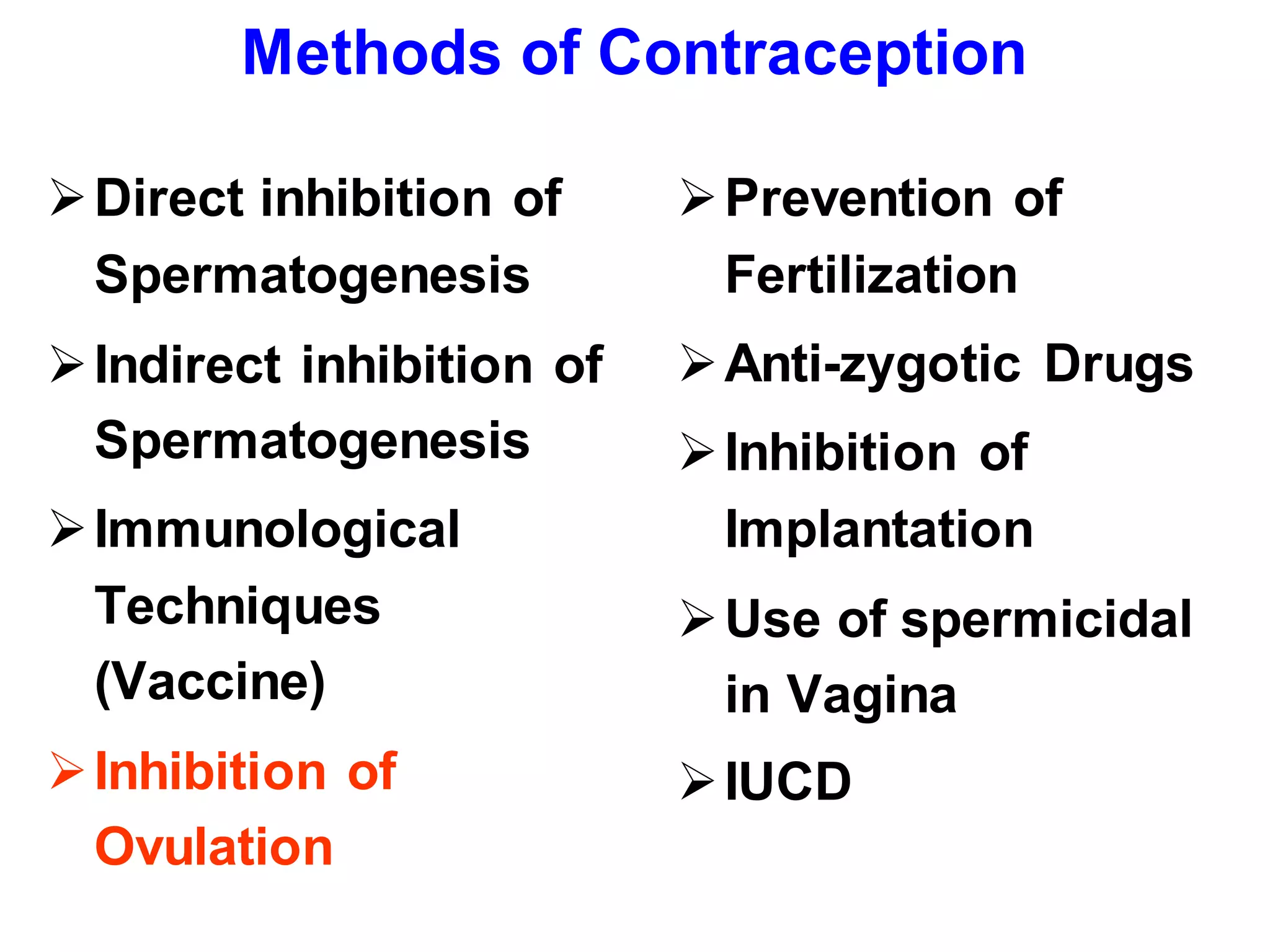
Methods of Contraception
Direct inhibition of
Spermatogenesis
Indirect inhibition of
Spermatogenesis
Immunological
Techniques
(Vaccine)
Inhibition of
Ovulation
Prevention of
Fertilization
Anti-zygotic Drugs
Inhibition of
Implantation
Use of spermicidal
in Vagina
IUCD
History
 1950: Rock & Pincus  Oral Progesterone prevents
ovulation
 1959: 1st pill appeared in USA
 1960: Mini pill (Progesterone alone)
 1970: Introduction low dose or 2nd gen. of OCS
 1980: Biphasic or Triphasic Regimens
 1990: 3rd generation OCS
(E + P has less androgenic activity
E.g.: Norgestimate (P) 0.25 mg or Desogestrel (P) 0.15 mg)
Modern pills has less than 35 µg Oestrogen
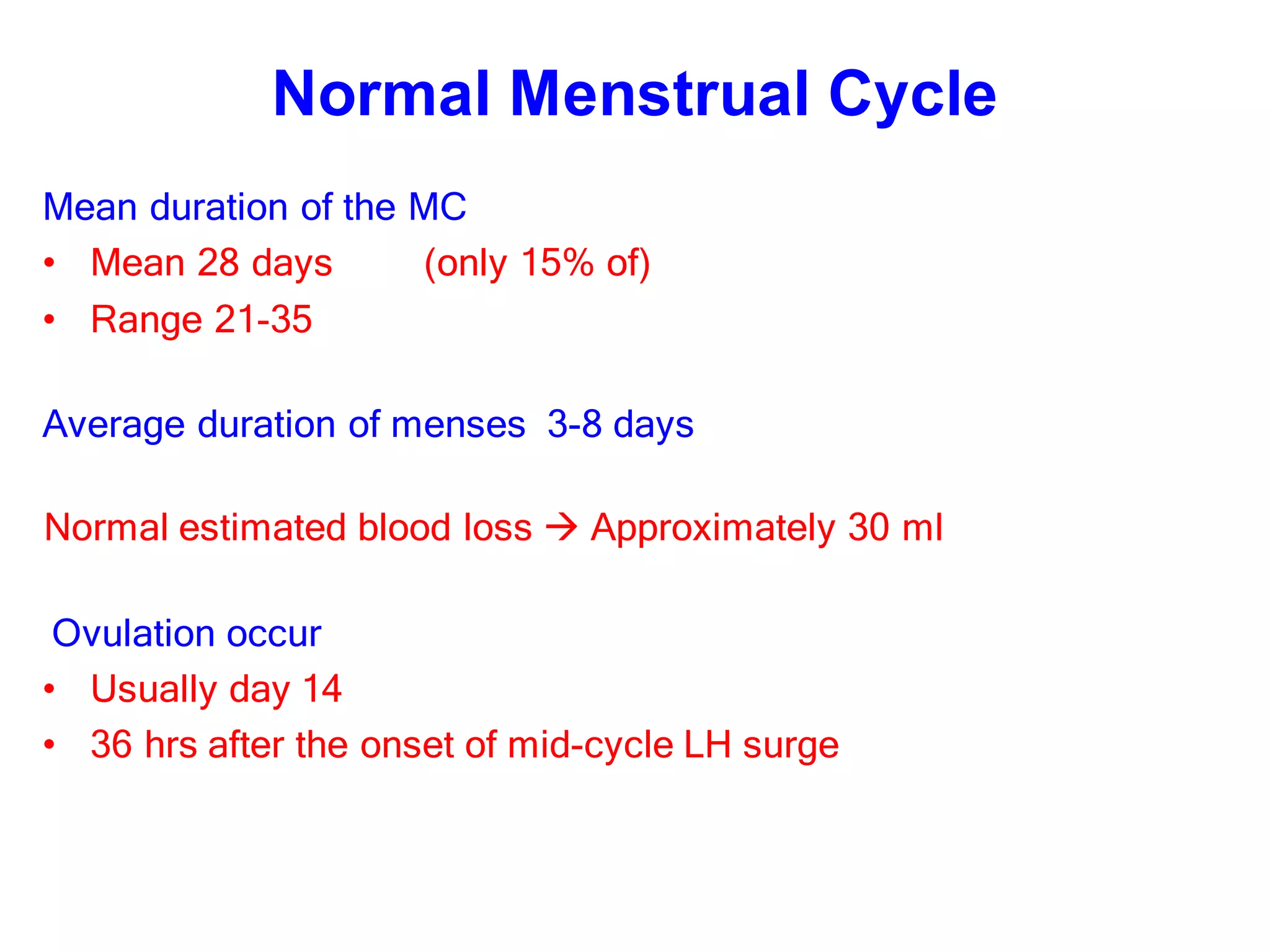
Normal Menstrual Cycle
Mean duration of the MC
• Mean 28 days (only 15% of)
• Range 21-35
Average duration of menses 3-8 days
Normal estimated blood loss  Approximately 30 ml
Ovulation occur
• Usually day 14
• 36 hrs after the onset of mid-cycle LH surge
Normal Menstrual Cycle
The phases of the MC & ovulation regulates by:
Interaction between hypothalamus, pituitary & ovaries
Mean age of menarche & menopause are: Menarche 12.7
Menopause 51.4
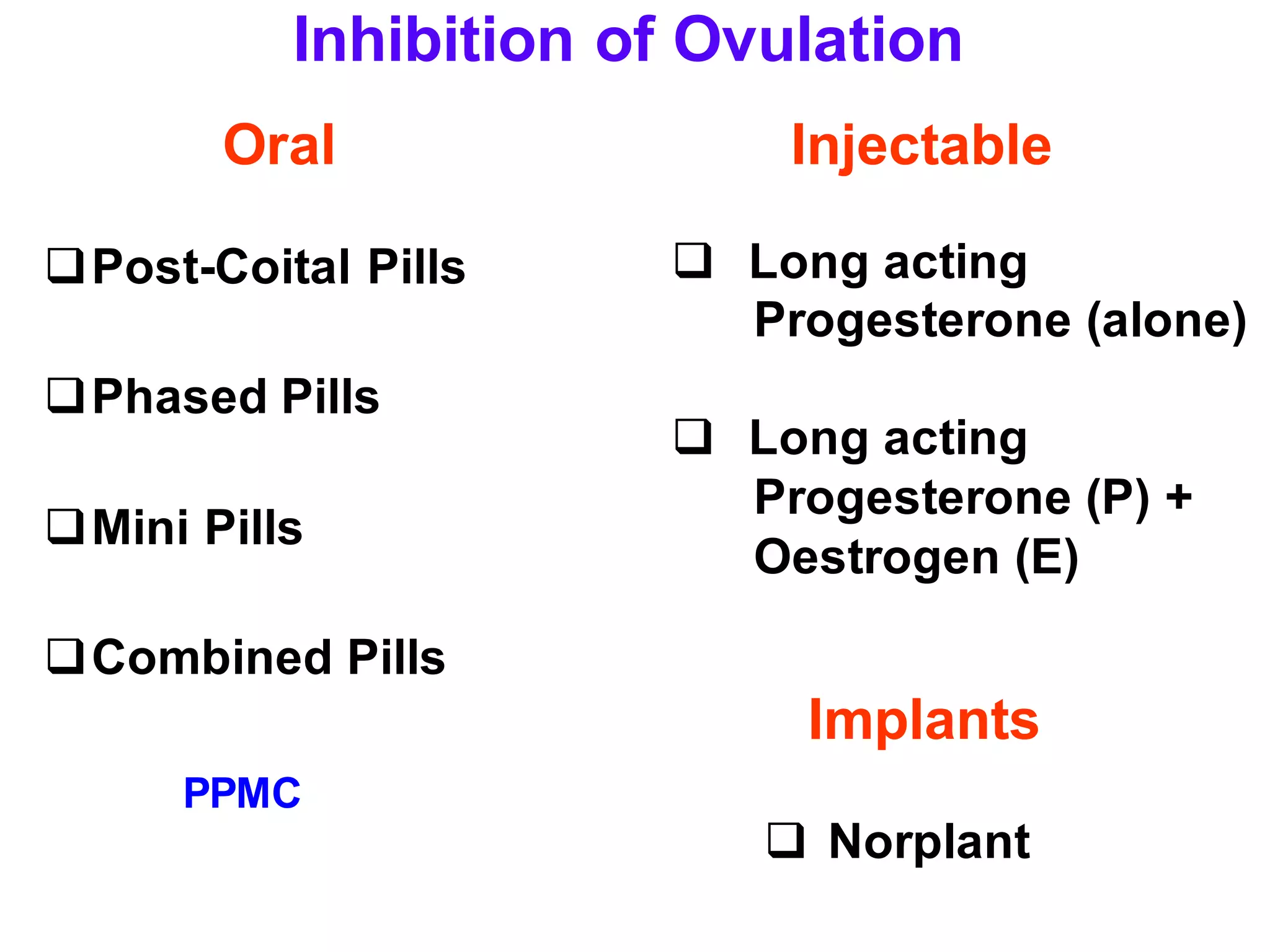
Inhibition of Ovulation
Oral Injectable
Post-Coital Pills
Phased Pills
Mini Pills
Combined Pills
PPMC
 Long acting
Progesterone (alone)
 Long acting
Progesterone (P) +
Oestrogen (E)
Implants
 Norplant
It recommended for >35 years old women& those with no withdrawal
bleeding or breakthrough bleeding while on monophasic pills
Inhibition of Ovulation
Phased Pills:
Triphasic:
 I 6 Tab. (EE 30 µg + Levonorgestrel 50 µg)
II 5 Tab. (EE 40 µg + Levonorgestrel 75 µg)
III 10 Tab. (EE 30 µg + Levonorgestrel 125 µg)
(EE Ethinylestradiol)
Superiority of Triphasic pills over monophasic pills is insufficient
Inhibition of Ovulation
Phased Pills:
Triphasic:
 I 7 Tab. (EE 35 µg + Norethindrone 50 µg)
II 7 Tab. (EE 35 µg + Norethindrone 75 µg)
III 7 Tab. (EE 35 µg + Norethindrone 100 µg)
(EE Ethinylestradiol)
Inhibition of Ovulation
Emergency (Post-Coital) Pills:
 Need to be given within 72 h
 Levonorgestrel 0.75 mg two doses 12 h interval or 1.5
mg single dose taken as soon as possible
 Low dose E (100 µg) + Norgestrel (1mg) taken 2 doses
at 12 h interval within 72hrs  Yuzpe Method (SB)
 Ulipristal 30 mg singe dose within 120 hrs
 Mifepristone 600mg  Single dose within 72hrs
 90 – 98 % effective
Inhibition of ovulation
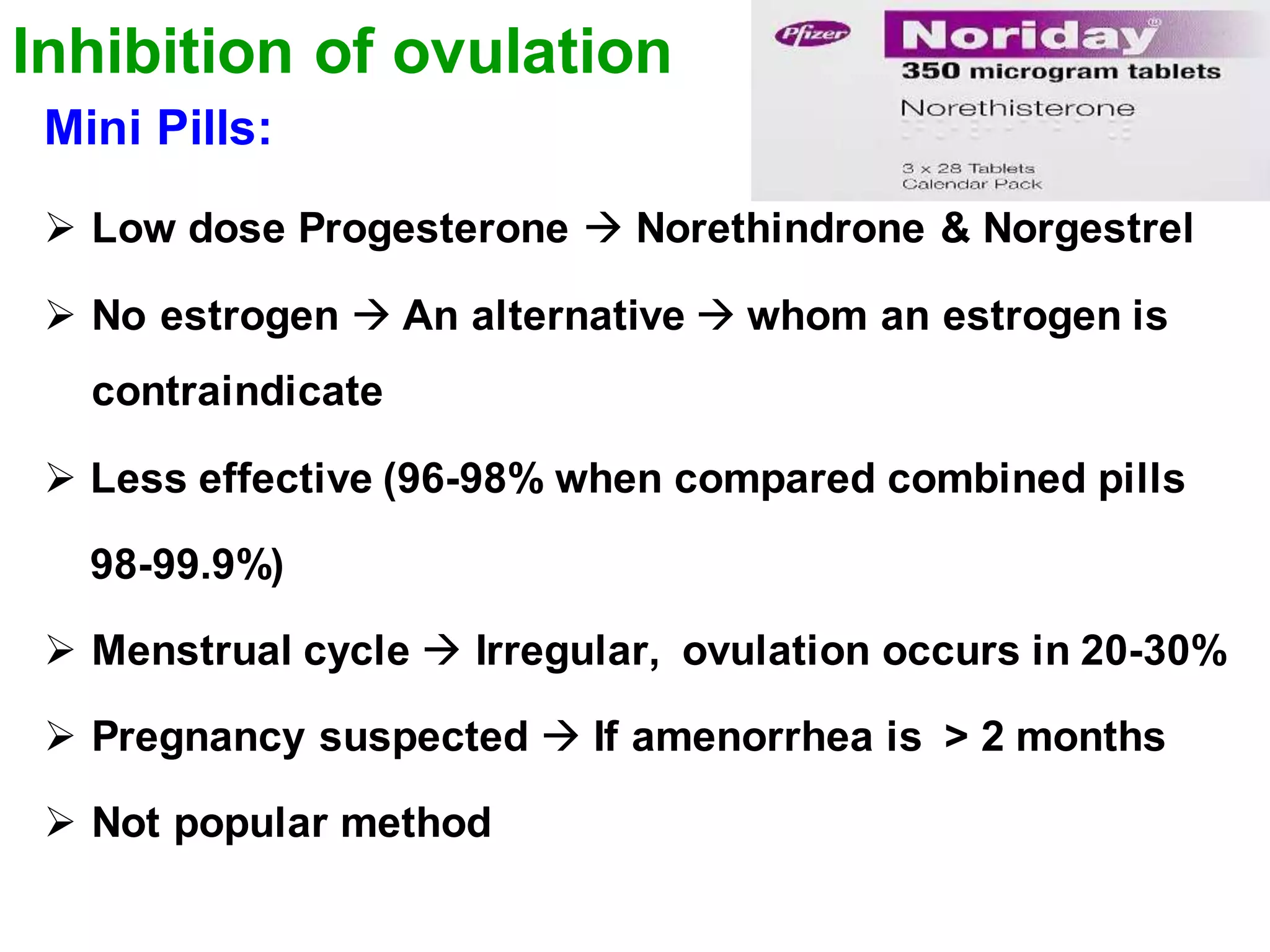
Mini Pills:
 Low dose Progesterone  Norethindrone & Norgestrel
 No estrogen  An alternative  whom an estrogen is
contraindicate
 Less effective (96-98% when compared combined pills
98-99.9%)
 Menstrual cycle  Irregular, ovulation occurs in 20-30%
 Pregnancy suspected  If amenorrhea is > 2 months
 Not popular method
Inhibition of ovulation
Combined Preparations:
 One tablet is taken daily for 21 days (E+P)  starting on
the 5th day of Menstruation + 7 days (gap of after next
course start in bleeding occurs)
 A cycle of 28 days is maintained
 Calendar pack pills
 Most popular method
 99 – 100% effective
Addition of Progesterone: Ensures contraceptive effect
& Predictable bleeding, Prevent breakthrough bleeding
Combined Pills
Oestrogen Progestin
Ethinylestradiol 50 µg Norgestrel 0.5 mg
Ethinylestradiol 30 µg Norgestrel 0.3 mg
Ethinylestradiol 50 µg Levonorgestrel 0.25 mg
Ethinylestradiol 30 µg Levonorgestrel 0.15 mg
Ethinylestradiol 20 µg Levonorgestrel 0.1 mg
Ethinylestradiol 30 µg Desogestrel 0.15 mg
Ethinylestradiol 20 µg Desogestrel 0.15 mg
OCS: Mechanism of Actions
 Decrease Gn release from pituitary absence of
FSH (E)& LH (P) peaks
 Decrease Follicular development & Ovulation
 Thick cervical mucus secretion (P)
 Decrease Implantation of blastocyst in
endometrium
 Contractions of uterus & Fallopian tubes are
modified  disfavor of fertilization
OCS: Practical Problems
Missing a pill?
Critical period
Short delay
12 h or More late
More than 1-2 tablets missed
If pregnancy occurs during OCS intake
Female with Acne & Hirsutism
Female with excessive menstrual loss
If OCS is discontinued
OCS: Adverse Effects
Most Serious:
CVS side effects:
 Thrombophlebitis (due to E & P)
 Thromboembolism (due to Oestrogen)
 Hypertension
 Cerebral & Coronary thrombosis
 incidence of M.I. & Stroke
Cancer: Breast, Vagina & Cervix ?
Benign Hepatoma: Rare tumor appear
Gall Stones: biliary cholesterol secretion
Above
35 Years
OCS: Adverse Effects
Less Serious:
 Wt. gain
 Pigmentation of Cheeks, Nose & Forehead
 Pruritus vulvae
 Diabetes?
 Mood swings, Abdominal discomfort
Non - Serious:
 Nausea, Vomiting
 Breakthrough bleeding
 Breast discomfort
 Suppression of lactation (very rare)
OCS: Drug Interactions
A. Enzyme Inducers
 Phenytoin
 Phenobarbitone
 Primidone
 Carbamazepine
 Rifampicin
B. Suppression of Intestinal Microflora
 Tetracycline
 Ampicillin
OCS: Contraindications
Thrombo-embolic, Coronary & Cerebrovascular disease
or history of above
 Hypertension (moderate to severe)
 Hyperlipidemia
Active Liver disease, Hepatoma or History of Jaundice
Suspected / Overt malignancy of Genitals / Breast
 Porphyria
Impending major surgery (Post-operative thromboembolism)
OCS: Relative Contraindications
Diabetes
Obesity
Smoking
Undiagnosed vaginal bleeding
Uterine leiomyoma
Mentally ill
Above 35 years age
Mild hypertension
Migraine
Gall bladder diseases
OCS: Other Health Benefits
1. Reduced risk of:
 Ovarian cysts
 Ovarian & Endometrial cancer
 Benign breast diseases
2. Lower incidence of ectopic pregnancy
3. Less common:
Iron Deficiency anemia
Rheumatoid Arthritis
4. Benefits in:
 Pre-menstrual tension
 Dysmenorrhea Menstrual cramps
 Endometriosis
 Acne & Hirsutism
WHO study: Combination of DMPA (25 mg) + Oestradiol cypionate (5mg)
 Has high efficacy & Regular menstrual bleeding
Injectable Preparations
 Long acting P + O  once a month, I.M.
 Long acting P only  Higher dose, I.M.  once in several month
e.g., Depot Medroxyprogesterone acetate (DMPA)  150-400 mg / 3-6
months Norethindrone enanthate (NEE, 200 mg / 2-3 months)
MOA Inhibit pituitary LH, Suppression of ovulation + Act on
Endometrium, Fallopian tube & Cervical secretion
ADR  Complete disruption of menstrual bleeding pattern &
Total amenorrhea; in some people permanent sterility
When to start? -- Any time you are certain that the patient is not pregnant
Transdermal contraceptive Norelgestromin (P)+EE 
once weekly application for 3 weeks  1 week gap
Implants: Levonorgestrel Implant
 Consists of 6 flexible capsules containing Levonorgestrel (36mg/
capsule  Total216 mg)
 Inserted under the skin (SC) using LA
 Effective for 5 years, to be replaced afterwards
MOA Antioestrogenic action on the endometrium & Cervical
secretion; LH peak & Ovulationsuppressed
ADR  Irregular bleeding in 70% women & few pregnancy  Some
ectopic (1st yr), H, N, Nervousness, Skin rash, Hirsutism,
Acne, Breast tenderness, Wt. gain, Enlarged ovarian follicles
Centchroman Ormeloxifene
 Non-steroidal oral contraceptive (CDRI, Lucknow)
 Oestrogen antagonist
 Anti-implantation agent
 Safer free from OCS side effects; Menstrual cycle not
disturbed  May be lengthened in 6-10% women
 For all age group of women
 Failure rate: 1 - 3 %
 Side effects Enlargement of ovary
 C/I: Polycystic ovarian disease, Cervical hyperplasia, Renal or
Hepatic disease, Tuberculosis & Lactating mother
 Dose: 30mg tablet twice a week; 30mg once a week till needed

Oral and injectable contraceptive steroids

  • 1.
  • 2.
    Methods of Contraception Directinhibition of Spermatogenesis Indirect inhibition of Spermatogenesis Immunological Techniques (Vaccine) Inhibition of Ovulation Prevention of Fertilization Anti-zygotic Drugs Inhibition of Implantation Use of spermicidal in Vagina IUCD
  • 3.
    History  1950: Rock& Pincus  Oral Progesterone prevents ovulation  1959: 1st pill appeared in USA  1960: Mini pill (Progesterone alone)  1970: Introduction low dose or 2nd gen. of OCS  1980: Biphasic or Triphasic Regimens  1990: 3rd generation OCS (E + P has less androgenic activity E.g.: Norgestimate (P) 0.25 mg or Desogestrel (P) 0.15 mg) Modern pills has less than 35 µg Oestrogen
  • 4.
    Normal Menstrual Cycle Meanduration of the MC • Mean 28 days (only 15% of) • Range 21-35 Average duration of menses 3-8 days Normal estimated blood loss  Approximately 30 ml Ovulation occur • Usually day 14 • 36 hrs after the onset of mid-cycle LH surge
  • 5.
    Normal Menstrual Cycle Thephases of the MC & ovulation regulates by: Interaction between hypothalamus, pituitary & ovaries Mean age of menarche & menopause are: Menarche 12.7 Menopause 51.4
  • 8.
    Inhibition of Ovulation OralInjectable Post-Coital Pills Phased Pills Mini Pills Combined Pills PPMC  Long acting Progesterone (alone)  Long acting Progesterone (P) + Oestrogen (E) Implants  Norplant
  • 9.
    It recommended for>35 years old women& those with no withdrawal bleeding or breakthrough bleeding while on monophasic pills Inhibition of Ovulation Phased Pills: Triphasic:  I 6 Tab. (EE 30 µg + Levonorgestrel 50 µg) II 5 Tab. (EE 40 µg + Levonorgestrel 75 µg) III 10 Tab. (EE 30 µg + Levonorgestrel 125 µg) (EE Ethinylestradiol)
  • 10.
    Superiority of Triphasicpills over monophasic pills is insufficient Inhibition of Ovulation Phased Pills: Triphasic:  I 7 Tab. (EE 35 µg + Norethindrone 50 µg) II 7 Tab. (EE 35 µg + Norethindrone 75 µg) III 7 Tab. (EE 35 µg + Norethindrone 100 µg) (EE Ethinylestradiol)
  • 11.
    Inhibition of Ovulation Emergency(Post-Coital) Pills:  Need to be given within 72 h  Levonorgestrel 0.75 mg two doses 12 h interval or 1.5 mg single dose taken as soon as possible  Low dose E (100 µg) + Norgestrel (1mg) taken 2 doses at 12 h interval within 72hrs  Yuzpe Method (SB)  Ulipristal 30 mg singe dose within 120 hrs  Mifepristone 600mg  Single dose within 72hrs  90 – 98 % effective
  • 12.
    Inhibition of ovulation MiniPills:  Low dose Progesterone  Norethindrone & Norgestrel  No estrogen  An alternative  whom an estrogen is contraindicate  Less effective (96-98% when compared combined pills 98-99.9%)  Menstrual cycle  Irregular, ovulation occurs in 20-30%  Pregnancy suspected  If amenorrhea is > 2 months  Not popular method
  • 13.
    Inhibition of ovulation CombinedPreparations:  One tablet is taken daily for 21 days (E+P)  starting on the 5th day of Menstruation + 7 days (gap of after next course start in bleeding occurs)  A cycle of 28 days is maintained  Calendar pack pills  Most popular method  99 – 100% effective
  • 14.
    Addition of Progesterone:Ensures contraceptive effect & Predictable bleeding, Prevent breakthrough bleeding Combined Pills Oestrogen Progestin Ethinylestradiol 50 µg Norgestrel 0.5 mg Ethinylestradiol 30 µg Norgestrel 0.3 mg Ethinylestradiol 50 µg Levonorgestrel 0.25 mg Ethinylestradiol 30 µg Levonorgestrel 0.15 mg Ethinylestradiol 20 µg Levonorgestrel 0.1 mg Ethinylestradiol 30 µg Desogestrel 0.15 mg Ethinylestradiol 20 µg Desogestrel 0.15 mg
  • 15.
    OCS: Mechanism ofActions  Decrease Gn release from pituitary absence of FSH (E)& LH (P) peaks  Decrease Follicular development & Ovulation  Thick cervical mucus secretion (P)  Decrease Implantation of blastocyst in endometrium  Contractions of uterus & Fallopian tubes are modified  disfavor of fertilization
  • 16.
    OCS: Practical Problems Missinga pill? Critical period Short delay 12 h or More late More than 1-2 tablets missed If pregnancy occurs during OCS intake Female with Acne & Hirsutism Female with excessive menstrual loss If OCS is discontinued
  • 17.
    OCS: Adverse Effects MostSerious: CVS side effects:  Thrombophlebitis (due to E & P)  Thromboembolism (due to Oestrogen)  Hypertension  Cerebral & Coronary thrombosis  incidence of M.I. & Stroke Cancer: Breast, Vagina & Cervix ? Benign Hepatoma: Rare tumor appear Gall Stones: biliary cholesterol secretion Above 35 Years
  • 18.
    OCS: Adverse Effects LessSerious:  Wt. gain  Pigmentation of Cheeks, Nose & Forehead  Pruritus vulvae  Diabetes?  Mood swings, Abdominal discomfort Non - Serious:  Nausea, Vomiting  Breakthrough bleeding  Breast discomfort  Suppression of lactation (very rare)
  • 19.
    OCS: Drug Interactions A.Enzyme Inducers  Phenytoin  Phenobarbitone  Primidone  Carbamazepine  Rifampicin B. Suppression of Intestinal Microflora  Tetracycline  Ampicillin
  • 20.
    OCS: Contraindications Thrombo-embolic, Coronary& Cerebrovascular disease or history of above  Hypertension (moderate to severe)  Hyperlipidemia Active Liver disease, Hepatoma or History of Jaundice Suspected / Overt malignancy of Genitals / Breast  Porphyria Impending major surgery (Post-operative thromboembolism)
  • 21.
    OCS: Relative Contraindications Diabetes Obesity Smoking Undiagnosedvaginal bleeding Uterine leiomyoma Mentally ill Above 35 years age Mild hypertension Migraine Gall bladder diseases
  • 22.
    OCS: Other HealthBenefits 1. Reduced risk of:  Ovarian cysts  Ovarian & Endometrial cancer  Benign breast diseases 2. Lower incidence of ectopic pregnancy 3. Less common: Iron Deficiency anemia Rheumatoid Arthritis 4. Benefits in:  Pre-menstrual tension  Dysmenorrhea Menstrual cramps  Endometriosis  Acne & Hirsutism
  • 23.
    WHO study: Combinationof DMPA (25 mg) + Oestradiol cypionate (5mg)  Has high efficacy & Regular menstrual bleeding Injectable Preparations  Long acting P + O  once a month, I.M.  Long acting P only  Higher dose, I.M.  once in several month e.g., Depot Medroxyprogesterone acetate (DMPA)  150-400 mg / 3-6 months Norethindrone enanthate (NEE, 200 mg / 2-3 months) MOA Inhibit pituitary LH, Suppression of ovulation + Act on Endometrium, Fallopian tube & Cervical secretion ADR  Complete disruption of menstrual bleeding pattern & Total amenorrhea; in some people permanent sterility When to start? -- Any time you are certain that the patient is not pregnant
  • 24.
    Transdermal contraceptive Norelgestromin(P)+EE  once weekly application for 3 weeks  1 week gap Implants: Levonorgestrel Implant  Consists of 6 flexible capsules containing Levonorgestrel (36mg/ capsule  Total216 mg)  Inserted under the skin (SC) using LA  Effective for 5 years, to be replaced afterwards MOA Antioestrogenic action on the endometrium & Cervical secretion; LH peak & Ovulationsuppressed ADR  Irregular bleeding in 70% women & few pregnancy  Some ectopic (1st yr), H, N, Nervousness, Skin rash, Hirsutism, Acne, Breast tenderness, Wt. gain, Enlarged ovarian follicles
  • 25.
    Centchroman Ormeloxifene  Non-steroidaloral contraceptive (CDRI, Lucknow)  Oestrogen antagonist  Anti-implantation agent  Safer free from OCS side effects; Menstrual cycle not disturbed  May be lengthened in 6-10% women  For all age group of women  Failure rate: 1 - 3 %  Side effects Enlargement of ovary  C/I: Polycystic ovarian disease, Cervical hyperplasia, Renal or Hepatic disease, Tuberculosis & Lactating mother  Dose: 30mg tablet twice a week; 30mg once a week till needed