PROCESSING PROBLEMS IN TABLET
MANUFACTURING
PROCESSING TABLETS IN TABLET MANUFACTURING
 An ideal tablet should be free from visual defect or functional
defect.
 In olden days tablets were initially punched on small scale
hand operated missions, which suffered the problem of the
varied strength and integrity.
 With the modern evolution of industrial machinery, the tablet
punching missions are mechanized.
 However, the tablet processing problem still persists.
 An industrial pharmacist usually encounters number of
problems in tablet processing.
 Majority of visual defects are due to inadequate fines
or inadequate moisture in the granules ready for compression
or due to defective machine setting.
 Functional effects are due to defective formulation.
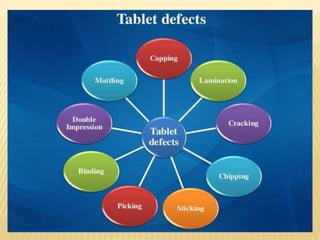
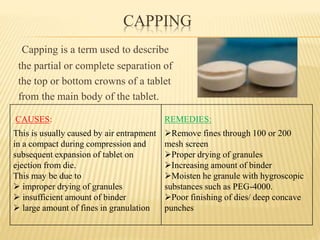
CAPPING
Capping is a term used to describe
the partial or complete separation of
the top or bottom crowns of a tablet
from the main body of the tablet.
CAUSES:
This is usually caused by air entrapment
in a compact during compression and
subsequent expansion of tablet on
ejection from die.
This may be due to
 improper drying of granules
 insufficient amount of binder
 large amount of fines in granulation
REMEDIES:
Remove fines through 100 or 200
mesh screen
Proper drying of granules
Increasing amount of binder
Moisten he granule with hygroscopic
substances such as PEG-4000.
Poor finishing of dies/ deep concave
punches
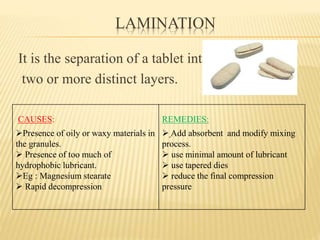
LAMINATION
It is the separation of a tablet into
two or more distinct layers.
CAUSES:
Presence of oily or waxy materials in
the granules.
 Presence of too much of
hydrophobic lubricant.
Eg : Magnesium stearate
 Rapid decompression
REMEDIES:
 Add absorbent and modify mixing
process.
 use minimal amount of lubricant
 use tapered dies
 reduce the final compression
pressure
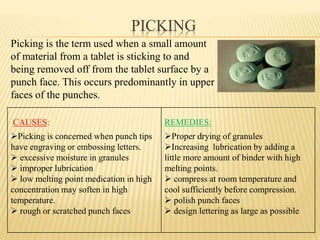
PICKING
CAUSES:
Picking is concerned when punch tips
have engraving or embossing letters.
 excessive moisture in granules
 improper lubrication
 low melting point medication in high
concentration may soften in high
temperature.
 rough or scratched punch faces
REMEDIES:
Proper drying of granules
Increasing lubrication by adding a
little more amount of binder with high
melting points.
 compress at room temperature and
cool sufficiently before compression.
 polish punch faces
 design lettering as large as possible
Picking is the term used when a small amount
of material from a tablet is sticking to and
being removed off from the tablet surface by a
punch face. This occurs predominantly in upper
faces of the punches.
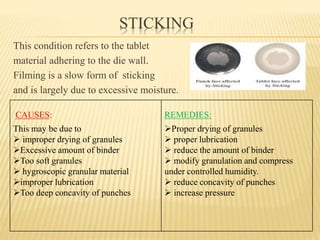
STICKING
This condition refers to the tablet
material adhering to the die wall.
Filming is a slow form of sticking
and is largely due to excessive moisture.
CAUSES:
This may be due to
 improper drying of granules
Excessive amount of binder
Too soft granules
 hygroscopic granular material
improper lubrication
Too deep concavity of punches
REMEDIES:
Proper drying of granules
 proper lubrication
 reduce the amount of binder
 modify granulation and compress
under controlled humidity.
 reduce concavity of punches
 increase pressure
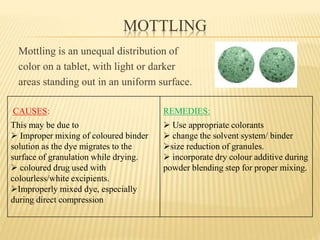
MOTTLING
Mottling is an unequal distribution of
color on a tablet, with light or darker
areas standing out in an uniform surface.
CAUSES:
This may be due to
 Improper mixing of coloured binder
solution as the dye migrates to the
surface of granulation while drying.
 coloured drug used with
colourless/white excipients.
Improperly mixed dye, especially
during direct compression
REMEDIES:
 Use appropriate colorants
 change the solvent system/ binder
size reduction of granules.
 incorporate dry colour additive during
powder blending step for proper mixing.
CHIPPING
CAUSES:
This may be due to
 Sticking on punch faces
 Too much binding might cause
chipping
 Concavity too deep to compress
 groove of die worn at compression
point
REMEDIES:
 proper drying of granules
 increasing lubrication
 optimize binding by using binders
 reduce concavity of punches instead
use flat punches
 Polish to open end, reverse or replace
the die.
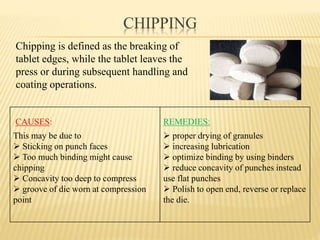
Chipping is defined as the breaking of
tablet edges, while the tablet leaves the
press or during subsequent handling and
coating operations.
CRACKING
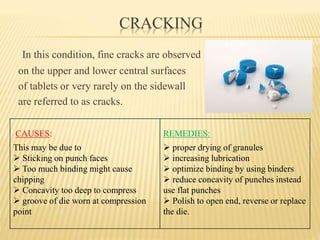
In this condition, fine cracks are observed
on the upper and lower central surfaces
of tablets or very rarely on the sidewall
are referred to as cracks.
CAUSES:
This may be due to
 Sticking on punch faces
 Too much binding might cause
chipping
 Concavity too deep to compress
 groove of die worn at compression
point
REMEDIES:
 proper drying of granules
 increasing lubrication
 optimize binding by using binders
 reduce concavity of punches instead
use flat punches
 Polish to open end, reverse or replace
the die.
Processing problems in tablet manufacturing

Processing problems in tablet manufacturing

  • 1.
    PROCESSING PROBLEMS INTABLET MANUFACTURING
  • 2.
    PROCESSING TABLETS INTABLET MANUFACTURING  An ideal tablet should be free from visual defect or functional defect.  In olden days tablets were initially punched on small scale hand operated missions, which suffered the problem of the varied strength and integrity.  With the modern evolution of industrial machinery, the tablet punching missions are mechanized.  However, the tablet processing problem still persists.  An industrial pharmacist usually encounters number of problems in tablet processing.  Majority of visual defects are due to inadequate fines or inadequate moisture in the granules ready for compression or due to defective machine setting.  Functional effects are due to defective formulation.
  • 4.
    CAPPING Capping is aterm used to describe the partial or complete separation of the top or bottom crowns of a tablet from the main body of the tablet. CAUSES: This is usually caused by air entrapment in a compact during compression and subsequent expansion of tablet on ejection from die. This may be due to  improper drying of granules  insufficient amount of binder  large amount of fines in granulation REMEDIES: Remove fines through 100 or 200 mesh screen Proper drying of granules Increasing amount of binder Moisten he granule with hygroscopic substances such as PEG-4000. Poor finishing of dies/ deep concave punches
  • 5.
    LAMINATION It is theseparation of a tablet into two or more distinct layers. CAUSES: Presence of oily or waxy materials in the granules.  Presence of too much of hydrophobic lubricant. Eg : Magnesium stearate  Rapid decompression REMEDIES:  Add absorbent and modify mixing process.  use minimal amount of lubricant  use tapered dies  reduce the final compression pressure
  • 6.
    PICKING CAUSES: Picking is concernedwhen punch tips have engraving or embossing letters.  excessive moisture in granules  improper lubrication  low melting point medication in high concentration may soften in high temperature.  rough or scratched punch faces REMEDIES: Proper drying of granules Increasing lubrication by adding a little more amount of binder with high melting points.  compress at room temperature and cool sufficiently before compression.  polish punch faces  design lettering as large as possible Picking is the term used when a small amount of material from a tablet is sticking to and being removed off from the tablet surface by a punch face. This occurs predominantly in upper faces of the punches.
  • 7.
    STICKING This condition refersto the tablet material adhering to the die wall. Filming is a slow form of sticking and is largely due to excessive moisture. CAUSES: This may be due to  improper drying of granules Excessive amount of binder Too soft granules  hygroscopic granular material improper lubrication Too deep concavity of punches REMEDIES: Proper drying of granules  proper lubrication  reduce the amount of binder  modify granulation and compress under controlled humidity.  reduce concavity of punches  increase pressure
  • 8.
    MOTTLING Mottling is anunequal distribution of color on a tablet, with light or darker areas standing out in an uniform surface. CAUSES: This may be due to  Improper mixing of coloured binder solution as the dye migrates to the surface of granulation while drying.  coloured drug used with colourless/white excipients. Improperly mixed dye, especially during direct compression REMEDIES:  Use appropriate colorants  change the solvent system/ binder size reduction of granules.  incorporate dry colour additive during powder blending step for proper mixing.
  • 9.
    CHIPPING CAUSES: This may bedue to  Sticking on punch faces  Too much binding might cause chipping  Concavity too deep to compress  groove of die worn at compression point REMEDIES:  proper drying of granules  increasing lubrication  optimize binding by using binders  reduce concavity of punches instead use flat punches  Polish to open end, reverse or replace the die. Chipping is defined as the breaking of tablet edges, while the tablet leaves the press or during subsequent handling and coating operations.
  • 10.
    CRACKING In this condition,fine cracks are observed on the upper and lower central surfaces of tablets or very rarely on the sidewall are referred to as cracks. CAUSES: This may be due to  Sticking on punch faces  Too much binding might cause chipping  Concavity too deep to compress  groove of die worn at compression point REMEDIES:  proper drying of granules  increasing lubrication  optimize binding by using binders  reduce concavity of punches instead use flat punches  Polish to open end, reverse or replace the die.