Presentation on
Optimisation and Evaluation of
microbially triggered chronotherapeutic
drug delivery system
Overview
๏ƒ˜ Introduction
๏ƒ˜ Aim and Objectives
๏ƒ˜ Why targeted to the colon
๏ƒ˜ Cardiovascular diseases and
chronotherapeutic
๏ƒ˜ Method
๏ƒ˜ Results
๏ƒ˜ Conclusion
INTRODUCTION
The chronotherapeutic drug delivery is one of the major
research areas, where the in vivo bioavailability of drug can
be timed to synchronize with the circadian rhythms of
disease in order to minimize side effects and to increase the
efficacy of treatment. Though chronotherapy can be achieved
through various drug delivery systems, Colon targeting drug
delivery plays an important role in achieving timed release
based on the circadian rhythm in the treatment of various
ailments such as asthma, cardiovascular disease, glaucoma,
rheumatoid arthritis and cancer.
Aim and Objectives:
The aim of the present work was to develop, optimize and
evaluate the microbially triggered CDDS.
๏ƒ˜ Delay the drug absorption.
๏ƒ˜ Targeted drug delivery to the colon would ensure direct treatment at the
disease site, lower dosing and fewer systemic side effects.
๏ƒ˜ Targeted drug delivery to the colon is considered to be beneficial in the
treatment of various colonic diseases.
๏ƒ˜ For oral administration of peptide and protein drugs.
๏ƒ˜ Colon targeting formulation could also be used to prolong the drug delivery.
๏ƒ˜ Formulations for colonic delivery are also suitable for delivery of drugs
which are polar and/or susceptible to chemical and enzymatic degradation in
the upper GIT.
๏ƒ˜ To prevent asthma, arthritis attacks in early morning
Why targeted to the Colon โ€ฆ?
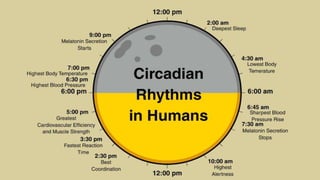
Cardiovascular diseases and chronotherapeutic:
This theory is based on the assumption of biological functions that
display constancy over time. However, chronobiological studies have
established circadian rhythm for almost all body functions.
For example, it has often been found that the blood pressure of a
hypertensive patient increases rapidly in the morning after
awakening, typically peaks in the middle to late time of the day,
decreases in the evening, and is lowest while the patient sleeps at
night. Currently, there are antihypertensive products in the market
that are chronotherapeutic medications with novel drug delivery
systems, releasing drug during the vulnerable period of 6 am to noon
upon administration of medications at 10 pm.
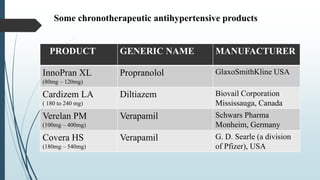
Some chronotherapeutic antihypertensive products
PRODUCT GENERIC NAME MANUFACTURER
InnoPran XL
(80mg โ€“ 120mg)
Propranolol GlaxoSmithKline USA
Cardizem LA
( 180 to 240 mg)
Diltiazem Biovail Corporation
Mississauga, Canada
Verelan PM
(100mg โ€“ 400mg)
Verapamil Schwars Pharma
Monheim, Germany
Covera HS
(180mg โ€“ 540mg)
Verapamil G. D. Searle (a division
of Pfizer), USA
Methods:
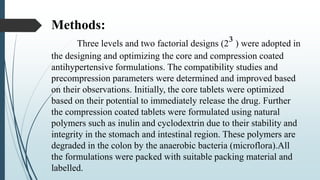
Three levels and two factorial designs (2ยณ ) were adopted in
the designing and optimizing the core and compression coated
antihypertensive formulations. The compatibility studies and
precompression parameters were determined and improved based
on their observations. Initially, the core tablets were optimized
based on their potential to immediately release the drug. Further
the compression coated tablets were formulated using natural
polymers such as inulin and cyclodextrin due to their stability and
integrity in the stomach and intestinal region. These polymers are
degraded in the colon by the anaerobic bacteria (microflora).All
the formulations were packed with suitable packing material and
labelled.
Results:
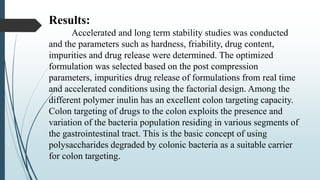
Accelerated and long term stability studies was conducted
and the parameters such as hardness, friability, drug content,
impurities and drug release were determined. The optimized
formulation was selected based on the post compression
parameters, impurities drug release of formulations from real time
and accelerated conditions using the factorial design. Among the
different polymer inulin has an excellent colon targeting capacity.
Colon targeting of drugs to the colon exploits the presence and
variation of the bacteria population residing in various segments of
the gastrointestinal tract. This is the basic concept of using
polysaccharides degraded by colonic bacteria as a suitable carrier
for colon targeting.
Conclusion:
Inulin is particularly attractive for this purpose because it is
not digested or absorbed in the upper GIT tract, whereas it is
significantly hydrolyzed by inulinases produced by Bifidobacterium
in the colon.
Keywords: CDDS; Inulin; Cyclodextrin; Antihypertension; Factorial design
THANK YOU

Presentation for seminar

  • 1.
    Presentation on Optimisation andEvaluation of microbially triggered chronotherapeutic drug delivery system
  • 2.
    Overview ๏ƒ˜ Introduction ๏ƒ˜ Aimand Objectives ๏ƒ˜ Why targeted to the colon ๏ƒ˜ Cardiovascular diseases and chronotherapeutic ๏ƒ˜ Method ๏ƒ˜ Results ๏ƒ˜ Conclusion
  • 3.
    INTRODUCTION The chronotherapeutic drugdelivery is one of the major research areas, where the in vivo bioavailability of drug can be timed to synchronize with the circadian rhythms of disease in order to minimize side effects and to increase the efficacy of treatment. Though chronotherapy can be achieved through various drug delivery systems, Colon targeting drug delivery plays an important role in achieving timed release based on the circadian rhythm in the treatment of various ailments such as asthma, cardiovascular disease, glaucoma, rheumatoid arthritis and cancer.
  • 4.
    Aim and Objectives: Theaim of the present work was to develop, optimize and evaluate the microbially triggered CDDS.
  • 5.
    ๏ƒ˜ Delay thedrug absorption. ๏ƒ˜ Targeted drug delivery to the colon would ensure direct treatment at the disease site, lower dosing and fewer systemic side effects. ๏ƒ˜ Targeted drug delivery to the colon is considered to be beneficial in the treatment of various colonic diseases. ๏ƒ˜ For oral administration of peptide and protein drugs. ๏ƒ˜ Colon targeting formulation could also be used to prolong the drug delivery. ๏ƒ˜ Formulations for colonic delivery are also suitable for delivery of drugs which are polar and/or susceptible to chemical and enzymatic degradation in the upper GIT. ๏ƒ˜ To prevent asthma, arthritis attacks in early morning Why targeted to the Colon โ€ฆ?
  • 6.
    Cardiovascular diseases andchronotherapeutic: This theory is based on the assumption of biological functions that display constancy over time. However, chronobiological studies have established circadian rhythm for almost all body functions. For example, it has often been found that the blood pressure of a hypertensive patient increases rapidly in the morning after awakening, typically peaks in the middle to late time of the day, decreases in the evening, and is lowest while the patient sleeps at night. Currently, there are antihypertensive products in the market that are chronotherapeutic medications with novel drug delivery systems, releasing drug during the vulnerable period of 6 am to noon upon administration of medications at 10 pm.
  • 8.
    Some chronotherapeutic antihypertensiveproducts PRODUCT GENERIC NAME MANUFACTURER InnoPran XL (80mg โ€“ 120mg) Propranolol GlaxoSmithKline USA Cardizem LA ( 180 to 240 mg) Diltiazem Biovail Corporation Mississauga, Canada Verelan PM (100mg โ€“ 400mg) Verapamil Schwars Pharma Monheim, Germany Covera HS (180mg โ€“ 540mg) Verapamil G. D. Searle (a division of Pfizer), USA
  • 9.
    Methods: Three levels andtwo factorial designs (2ยณ ) were adopted in the designing and optimizing the core and compression coated antihypertensive formulations. The compatibility studies and precompression parameters were determined and improved based on their observations. Initially, the core tablets were optimized based on their potential to immediately release the drug. Further the compression coated tablets were formulated using natural polymers such as inulin and cyclodextrin due to their stability and integrity in the stomach and intestinal region. These polymers are degraded in the colon by the anaerobic bacteria (microflora).All the formulations were packed with suitable packing material and labelled.
  • 10.
    Results: Accelerated and longterm stability studies was conducted and the parameters such as hardness, friability, drug content, impurities and drug release were determined. The optimized formulation was selected based on the post compression parameters, impurities drug release of formulations from real time and accelerated conditions using the factorial design. Among the different polymer inulin has an excellent colon targeting capacity. Colon targeting of drugs to the colon exploits the presence and variation of the bacteria population residing in various segments of the gastrointestinal tract. This is the basic concept of using polysaccharides degraded by colonic bacteria as a suitable carrier for colon targeting.
  • 11.
    Conclusion: Inulin is particularlyattractive for this purpose because it is not digested or absorbed in the upper GIT tract, whereas it is significantly hydrolyzed by inulinases produced by Bifidobacterium in the colon. Keywords: CDDS; Inulin; Cyclodextrin; Antihypertension; Factorial design
  • 12.