SOLVING
INEQUALITIES
SECTION 1-2
ESSENTIAL QUESTIONS
• How do you solve one step inequalities?
• How do you solve multi-step inequalities?
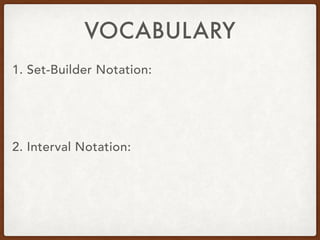
VOCABULARY
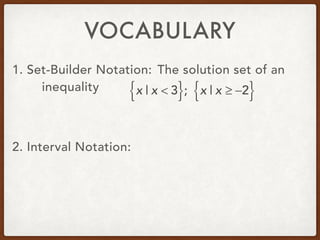
1. Set-Builder Notation:
2. Interval Notation:
VOCABULARY
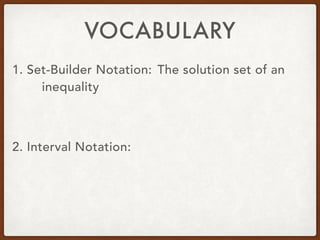
1. Set-Builder Notation: The solution set of an
inequality
2. Interval Notation:
VOCABULARY
1. Set-Builder Notation: The solution set of an
inequality
2. Interval Notation:
x | x < 3{ }; x | x ≥ −2{ }
VOCABULARY
1. Set-Builder Notation: The solution set of an
inequality
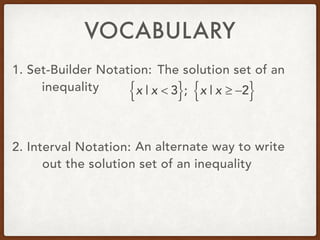
2. Interval Notation: An alternate way to write
out the solution set of an inequality
x | x < 3{ }; x | x ≥ −2{ }
VOCABULARY
1. Set-Builder Notation: The solution set of an
inequality
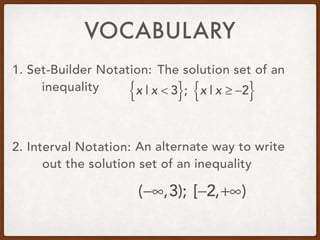
2. Interval Notation: An alternate way to write
out the solution set of an inequality
x | x < 3{ }; x | x ≥ −2{ }
(−∞,3); [−2,+∞)
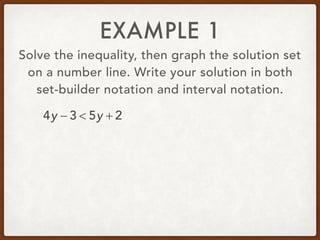
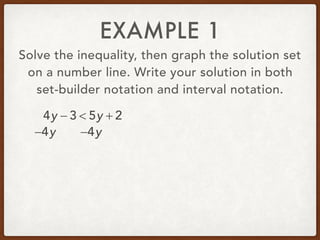
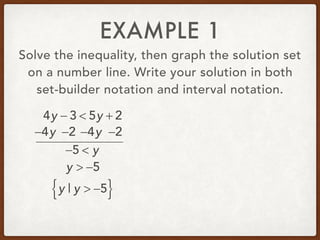
EXAMPLE 1
Solve the inequality, then graph the solution set
on a number line. Write your solution in both
set-builder notation and interval notation.
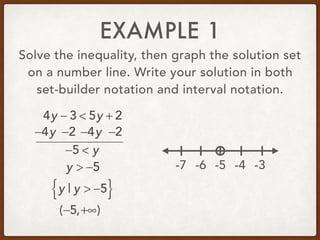
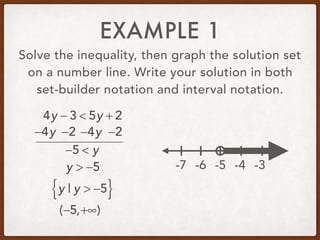
4y − 3 < 5y + 2
EXAMPLE 1
Solve the inequality, then graph the solution set
on a number line. Write your solution in both
set-builder notation and interval notation.
4y − 3 < 5y + 2
−4y −4y
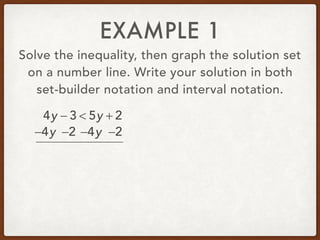
EXAMPLE 1
Solve the inequality, then graph the solution set
on a number line. Write your solution in both
set-builder notation and interval notation.
4y − 3 < 5y + 2
−4y −4y −2−2
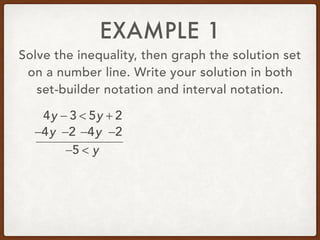
EXAMPLE 1
Solve the inequality, then graph the solution set
on a number line. Write your solution in both
set-builder notation and interval notation.
4y − 3 < 5y + 2
−4y −4y −2−2
−5 < y
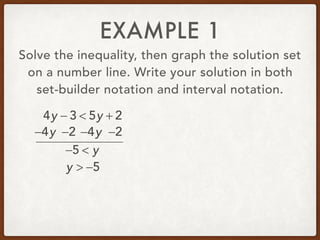
EXAMPLE 1
Solve the inequality, then graph the solution set
on a number line. Write your solution in both
set-builder notation and interval notation.
4y − 3 < 5y + 2
−4y −4y −2−2
−5 < y
y > −5
EXAMPLE 1
Solve the inequality, then graph the solution set
on a number line. Write your solution in both
set-builder notation and interval notation.
4y − 3 < 5y + 2
−4y −4y −2−2
−5 < y
y > −5
y | y > −5{ }
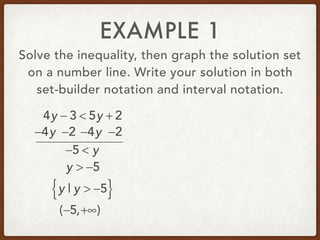
EXAMPLE 1
Solve the inequality, then graph the solution set
on a number line. Write your solution in both
set-builder notation and interval notation.
4y − 3 < 5y + 2
−4y −4y −2−2
−5 < y
y > −5
y | y > −5{ }
(−5,+∞)
EXAMPLE 1
Solve the inequality, then graph the solution set
on a number line. Write your solution in both
set-builder notation and interval notation.
4y − 3 < 5y + 2
−4y −4y −2−2
−5 < y
y > −5
y | y > −5{ }
(−5,+∞)
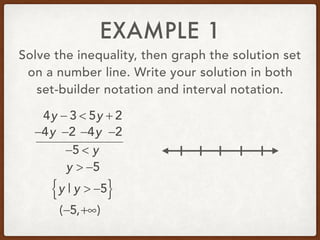
EXAMPLE 1
Solve the inequality, then graph the solution set
on a number line. Write your solution in both
set-builder notation and interval notation.
4y − 3 < 5y + 2
−4y −4y −2−2
−5 < y
y > −5
y | y > −5{ }
(−5,+∞)
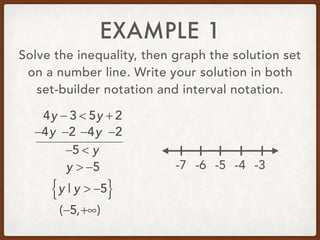
-5 -4 -3-6-7
EXAMPLE 1
Solve the inequality, then graph the solution set
on a number line. Write your solution in both
set-builder notation and interval notation.
4y − 3 < 5y + 2
−4y −4y −2−2
−5 < y
y > −5
y | y > −5{ }
(−5,+∞)
-5 -4 -3-6-7
EXAMPLE 1
Solve the inequality, then graph the solution set
on a number line. Write your solution in both
set-builder notation and interval notation.
4y − 3 < 5y + 2
−4y −4y −2−2
−5 < y
y > −5
y | y > −5{ }
(−5,+∞)
-5 -4 -3-6-7
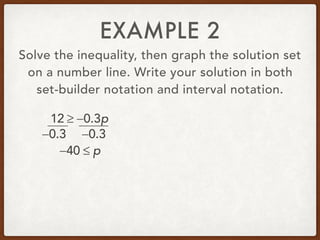
EXAMPLE 2
Solve the inequality, then graph the solution set
on a number line. Write your solution in both
set-builder notation and interval notation.
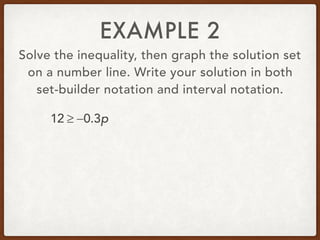
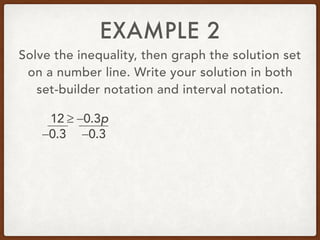
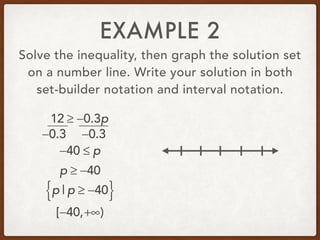
12 ≥ −0.3p
EXAMPLE 2
Solve the inequality, then graph the solution set
on a number line. Write your solution in both
set-builder notation and interval notation.
12 ≥ −0.3p
−0.3−0.3
EXAMPLE 2
Solve the inequality, then graph the solution set
on a number line. Write your solution in both
set-builder notation and interval notation.
12 ≥ −0.3p
−40 ≤ p
−0.3−0.3
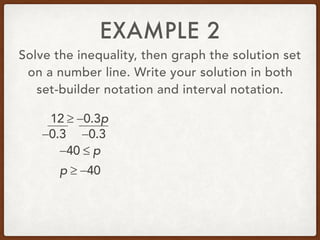
EXAMPLE 2
Solve the inequality, then graph the solution set
on a number line. Write your solution in both
set-builder notation and interval notation.
12 ≥ −0.3p
−40 ≤ p
−0.3−0.3
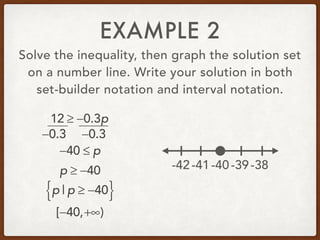
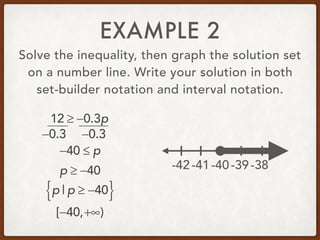
p ≥ −40
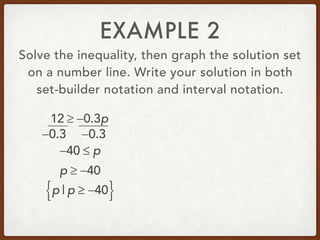
EXAMPLE 2
Solve the inequality, then graph the solution set
on a number line. Write your solution in both
set-builder notation and interval notation.
12 ≥ −0.3p
−40 ≤ p
p | p ≥ −40{ }
−0.3−0.3
p ≥ −40
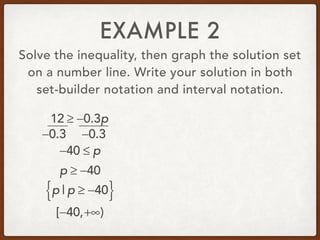
EXAMPLE 2
Solve the inequality, then graph the solution set
on a number line. Write your solution in both
set-builder notation and interval notation.
12 ≥ −0.3p
−40 ≤ p
p | p ≥ −40{ }
[−40,+∞)
−0.3−0.3
p ≥ −40
EXAMPLE 2
Solve the inequality, then graph the solution set
on a number line. Write your solution in both
set-builder notation and interval notation.
12 ≥ −0.3p
−40 ≤ p
p | p ≥ −40{ }
[−40,+∞)
−0.3−0.3
p ≥ −40
EXAMPLE 2
Solve the inequality, then graph the solution set
on a number line. Write your solution in both
set-builder notation and interval notation.
12 ≥ −0.3p
−40 ≤ p
p | p ≥ −40{ }
[−40,+∞)
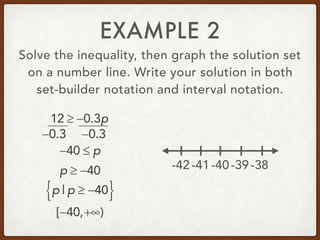
-40-39-38-41-42
−0.3−0.3
p ≥ −40
EXAMPLE 2
Solve the inequality, then graph the solution set
on a number line. Write your solution in both
set-builder notation and interval notation.
12 ≥ −0.3p
−40 ≤ p
p | p ≥ −40{ }
[−40,+∞)
-40-39-38-41-42
−0.3−0.3
p ≥ −40
EXAMPLE 2
Solve the inequality, then graph the solution set
on a number line. Write your solution in both
set-builder notation and interval notation.
12 ≥ −0.3p
−40 ≤ p
p | p ≥ −40{ }
[−40,+∞)
-40-39-38-41-42
−0.3−0.3
p ≥ −40
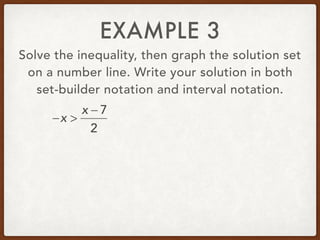
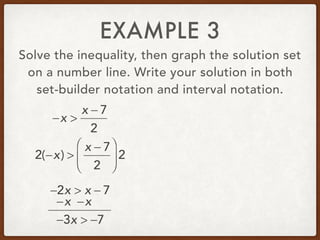
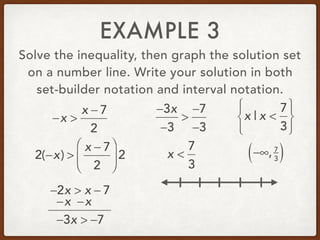
EXAMPLE 3
Solve the inequality, then graph the solution set
on a number line. Write your solution in both
set-builder notation and interval notation.
−x >
x − 7
2
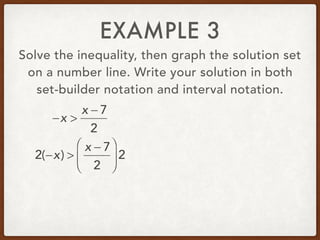
EXAMPLE 3
Solve the inequality, then graph the solution set
on a number line. Write your solution in both
set-builder notation and interval notation.
−x >
x − 7
2
2(−x) >
x − 7
2
⎛
⎝
⎜
⎞
⎠
⎟ 2
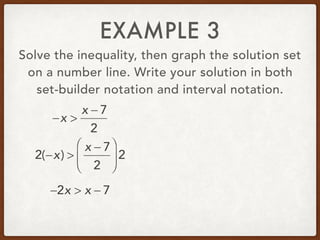
EXAMPLE 3
Solve the inequality, then graph the solution set
on a number line. Write your solution in both
set-builder notation and interval notation.
−x >
x − 7
2
−2x > x − 7
2(−x) >
x − 7
2
⎛
⎝
⎜
⎞
⎠
⎟ 2
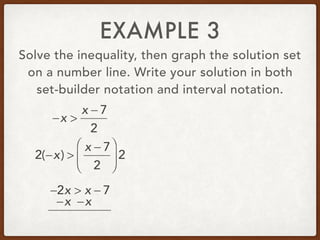
EXAMPLE 3
Solve the inequality, then graph the solution set
on a number line. Write your solution in both
set-builder notation and interval notation.
−x >
x − 7
2
−2x > x − 7
2(−x) >
x − 7
2
⎛
⎝
⎜
⎞
⎠
⎟ 2
−x−x
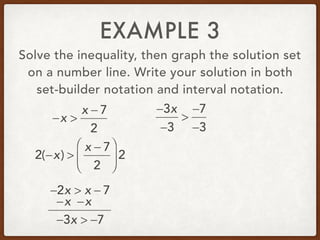
EXAMPLE 3
Solve the inequality, then graph the solution set
on a number line. Write your solution in both
set-builder notation and interval notation.
−x >
x − 7
2
−2x > x − 7
2(−x) >
x − 7
2
⎛
⎝
⎜
⎞
⎠
⎟ 2
−x−x
−3x > −7
EXAMPLE 3
Solve the inequality, then graph the solution set
on a number line. Write your solution in both
set-builder notation and interval notation.
−x >
x − 7
2
−2x > x − 7
2(−x) >
x − 7
2
⎛
⎝
⎜
⎞
⎠
⎟ 2
−x−x
−3x > −7
−3x
−3
>
−7
−3
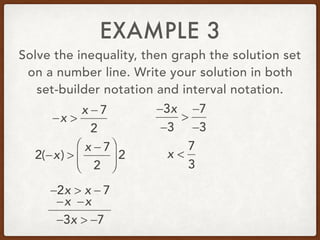
EXAMPLE 3
Solve the inequality, then graph the solution set
on a number line. Write your solution in both
set-builder notation and interval notation.
−x >
x − 7
2
−2x > x − 7
2(−x) >
x − 7
2
⎛
⎝
⎜
⎞
⎠
⎟ 2
−x−x
−3x > −7
−3x
−3
>
−7
−3
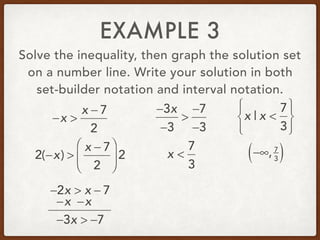
x <
7
3
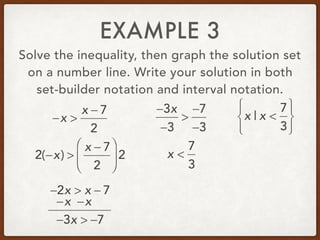
EXAMPLE 3
Solve the inequality, then graph the solution set
on a number line. Write your solution in both
set-builder notation and interval notation.
−x >
x − 7
2
−2x > x − 7
2(−x) >
x − 7
2
⎛
⎝
⎜
⎞
⎠
⎟ 2
−x−x
−3x > −7
−3x
−3
>
−7
−3
x <
7
3
x | x <
7
3
⎧
⎨
⎪
⎩⎪
⎫
⎬
⎪
⎭⎪
EXAMPLE 3
Solve the inequality, then graph the solution set
on a number line. Write your solution in both
set-builder notation and interval notation.
−x >
x − 7
2
−2x > x − 7
2(−x) >
x − 7
2
⎛
⎝
⎜
⎞
⎠
⎟ 2
−x−x
−3x > −7
−3x
−3
>
−7
−3
x <
7
3
x | x <
7
3
⎧
⎨
⎪
⎩⎪
⎫
⎬
⎪
⎭⎪
−∞, 7
3( )
EXAMPLE 3
Solve the inequality, then graph the solution set
on a number line. Write your solution in both
set-builder notation and interval notation.
−x >
x − 7
2
−2x > x − 7
2(−x) >
x − 7
2
⎛
⎝
⎜
⎞
⎠
⎟ 2
−x−x
−3x > −7
−3x
−3
>
−7
−3
x <
7
3
x | x <
7
3
⎧
⎨
⎪
⎩⎪
⎫
⎬
⎪
⎭⎪
−∞, 7
3( )
EXAMPLE 3
Solve the inequality, then graph the solution set
on a number line. Write your solution in both
set-builder notation and interval notation.
−x >
x − 7
2
−2x > x − 7
2(−x) >
x − 7
2
⎛
⎝
⎜
⎞
⎠
⎟ 2
−x−x
−3x > −7
−3x
−3
>
−7
−3
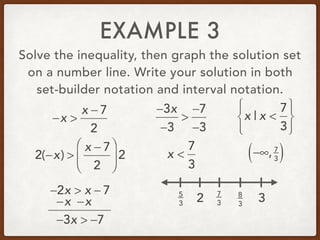
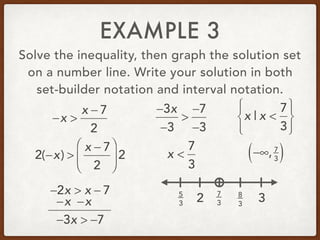
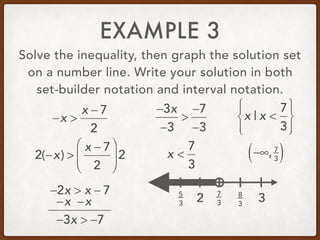
x <
7
3
7
3
8
3
325
3
x | x <
7
3
⎧
⎨
⎪
⎩⎪
⎫
⎬
⎪
⎭⎪
−∞, 7
3( )
EXAMPLE 3
Solve the inequality, then graph the solution set
on a number line. Write your solution in both
set-builder notation and interval notation.
−x >
x − 7
2
−2x > x − 7
2(−x) >
x − 7
2
⎛
⎝
⎜
⎞
⎠
⎟ 2
−x−x
−3x > −7
−3x
−3
>
−7
−3
x <
7
3
7
3
8
3
325
3
x | x <
7
3
⎧
⎨
⎪
⎩⎪
⎫
⎬
⎪
⎭⎪
−∞, 7
3( )
EXAMPLE 3
Solve the inequality, then graph the solution set
on a number line. Write your solution in both
set-builder notation and interval notation.
−x >
x − 7
2
−2x > x − 7
2(−x) >
x − 7
2
⎛
⎝
⎜
⎞
⎠
⎟ 2
−x−x
−3x > −7
−3x
−3
>
−7
−3
x <
7
3
7
3
8
3
325
3
x | x <
7
3
⎧
⎨
⎪
⎩⎪
⎫
⎬
⎪
⎭⎪
−∞, 7
3( )
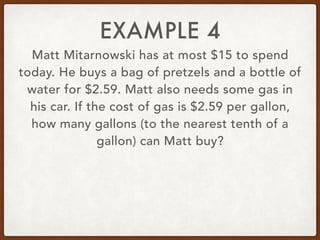
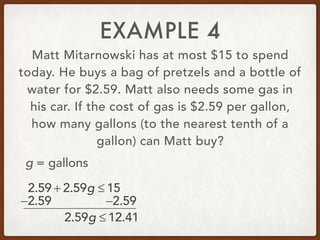
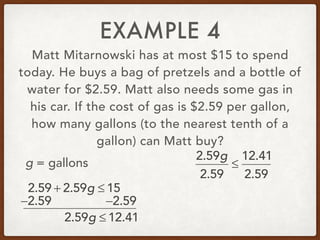
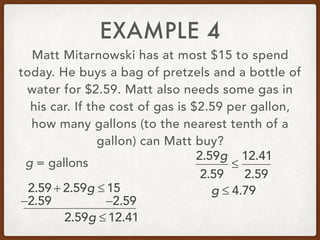
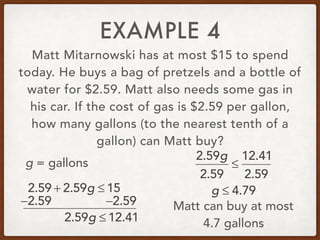
EXAMPLE 4
Matt Mitarnowski has at most $15 to spend
today. He buys a bag of pretzels and a bottle of
water for $2.59. Matt also needs some gas in
his car. If the cost of gas is $2.59 per gallon,
how many gallons (to the nearest tenth of a
gallon) can Matt buy?
EXAMPLE 4
Matt Mitarnowski has at most $15 to spend
today. He buys a bag of pretzels and a bottle of
water for $2.59. Matt also needs some gas in
his car. If the cost of gas is $2.59 per gallon,
how many gallons (to the nearest tenth of a
gallon) can Matt buy?
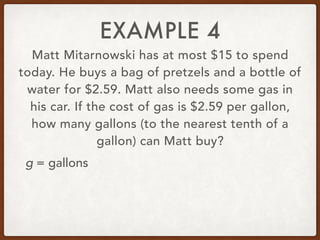
g = gallons
EXAMPLE 4
Matt Mitarnowski has at most $15 to spend
today. He buys a bag of pretzels and a bottle of
water for $2.59. Matt also needs some gas in
his car. If the cost of gas is $2.59 per gallon,
how many gallons (to the nearest tenth of a
gallon) can Matt buy?
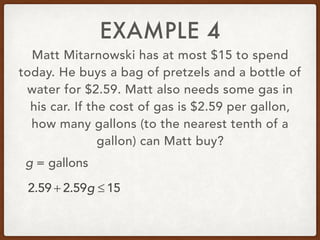
2.59 + 2.59g ≤ 15
g = gallons
EXAMPLE 4
Matt Mitarnowski has at most $15 to spend
today. He buys a bag of pretzels and a bottle of
water for $2.59. Matt also needs some gas in
his car. If the cost of gas is $2.59 per gallon,
how many gallons (to the nearest tenth of a
gallon) can Matt buy?
2.59 + 2.59g ≤ 15
g = gallons
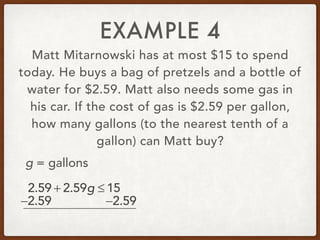
−2.59 −2.59
EXAMPLE 4
Matt Mitarnowski has at most $15 to spend
today. He buys a bag of pretzels and a bottle of
water for $2.59. Matt also needs some gas in
his car. If the cost of gas is $2.59 per gallon,
how many gallons (to the nearest tenth of a
gallon) can Matt buy?
2.59 + 2.59g ≤ 15
g = gallons
−2.59 −2.59
2.59g ≤ 12.41
EXAMPLE 4
Matt Mitarnowski has at most $15 to spend
today. He buys a bag of pretzels and a bottle of
water for $2.59. Matt also needs some gas in
his car. If the cost of gas is $2.59 per gallon,
how many gallons (to the nearest tenth of a
gallon) can Matt buy?
2.59 + 2.59g ≤ 15
g = gallons
−2.59 −2.59
2.59g ≤ 12.41
2.59g
2.59
≤
12.41
2.59
EXAMPLE 4
Matt Mitarnowski has at most $15 to spend
today. He buys a bag of pretzels and a bottle of
water for $2.59. Matt also needs some gas in
his car. If the cost of gas is $2.59 per gallon,
how many gallons (to the nearest tenth of a
gallon) can Matt buy?
2.59 + 2.59g ≤ 15
g = gallons
−2.59 −2.59
2.59g ≤ 12.41
2.59g
2.59
≤
12.41
2.59
g ≤ 4.79
EXAMPLE 4
Matt Mitarnowski has at most $15 to spend
today. He buys a bag of pretzels and a bottle of
water for $2.59. Matt also needs some gas in
his car. If the cost of gas is $2.59 per gallon,
how many gallons (to the nearest tenth of a
gallon) can Matt buy?
2.59 + 2.59g ≤ 15
g = gallons
−2.59 −2.59
2.59g ≤ 12.41
2.59g
2.59
≤
12.41
2.59
g ≤ 4.79
Matt can buy at most
4.7 gallons
EXAMPLE 5
Solve the inequality, then graph the solution set
on a number line. Write your solution in both
set-builder notation and interval notation.
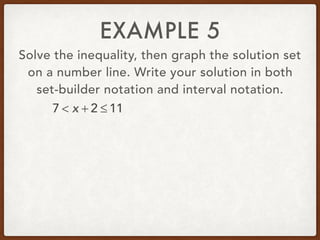
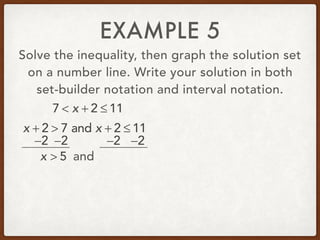
7 < x + 2 ≤ 11
EXAMPLE 5
Solve the inequality, then graph the solution set
on a number line. Write your solution in both
set-builder notation and interval notation.
7 < x + 2 ≤ 11
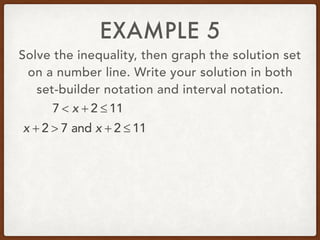
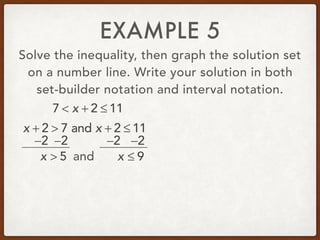
x + 2 > 7 and x + 2 ≤ 11
EXAMPLE 5
Solve the inequality, then graph the solution set
on a number line. Write your solution in both
set-builder notation and interval notation.
7 < x + 2 ≤ 11
x + 2 > 7 and x + 2 ≤ 11
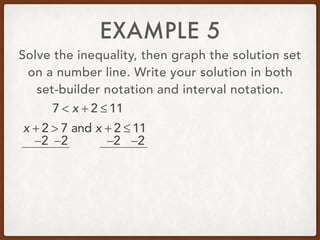
−2 −2 −2 −2
EXAMPLE 5
Solve the inequality, then graph the solution set
on a number line. Write your solution in both
set-builder notation and interval notation.
7 < x + 2 ≤ 11
x + 2 > 7 and x + 2 ≤ 11
−2 −2 −2 −2
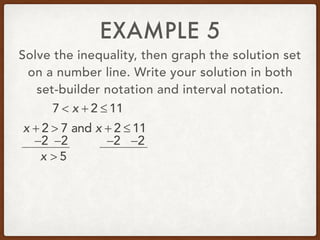
x > 5
EXAMPLE 5
Solve the inequality, then graph the solution set
on a number line. Write your solution in both
set-builder notation and interval notation.
7 < x + 2 ≤ 11
x + 2 > 7 and x + 2 ≤ 11
−2 −2 −2 −2
x > 5 and
EXAMPLE 5
Solve the inequality, then graph the solution set
on a number line. Write your solution in both
set-builder notation and interval notation.
7 < x + 2 ≤ 11
x + 2 > 7 and x + 2 ≤ 11
−2 −2 −2 −2
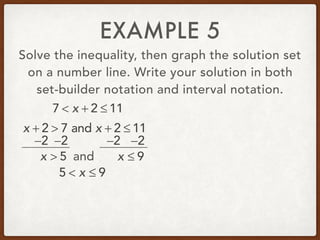
x > 5 and x ≤ 9
EXAMPLE 5
Solve the inequality, then graph the solution set
on a number line. Write your solution in both
set-builder notation and interval notation.
7 < x + 2 ≤ 11
x + 2 > 7 and x + 2 ≤ 11
−2 −2 −2 −2
x > 5 and x ≤ 9
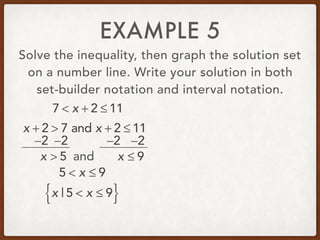
5 < x ≤ 9
EXAMPLE 5
Solve the inequality, then graph the solution set
on a number line. Write your solution in both
set-builder notation and interval notation.
7 < x + 2 ≤ 11
x + 2 > 7 and x + 2 ≤ 11
−2 −2 −2 −2
x > 5 and x ≤ 9
5 < x ≤ 9
x | 5 < x ≤ 9{ }
EXAMPLE 5
Solve the inequality, then graph the solution set
on a number line. Write your solution in both
set-builder notation and interval notation.
7 < x + 2 ≤ 11
x + 2 > 7 and x + 2 ≤ 11
−2 −2 −2 −2
x > 5 and x ≤ 9
5 < x ≤ 9
x | 5 < x ≤ 9{ }
(5,9]
EXAMPLE 5
Solve the inequality, then graph the solution set
on a number line. Write your solution in both
set-builder notation and interval notation.
7 < x + 2 ≤ 11
x + 2 > 7 and x + 2 ≤ 11
−2 −2 −2 −2
x > 5 and x ≤ 9
5 < x ≤ 9
x | 5 < x ≤ 9{ }
(5,9]
EXAMPLE 5
Solve the inequality, then graph the solution set
on a number line. Write your solution in both
set-builder notation and interval notation.
7 < x + 2 ≤ 11
x + 2 > 7 and x + 2 ≤ 11
−2 −2 −2 −2
x > 5 and x ≤ 9
5 < x ≤ 9
x | 5 < x ≤ 9{ }
(5,9]
5 6 7 8 9
EXAMPLE 5
Solve the inequality, then graph the solution set
on a number line. Write your solution in both
set-builder notation and interval notation.
7 < x + 2 ≤ 11
x + 2 > 7 and x + 2 ≤ 11
−2 −2 −2 −2
x > 5 and x ≤ 9
5 < x ≤ 9
x | 5 < x ≤ 9{ }
(5,9]
5 6 7 8 9
EXAMPLE 5
Solve the inequality, then graph the solution set
on a number line. Write your solution in both
set-builder notation and interval notation.
7 < x + 2 ≤ 11
x + 2 > 7 and x + 2 ≤ 11
−2 −2 −2 −2
x > 5 and x ≤ 9
5 < x ≤ 9
x | 5 < x ≤ 9{ }
(5,9]
5 6 7 8 9
EXAMPLE 5
Solve the inequality, then graph the solution set
on a number line. Write your solution in both
set-builder notation and interval notation.
7 < x + 2 ≤ 11
x + 2 > 7 and x + 2 ≤ 11
−2 −2 −2 −2
x > 5 and x ≤ 9
5 < x ≤ 9
x | 5 < x ≤ 9{ }
(5,9]
5 6 7 8 9
EXAMPLE 6
Graph the solution set on a number line.
(−∞,5]∪ (7,+∞)
EXAMPLE 6
Graph the solution set on a number line.
(−∞,5]∪ (7,+∞)
EXAMPLE 6
Graph the solution set on a number line.
(−∞,5]∪ (7,+∞)
5 6 7 84
EXAMPLE 6
Graph the solution set on a number line.
(−∞,5]∪ (7,+∞)
5 6 7 84
EXAMPLE 6
Graph the solution set on a number line.
(−∞,5]∪ (7,+∞)
5 6 7 84
EXAMPLE 6
Graph the solution set on a number line.
(−∞,5]∪ (7,+∞)
5 6 7 84
EXAMPLE 6
Graph the solution set on a number line.
(−∞,5]∪ (7,+∞)
5 6 7 84
PROBLEM SET
PROBLEM SET
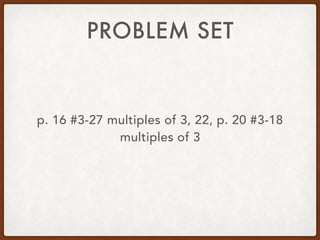
p. 16 #3-27 multiples of 3, 22, p. 20 #3-18
multiples of 3

Algebra 2 Section 1-2

  • 1.
  • 2.
    ESSENTIAL QUESTIONS • Howdo you solve one step inequalities? • How do you solve multi-step inequalities?
  • 3.
  • 4.
    VOCABULARY 1. Set-Builder Notation:The solution set of an inequality 2. Interval Notation:
  • 5.
    VOCABULARY 1. Set-Builder Notation:The solution set of an inequality 2. Interval Notation: x | x < 3{ }; x | x ≥ −2{ }
  • 6.
    VOCABULARY 1. Set-Builder Notation:The solution set of an inequality 2. Interval Notation: An alternate way to write out the solution set of an inequality x | x < 3{ }; x | x ≥ −2{ }
  • 7.
    VOCABULARY 1. Set-Builder Notation:The solution set of an inequality 2. Interval Notation: An alternate way to write out the solution set of an inequality x | x < 3{ }; x | x ≥ −2{ } (−∞,3); [−2,+∞)
  • 8.
    EXAMPLE 1 Solve theinequality, then graph the solution set on a number line. Write your solution in both set-builder notation and interval notation. 4y − 3 < 5y + 2
  • 9.
    EXAMPLE 1 Solve theinequality, then graph the solution set on a number line. Write your solution in both set-builder notation and interval notation. 4y − 3 < 5y + 2 −4y −4y
  • 10.
    EXAMPLE 1 Solve theinequality, then graph the solution set on a number line. Write your solution in both set-builder notation and interval notation. 4y − 3 < 5y + 2 −4y −4y −2−2
  • 11.
    EXAMPLE 1 Solve theinequality, then graph the solution set on a number line. Write your solution in both set-builder notation and interval notation. 4y − 3 < 5y + 2 −4y −4y −2−2 −5 < y
  • 12.
    EXAMPLE 1 Solve theinequality, then graph the solution set on a number line. Write your solution in both set-builder notation and interval notation. 4y − 3 < 5y + 2 −4y −4y −2−2 −5 < y y > −5
  • 13.
    EXAMPLE 1 Solve theinequality, then graph the solution set on a number line. Write your solution in both set-builder notation and interval notation. 4y − 3 < 5y + 2 −4y −4y −2−2 −5 < y y > −5 y | y > −5{ }
  • 14.
    EXAMPLE 1 Solve theinequality, then graph the solution set on a number line. Write your solution in both set-builder notation and interval notation. 4y − 3 < 5y + 2 −4y −4y −2−2 −5 < y y > −5 y | y > −5{ } (−5,+∞)
  • 15.
    EXAMPLE 1 Solve theinequality, then graph the solution set on a number line. Write your solution in both set-builder notation and interval notation. 4y − 3 < 5y + 2 −4y −4y −2−2 −5 < y y > −5 y | y > −5{ } (−5,+∞)
  • 16.
    EXAMPLE 1 Solve theinequality, then graph the solution set on a number line. Write your solution in both set-builder notation and interval notation. 4y − 3 < 5y + 2 −4y −4y −2−2 −5 < y y > −5 y | y > −5{ } (−5,+∞) -5 -4 -3-6-7
  • 17.
    EXAMPLE 1 Solve theinequality, then graph the solution set on a number line. Write your solution in both set-builder notation and interval notation. 4y − 3 < 5y + 2 −4y −4y −2−2 −5 < y y > −5 y | y > −5{ } (−5,+∞) -5 -4 -3-6-7
  • 18.
    EXAMPLE 1 Solve theinequality, then graph the solution set on a number line. Write your solution in both set-builder notation and interval notation. 4y − 3 < 5y + 2 −4y −4y −2−2 −5 < y y > −5 y | y > −5{ } (−5,+∞) -5 -4 -3-6-7
  • 19.
    EXAMPLE 2 Solve theinequality, then graph the solution set on a number line. Write your solution in both set-builder notation and interval notation. 12 ≥ −0.3p
  • 20.
    EXAMPLE 2 Solve theinequality, then graph the solution set on a number line. Write your solution in both set-builder notation and interval notation. 12 ≥ −0.3p −0.3−0.3
  • 21.
    EXAMPLE 2 Solve theinequality, then graph the solution set on a number line. Write your solution in both set-builder notation and interval notation. 12 ≥ −0.3p −40 ≤ p −0.3−0.3
  • 22.
    EXAMPLE 2 Solve theinequality, then graph the solution set on a number line. Write your solution in both set-builder notation and interval notation. 12 ≥ −0.3p −40 ≤ p −0.3−0.3 p ≥ −40
  • 23.
    EXAMPLE 2 Solve theinequality, then graph the solution set on a number line. Write your solution in both set-builder notation and interval notation. 12 ≥ −0.3p −40 ≤ p p | p ≥ −40{ } −0.3−0.3 p ≥ −40
  • 24.
    EXAMPLE 2 Solve theinequality, then graph the solution set on a number line. Write your solution in both set-builder notation and interval notation. 12 ≥ −0.3p −40 ≤ p p | p ≥ −40{ } [−40,+∞) −0.3−0.3 p ≥ −40
  • 25.
    EXAMPLE 2 Solve theinequality, then graph the solution set on a number line. Write your solution in both set-builder notation and interval notation. 12 ≥ −0.3p −40 ≤ p p | p ≥ −40{ } [−40,+∞) −0.3−0.3 p ≥ −40
  • 26.
    EXAMPLE 2 Solve theinequality, then graph the solution set on a number line. Write your solution in both set-builder notation and interval notation. 12 ≥ −0.3p −40 ≤ p p | p ≥ −40{ } [−40,+∞) -40-39-38-41-42 −0.3−0.3 p ≥ −40
  • 27.
    EXAMPLE 2 Solve theinequality, then graph the solution set on a number line. Write your solution in both set-builder notation and interval notation. 12 ≥ −0.3p −40 ≤ p p | p ≥ −40{ } [−40,+∞) -40-39-38-41-42 −0.3−0.3 p ≥ −40
  • 28.
    EXAMPLE 2 Solve theinequality, then graph the solution set on a number line. Write your solution in both set-builder notation and interval notation. 12 ≥ −0.3p −40 ≤ p p | p ≥ −40{ } [−40,+∞) -40-39-38-41-42 −0.3−0.3 p ≥ −40
  • 29.
    EXAMPLE 3 Solve theinequality, then graph the solution set on a number line. Write your solution in both set-builder notation and interval notation. −x > x − 7 2
  • 30.
    EXAMPLE 3 Solve theinequality, then graph the solution set on a number line. Write your solution in both set-builder notation and interval notation. −x > x − 7 2 2(−x) > x − 7 2 ⎛ ⎝ ⎜ ⎞ ⎠ ⎟ 2
  • 31.
    EXAMPLE 3 Solve theinequality, then graph the solution set on a number line. Write your solution in both set-builder notation and interval notation. −x > x − 7 2 −2x > x − 7 2(−x) > x − 7 2 ⎛ ⎝ ⎜ ⎞ ⎠ ⎟ 2
  • 32.
    EXAMPLE 3 Solve theinequality, then graph the solution set on a number line. Write your solution in both set-builder notation and interval notation. −x > x − 7 2 −2x > x − 7 2(−x) > x − 7 2 ⎛ ⎝ ⎜ ⎞ ⎠ ⎟ 2 −x−x
  • 33.
    EXAMPLE 3 Solve theinequality, then graph the solution set on a number line. Write your solution in both set-builder notation and interval notation. −x > x − 7 2 −2x > x − 7 2(−x) > x − 7 2 ⎛ ⎝ ⎜ ⎞ ⎠ ⎟ 2 −x−x −3x > −7
  • 34.
    EXAMPLE 3 Solve theinequality, then graph the solution set on a number line. Write your solution in both set-builder notation and interval notation. −x > x − 7 2 −2x > x − 7 2(−x) > x − 7 2 ⎛ ⎝ ⎜ ⎞ ⎠ ⎟ 2 −x−x −3x > −7 −3x −3 > −7 −3
  • 35.
    EXAMPLE 3 Solve theinequality, then graph the solution set on a number line. Write your solution in both set-builder notation and interval notation. −x > x − 7 2 −2x > x − 7 2(−x) > x − 7 2 ⎛ ⎝ ⎜ ⎞ ⎠ ⎟ 2 −x−x −3x > −7 −3x −3 > −7 −3 x < 7 3
  • 36.
    EXAMPLE 3 Solve theinequality, then graph the solution set on a number line. Write your solution in both set-builder notation and interval notation. −x > x − 7 2 −2x > x − 7 2(−x) > x − 7 2 ⎛ ⎝ ⎜ ⎞ ⎠ ⎟ 2 −x−x −3x > −7 −3x −3 > −7 −3 x < 7 3 x | x < 7 3 ⎧ ⎨ ⎪ ⎩⎪ ⎫ ⎬ ⎪ ⎭⎪
  • 37.
    EXAMPLE 3 Solve theinequality, then graph the solution set on a number line. Write your solution in both set-builder notation and interval notation. −x > x − 7 2 −2x > x − 7 2(−x) > x − 7 2 ⎛ ⎝ ⎜ ⎞ ⎠ ⎟ 2 −x−x −3x > −7 −3x −3 > −7 −3 x < 7 3 x | x < 7 3 ⎧ ⎨ ⎪ ⎩⎪ ⎫ ⎬ ⎪ ⎭⎪ −∞, 7 3( )
  • 38.
    EXAMPLE 3 Solve theinequality, then graph the solution set on a number line. Write your solution in both set-builder notation and interval notation. −x > x − 7 2 −2x > x − 7 2(−x) > x − 7 2 ⎛ ⎝ ⎜ ⎞ ⎠ ⎟ 2 −x−x −3x > −7 −3x −3 > −7 −3 x < 7 3 x | x < 7 3 ⎧ ⎨ ⎪ ⎩⎪ ⎫ ⎬ ⎪ ⎭⎪ −∞, 7 3( )
  • 39.
    EXAMPLE 3 Solve theinequality, then graph the solution set on a number line. Write your solution in both set-builder notation and interval notation. −x > x − 7 2 −2x > x − 7 2(−x) > x − 7 2 ⎛ ⎝ ⎜ ⎞ ⎠ ⎟ 2 −x−x −3x > −7 −3x −3 > −7 −3 x < 7 3 7 3 8 3 325 3 x | x < 7 3 ⎧ ⎨ ⎪ ⎩⎪ ⎫ ⎬ ⎪ ⎭⎪ −∞, 7 3( )
  • 40.
    EXAMPLE 3 Solve theinequality, then graph the solution set on a number line. Write your solution in both set-builder notation and interval notation. −x > x − 7 2 −2x > x − 7 2(−x) > x − 7 2 ⎛ ⎝ ⎜ ⎞ ⎠ ⎟ 2 −x−x −3x > −7 −3x −3 > −7 −3 x < 7 3 7 3 8 3 325 3 x | x < 7 3 ⎧ ⎨ ⎪ ⎩⎪ ⎫ ⎬ ⎪ ⎭⎪ −∞, 7 3( )
  • 41.
    EXAMPLE 3 Solve theinequality, then graph the solution set on a number line. Write your solution in both set-builder notation and interval notation. −x > x − 7 2 −2x > x − 7 2(−x) > x − 7 2 ⎛ ⎝ ⎜ ⎞ ⎠ ⎟ 2 −x−x −3x > −7 −3x −3 > −7 −3 x < 7 3 7 3 8 3 325 3 x | x < 7 3 ⎧ ⎨ ⎪ ⎩⎪ ⎫ ⎬ ⎪ ⎭⎪ −∞, 7 3( )
  • 42.
    EXAMPLE 4 Matt Mitarnowskihas at most $15 to spend today. He buys a bag of pretzels and a bottle of water for $2.59. Matt also needs some gas in his car. If the cost of gas is $2.59 per gallon, how many gallons (to the nearest tenth of a gallon) can Matt buy?
  • 43.
    EXAMPLE 4 Matt Mitarnowskihas at most $15 to spend today. He buys a bag of pretzels and a bottle of water for $2.59. Matt also needs some gas in his car. If the cost of gas is $2.59 per gallon, how many gallons (to the nearest tenth of a gallon) can Matt buy? g = gallons
  • 44.
    EXAMPLE 4 Matt Mitarnowskihas at most $15 to spend today. He buys a bag of pretzels and a bottle of water for $2.59. Matt also needs some gas in his car. If the cost of gas is $2.59 per gallon, how many gallons (to the nearest tenth of a gallon) can Matt buy? 2.59 + 2.59g ≤ 15 g = gallons
  • 45.
    EXAMPLE 4 Matt Mitarnowskihas at most $15 to spend today. He buys a bag of pretzels and a bottle of water for $2.59. Matt also needs some gas in his car. If the cost of gas is $2.59 per gallon, how many gallons (to the nearest tenth of a gallon) can Matt buy? 2.59 + 2.59g ≤ 15 g = gallons −2.59 −2.59
  • 46.
    EXAMPLE 4 Matt Mitarnowskihas at most $15 to spend today. He buys a bag of pretzels and a bottle of water for $2.59. Matt also needs some gas in his car. If the cost of gas is $2.59 per gallon, how many gallons (to the nearest tenth of a gallon) can Matt buy? 2.59 + 2.59g ≤ 15 g = gallons −2.59 −2.59 2.59g ≤ 12.41
  • 47.
    EXAMPLE 4 Matt Mitarnowskihas at most $15 to spend today. He buys a bag of pretzels and a bottle of water for $2.59. Matt also needs some gas in his car. If the cost of gas is $2.59 per gallon, how many gallons (to the nearest tenth of a gallon) can Matt buy? 2.59 + 2.59g ≤ 15 g = gallons −2.59 −2.59 2.59g ≤ 12.41 2.59g 2.59 ≤ 12.41 2.59
  • 48.
    EXAMPLE 4 Matt Mitarnowskihas at most $15 to spend today. He buys a bag of pretzels and a bottle of water for $2.59. Matt also needs some gas in his car. If the cost of gas is $2.59 per gallon, how many gallons (to the nearest tenth of a gallon) can Matt buy? 2.59 + 2.59g ≤ 15 g = gallons −2.59 −2.59 2.59g ≤ 12.41 2.59g 2.59 ≤ 12.41 2.59 g ≤ 4.79
  • 49.
    EXAMPLE 4 Matt Mitarnowskihas at most $15 to spend today. He buys a bag of pretzels and a bottle of water for $2.59. Matt also needs some gas in his car. If the cost of gas is $2.59 per gallon, how many gallons (to the nearest tenth of a gallon) can Matt buy? 2.59 + 2.59g ≤ 15 g = gallons −2.59 −2.59 2.59g ≤ 12.41 2.59g 2.59 ≤ 12.41 2.59 g ≤ 4.79 Matt can buy at most 4.7 gallons
  • 50.
    EXAMPLE 5 Solve theinequality, then graph the solution set on a number line. Write your solution in both set-builder notation and interval notation. 7 < x + 2 ≤ 11
  • 51.
    EXAMPLE 5 Solve theinequality, then graph the solution set on a number line. Write your solution in both set-builder notation and interval notation. 7 < x + 2 ≤ 11 x + 2 > 7 and x + 2 ≤ 11
  • 52.
    EXAMPLE 5 Solve theinequality, then graph the solution set on a number line. Write your solution in both set-builder notation and interval notation. 7 < x + 2 ≤ 11 x + 2 > 7 and x + 2 ≤ 11 −2 −2 −2 −2
  • 53.
    EXAMPLE 5 Solve theinequality, then graph the solution set on a number line. Write your solution in both set-builder notation and interval notation. 7 < x + 2 ≤ 11 x + 2 > 7 and x + 2 ≤ 11 −2 −2 −2 −2 x > 5
  • 54.
    EXAMPLE 5 Solve theinequality, then graph the solution set on a number line. Write your solution in both set-builder notation and interval notation. 7 < x + 2 ≤ 11 x + 2 > 7 and x + 2 ≤ 11 −2 −2 −2 −2 x > 5 and
  • 55.
    EXAMPLE 5 Solve theinequality, then graph the solution set on a number line. Write your solution in both set-builder notation and interval notation. 7 < x + 2 ≤ 11 x + 2 > 7 and x + 2 ≤ 11 −2 −2 −2 −2 x > 5 and x ≤ 9
  • 56.
    EXAMPLE 5 Solve theinequality, then graph the solution set on a number line. Write your solution in both set-builder notation and interval notation. 7 < x + 2 ≤ 11 x + 2 > 7 and x + 2 ≤ 11 −2 −2 −2 −2 x > 5 and x ≤ 9 5 < x ≤ 9
  • 57.
    EXAMPLE 5 Solve theinequality, then graph the solution set on a number line. Write your solution in both set-builder notation and interval notation. 7 < x + 2 ≤ 11 x + 2 > 7 and x + 2 ≤ 11 −2 −2 −2 −2 x > 5 and x ≤ 9 5 < x ≤ 9 x | 5 < x ≤ 9{ }
  • 58.
    EXAMPLE 5 Solve theinequality, then graph the solution set on a number line. Write your solution in both set-builder notation and interval notation. 7 < x + 2 ≤ 11 x + 2 > 7 and x + 2 ≤ 11 −2 −2 −2 −2 x > 5 and x ≤ 9 5 < x ≤ 9 x | 5 < x ≤ 9{ } (5,9]
  • 59.
    EXAMPLE 5 Solve theinequality, then graph the solution set on a number line. Write your solution in both set-builder notation and interval notation. 7 < x + 2 ≤ 11 x + 2 > 7 and x + 2 ≤ 11 −2 −2 −2 −2 x > 5 and x ≤ 9 5 < x ≤ 9 x | 5 < x ≤ 9{ } (5,9]
  • 60.
    EXAMPLE 5 Solve theinequality, then graph the solution set on a number line. Write your solution in both set-builder notation and interval notation. 7 < x + 2 ≤ 11 x + 2 > 7 and x + 2 ≤ 11 −2 −2 −2 −2 x > 5 and x ≤ 9 5 < x ≤ 9 x | 5 < x ≤ 9{ } (5,9] 5 6 7 8 9
  • 61.
    EXAMPLE 5 Solve theinequality, then graph the solution set on a number line. Write your solution in both set-builder notation and interval notation. 7 < x + 2 ≤ 11 x + 2 > 7 and x + 2 ≤ 11 −2 −2 −2 −2 x > 5 and x ≤ 9 5 < x ≤ 9 x | 5 < x ≤ 9{ } (5,9] 5 6 7 8 9
  • 62.
    EXAMPLE 5 Solve theinequality, then graph the solution set on a number line. Write your solution in both set-builder notation and interval notation. 7 < x + 2 ≤ 11 x + 2 > 7 and x + 2 ≤ 11 −2 −2 −2 −2 x > 5 and x ≤ 9 5 < x ≤ 9 x | 5 < x ≤ 9{ } (5,9] 5 6 7 8 9
  • 63.
    EXAMPLE 5 Solve theinequality, then graph the solution set on a number line. Write your solution in both set-builder notation and interval notation. 7 < x + 2 ≤ 11 x + 2 > 7 and x + 2 ≤ 11 −2 −2 −2 −2 x > 5 and x ≤ 9 5 < x ≤ 9 x | 5 < x ≤ 9{ } (5,9] 5 6 7 8 9
  • 64.
    EXAMPLE 6 Graph thesolution set on a number line. (−∞,5]∪ (7,+∞)
  • 65.
    EXAMPLE 6 Graph thesolution set on a number line. (−∞,5]∪ (7,+∞)
  • 66.
    EXAMPLE 6 Graph thesolution set on a number line. (−∞,5]∪ (7,+∞) 5 6 7 84
  • 67.
    EXAMPLE 6 Graph thesolution set on a number line. (−∞,5]∪ (7,+∞) 5 6 7 84
  • 68.
    EXAMPLE 6 Graph thesolution set on a number line. (−∞,5]∪ (7,+∞) 5 6 7 84
  • 69.
    EXAMPLE 6 Graph thesolution set on a number line. (−∞,5]∪ (7,+∞) 5 6 7 84
  • 70.
    EXAMPLE 6 Graph thesolution set on a number line. (−∞,5]∪ (7,+∞) 5 6 7 84
  • 71.
  • 72.
    PROBLEM SET p. 16#3-27 multiples of 3, 22, p. 20 #3-18 multiples of 3