


BIOTECHNOLOGY


PRODUCTION
OF BIODIESEL
FROM ALGAE
            BY Gokul Achari
            B.E (Chemical)
            M.G.M C.E.T
            Kamothe
            Email id:
            gokulachari@gmail.com
Less dependence on fossil fuels
Predicted earlier for alternative
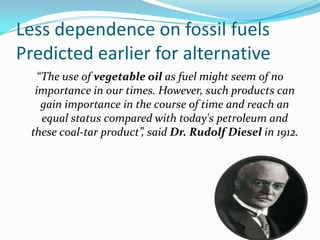
   “The use of vegetable oil as fuel might seem of no
  importance in our times. However, such products can
    gain importance in the course of time and reach an
    equal status compared with today's petroleum and
 these coal-tar product”, said Dr. Rudolf Diesel in 1912.
Why Algae for Biodiesel????
     In the beginning, there were algae, but there was no
    oil Then, from algae came oil. Now, the algae are still
    there, but oil is fast depleting In future, there will be
    no oil, but there will still be algae So, doesn’t it make
    sense to explore if we can again get oil from algae? This
    is what we try to do –explore the potential of getting
    oil from algaeBiodiesel
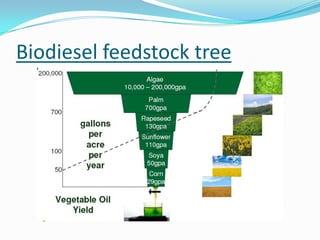
Biodiesel feedstock tree
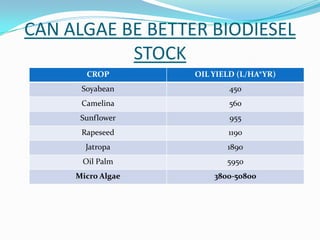
CAN ALGAE BE BETTER BIODIESEL
           STOCK
       CROP        OIL YIELD (L/HA*YR)
      Soyabean             450
      Camelina             560
      Sunflower            955
      Rapeseed            1190
       Jatropa            1890
      Oil Palm            5950
     Micro Algae       3800-50800
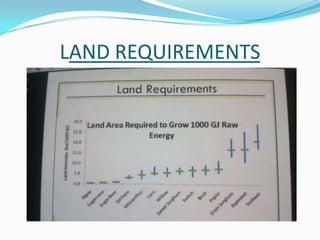
LAND REQUIREMENTS
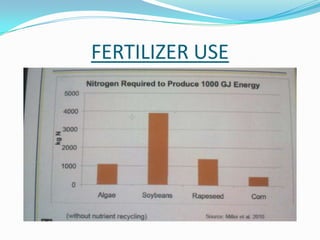
FERTILIZER USE
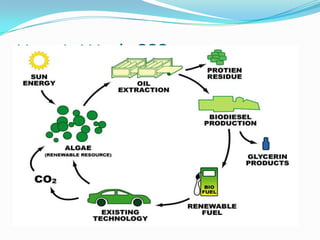
How It Works???
Advantages of Biodiesel from
algae oil

 Rapid growth rates
 A high per-acre yield (7 to 31 times greater than the
    next best crop – palm oil)
   Certain species of algae can be harvested daily
   Algae biofuel contains no sulphur
   Algae biofuel is non-toxic
   Algae biofuel is highly bio-degradable
Advantages of Biodiesel from
algae oil
 Algae consume carbon dioxide as they grow, so they
  could be used to capture CO2 from power stations and
  other industrial plant that would otherwise go into the
  atmosphere.
 Many more……
Selection of Algal strain
very important
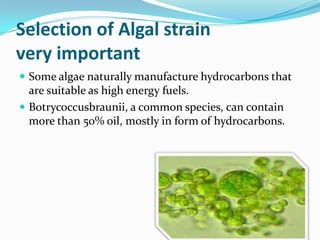
 Some algae naturally manufacture hydrocarbons that
  are suitable as high energy fuels.
 Botrycoccusbraunii, a common species, can contain
  more than 50% oil, mostly in form of hydrocarbons.
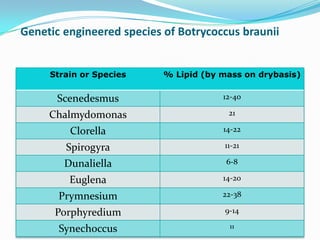
Genetic engineered species of Botrycoccus braunii


     Strain or Species     % Lipid (by mass on drybasis)


      Scenedesmus                      12-40

     Chalmydomonas                       21

         Clorella                      14-22

        Spirogyra                      11-21

        Dunaliella                      6-8

         Euglena                       14-20

       Prymnesium                      22-38

      Porphyredium                      9-14

       Synechoccus                       11
Mass production of Biodiesel from
algae

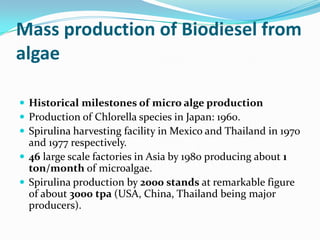
 Historical milestones of micro alge production
 Production of Chlorella species in Japan: 1960.
 Spirulina harvesting facility in Mexico and Thailand in 1970
  and 1977 respectively.
 46 large scale factories in Asia by 1980 producing about 1
  ton/month of microalgae.
 Spirulina production by 2000 stands at remarkable figure
  of about 3000 tpa (USA, China, Thailand being major
  producers).
What effects Algal Growth??
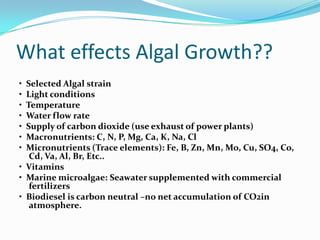
• Selected Algal strain
• Light conditions
• Temperature
• Water flow rate
• Supply of carbon dioxide (use exhaust of power plants)
• Macronutrients: C, N, P, Mg, Ca, K, Na, Cl
• Micronutrients (Trace elements): Fe, B, Zn, Mn, Mo, Cu, SO4, Co,
   Cd, Va, Al, Br, Etc..
• Vitamins
• Marine microalgae: Seawater supplemented with commercial
   fertilizers
• Biodiesel is carbon neutral –no net accumulation of CO2in
   atmosphere.
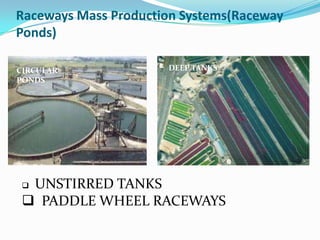
Raceways Mass Production Systems(Raceway
Ponds)

CIRCULAR              DEEP TANKS
PONDS


 UNSTIRRED TANKS
  PADDLE WHEEL RACEWAYS
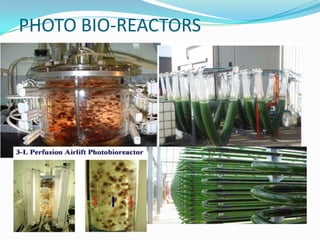
PHOTO BIO-REACTORS
FEATURES OF RACEWAY PONDS
Closed loop recirculation channel; mixing achieved with paddle
  wheel.
•MOC: concrete, compacted earth or lining with white plastic to
  reduce seepage losses.
•Typical dimensions: Depth –20-30 cm; Area –100-250 hectare,
  production –0.1 to 0.5 g dry weight per liter.
•Limitations:
–Significant evaporation losses.
– Poor thermal or temperature control.
– Poor utilization of CO2due to evaporation or stripping.
– Contamination from unwanted algae and micro-organisms.
– Low biomass concentration due to poor mixing and optically
  dark zones.
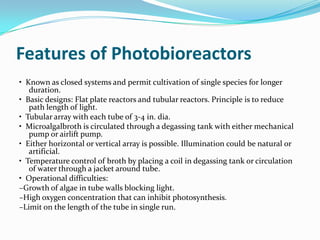
Features of Photobioreactors
• Known as closed systems and permit cultivation of single species for longer
   duration.
• Basic designs: Flat plate reactors and tubular reactors. Principle is to reduce
   path length of light.
• Tubular array with each tube of 3-4 in. dia.
• Microalgalbroth is circulated through a degassing tank with either mechanical
   pump or airlift pump.
• Either horizontal or vertical array is possible. Illumination could be natural or
   artificial.
• Temperature control of broth by placing a coil in degassing tank or circulation
   of water through a jacket around tube.
• Operational difficulties:
–Growth of algae in tube walls blocking light.
–High oxygen concentration that can inhibit photosynthesis.
–Limit on the length of the tube in single run.
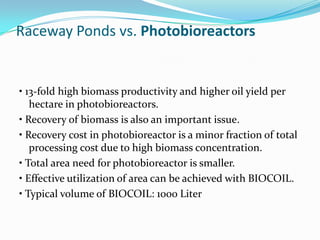
Raceway Ponds vs. Photobioreactors


• 13-fold high biomass productivity and higher oil yield per
   hectare in photobioreactors.
• Recovery of biomass is also an important issue.
• Recovery cost in photobioreactor is a minor fraction of total
   processing cost due to high biomass concentration.
• Total area need for photobioreactor is smaller.
• Effective utilization of area can be achieved with BIOCOIL.
• Typical volume of BIOCOIL: 1000 Liter
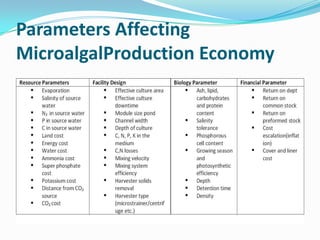
Parameters Affecting
MicroalgalProduction Economy
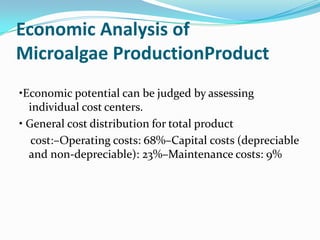
Economic Analysis of
Microalgae ProductionProduct
•Economic potential can be judged by assessing
  individual cost centers.
• General cost distribution for total product
   cost:–Operating costs: 68%–Capital costs (depreciable
  and non-depreciable): 23%–Maintenance costs: 9%
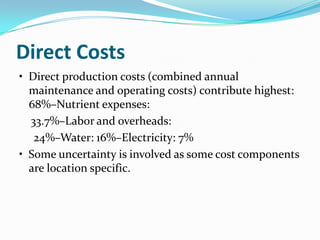
Direct Costs
• Direct production costs (combined annual
  maintenance and operating costs) contribute highest:
  68%–Nutrient expenses:
  33.7%–Labor and overheads:
   24%–Water: 16%–Electricity: 7%
• Some uncertainty is involved as some cost components
  are location specific.
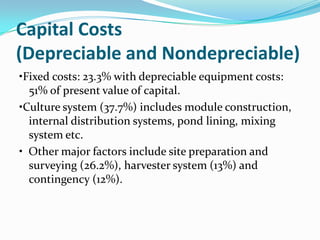
Capital Costs
(Depreciable and Nondepreciable)
•Fixed costs: 23.3% with depreciable equipment costs:
  51% of present value of capital.
•Culture system (37.7%) includes module construction,
  internal distribution systems, pond lining, mixing
  system etc.
• Other major factors include site preparation and
  surveying (26.2%), harvester system (13%) and
  contingency (12%).
Nondepreciable Capital
•These are non-equipment expenditures not subject to
  depreciation.
•49% of total present value of capital investment.
•Use of novel technology warrants higher contingency
  allowance.
•Low contribution of land cost is due to use of marginal
  land for algae cultivation.
Depreciable Investment
• Specific life time for each equipment differs but average
   life is ~ 15 years.
• Highest contribution by the harvesting system.
• Lining of pond bottoms, construction of piping
   system, mixing system are other components
   contributing to depreciation.
Improvement of
MicroalgalBiodiesel Economics
• Biorefinerybased strategy to utilize every component of biomass
   raw material.
– Residual biomass can be animal feed.
– Anaerobic digestion of biomass for methane production which
   can be used for producing electricity.
• Revenue earned out of side products can improve economics of
   production.
• Other strategies would be genetic and metabolic engineering.
   Possible methodologies are:
– Increase photosynthetic efficiency.
– Enhance biomass growth rate.
– Increase lipid or oil content of biomass.
– Elimination of light saturation phenomena, photo-inhibition
   effect, susceptibility to bio-oxidation.
CONCLUSION
• Microalgalroute to biodiesel is a potential alternative to vegetable oil.
• Overall economics of the process needs improvement to be competitive
   substitute to petrodiesel.
• Roots of improvement in economy lie in both science and technology of
   microalgae.
• Enhancement in lipid content through genetic modification is one
   route.
• Much simpler and effective way to achieve the same goal would through
   photobioreactor engineering. Extensive research on diverse aspects of
   photobioreactor is needed.
• Biorefinery approach can also improve the economics significantly.
REFERENCES
 http://algaetechinternational.com/page.php?22
 http://www.nasa.gov/centers/ames/research/OMEGA/index.html
 The microalgalbiodiesel project at I.I.T. Guwahati has been sponsored by
  Defense Research Laboratory (DRDO) at Tezpur, Assam.
 Genetic Engineering of Algae for Biofuel Production
  Stephen Mayfield
  Department of Cell Biology and
  The Skaggs Institute for Chemical Biology
   The Scripps Research Institute
 From wet algae to liquid fuel
  by Phillip E. Savage, University of Michigan, Chem Department
REFERENCES
 Environmental biotechnology second edition by Alan
  Scragg.
 Biodiesel from Algae oil Research report by Leonard
  Wagner
 www.oilgae.com
 www.aiche.org
Thank you!!!!!
Production of Biodiesel from Algae

Production of Biodiesel from Algae

  • 1.
    BIOTECHNOLOGY PRODUCTION OF BIODIESEL FROM ALGAE BY Gokul Achari B.E (Chemical) M.G.M C.E.T Kamothe Email id: gokulachari@gmail.com
  • 2.
    Less dependence onfossil fuels Predicted earlier for alternative “The use of vegetable oil as fuel might seem of no importance in our times. However, such products can gain importance in the course of time and reach an equal status compared with today's petroleum and these coal-tar product”, said Dr. Rudolf Diesel in 1912.
  • 4.
    Why Algae forBiodiesel????  In the beginning, there were algae, but there was no oil Then, from algae came oil. Now, the algae are still there, but oil is fast depleting In future, there will be no oil, but there will still be algae So, doesn’t it make sense to explore if we can again get oil from algae? This is what we try to do –explore the potential of getting oil from algaeBiodiesel
  • 5.
  • 6.
    CAN ALGAE BEBETTER BIODIESEL STOCK CROP OIL YIELD (L/HA*YR) Soyabean 450 Camelina 560 Sunflower 955 Rapeseed 1190 Jatropa 1890 Oil Palm 5950 Micro Algae 3800-50800
  • 7.
  • 8.
  • 9.
  • 10.
    Advantages of Biodieselfrom algae oil  Rapid growth rates  A high per-acre yield (7 to 31 times greater than the next best crop – palm oil)  Certain species of algae can be harvested daily  Algae biofuel contains no sulphur  Algae biofuel is non-toxic  Algae biofuel is highly bio-degradable
  • 11.
    Advantages of Biodieselfrom algae oil  Algae consume carbon dioxide as they grow, so they could be used to capture CO2 from power stations and other industrial plant that would otherwise go into the atmosphere.  Many more……
  • 12.
    Selection of Algalstrain very important  Some algae naturally manufacture hydrocarbons that are suitable as high energy fuels.  Botrycoccusbraunii, a common species, can contain more than 50% oil, mostly in form of hydrocarbons.
  • 13.
    Genetic engineered speciesof Botrycoccus braunii Strain or Species % Lipid (by mass on drybasis) Scenedesmus 12-40 Chalmydomonas 21 Clorella 14-22 Spirogyra 11-21 Dunaliella 6-8 Euglena 14-20 Prymnesium 22-38 Porphyredium 9-14 Synechoccus 11
  • 14.
    Mass production ofBiodiesel from algae  Historical milestones of micro alge production  Production of Chlorella species in Japan: 1960.  Spirulina harvesting facility in Mexico and Thailand in 1970 and 1977 respectively.  46 large scale factories in Asia by 1980 producing about 1 ton/month of microalgae.  Spirulina production by 2000 stands at remarkable figure of about 3000 tpa (USA, China, Thailand being major producers).
  • 15.
    What effects AlgalGrowth?? • Selected Algal strain • Light conditions • Temperature • Water flow rate • Supply of carbon dioxide (use exhaust of power plants) • Macronutrients: C, N, P, Mg, Ca, K, Na, Cl • Micronutrients (Trace elements): Fe, B, Zn, Mn, Mo, Cu, SO4, Co, Cd, Va, Al, Br, Etc.. • Vitamins • Marine microalgae: Seawater supplemented with commercial fertilizers • Biodiesel is carbon neutral –no net accumulation of CO2in atmosphere.
  • 16.
    Raceways Mass ProductionSystems(Raceway Ponds) CIRCULAR DEEP TANKS PONDS UNSTIRRED TANKS  PADDLE WHEEL RACEWAYS
  • 17.
  • 18.
    FEATURES OF RACEWAYPONDS Closed loop recirculation channel; mixing achieved with paddle wheel. •MOC: concrete, compacted earth or lining with white plastic to reduce seepage losses. •Typical dimensions: Depth –20-30 cm; Area –100-250 hectare, production –0.1 to 0.5 g dry weight per liter. •Limitations: –Significant evaporation losses. – Poor thermal or temperature control. – Poor utilization of CO2due to evaporation or stripping. – Contamination from unwanted algae and micro-organisms. – Low biomass concentration due to poor mixing and optically dark zones.
  • 19.
    Features of Photobioreactors •Known as closed systems and permit cultivation of single species for longer duration. • Basic designs: Flat plate reactors and tubular reactors. Principle is to reduce path length of light. • Tubular array with each tube of 3-4 in. dia. • Microalgalbroth is circulated through a degassing tank with either mechanical pump or airlift pump. • Either horizontal or vertical array is possible. Illumination could be natural or artificial. • Temperature control of broth by placing a coil in degassing tank or circulation of water through a jacket around tube. • Operational difficulties: –Growth of algae in tube walls blocking light. –High oxygen concentration that can inhibit photosynthesis. –Limit on the length of the tube in single run.
  • 20.
    Raceway Ponds vs.Photobioreactors • 13-fold high biomass productivity and higher oil yield per hectare in photobioreactors. • Recovery of biomass is also an important issue. • Recovery cost in photobioreactor is a minor fraction of total processing cost due to high biomass concentration. • Total area need for photobioreactor is smaller. • Effective utilization of area can be achieved with BIOCOIL. • Typical volume of BIOCOIL: 1000 Liter
  • 21.
  • 22.
    Economic Analysis of MicroalgaeProductionProduct •Economic potential can be judged by assessing individual cost centers. • General cost distribution for total product cost:–Operating costs: 68%–Capital costs (depreciable and non-depreciable): 23%–Maintenance costs: 9%
  • 23.
    Direct Costs • Directproduction costs (combined annual maintenance and operating costs) contribute highest: 68%–Nutrient expenses: 33.7%–Labor and overheads: 24%–Water: 16%–Electricity: 7% • Some uncertainty is involved as some cost components are location specific.
  • 24.
    Capital Costs (Depreciable andNondepreciable) •Fixed costs: 23.3% with depreciable equipment costs: 51% of present value of capital. •Culture system (37.7%) includes module construction, internal distribution systems, pond lining, mixing system etc. • Other major factors include site preparation and surveying (26.2%), harvester system (13%) and contingency (12%).
  • 25.
    Nondepreciable Capital •These arenon-equipment expenditures not subject to depreciation. •49% of total present value of capital investment. •Use of novel technology warrants higher contingency allowance. •Low contribution of land cost is due to use of marginal land for algae cultivation.
  • 26.
    Depreciable Investment • Specificlife time for each equipment differs but average life is ~ 15 years. • Highest contribution by the harvesting system. • Lining of pond bottoms, construction of piping system, mixing system are other components contributing to depreciation.
  • 27.
    Improvement of MicroalgalBiodiesel Economics •Biorefinerybased strategy to utilize every component of biomass raw material. – Residual biomass can be animal feed. – Anaerobic digestion of biomass for methane production which can be used for producing electricity. • Revenue earned out of side products can improve economics of production. • Other strategies would be genetic and metabolic engineering. Possible methodologies are: – Increase photosynthetic efficiency. – Enhance biomass growth rate. – Increase lipid or oil content of biomass. – Elimination of light saturation phenomena, photo-inhibition effect, susceptibility to bio-oxidation.
  • 28.
    CONCLUSION • Microalgalroute tobiodiesel is a potential alternative to vegetable oil. • Overall economics of the process needs improvement to be competitive substitute to petrodiesel. • Roots of improvement in economy lie in both science and technology of microalgae. • Enhancement in lipid content through genetic modification is one route. • Much simpler and effective way to achieve the same goal would through photobioreactor engineering. Extensive research on diverse aspects of photobioreactor is needed. • Biorefinery approach can also improve the economics significantly.
  • 29.
    REFERENCES  http://algaetechinternational.com/page.php?22  http://www.nasa.gov/centers/ames/research/OMEGA/index.html The microalgalbiodiesel project at I.I.T. Guwahati has been sponsored by Defense Research Laboratory (DRDO) at Tezpur, Assam.  Genetic Engineering of Algae for Biofuel Production Stephen Mayfield Department of Cell Biology and The Skaggs Institute for Chemical Biology The Scripps Research Institute  From wet algae to liquid fuel by Phillip E. Savage, University of Michigan, Chem Department
  • 30.
    REFERENCES  Environmental biotechnologysecond edition by Alan Scragg.  Biodiesel from Algae oil Research report by Leonard Wagner  www.oilgae.com  www.aiche.org
  • 31.