Dr. P. Suganya
Assistant Professor
Department of Biotechnology
Sri Kaliswari College
(Autonomous)
Sivakasi
ALGAE CLASSIFICATION
 Linnaeus in 1753 was first to introduced the term algae
(Latin- seaweeds) meaning, the Hepaticeae.
 The algae (singular: alga) many of which are are unicellular.
 Algae are ubiquitous, most of algae lives in aquatic
environment but many also thrive a terrestrial and a
subterranean alga.
 Algae contains chlorophyll and are photosynthetic.
 algae are of great general interest to all biologist because
single algal cells are complete organism capable of
photosynthesis and the synthesis of a multitude of other
compounds which constitutes the cell.
 The branch that deals with the study of algae are known as
as phycology.
 Algae chlorophyll bearing thalloid.
INTRODUCTION
 Algae are present everywhere in distribution.
 They occur in great abundance in oceans, seas, ponds, fresh
water, steams and Salt Lake.
 Many are found in soil of dam, rocks, stones, and bark of tree
and on other animals and plants surface.
 Small aquatic forms make a large of the free floating
microscopic life in water, called plankton.
 Phytoplankton is made up of plants i.e. algal forms.
 Zooplankton is composed of animal organisms.
 Some Species of algae grow on the snow and ice of polar region
and mountain peaks.
 Some, algae grow in hot springes at temperature has high as
55°C.
 Some are Endophytice. They are not free living but live in other
organisms such algae are widespread in protozoa, molluscus,
sponges and corals.
OCCURRENCE
 Morphology
 Algae have a wide range of size and shapes.
 Algae that occur as unicellular and they are spherical, rod-shaped,
club-shaped, or spindle shaped.
 Many are multicellular and have understandable form, shape and
various complexity.
 Algal cells are eukaryotic.
 In most of the algal species cell wall is very rigid and thin.
 Cell wall of diatoms are contain silica which makes them thick and
rigid.
 The motile algae have flexible cell membrane called Periplasts.
eg. Spirulina.
 Algae contains a discrete nucleus.
 Chlorophyll and other pigments are found in membrane bound
organelles known as Chloroplast.
 Within the plastid matrix or stroma are found flattened membranes
vesicles called Thylakoid.
CHARACTERISTICS
 Algal pigments
There are three kinds of photosynthetic pigments are present in
algae:
 chlorophyll
 carotenoid
 biloproteins or phycobilins
Chlorophyll
 There are five chlorophylls: A, B, C, D and
 Chlorophyll A is present in all algae.
 Chlorophyll B – Euglenophycophyta, Cholorophycophyta.
 Chlorophyll C– Xanthophycophyta, Bacillariophycophyta,
Chrysophycophyta, Cryptophycophyta.
 Chlorophyll D – Rhodophycophyta
 Chlorophyll E – Xanthophycophyta.
Carotenoids
 There are two kinds of carotenoids:
 Carotenes – linear, unsaturated hydrocarbon.
 Xanthophyll – oxygenated derivatives.
 Biloproteins or phycobilins
 It is water soluble pigments.
 Present in Rhodophycophyta.
 Two types of phycobilins – Phycocyanin, Phycoerythrin
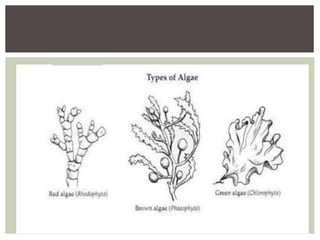
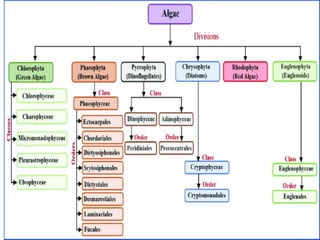
 The are three main groups of algae being:
 Green algae
 Red algae
 Brown algae.
 They are classified on the basis of following characteristics:
 Primary photosynthetic pigments.
 Storage product.
 Cell wall composition.
 Type and location of flagella.
CLASSIFICATION OF ALAGE
 Habitat – Freshwater, Marine and terrestrial.
 Photosynthetic pigments- Chlorophyll A and B carotenoid.
 Cell wall components- Cellulose.
 Storage food- Starch (stored inside the plastids).
 Flagella- Two flagella per cell.
 Asexual reproduction- reproduce vegetatively by fermentation
or by formation of mitospores.
 Sexual reproduction- reproduction is of Isogamous,
Anisogamous, Oogamous.
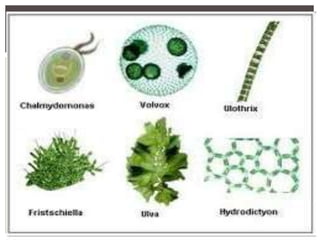
 Example- Chlamydomonas, Volvox, ulothrix, chara, ulva (sea
lettuce).
Example- Chlamydomonas, Volvox, ulothrix, chara, ulva (sea
lettuce).
GREEN ALGAE – CHLOROPHYCEAE
 Habitat- Marine and freshwater.
 Photosynthetic pigment- Chlorophyll A and D, carotenoids and
phycobilins. Commonly called red alage because of presence
of red pigment – phycoerythrin.
 Cell wall components- Cellulose
 Stored food- Floridian starch (alpha -1,4 glucon) stored in
cytosol.
 Flagella- Absent.
 Asexual reproduction- By fragmentation or by non-motile
mitospores.
 Sexual reproduction- Oogamous and gametes are non- motile.
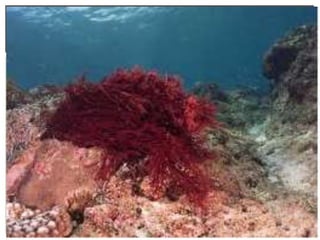
 Example – Polysiphoria, Gracilaria and Gelidium.
RED ALGAE – RHODOPHYCEAE
 Habitat- marine and freshwater.
 Photosynthetic pigment- chlorophyll A and C, carotenoids and
phycobilins.
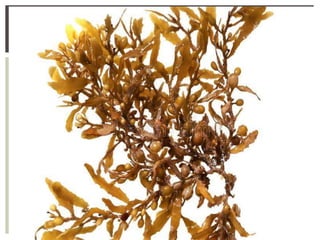
 Shades of brown depends on xanthophyll pigment,
fucoxanthin, present.
 Cell wall components- cellulose and alginic acid.
 Cellulose is covered by a gelatinous coating of Algin.
 Stored food- Laminarin, mannitol
 Flagella- 2, unequal, lateral.
 Asexual reproduction- by fragmentation or by motile
zoospores.
 Sexual reproduction- is isogamous, anisogamous, Oogamous.
 Example – Ectocarpus, Laminaria, fucus.
BROWN ALGAE – PHAEOPHYCEAE
 Algae as primary producers- algae provides the base or beginning of most
aquatic animals or organisms because of their photosynthetic activities so
it is also known as primary producers of organic matter.
 Commercial products from algae- many products are derived from algal cell
wall for economic value. Three of these are: Agar Alginic Acid,
and Carrageenan, are produced from the walls of algae.
 Carrageenan is produced from the walls of several red algae. Species
of Chondrus, Gigartina are mostly used.
 Agar is well known as a solidifying agent in the preparation of
microbiological media. It is obtained from red algae. Species
of Gelidium and Gracilaria are extensively used.
 Alginic acid and its salts are obtained from the wall for brown algae.
Species of brown algae producing this compound include-
Macrocystis, Laminaria, Fucus.
 Algae as food- many species of algae are (mostly red and brown algae) are
used as food in the far east.
 Red algae one of the most important is Porphyra: it is used as food in
Japan where it is called
 Other red algae such as Chondrus, Nemalion are locally collected and
prepared.
ECONOMIC IMPORTANCE OF ALGAE
 https://www.biologydiscussion.com/algae/algae-definition-
characteristics-and-structure-with diagram/46727
REFERENCES

Algae classification

  • 1.
    Dr. P. Suganya AssistantProfessor Department of Biotechnology Sri Kaliswari College (Autonomous) Sivakasi ALGAE CLASSIFICATION
  • 2.
     Linnaeus in1753 was first to introduced the term algae (Latin- seaweeds) meaning, the Hepaticeae.  The algae (singular: alga) many of which are are unicellular.  Algae are ubiquitous, most of algae lives in aquatic environment but many also thrive a terrestrial and a subterranean alga.  Algae contains chlorophyll and are photosynthetic.  algae are of great general interest to all biologist because single algal cells are complete organism capable of photosynthesis and the synthesis of a multitude of other compounds which constitutes the cell.  The branch that deals with the study of algae are known as as phycology.  Algae chlorophyll bearing thalloid. INTRODUCTION
  • 3.
     Algae arepresent everywhere in distribution.  They occur in great abundance in oceans, seas, ponds, fresh water, steams and Salt Lake.  Many are found in soil of dam, rocks, stones, and bark of tree and on other animals and plants surface.  Small aquatic forms make a large of the free floating microscopic life in water, called plankton.  Phytoplankton is made up of plants i.e. algal forms.  Zooplankton is composed of animal organisms.  Some Species of algae grow on the snow and ice of polar region and mountain peaks.  Some, algae grow in hot springes at temperature has high as 55°C.  Some are Endophytice. They are not free living but live in other organisms such algae are widespread in protozoa, molluscus, sponges and corals. OCCURRENCE
  • 5.
     Morphology  Algaehave a wide range of size and shapes.  Algae that occur as unicellular and they are spherical, rod-shaped, club-shaped, or spindle shaped.  Many are multicellular and have understandable form, shape and various complexity.  Algal cells are eukaryotic.  In most of the algal species cell wall is very rigid and thin.  Cell wall of diatoms are contain silica which makes them thick and rigid.  The motile algae have flexible cell membrane called Periplasts. eg. Spirulina.  Algae contains a discrete nucleus.  Chlorophyll and other pigments are found in membrane bound organelles known as Chloroplast.  Within the plastid matrix or stroma are found flattened membranes vesicles called Thylakoid. CHARACTERISTICS
  • 6.
     Algal pigments Thereare three kinds of photosynthetic pigments are present in algae:  chlorophyll  carotenoid  biloproteins or phycobilins
  • 7.
    Chlorophyll  There arefive chlorophylls: A, B, C, D and  Chlorophyll A is present in all algae.  Chlorophyll B – Euglenophycophyta, Cholorophycophyta.  Chlorophyll C– Xanthophycophyta, Bacillariophycophyta, Chrysophycophyta, Cryptophycophyta.  Chlorophyll D – Rhodophycophyta  Chlorophyll E – Xanthophycophyta.
  • 8.
    Carotenoids  There aretwo kinds of carotenoids:  Carotenes – linear, unsaturated hydrocarbon.  Xanthophyll – oxygenated derivatives.  Biloproteins or phycobilins  It is water soluble pigments.  Present in Rhodophycophyta.  Two types of phycobilins – Phycocyanin, Phycoerythrin
  • 9.
     The arethree main groups of algae being:  Green algae  Red algae  Brown algae.  They are classified on the basis of following characteristics:  Primary photosynthetic pigments.  Storage product.  Cell wall composition.  Type and location of flagella. CLASSIFICATION OF ALAGE
  • 11.
     Habitat –Freshwater, Marine and terrestrial.  Photosynthetic pigments- Chlorophyll A and B carotenoid.  Cell wall components- Cellulose.  Storage food- Starch (stored inside the plastids).  Flagella- Two flagella per cell.  Asexual reproduction- reproduce vegetatively by fermentation or by formation of mitospores.  Sexual reproduction- reproduction is of Isogamous, Anisogamous, Oogamous.  Example- Chlamydomonas, Volvox, ulothrix, chara, ulva (sea lettuce). Example- Chlamydomonas, Volvox, ulothrix, chara, ulva (sea lettuce). GREEN ALGAE – CHLOROPHYCEAE
  • 13.
     Habitat- Marineand freshwater.  Photosynthetic pigment- Chlorophyll A and D, carotenoids and phycobilins. Commonly called red alage because of presence of red pigment – phycoerythrin.  Cell wall components- Cellulose  Stored food- Floridian starch (alpha -1,4 glucon) stored in cytosol.  Flagella- Absent.  Asexual reproduction- By fragmentation or by non-motile mitospores.  Sexual reproduction- Oogamous and gametes are non- motile.  Example – Polysiphoria, Gracilaria and Gelidium. RED ALGAE – RHODOPHYCEAE
  • 15.
     Habitat- marineand freshwater.  Photosynthetic pigment- chlorophyll A and C, carotenoids and phycobilins.  Shades of brown depends on xanthophyll pigment, fucoxanthin, present.  Cell wall components- cellulose and alginic acid.  Cellulose is covered by a gelatinous coating of Algin.  Stored food- Laminarin, mannitol  Flagella- 2, unequal, lateral.  Asexual reproduction- by fragmentation or by motile zoospores.  Sexual reproduction- is isogamous, anisogamous, Oogamous.  Example – Ectocarpus, Laminaria, fucus. BROWN ALGAE – PHAEOPHYCEAE
  • 17.
     Algae asprimary producers- algae provides the base or beginning of most aquatic animals or organisms because of their photosynthetic activities so it is also known as primary producers of organic matter.  Commercial products from algae- many products are derived from algal cell wall for economic value. Three of these are: Agar Alginic Acid, and Carrageenan, are produced from the walls of algae.  Carrageenan is produced from the walls of several red algae. Species of Chondrus, Gigartina are mostly used.  Agar is well known as a solidifying agent in the preparation of microbiological media. It is obtained from red algae. Species of Gelidium and Gracilaria are extensively used.  Alginic acid and its salts are obtained from the wall for brown algae. Species of brown algae producing this compound include- Macrocystis, Laminaria, Fucus.  Algae as food- many species of algae are (mostly red and brown algae) are used as food in the far east.  Red algae one of the most important is Porphyra: it is used as food in Japan where it is called  Other red algae such as Chondrus, Nemalion are locally collected and prepared. ECONOMIC IMPORTANCE OF ALGAE
  • 18.