PHENOL & IT’S COMPOUNDS
Page 1
VEERMATA JIJAMATA TECHNOLOGICAL INSTITUTE,
MATUNGA, MUMBAI.
DEPARTMENT OF CIVIL ENGINEERING
SEMINAR ON
PHENOL & IT’S COMPOUNDS
BY-
SOURABH M. KULKARNI
M. Tech (ENVIRONMENTAL ENGG.)
ROLL NO. - 112020016
UNDER THE GUIDEANCE OF -
DR. P.P BHAVE
PHENOL & IT’S COMPOUNDS
Page 2
INDEX -
Sr no Description Page no
1 Introduction of Phenol 3
2 Properties 4
3 Standards- related with
the hazardous
management rule,
CPHEEO,Effluents etc.
5
4 Compounds 5
5 Uses 6
6 Sources 6
7 Effects 7
8 Determination 11
9 Treatments 13
10 Case study 17
11 Conclusion 19
PHENOL & IT’S COMPOUNDS
Page 3
 INTRODUCTION–
 Phenol, also known as carbolic acid and phenic acid, is an organic
compound with the chemical formula C6H5OH. It is a
white crystallinesolid at room temperature. The molecule consists of
a phenyl group (-C6H5) bonded to a hydroxyl group (-OH). It is
mildly acidic, but requires careful handling due to its propensity to cause
burns.
 Phenol was first extracted from coal tar, but today is produced on an large
scale (about 7 billion kg/year) using industrial processes. It is an important
industrial commodity as a precursor to many materials and useful
compounds.[4]
Its major uses involve its conversion to plastics or related
materials. Phenol and its chemical derivatives are key for
building polycarbonates, epoxies, Bakelite, nylon, detergents and a large
collection of drugs, herbicides and pharmaceuticals
 Acidity of phenol-
It is slightly acidic: the phenol molecules have weak tendencies to lose the H+
ion
from the hydroxyl group, resulting in the highly water-
soluble phenolate anion C6H5O−
(also called phenoxide).[5]
Compared
to aliphatic alcohols, phenol is about 1 million times more acidic, although it is still
considered a weak acid. It reacts completely with aqueous NaOH to lose H+
,
whereas most alcohols react only partially. Phenols are less acidic than carboxylic
acids, and even carbonic acid.
One explanation for the increased acidity over alcohols is resonance
stabilization of the phenoxide anion by the aromatic ring. In this way, the negative
charge on oxygen is shared by the ortho and para carbon atoms.[6]
In another
explanation, increased acidity is the result of orbital overlap between the oxygen's
lone pairs and the aromatic system.[7]
In a third, the dominant effect is
the induction from the sp2
hybridised carbons; the comparatively more powerful
inductive withdrawal of electron density that is provided by the sp2
system
compared to an sp3
system allows for great stabilization of the oxyanion.
In making this conclusion, one can examine the pKa of the enol of acetone, which
is 19.0, in comparison to phenol with a pKa of 10.0.[8]
However, this similarity of
acidities of phenol and acetone enol is not observed in the gas phase, and is
because the difference of solvation energies of the deprotonated acetone enol and
PHENOL & IT’S COMPOUNDS
Page 4
phenoxide almost exactly offsets the experimentally observed gas phase acidity
difference. It has recently been shown that only about 1/3 of the increased acidity
of phenol is due to inductive effects, with resonance accounting for the rest.[9]
 PROPERTIES –
MOLECULAR FORMULA C6H5OH
BOILING POINT 181.7° C
MELTING POINT 40.5° C
DENSITY 1.07g/cm3
APPEARANCE TRANSPARENT CRYSTALLLINE
SOLID
SOLUBILITY IN WATER 8.3g /100ml @ 20° C
FLASH POINT 79° C
PHENOL & IT’S COMPOUNDS
Page 5
 STANDERDS–
 Hazardous Waste (Management, Handling &
Transboundary Movement) Rules, 2008. (schedule II)
Phenol and phenolic compounds-5000mg/kg.
 Phenolie compounds as C6H5OH. (Schedule- VI) Effluents.
Inland surface water- 1 mg/l
Marine costal- 5 mg/l
Public sewers- 5 mg/l
 Drinking water quality stds as per CPHEEO, 1999
Phenol & its compounds- 0.001 mg/lit.
 COMPOUNDS OF PHENOL–
Phenol the parent compound, used as
an disinfectant and for chemical
synthesis
Bisphenol A and other bisphenols produced from
ketones and phenol / cresol
BHT (butylated hydroxytoluene) - a fat-
soluble antioxidant and food additive
Capsaicin the pungent compound of chili peppers
Phenolphthalein pH indicator
Propofol an anesthetic
Xylenol used in antiseptics & disinfecticides
Gallic acid found in galls
Picric acid (trinitrophenol) - an explosive material
Raspberry ketone a compound with an
intense raspberry smell
Tyrosine A amino acid
PHENOL & IT’S COMPOUNDS
Page 6
 USES OF PHENOL-
The major uses of phenol, consuming two thirds of its production, involve its
conversion to plastics or related materials. Condensation with acetone
givesbisphenol-A, a key precursor to polycarbonates and epoxide resins.
Condensation of phenol, alkylphenols, or diphenols
with formaldehyde gives phenolic resins, a famous example of which is Bakelite.
Hydrogenation of phenol gives cyclohexanone, a precursor to nylon.
Nonionic detergents are produced by alkylation of phenol to give the alkylphenols,
e.g., nonylphenol, which are then subjected to ethoxylation.
Phenol is also a versatile precursor to a large collection of drugs, most
notably aspirin but also many herbicides and pharmaceuticals. Phenol is also used
as an oral anesthetic/analgesic, commonly used to temporarily treat pharyngitis.
Niche uses-
Phenol is so inexpensive that it attracts many small-scale uses. It once was widely
used as an antiseptic, especially as Carbolic soap, from the early 1900s through the
1970s. It is a component of industrial paint strippers used in the aviation industry
for the removal of epoxy, polyurethane and other chemically resistant coatings.
Phenol derivatives are also used in the preparation
of cosmetics including sunscreens, hair dyes, and skin lightening preparations.
 SOURCES OF PHENOL-
Currently, phenol is produced at a rate of about 6 million ton/yr worldwide, with a
significantly increasing trend. The so called Hock processes, i.e., the three-step
cumene synthesis and oxidation processes (such as the Sunoco-UOP, the KBR and
the GE-Lummus processes), consisting in the simultaneous syntheses of phenol
and acetone from benzene, propylene and oxygen, produces about 95% of the
phenol used in the world. These processes involve: (i) alkylation of benzene with
propene to form cumene, catalyzed by phosphoric acid, aluminum chloride or,
recently, by beta or MCM22 zeolite (ii) oxidation
ofcumenetocumenehydroperoxide (CHP) with air proceeding via a free-radical
mechanism that is essentially auto-catalyzed by CHP; (iii) cleavage of cumene
hydroperoxide to phenol and acetone, catalyzed by sulphuric acid. Several
alternative industrial syntheses of phenol exist, i.e., through chlorobenzene
(reaction with caustic soda at 350 ◦C) or by sodic benzensolfonate alkaline fusion
or by oxidation of toluene via benzoic acid. Phenol is also present in benzole and
PHENOL & IT’S COMPOUNDS
Page 7
coal tar produced during coal coking. It may be separated from these byproducts
by extraction with caustic solutions as sodium phenate. It is shipped in the molten
state at elevated temperatures or in the solid or crystalline form; it is also available
as an aqueous solution. Phenol and many substituted phenols are natural
components of many substances (e.g., tea, wine and smoked foods), and phenol is
also emitted from the combustion of fossil fuels and tobacco. It is also present in
animalwastes and decomposing organic material and may be formed in air as a
product of benzene photooxidation. Bacteria in the environment quickly break
downphenol, and so levels in air (1–2 days),water (9 days) and soil (2–5 days) are
generally quite low.
 Chemical industries
 Pesticide industries
 Plastic processing
 Pharmaceutical industries
 Wine industries
 Dyes & Textile industries
 Petrolium refining
 Tobaco smoke
 Foods
 Animal waste
 Decomposition of waste
 EFFECTS OF PHENOLS-
The sterilizing activity of phenol was discovered by the English surgeon Joseph
Lister in 1865. The germicidal activity of phenol appears associated to its protein
denaturing ability. It has lipofile properties, so it binds itself to the batteric proteine
by hydrogen bonds. Onthe other hand, phenol has relevant health effects
forhumans . The manufacture and transportation of phenol as well as its many
usesmay lead toworker exposures to this substance, through inhalation, ingestion,
eye or skin contact, and absorption through the skin. Phenol is rapidly absorbed
through the skin and can cause skin and eye burns upon contact. Comas,
convulsions, cyanosis and death can result from overexposure to it. Internally,
phenol affects the liver, kidneys, lungs, and vascular system. The ingestion of 1 g
of phenol is deadly for man. The Nazi used phenol toxicity for refining
extermination techniques, making phenol injections for killing the prisoners. Death
was coming up in a fewseconds and the methodwas considered to efficacious and
PHENOL & IT’S COMPOUNDS
Page 8
economic . No evidence exists to indicate that phenol has any carcinogenic
potential.
Phenol irritates skin and causes its necrosis, it damages kidneys, liver, muscle and
eyes. Damage to skin is caused by its coagulation related to reaction to phenol with
aminoacids contained in keratin of epidermis and collagen in inner ski]. In a dose
of 1 g phenol may be lethal for an adult man, but individual tolerance for this
compound can be high. Some reports reveal that a man can survive even after
administration of 30 g of this compound (60 ml of 50% solution). In regard to fast
absorption by skin (from 60%-90%) even contact of hand or forehand with phenol
solution may cause death . Acute poison with phenol is characterized by dryness in
throat and mouth, dark-coloured urine and strong irritation of mucous membranes.
The investigations showed that chronic administration of phenol by animals leads
to pathological changes in skin, esophagus, lungs, liver, kidneys and also
urogenital tract. Described changes are mainly induced by lipid peroxidation that is
responsible for damage and finally degradation of a cell’s membrane.
Chronic exposure of workers to phenol vapours causes anorexia, lost of body
weight, weakness, headache, muscles pain and icterus. Phenol is mainly
accumulated in brain, kidneys, liver and muscles. Two days after phenol
administration it is mainly excreted in unchanged form and also conjugated with
sulphates and glucuronides. Catechol is also considered a strong toxin. Doses of 50
to 500 mg/kg of body weight usually cause death. For mice after oral
administration of catechol LD50 is 260 mg/kg of body weight.
Acute poison with chlorophenols is characterized by burning pain in mouth and
throat, white necrotic lesions in mouth, esophagus and stomach, vomiting,
headache, irregular pulse, decrease of temperature and muscle weakness,
convulsions and death . Chronic exposure to chlorophenols cause hypotension, fall
of body temperature, weakness and abdominal pain. Poisoning by chlorophenols
results in damage to lungs, liver, kidneys, skin and digestive tract. Strong toxicity
of chlorophenols is expressed by very low, acceptable daily intake (ADI) for
pentachlorophenol that was established for 16 μg for a man of 70 kg of
bodyweight. LD50 for male and female of rats after oral administration of PCP is
14 mg and 3.85 mg/kg of bodyweight respectively . For 2,4,5-trichlorophenol
LD50 is much higher and is of 820 mg/kg of body weight, . Air pollution with a
mixture that contained 2-chloro-6-fluorophenol is the result of an accident in a
chemical factory (New York, US A) that caused symptoms like dryness in mouth
and throat, coughs, headaches and abdominal pain. Chlorophenols undergo fast
PHENOL & IT’S COMPOUNDS
Page 9
absorption by skin and mucous membrane of respiratory system.
Pentachlorophenol and tetrachlorophenol dissolved in fats are adsorbed by skin in
62% and 63% respectively. Chlorophenol accumulation proceeds in kidneys,
spleen, liver, heart, brain and fat tissue.
Clinical symptoms related to poisons with nitrophenols are similar to that exerted
by chlorophenols. 2,4-dinitrophenol has been used as a slimming drug and as an
additive in food at the beginning of the last century. Numerous cases of chronic
heat, depression and deaths led
to this compound being removed from the market. It is considered that a lethal
dose of 2,4-dinitrophenol for a man is of 14 to 35 mg/kg of bodyweight . Lethal
doses (LD50) of nitrophenol orally administrated to rats and mice are 450-850
mg/kg and 380 mg/kg of body weight, respectively, and for dinitrophenol (rats)
only 30 mg/kg of bodyweight. 2,4 dinitrophenol undergoes fast absorption by skin
and respiratory system, it is also quickly absorbed from the digestive tract. The
compound is accumulated in blood plasma, kidneys, lungs and liver. In work, acute
poison as the result of one intake of 2,4-dinitrophenol has been described. In the
first hour after poisoning a high increase of temperature and intense perspiration
was observed. In the next hour, in spite of antidotes being applied, contact with the
patient was broken and circulatory and cardiac failure caused death.
The highest occupational exposure is noted form methylphenols. It has been
estimated that in world exposure to 4-methylphenol concerns some 600 to 1,200
thousands of workers. This mainly refers to workers who produce antioxidants,
disinfectants, dyes, plastics, explosives, epoxy-resins, coal tar and steel . Acute
poison with methylphenols cause burning pain in mouth and throat, abdominal
pain, headache, weak irregular pulse, hypotension, fall of body temperature,
stentorous breathing, darkcolored urine, shock, paralysis of nervous system,
comaand death. The incident of poison related with intentional administration of
140 ml of 50% of 4 methylphenol solution by a man has led to an increase of
plasma aminotransferases activity and then degradation of hepatocytes. In spite of
intensive detoxification, the sufferer died after 14 days . It is considered that a
lethal dose of 4-methylphenol for man is of 30-60 g. Lethal doses for animals are
different in regards to the type of chemical structure of methylphenols. For
example, LD50 for rats that were orally administrated of 2,4-dimethylphenol was
estimated for 207 mg/kg of body weight . Para-cresol is absorbed by skin, mucous
membrane of digestive tract and respiratory system. It is excreted in urine and in a
low concentration with bile and expired air . 30 minutes after administration, 2,4-
dimethylphenol is metabolized and excreted 94% conjugated with glucuronides
PHENOL & IT’S COMPOUNDS
Page 10
and other conjugates. Considerable toxicity exerts 4-aminophenol. This compound
causes skin and eye irritation, eczemas, asthma and anoxia . Aminophenol toxicity
is related with generation of semiquinones and superoxide radicals that damage a
cell’s biomolecules. P-aminophenol by formation quinonoimines damages cell
membranes and in particular (in doses of 200 mg/kg of body weight) is
characterized by nephrotoxic influence. Lethal doses of p-aminophenol for a man
are estimated at 50 to 500 mg/kg of body weight. LD50 for rat after oral
administration is much higher and is of 1580 mg/kg of body weight.
The investigations revealed that buthylhydroxytoluene and buthylhydroxyanisole
reveal histopathological activity. Those compounds cause damage of adrenal gland
and increase brain and liver weight . The results of clinical investigation also
describe mass poison with chlorophenols. The example is pollution of water and
fish in reservoir in Jarrela locality in south Finland with a mixture of 2,4,6-
trichlorophenol, 2,3,4,6-tetrachlorophenol and pentachlorophenol derived from a
wood processing plant. As the result of poison of about 2000 people – the
consummates of water and fish increase morbidity on the side of digestive tract.
Also, the increase of infections of respiratory system, strong exhaustion, headaches
and depression were observed .
PHENOL & IT’S COMPOUNDS
Page 11
 Determination methods-
In biological samples- (blood, urine)
 Gas chromatography
 Spectro photometry
 Thin layer chromatography
 High performance liquid chromatography
For environmental samples- (drinking water, wastewater industrial emission,air
etc.)
 HPCL
 Ultraviolet detection
 Electron capture detector
 Electrochemical detection
 Flame ionisation detector
PHENOL & IT’S COMPOUNDS
Page 12
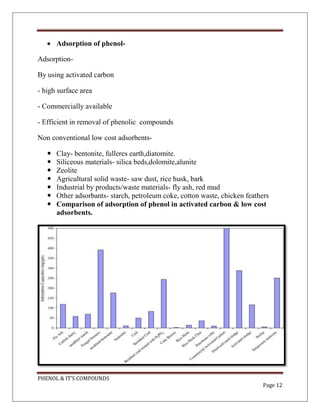
 Adsorption of phenol-
Adsorption-
By using activated carbon
- high surface area
- Commercially available
- Efficient in removal of phenolic compounds
Non conventional low cost adsorbents-
 Clay- bentonite, fulleres earth,diatomite.
 Siliceous materials- silica beds,dolomite,alunite
 Zeolite
 Agricultural solid waste- saw dust, rice husk, bark
 Industrial by products/waste materials- fly ash, red mud
 Other adsorbants- starch, petroleum coke, cotton waste, chicken feathers
 Comparison of adsorption of phenol in activated carbon & low cost
adsorbents.
PHENOL & IT’S COMPOUNDS
Page 13
 Methods of Treatment-
Biofilteration-
Bio-filtration consists in the treatment of the waste, usually prehumidified, by
passing it at room or slightly higher temperature through a wet bed of organic
materials which is populated by micro-organisms . Odorous contaminants are
aerobically degraded to various end products and/or incorporated in the bio-mass.
Different bacteria can be responsible for the organic carbon oxidation to carbon
dioxide, for the conversion of nitrogen compounds to nitrate ion and for the
oxidation of sulphur to sulphate ions. Mixed micro-organisms cultures naturally
grow on appropriate natural biofilter beds, that can be maintained in a wet
environment by appropriated humidification and ventilation procedures , and
abatement of all volatile compounds can be obtained simultaneously. This
technique is becoming widely applied due to its efficiency (in particular for
sulphur compounds if the feed is not excessively concentrated), to the moderate
capital costs, and to the very low maintenance costs. In particular biofiltration
seems to be the choice technique for the treatment of the odorous emissions arising
from wastewater treatments and from the bio-industry due to (i) the chemical
complexity of the wastes; (ii) the low concentration of the contaminants; (iii) the
high flowrates to be handled . On the other hand this technology is quite versatile,
being applied to waste gases of very different origins and containing any quality of
pollutants. The application of a pure strain of P. putida and amixed culture of
Pseudomonas sp. for phenol biofiltration fromwaste gases has been the object of
studies by Zilli et al..More commonly, mixed strains culture are spontaneously
formed or inoculated on biofilters over soil, organic, inorganic, and
inertmatter.Natural materials such as peat, compost, soil, activated carbon have
been mostly used as filter media. The nature of biofilter medium is a key factor for
a successful application of biofilters, affecting both, the removal performance
related to bacterial activity, and the cost related to pressure drop and bed material
replacement . As reviewed by Kennes and Veiga , recently isolated new fungal
strains are able to degrade alkylbenzenes and other related volatile organic
pollutants, including phenol, for air pollution control. In biofiltration, the most
extensively studied organism belongs to the genus Exophiala, although strains of
Scedosporium, Paecilomyces, Cladosporium, Cladophialophora, and white-rot
fungi are all potential candidates for use in biofilters. Encouraging results were
obtained in most of the cases in which some of those organismswere present in
gas-phase biofilters. They allowreaching high elimination capacities and are
resistant to low pH values and to reduce moisture content. The performance of
PHENOL & IT’S COMPOUNDS
Page 14
biofilters can be improved by adopting design and operational strategies to manage
transients which may occur during normal operation . The two-phase partitioning
bioscrubber (TPPB) is an emerging biotechnology developed to treat waste gases
that has shown promise for removing toxic VOCs, suchasbenzene . The TPPB is
essentially operated as a liquid–liquid partitioning bioreactor into which the VOC
substrate and oxygen are both continuously and solely introduced through
absorption from the gas stream while the liquid contents effectively remain as a
closed system . The high performance potential of TPPBs is due to enhanced rates
of absorption of hydrophobic VOCs and dissolved oxygen, as well as
biodegradation by their ability to maintain sub-inhibitory conditions when treating
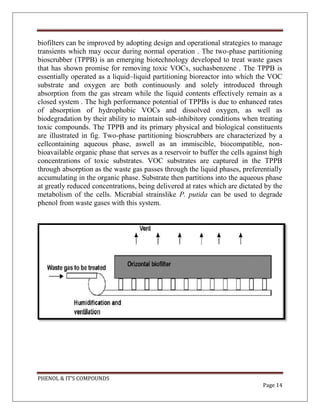
toxic compounds. The TPPB and its primary physical and biological constituents
are illustrated in fig. Two-phase partitioning bioscrubbers are characterized by a
cellcontaining aqueous phase, aswell as an immiscible, biocompatible, non-
bioavailable organic phase that serves as a reservoir to buffer the cells against high
concentrations of toxic substrates. VOC substrates are captured in the TPPB
through absorption as the waste gas passes through the liquid phases, preferentially
accumulating in the organic phase. Substrate then partitions into the aqueous phase
at greatly reduced concentrations, being delivered at rates which are dictated by the
metabolism of the cells. Micrabial strainslike P. putida can be used to degrade
phenol from waste gases with this system.
PHENOL & IT’S COMPOUNDS
Page 15
Thermal oxidation-
Thermal incineration is typically applied to gaseous wastes highly concentrated in
low value hydrocarbon or oxygenated vapors, and in plants needing additional
energy supply in the form of heat or steam. In this case in fact no additional fuel
has to be added and the energy obtained is utilised either by producing
steam(regenerative burners) or by preheating the gas (recuperative burners). This is
the case of several wastes from refinery or petrochemical plants. If concentration
of VOC is low, additional fuel is to be added, and this strongly lowers the
economicity of the process.
On the other hand, thermal incineration is applied if thewaste VOC is harmful and
does not give rise by combustion to other noxious compounds. One of the main
drawbacks of this technology is the production of NOx, due to the high
temperature combustion in air. This technique may be applied to phenol-containing
waste gases, in particular when in combination with other organic pollutants.
Photocatalytic destruction-
Photocatalytic treatment of gaseous wastes is possible but still in the experimental
stage of evolution. This method can avoid the need of additional fuel and the
emission ofNOx, but requires energy consumption in the form of UV light. The
catalysts are based on TiO2 materials and are not very expensive. Commercial
application is already available, e.g., for air purification in the car’s climatization
devices. Application to larger scales will possibly become commercial in the near
future. Interesting potential large scale applications imply the deposition of
photocatalytically active TiO2 layers on lightened surfaces such as skyscraper
windows, traffic lights, road sign reflectors and also computer and TV screens, to
apply sunlight or artificial light to photo-catalyze the decomposition of outdoor and
indoor air pollutants.
of phenol vapors on anatase TiO2 has been the object of a study by Palmisano et
al. The phenol photodegradation rate follows pseudo-first order kinetics with an
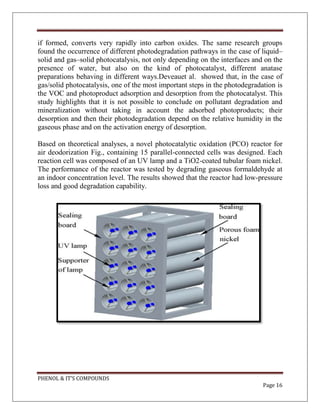
Fig. . Schematic diagram of a new PCO reactor. Reprinted with permission from
Ref.. observed rate constant, Kb = 1.69 h−l. The mineralization process is complete
in about 3–4 h while accumulation of organic intermediate compounds m the first
30min of the reaction was observed. Spectroscopic measurements suggest that
pyrocatecol is an intermediate in the reaction, while hydroquinone was not
observed, although it was found that The photocatalytic abatement hydroquinone,
PHENOL & IT’S COMPOUNDS
Page 16
if formed, converts very rapidly into carbon oxides. The same research groups
found the occurrence of different photodegradation pathways in the case of liquid–
solid and gas–solid photocatalysis, not only depending on the interfaces and on the
presence of water, but also on the kind of photocatalyst, different anatase
preparations behaving in different ways.Deveauet al. showed that, in the case of
gas/solid photocatalysis, one of the most important steps in the photodegradation is
the VOC and photoproduct adsorption and desorption from the photocatalyst. This
study highlights that it is not possible to conclude on pollutant degradation and
mineralization without taking in account the adsorbed photoproducts; their
desorption and then their photodegradation depend on the relative humidity in the
gaseous phase and on the activation energy of desorption.
Based on theoretical analyses, a novel photocatalytic oxidation (PCO) reactor for
air deodorization Fig., containing 15 parallel-connected cells was designed. Each
reaction cell was composed of an UV lamp and a TiO2-coated tubular foam nickel.
The performance of the reactor was tested by degrading gaseous formaldehyde at
an indoor concentration level. The results showed that the reactor had low-pressure
loss and good degradation capability.
PHENOL & IT’S COMPOUNDS
Page 17
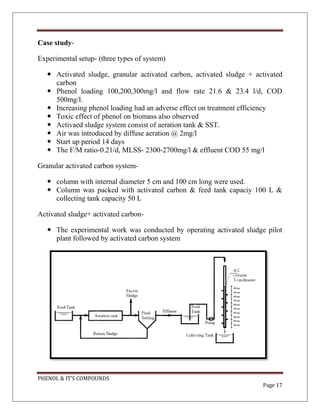
Case study-
Experimental setup- (three types of system)
 Activated sludge, granular activated carbon, activated sludge + activated
carbon
 Phenol loading 100,200,300mg/l and flow rate 21.6 & 23.4 l/d, COD
500mg/l.
 Increasing phenol loading had an adverse effect on treatment efficiency
 Toxic effect of phenol on biomass also observed
 Activaed sludge system consist of aeration tank & SST.
 Air was introduced by diffuse aeration @ 2mg/l
 Start up period 14 days
 The F/M ratio-0.21/d, MLSS- 2300-2700mg/l & effluent COD 55 mg/l
Granular activated carbon system-
 column with internal diameter 5 cm and 100 cm long were used.
 Column was packed with activated carbon & feed tank capaciy 100 L &
collecting tank capacity 50 L
Activated sludge+ activated carbon-
 The experimental work was conducted by operating activated sludge pilot
plant followed by activated carbon system
PHENOL & IT’S COMPOUNDS
Page 18
Result-
 For all cases, it is obvious that A.S + A.C system gave the highest COD%
removal comparing with the other two systems.
 It is also clear that increasing operation time in all systems resulted in
increasing the COD removal efficiency.
 The adverse effect of phenol loading on COD removal can be recognized for
all cases.
 For example, the average COD% removal was 84.80 % in A.S + A.C system
after 14 days of operation with 100 mg/l phenol, adding 200 mg/l of phenol
decreased the COD% removal to 77.2 %, while adding 300 mg/l of phenol
decreased it to 62.3 %.
Discussion during process-
 The A.S + A.C system gave the highest COD and phenol % removal
comparing with the other two systems (A.S and A.C systems).
 Increasing the influent phenol concentration decreased the COD and phenol
removal efficiency.
 Increasing flow rate decreased the COD and phenol removal efficiency for
all systems.
 Increasing the influent phenol concentration results in increasing phenol
toxicity
PHENOL & IT’S COMPOUNDS
Page 19
References-
Research papers-
 Technologies for the removal of phenol from fluid streams: A short review
of recent developments.
 Adsorption of phenolic compounds on low-cost adsorbents: A review
 Phenols – Sources and Toxicity
 Phenolic wastewater treatment
 http://cpcb.nic.in/

Phenol & it's Compounds

  • 1.
    PHENOL & IT’SCOMPOUNDS Page 1 VEERMATA JIJAMATA TECHNOLOGICAL INSTITUTE, MATUNGA, MUMBAI. DEPARTMENT OF CIVIL ENGINEERING SEMINAR ON PHENOL & IT’S COMPOUNDS BY- SOURABH M. KULKARNI M. Tech (ENVIRONMENTAL ENGG.) ROLL NO. - 112020016 UNDER THE GUIDEANCE OF - DR. P.P BHAVE
  • 2.
    PHENOL & IT’SCOMPOUNDS Page 2 INDEX - Sr no Description Page no 1 Introduction of Phenol 3 2 Properties 4 3 Standards- related with the hazardous management rule, CPHEEO,Effluents etc. 5 4 Compounds 5 5 Uses 6 6 Sources 6 7 Effects 7 8 Determination 11 9 Treatments 13 10 Case study 17 11 Conclusion 19
  • 3.
    PHENOL & IT’SCOMPOUNDS Page 3  INTRODUCTION–  Phenol, also known as carbolic acid and phenic acid, is an organic compound with the chemical formula C6H5OH. It is a white crystallinesolid at room temperature. The molecule consists of a phenyl group (-C6H5) bonded to a hydroxyl group (-OH). It is mildly acidic, but requires careful handling due to its propensity to cause burns.  Phenol was first extracted from coal tar, but today is produced on an large scale (about 7 billion kg/year) using industrial processes. It is an important industrial commodity as a precursor to many materials and useful compounds.[4] Its major uses involve its conversion to plastics or related materials. Phenol and its chemical derivatives are key for building polycarbonates, epoxies, Bakelite, nylon, detergents and a large collection of drugs, herbicides and pharmaceuticals  Acidity of phenol- It is slightly acidic: the phenol molecules have weak tendencies to lose the H+ ion from the hydroxyl group, resulting in the highly water- soluble phenolate anion C6H5O− (also called phenoxide).[5] Compared to aliphatic alcohols, phenol is about 1 million times more acidic, although it is still considered a weak acid. It reacts completely with aqueous NaOH to lose H+ , whereas most alcohols react only partially. Phenols are less acidic than carboxylic acids, and even carbonic acid. One explanation for the increased acidity over alcohols is resonance stabilization of the phenoxide anion by the aromatic ring. In this way, the negative charge on oxygen is shared by the ortho and para carbon atoms.[6] In another explanation, increased acidity is the result of orbital overlap between the oxygen's lone pairs and the aromatic system.[7] In a third, the dominant effect is the induction from the sp2 hybridised carbons; the comparatively more powerful inductive withdrawal of electron density that is provided by the sp2 system compared to an sp3 system allows for great stabilization of the oxyanion. In making this conclusion, one can examine the pKa of the enol of acetone, which is 19.0, in comparison to phenol with a pKa of 10.0.[8] However, this similarity of acidities of phenol and acetone enol is not observed in the gas phase, and is because the difference of solvation energies of the deprotonated acetone enol and
  • 4.
    PHENOL & IT’SCOMPOUNDS Page 4 phenoxide almost exactly offsets the experimentally observed gas phase acidity difference. It has recently been shown that only about 1/3 of the increased acidity of phenol is due to inductive effects, with resonance accounting for the rest.[9]  PROPERTIES – MOLECULAR FORMULA C6H5OH BOILING POINT 181.7° C MELTING POINT 40.5° C DENSITY 1.07g/cm3 APPEARANCE TRANSPARENT CRYSTALLLINE SOLID SOLUBILITY IN WATER 8.3g /100ml @ 20° C FLASH POINT 79° C
  • 5.
    PHENOL & IT’SCOMPOUNDS Page 5  STANDERDS–  Hazardous Waste (Management, Handling & Transboundary Movement) Rules, 2008. (schedule II) Phenol and phenolic compounds-5000mg/kg.  Phenolie compounds as C6H5OH. (Schedule- VI) Effluents. Inland surface water- 1 mg/l Marine costal- 5 mg/l Public sewers- 5 mg/l  Drinking water quality stds as per CPHEEO, 1999 Phenol & its compounds- 0.001 mg/lit.  COMPOUNDS OF PHENOL– Phenol the parent compound, used as an disinfectant and for chemical synthesis Bisphenol A and other bisphenols produced from ketones and phenol / cresol BHT (butylated hydroxytoluene) - a fat- soluble antioxidant and food additive Capsaicin the pungent compound of chili peppers Phenolphthalein pH indicator Propofol an anesthetic Xylenol used in antiseptics & disinfecticides Gallic acid found in galls Picric acid (trinitrophenol) - an explosive material Raspberry ketone a compound with an intense raspberry smell Tyrosine A amino acid
  • 6.
    PHENOL & IT’SCOMPOUNDS Page 6  USES OF PHENOL- The major uses of phenol, consuming two thirds of its production, involve its conversion to plastics or related materials. Condensation with acetone givesbisphenol-A, a key precursor to polycarbonates and epoxide resins. Condensation of phenol, alkylphenols, or diphenols with formaldehyde gives phenolic resins, a famous example of which is Bakelite. Hydrogenation of phenol gives cyclohexanone, a precursor to nylon. Nonionic detergents are produced by alkylation of phenol to give the alkylphenols, e.g., nonylphenol, which are then subjected to ethoxylation. Phenol is also a versatile precursor to a large collection of drugs, most notably aspirin but also many herbicides and pharmaceuticals. Phenol is also used as an oral anesthetic/analgesic, commonly used to temporarily treat pharyngitis. Niche uses- Phenol is so inexpensive that it attracts many small-scale uses. It once was widely used as an antiseptic, especially as Carbolic soap, from the early 1900s through the 1970s. It is a component of industrial paint strippers used in the aviation industry for the removal of epoxy, polyurethane and other chemically resistant coatings. Phenol derivatives are also used in the preparation of cosmetics including sunscreens, hair dyes, and skin lightening preparations.  SOURCES OF PHENOL- Currently, phenol is produced at a rate of about 6 million ton/yr worldwide, with a significantly increasing trend. The so called Hock processes, i.e., the three-step cumene synthesis and oxidation processes (such as the Sunoco-UOP, the KBR and the GE-Lummus processes), consisting in the simultaneous syntheses of phenol and acetone from benzene, propylene and oxygen, produces about 95% of the phenol used in the world. These processes involve: (i) alkylation of benzene with propene to form cumene, catalyzed by phosphoric acid, aluminum chloride or, recently, by beta or MCM22 zeolite (ii) oxidation ofcumenetocumenehydroperoxide (CHP) with air proceeding via a free-radical mechanism that is essentially auto-catalyzed by CHP; (iii) cleavage of cumene hydroperoxide to phenol and acetone, catalyzed by sulphuric acid. Several alternative industrial syntheses of phenol exist, i.e., through chlorobenzene (reaction with caustic soda at 350 ◦C) or by sodic benzensolfonate alkaline fusion or by oxidation of toluene via benzoic acid. Phenol is also present in benzole and
  • 7.
    PHENOL & IT’SCOMPOUNDS Page 7 coal tar produced during coal coking. It may be separated from these byproducts by extraction with caustic solutions as sodium phenate. It is shipped in the molten state at elevated temperatures or in the solid or crystalline form; it is also available as an aqueous solution. Phenol and many substituted phenols are natural components of many substances (e.g., tea, wine and smoked foods), and phenol is also emitted from the combustion of fossil fuels and tobacco. It is also present in animalwastes and decomposing organic material and may be formed in air as a product of benzene photooxidation. Bacteria in the environment quickly break downphenol, and so levels in air (1–2 days),water (9 days) and soil (2–5 days) are generally quite low.  Chemical industries  Pesticide industries  Plastic processing  Pharmaceutical industries  Wine industries  Dyes & Textile industries  Petrolium refining  Tobaco smoke  Foods  Animal waste  Decomposition of waste  EFFECTS OF PHENOLS- The sterilizing activity of phenol was discovered by the English surgeon Joseph Lister in 1865. The germicidal activity of phenol appears associated to its protein denaturing ability. It has lipofile properties, so it binds itself to the batteric proteine by hydrogen bonds. Onthe other hand, phenol has relevant health effects forhumans . The manufacture and transportation of phenol as well as its many usesmay lead toworker exposures to this substance, through inhalation, ingestion, eye or skin contact, and absorption through the skin. Phenol is rapidly absorbed through the skin and can cause skin and eye burns upon contact. Comas, convulsions, cyanosis and death can result from overexposure to it. Internally, phenol affects the liver, kidneys, lungs, and vascular system. The ingestion of 1 g of phenol is deadly for man. The Nazi used phenol toxicity for refining extermination techniques, making phenol injections for killing the prisoners. Death was coming up in a fewseconds and the methodwas considered to efficacious and
  • 8.
    PHENOL & IT’SCOMPOUNDS Page 8 economic . No evidence exists to indicate that phenol has any carcinogenic potential. Phenol irritates skin and causes its necrosis, it damages kidneys, liver, muscle and eyes. Damage to skin is caused by its coagulation related to reaction to phenol with aminoacids contained in keratin of epidermis and collagen in inner ski]. In a dose of 1 g phenol may be lethal for an adult man, but individual tolerance for this compound can be high. Some reports reveal that a man can survive even after administration of 30 g of this compound (60 ml of 50% solution). In regard to fast absorption by skin (from 60%-90%) even contact of hand or forehand with phenol solution may cause death . Acute poison with phenol is characterized by dryness in throat and mouth, dark-coloured urine and strong irritation of mucous membranes. The investigations showed that chronic administration of phenol by animals leads to pathological changes in skin, esophagus, lungs, liver, kidneys and also urogenital tract. Described changes are mainly induced by lipid peroxidation that is responsible for damage and finally degradation of a cell’s membrane. Chronic exposure of workers to phenol vapours causes anorexia, lost of body weight, weakness, headache, muscles pain and icterus. Phenol is mainly accumulated in brain, kidneys, liver and muscles. Two days after phenol administration it is mainly excreted in unchanged form and also conjugated with sulphates and glucuronides. Catechol is also considered a strong toxin. Doses of 50 to 500 mg/kg of body weight usually cause death. For mice after oral administration of catechol LD50 is 260 mg/kg of body weight. Acute poison with chlorophenols is characterized by burning pain in mouth and throat, white necrotic lesions in mouth, esophagus and stomach, vomiting, headache, irregular pulse, decrease of temperature and muscle weakness, convulsions and death . Chronic exposure to chlorophenols cause hypotension, fall of body temperature, weakness and abdominal pain. Poisoning by chlorophenols results in damage to lungs, liver, kidneys, skin and digestive tract. Strong toxicity of chlorophenols is expressed by very low, acceptable daily intake (ADI) for pentachlorophenol that was established for 16 μg for a man of 70 kg of bodyweight. LD50 for male and female of rats after oral administration of PCP is 14 mg and 3.85 mg/kg of bodyweight respectively . For 2,4,5-trichlorophenol LD50 is much higher and is of 820 mg/kg of body weight, . Air pollution with a mixture that contained 2-chloro-6-fluorophenol is the result of an accident in a chemical factory (New York, US A) that caused symptoms like dryness in mouth and throat, coughs, headaches and abdominal pain. Chlorophenols undergo fast
  • 9.
    PHENOL & IT’SCOMPOUNDS Page 9 absorption by skin and mucous membrane of respiratory system. Pentachlorophenol and tetrachlorophenol dissolved in fats are adsorbed by skin in 62% and 63% respectively. Chlorophenol accumulation proceeds in kidneys, spleen, liver, heart, brain and fat tissue. Clinical symptoms related to poisons with nitrophenols are similar to that exerted by chlorophenols. 2,4-dinitrophenol has been used as a slimming drug and as an additive in food at the beginning of the last century. Numerous cases of chronic heat, depression and deaths led to this compound being removed from the market. It is considered that a lethal dose of 2,4-dinitrophenol for a man is of 14 to 35 mg/kg of bodyweight . Lethal doses (LD50) of nitrophenol orally administrated to rats and mice are 450-850 mg/kg and 380 mg/kg of body weight, respectively, and for dinitrophenol (rats) only 30 mg/kg of bodyweight. 2,4 dinitrophenol undergoes fast absorption by skin and respiratory system, it is also quickly absorbed from the digestive tract. The compound is accumulated in blood plasma, kidneys, lungs and liver. In work, acute poison as the result of one intake of 2,4-dinitrophenol has been described. In the first hour after poisoning a high increase of temperature and intense perspiration was observed. In the next hour, in spite of antidotes being applied, contact with the patient was broken and circulatory and cardiac failure caused death. The highest occupational exposure is noted form methylphenols. It has been estimated that in world exposure to 4-methylphenol concerns some 600 to 1,200 thousands of workers. This mainly refers to workers who produce antioxidants, disinfectants, dyes, plastics, explosives, epoxy-resins, coal tar and steel . Acute poison with methylphenols cause burning pain in mouth and throat, abdominal pain, headache, weak irregular pulse, hypotension, fall of body temperature, stentorous breathing, darkcolored urine, shock, paralysis of nervous system, comaand death. The incident of poison related with intentional administration of 140 ml of 50% of 4 methylphenol solution by a man has led to an increase of plasma aminotransferases activity and then degradation of hepatocytes. In spite of intensive detoxification, the sufferer died after 14 days . It is considered that a lethal dose of 4-methylphenol for man is of 30-60 g. Lethal doses for animals are different in regards to the type of chemical structure of methylphenols. For example, LD50 for rats that were orally administrated of 2,4-dimethylphenol was estimated for 207 mg/kg of body weight . Para-cresol is absorbed by skin, mucous membrane of digestive tract and respiratory system. It is excreted in urine and in a low concentration with bile and expired air . 30 minutes after administration, 2,4- dimethylphenol is metabolized and excreted 94% conjugated with glucuronides
  • 10.
    PHENOL & IT’SCOMPOUNDS Page 10 and other conjugates. Considerable toxicity exerts 4-aminophenol. This compound causes skin and eye irritation, eczemas, asthma and anoxia . Aminophenol toxicity is related with generation of semiquinones and superoxide radicals that damage a cell’s biomolecules. P-aminophenol by formation quinonoimines damages cell membranes and in particular (in doses of 200 mg/kg of body weight) is characterized by nephrotoxic influence. Lethal doses of p-aminophenol for a man are estimated at 50 to 500 mg/kg of body weight. LD50 for rat after oral administration is much higher and is of 1580 mg/kg of body weight. The investigations revealed that buthylhydroxytoluene and buthylhydroxyanisole reveal histopathological activity. Those compounds cause damage of adrenal gland and increase brain and liver weight . The results of clinical investigation also describe mass poison with chlorophenols. The example is pollution of water and fish in reservoir in Jarrela locality in south Finland with a mixture of 2,4,6- trichlorophenol, 2,3,4,6-tetrachlorophenol and pentachlorophenol derived from a wood processing plant. As the result of poison of about 2000 people – the consummates of water and fish increase morbidity on the side of digestive tract. Also, the increase of infections of respiratory system, strong exhaustion, headaches and depression were observed .
  • 11.
    PHENOL & IT’SCOMPOUNDS Page 11  Determination methods- In biological samples- (blood, urine)  Gas chromatography  Spectro photometry  Thin layer chromatography  High performance liquid chromatography For environmental samples- (drinking water, wastewater industrial emission,air etc.)  HPCL  Ultraviolet detection  Electron capture detector  Electrochemical detection  Flame ionisation detector
  • 12.
    PHENOL & IT’SCOMPOUNDS Page 12  Adsorption of phenol- Adsorption- By using activated carbon - high surface area - Commercially available - Efficient in removal of phenolic compounds Non conventional low cost adsorbents-  Clay- bentonite, fulleres earth,diatomite.  Siliceous materials- silica beds,dolomite,alunite  Zeolite  Agricultural solid waste- saw dust, rice husk, bark  Industrial by products/waste materials- fly ash, red mud  Other adsorbants- starch, petroleum coke, cotton waste, chicken feathers  Comparison of adsorption of phenol in activated carbon & low cost adsorbents.
  • 13.
    PHENOL & IT’SCOMPOUNDS Page 13  Methods of Treatment- Biofilteration- Bio-filtration consists in the treatment of the waste, usually prehumidified, by passing it at room or slightly higher temperature through a wet bed of organic materials which is populated by micro-organisms . Odorous contaminants are aerobically degraded to various end products and/or incorporated in the bio-mass. Different bacteria can be responsible for the organic carbon oxidation to carbon dioxide, for the conversion of nitrogen compounds to nitrate ion and for the oxidation of sulphur to sulphate ions. Mixed micro-organisms cultures naturally grow on appropriate natural biofilter beds, that can be maintained in a wet environment by appropriated humidification and ventilation procedures , and abatement of all volatile compounds can be obtained simultaneously. This technique is becoming widely applied due to its efficiency (in particular for sulphur compounds if the feed is not excessively concentrated), to the moderate capital costs, and to the very low maintenance costs. In particular biofiltration seems to be the choice technique for the treatment of the odorous emissions arising from wastewater treatments and from the bio-industry due to (i) the chemical complexity of the wastes; (ii) the low concentration of the contaminants; (iii) the high flowrates to be handled . On the other hand this technology is quite versatile, being applied to waste gases of very different origins and containing any quality of pollutants. The application of a pure strain of P. putida and amixed culture of Pseudomonas sp. for phenol biofiltration fromwaste gases has been the object of studies by Zilli et al..More commonly, mixed strains culture are spontaneously formed or inoculated on biofilters over soil, organic, inorganic, and inertmatter.Natural materials such as peat, compost, soil, activated carbon have been mostly used as filter media. The nature of biofilter medium is a key factor for a successful application of biofilters, affecting both, the removal performance related to bacterial activity, and the cost related to pressure drop and bed material replacement . As reviewed by Kennes and Veiga , recently isolated new fungal strains are able to degrade alkylbenzenes and other related volatile organic pollutants, including phenol, for air pollution control. In biofiltration, the most extensively studied organism belongs to the genus Exophiala, although strains of Scedosporium, Paecilomyces, Cladosporium, Cladophialophora, and white-rot fungi are all potential candidates for use in biofilters. Encouraging results were obtained in most of the cases in which some of those organismswere present in gas-phase biofilters. They allowreaching high elimination capacities and are resistant to low pH values and to reduce moisture content. The performance of
  • 14.
    PHENOL & IT’SCOMPOUNDS Page 14 biofilters can be improved by adopting design and operational strategies to manage transients which may occur during normal operation . The two-phase partitioning bioscrubber (TPPB) is an emerging biotechnology developed to treat waste gases that has shown promise for removing toxic VOCs, suchasbenzene . The TPPB is essentially operated as a liquid–liquid partitioning bioreactor into which the VOC substrate and oxygen are both continuously and solely introduced through absorption from the gas stream while the liquid contents effectively remain as a closed system . The high performance potential of TPPBs is due to enhanced rates of absorption of hydrophobic VOCs and dissolved oxygen, as well as biodegradation by their ability to maintain sub-inhibitory conditions when treating toxic compounds. The TPPB and its primary physical and biological constituents are illustrated in fig. Two-phase partitioning bioscrubbers are characterized by a cellcontaining aqueous phase, aswell as an immiscible, biocompatible, non- bioavailable organic phase that serves as a reservoir to buffer the cells against high concentrations of toxic substrates. VOC substrates are captured in the TPPB through absorption as the waste gas passes through the liquid phases, preferentially accumulating in the organic phase. Substrate then partitions into the aqueous phase at greatly reduced concentrations, being delivered at rates which are dictated by the metabolism of the cells. Micrabial strainslike P. putida can be used to degrade phenol from waste gases with this system.
  • 15.
    PHENOL & IT’SCOMPOUNDS Page 15 Thermal oxidation- Thermal incineration is typically applied to gaseous wastes highly concentrated in low value hydrocarbon or oxygenated vapors, and in plants needing additional energy supply in the form of heat or steam. In this case in fact no additional fuel has to be added and the energy obtained is utilised either by producing steam(regenerative burners) or by preheating the gas (recuperative burners). This is the case of several wastes from refinery or petrochemical plants. If concentration of VOC is low, additional fuel is to be added, and this strongly lowers the economicity of the process. On the other hand, thermal incineration is applied if thewaste VOC is harmful and does not give rise by combustion to other noxious compounds. One of the main drawbacks of this technology is the production of NOx, due to the high temperature combustion in air. This technique may be applied to phenol-containing waste gases, in particular when in combination with other organic pollutants. Photocatalytic destruction- Photocatalytic treatment of gaseous wastes is possible but still in the experimental stage of evolution. This method can avoid the need of additional fuel and the emission ofNOx, but requires energy consumption in the form of UV light. The catalysts are based on TiO2 materials and are not very expensive. Commercial application is already available, e.g., for air purification in the car’s climatization devices. Application to larger scales will possibly become commercial in the near future. Interesting potential large scale applications imply the deposition of photocatalytically active TiO2 layers on lightened surfaces such as skyscraper windows, traffic lights, road sign reflectors and also computer and TV screens, to apply sunlight or artificial light to photo-catalyze the decomposition of outdoor and indoor air pollutants. of phenol vapors on anatase TiO2 has been the object of a study by Palmisano et al. The phenol photodegradation rate follows pseudo-first order kinetics with an Fig. . Schematic diagram of a new PCO reactor. Reprinted with permission from Ref.. observed rate constant, Kb = 1.69 h−l. The mineralization process is complete in about 3–4 h while accumulation of organic intermediate compounds m the first 30min of the reaction was observed. Spectroscopic measurements suggest that pyrocatecol is an intermediate in the reaction, while hydroquinone was not observed, although it was found that The photocatalytic abatement hydroquinone,
  • 16.
    PHENOL & IT’SCOMPOUNDS Page 16 if formed, converts very rapidly into carbon oxides. The same research groups found the occurrence of different photodegradation pathways in the case of liquid– solid and gas–solid photocatalysis, not only depending on the interfaces and on the presence of water, but also on the kind of photocatalyst, different anatase preparations behaving in different ways.Deveauet al. showed that, in the case of gas/solid photocatalysis, one of the most important steps in the photodegradation is the VOC and photoproduct adsorption and desorption from the photocatalyst. This study highlights that it is not possible to conclude on pollutant degradation and mineralization without taking in account the adsorbed photoproducts; their desorption and then their photodegradation depend on the relative humidity in the gaseous phase and on the activation energy of desorption. Based on theoretical analyses, a novel photocatalytic oxidation (PCO) reactor for air deodorization Fig., containing 15 parallel-connected cells was designed. Each reaction cell was composed of an UV lamp and a TiO2-coated tubular foam nickel. The performance of the reactor was tested by degrading gaseous formaldehyde at an indoor concentration level. The results showed that the reactor had low-pressure loss and good degradation capability.
  • 17.
    PHENOL & IT’SCOMPOUNDS Page 17 Case study- Experimental setup- (three types of system)  Activated sludge, granular activated carbon, activated sludge + activated carbon  Phenol loading 100,200,300mg/l and flow rate 21.6 & 23.4 l/d, COD 500mg/l.  Increasing phenol loading had an adverse effect on treatment efficiency  Toxic effect of phenol on biomass also observed  Activaed sludge system consist of aeration tank & SST.  Air was introduced by diffuse aeration @ 2mg/l  Start up period 14 days  The F/M ratio-0.21/d, MLSS- 2300-2700mg/l & effluent COD 55 mg/l Granular activated carbon system-  column with internal diameter 5 cm and 100 cm long were used.  Column was packed with activated carbon & feed tank capaciy 100 L & collecting tank capacity 50 L Activated sludge+ activated carbon-  The experimental work was conducted by operating activated sludge pilot plant followed by activated carbon system
  • 18.
    PHENOL & IT’SCOMPOUNDS Page 18 Result-  For all cases, it is obvious that A.S + A.C system gave the highest COD% removal comparing with the other two systems.  It is also clear that increasing operation time in all systems resulted in increasing the COD removal efficiency.  The adverse effect of phenol loading on COD removal can be recognized for all cases.  For example, the average COD% removal was 84.80 % in A.S + A.C system after 14 days of operation with 100 mg/l phenol, adding 200 mg/l of phenol decreased the COD% removal to 77.2 %, while adding 300 mg/l of phenol decreased it to 62.3 %. Discussion during process-  The A.S + A.C system gave the highest COD and phenol % removal comparing with the other two systems (A.S and A.C systems).  Increasing the influent phenol concentration decreased the COD and phenol removal efficiency.  Increasing flow rate decreased the COD and phenol removal efficiency for all systems.  Increasing the influent phenol concentration results in increasing phenol toxicity
  • 19.
    PHENOL & IT’SCOMPOUNDS Page 19 References- Research papers-  Technologies for the removal of phenol from fluid streams: A short review of recent developments.  Adsorption of phenolic compounds on low-cost adsorbents: A review  Phenols – Sources and Toxicity  Phenolic wastewater treatment  http://cpcb.nic.in/