Alcohols, Phenols
and Ethers
12G
INTRODUCTION
• Alcohols and phenols are formed when a hydrogen atom
in a hydrocarbon, aliphatic and aromatic respectively, is
replaced by –OH group.
• The substitution of a hydrogen atom in a hydrocarbon by
an alkoxy or aryloxy group (R–O/Ar–O) yields ethers.
USES
• Ordinary spirit used for polishing wooden furniture is
chiefly a compound containing hydroxyl group, ethanol.
• The sugar we eat, the cotton used for fabrics, the paper
we use for writing, are all made up of compounds
containing –OH groups.
Classification of alcohols
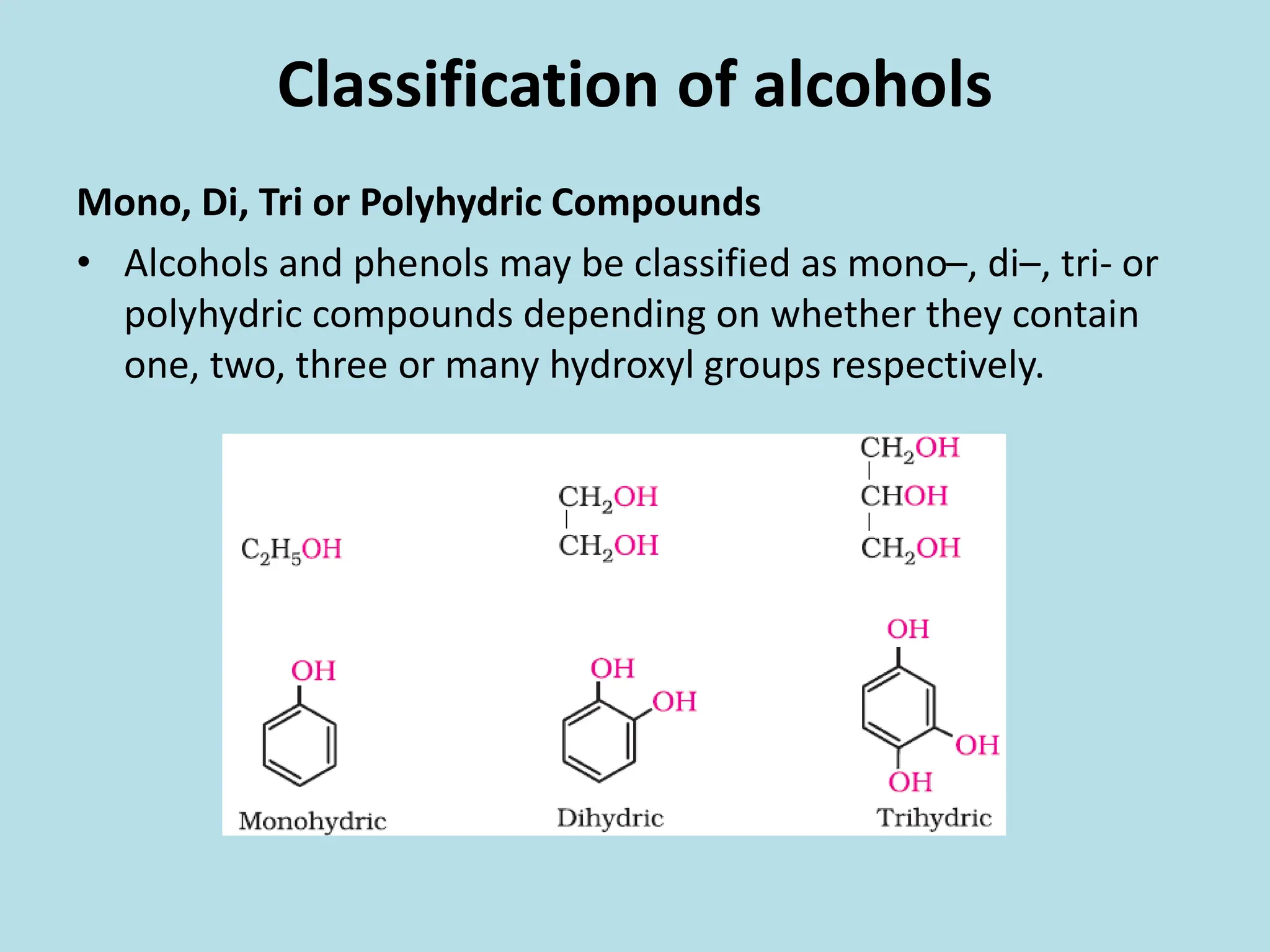
Mono, Di, Tri or Polyhydric Compounds
• Alcohols and phenols may be classified as mono–, di–, tri- or
polyhydric compounds depending on whether they contain
one, two, three or many hydroxyl groups respectively.
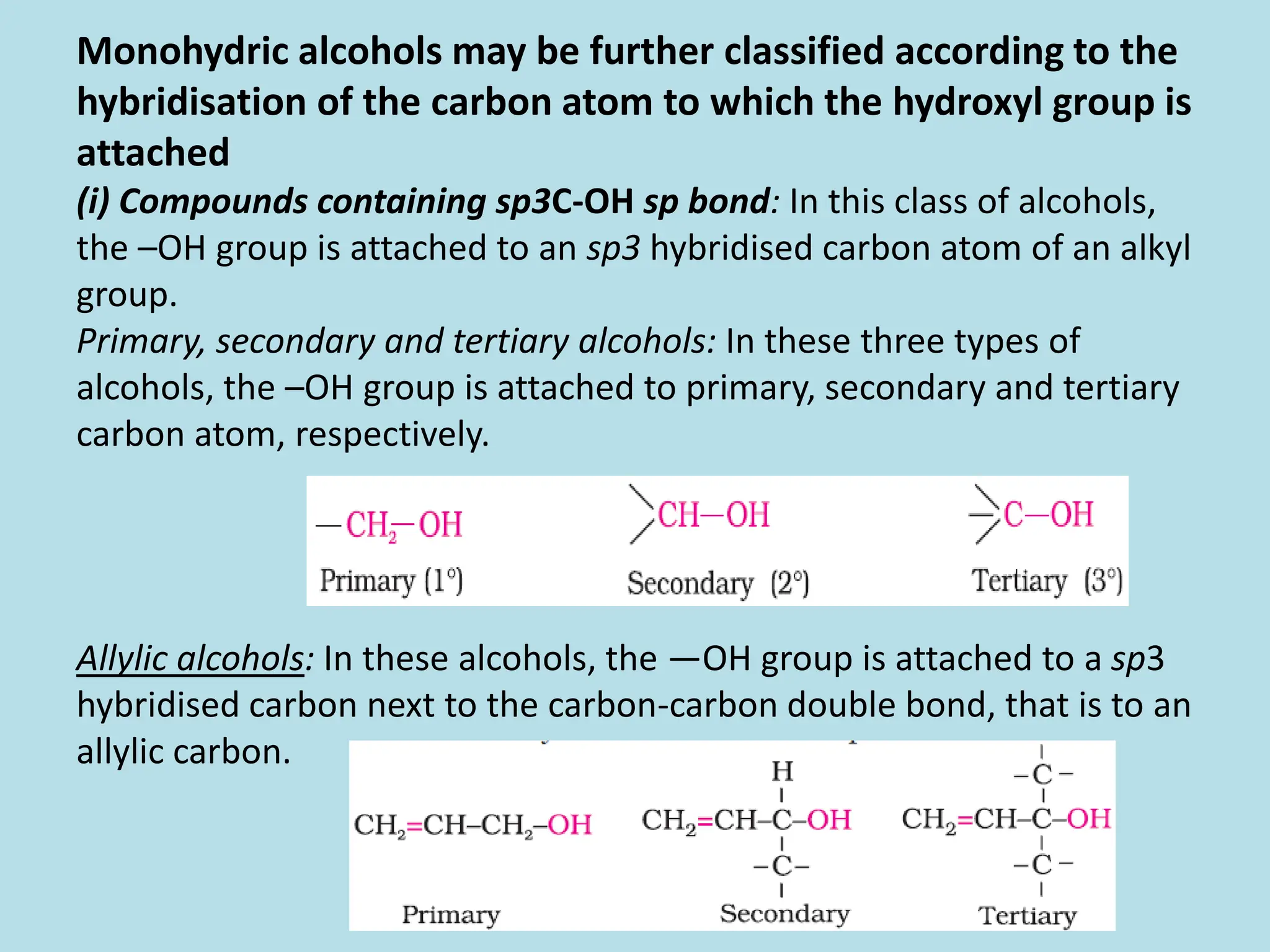
Monohydric alcohols may be further classified according to the
hybridisation of the carbon atom to which the hydroxyl group is
attached
(i) Compounds containing sp3C-OH sp bond: In this class of alcohols,
the –OH group is attached to an sp3 hybridised carbon atom of an alkyl
group.
Primary, secondary and tertiary alcohols: In these three types of
alcohols, the –OH group is attached to primary, secondary and tertiary
carbon atom, respectively.
Allylic alcohols: In these alcohols, the —OH group is attached to a sp3
hybridised carbon next to the carbon-carbon double bond, that is to an
allylic carbon.
Benzylic alcohols: In these alcohols, the —OH group is attached to a
sp3—hybridised carbon atom next to an aromatic ring.
(ii) Compounds containing sp2C-OH sp bond: These alcohols
contain —OH group bonded to a carbon-carbon double bond i.e., to a
vinylic carbon or to an aryl carbon. These alcohols are also known as
vinylic alcohols.
Classfication of Ethers
• Ethers are classified as simple or symmetrical, if the alkyl or
aryl groups attached to the oxygen atom are the same, and
mixed or unsymmetrical, if the two groups are different.
Diethyl ether, C2H5OC2H5, is a symmetrical ether whereas
C2H5OCH3 and C2H5OC6H5 are unsymmetrical ethers.
Nomenclature
• (a) Alcohols:
• The common name of an alcohol is derived from the common name
of the alkyl group and adding the word alcohol to it.
• According to IUPAC system ,the name of an alcohol is derived from
the name of the alkane from which the alcohol is derived, by
substituting ‘e’ of alkane with the suffix ‘ol’.
• For naming polyhydric alcohols, the ‘e’ of alkane is retained and the
ending ‘ol’ is added. The number of –OH groups is indicated by
• adding the multiplicative prefix, di, tri, etc., before ‘ol’. The positions
of
–OH groups are indicated by appropriate locants
• Cyclic alcohols are named using the prefix cyclo and considering the
—OH group attached to C–1.
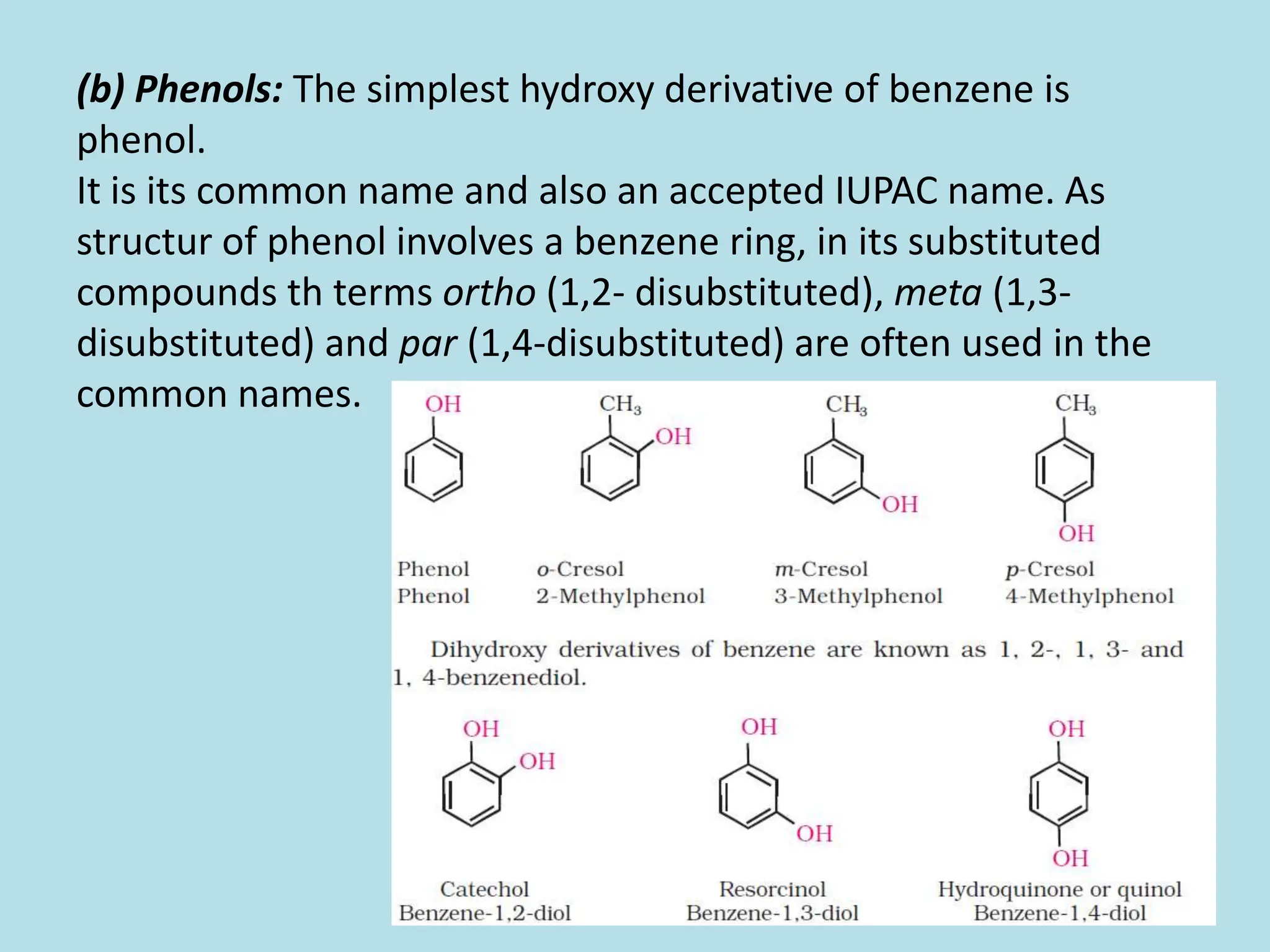
(b) Phenols: The simplest hydroxy derivative of benzene is
phenol.
It is its common name and also an accepted IUPAC name. As
structur of phenol involves a benzene ring, in its substituted
compounds th terms ortho (1,2- disubstituted), meta (1,3-
disubstituted) and par (1,4-disubstituted) are often used in the
common names.
(c) Ethers: Common names of ethers are derived from the names of
alkyl/ aryl groups written as separate words in alphabetical order and
adding the word ‘ether’ at the end.
If both the alkyl groups are the same, the prefix ‘di’ is added before the
alkyl group. For example, C2H5OC2H5 is diethyl ether.
According to IUPAC system of nomenclature, ethers are regarded a
hydrocarbon derivatives in which a hydrogen atom is replaced by a –
OR or –OAr group, where R and Ar represent alkyl and aryl groups,
respectively. The larger (R) group is chosen as the parent hydrocarbon.
Structures of Functional Groups
• In alcohols, the oxygen of the –OH group is attached to carbon by a
sigma bond formed by the overlap of a sp3 hybridised orbital of
carbon with a sp3 hybridised orbital of oxygen. The bond angle in
alcohols is slightly less than the tetrahedral angle (109°-28′).
• In phenols, the –OH group is attached to sp2 hybridised carbon of
an aromatic ring. The carbon– oxygen bond length (136 pm) in
phenol is slightly less than that in methanol.
• In ethers, the four electron pairs, i.e., the two bond pairs and two
lone pairs of electrons on oxygen are arranged approximately in a
tetrahedral arrangement. The bond angle is slightly greater than the
tetrahedral angle. The C–O bond length (141 pm) is almost the
same as in alcohols.
Preparation of Alcohols
From alkenes
(i) By acid catalysed hydration: Alkenes react with water in the presence
of acid as catalyst to form alcohols. In case of unsymmetrical alkenes,
the addition reaction takes place in accordance with Markovnikov’s
rule.
(ii) By hydroboration–oxidation: Diborane (BH3)2 reacts with alkenes to
give trialkyl boranes as addition product. This is oxidised to alcohol by
hydrogen peroxide in the presence of aqueous sodium hydroxide.
• (i) By reduction of aldehydes and ketones: Aldehydes and ketones
are reduced to the corresponding alcohols by addition of hydrogen
in the presence of catalysts . The usual catalyst is a finely divided
metal such as platinum, palladium or nickel. It is also prepared by
treating aldehydes and ketones with sodium borohydride (NaBH4)
or lithium aluminium hydride (LiAlH4). Aldehydes yield primary
alcohols whereas ketones give secondary alcohols.
(ii) By reduction of carboxylic acids and esters: Carboxylic acids
are reduced to primary alcohols in excellent yields by lithium
aluminium hydride, a strong reducing agent.
From carbonyl compounds
Commercially, acids are reduced to alcohols by converting them to the
esters, followed by their reduction using hydrogen in the presence of
catalyst (catalytic hydrogenation).
From Grignard reagents
Alcohols are produced by the reaction of Grignard reagents with
aldehydes and ketones. The first step of the reaction is the nucleophilic
addition of Grignard reagent to the carbonyl group to form an adduct.
Hydrolysis of the adduct yields an alcohol.
Preparation of Phenols
• From haloarenes
• Chlorobenzene is fused with NaOH at 623K and 320 atmospheric
pressure. Phenol is obtained by acidification of sodium phenoxide
so produced
• 2. From benzenesulphonic acid
• Benzene is sulphonated with oleum and benzene sulphonic acid so
formed is converted to sodium phenoxide on heating with molten
sodium hydroxide. Acidification of the sodium salt gives phenol.
Commercially, acids are reduced to alcohols by converting them to the
esters, followed by their reduction using hydrogen in the presence of
catalyst (catalytic hydrogenation).
From Grignard reagents
Alcohols are produced by the reaction of Grignard reagents with
aldehydes and ketones. The first step of the reaction is the nucleophilic
addition of Grignard reagent to the carbonyl group to form an adduct.
Hydrolysis of the adduct yields an alcohol.
Commercially, acids are reduced to alcohols by converting them to the
esters, followed by their reduction using hydrogen in the presence of
catalyst (catalytic hydrogenation).
From Grignard reagents
Alcohols are produced by the reaction of Grignard reagents with
aldehydes and ketones. The first step of the reaction is the nucleophilic
addition of Grignard reagent to the carbonyl group to form an adduct.
Hydrolysis of the adduct yields an alcohol.
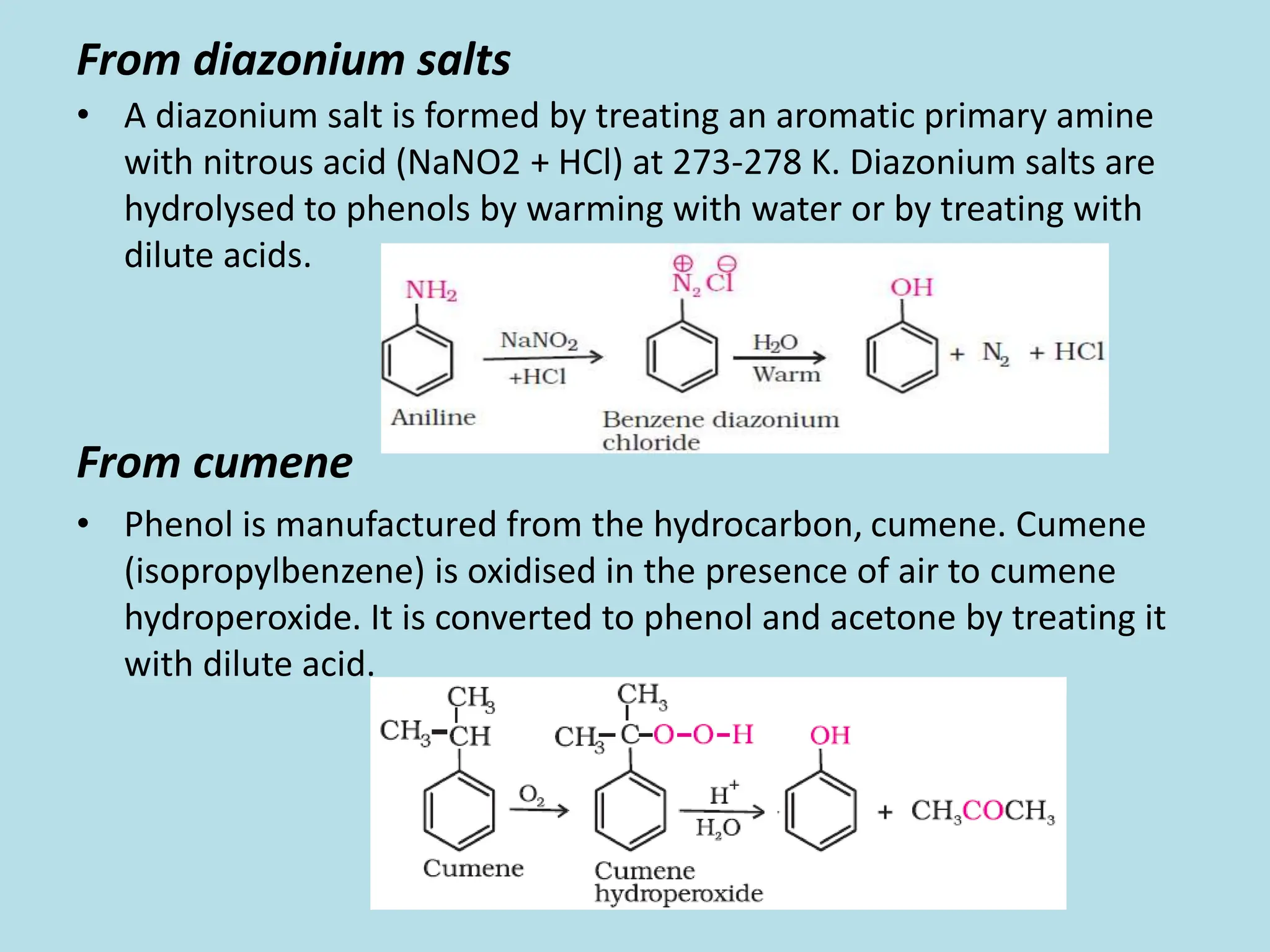
From diazonium salts
• A diazonium salt is formed by treating an aromatic primary amine
with nitrous acid (NaNO2 + HCl) at 273-278 K. Diazonium salts are
hydrolysed to phenols by warming with water or by treating with
dilute acids.
From cumene
• Phenol is manufactured from the hydrocarbon, cumene. Cumene
(isopropylbenzene) is oxidised in the presence of air to cumene
hydroperoxide. It is converted to phenol and acetone by treating it
with dilute acid.
• Boiling Points
• The boiling points of alcohols and phenols increase with increase in
the number of carbon atoms. In alcohols, the boiling points
decrease with increase of branching in carbon chain.
• The –OH group in alcohols and phenols is involved in intermolecular
hydrogen bonding
• Boiling points of alcohols and phenols are higher in comparison to
other classes of compounds, namely hydrocarbons, ethers,
haloalkanes and haloarenes of comparable molecular masses.
• The high boiling points of alcohols are mainly due to the presence
of intermolecular hydrogen bonding in them which is lacking in
ethers and hydrocarbons.
• Solubility
• Solubility of alcohols and phenols in water is due to their ability to
form hydrogen bonds with water molecules as shown. The solubility
decreases with increase in size of alkyl/aryl (hydrophobic) groups.
Several of the lower molecular mass alcohols are miscible with
water in all proportions.
Physical Properties
Chemical Reactions
Reactions involving cleavage of O–H bond
• Acidity of alcohols and phenols
(i) Reaction with metals: Alcohols and phenols react with active metals
such as sodium, potassium and aluminium to yield corresponding
alkoxides/phenoxides and hydrogen.
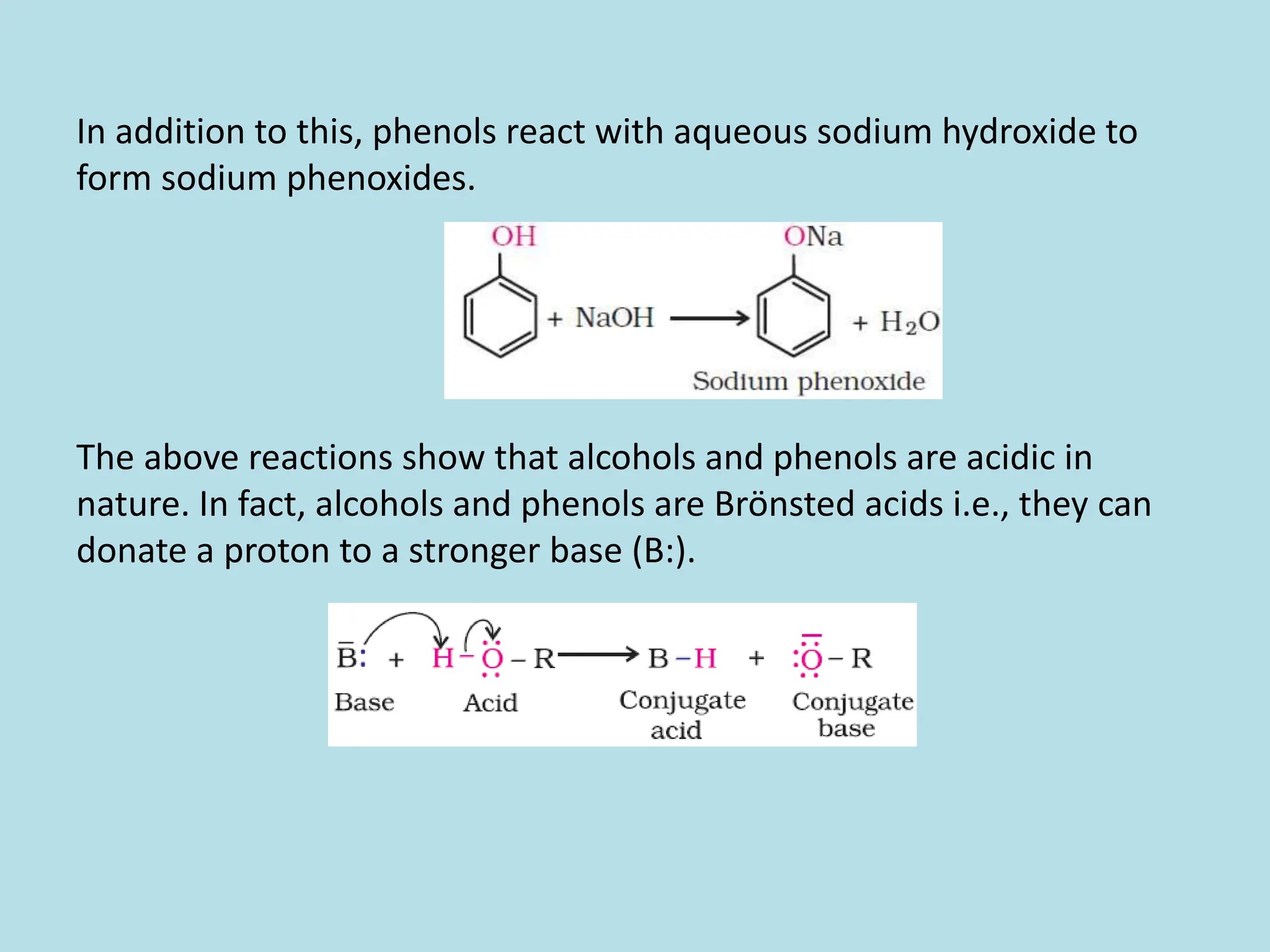
In addition to this, phenols react with aqueous sodium hydroxide to
form sodium phenoxides.
The above reactions show that alcohols and phenols are acidic in
nature. In fact, alcohols and phenols are Brönsted acids i.e., they can
donate a proton to a stronger base (B:).
Acidity of alcohols:
• The acidic character of alcohols is due to the polar nature of O–H
bond.
• Alcohols are weaker acids than water
• Alcohols act as Bronsted bases as well. It is due to the presence of
unshared electron pairs on oxygen, which makes them proton
acceptors
Acidity of phenols:
• The reactions of phenol with metals and sodium hydroxide indicate
its acidic nature. The hydroxyl group, in phenol is directly attached
to the sp2 hybridised carbon of benzene ring which acts as an
electron withdrawing group.
• The presence of electron withdrawing groups such as nitro group,
enhances the acidic strength of phenol. It is due to the effective
delocalisation of negative charge in phenoxide ion.
• Electron releasing groups, such as alkyl groups, in general, do not
favour the formation of phenoxide ion resulting in decrease in acid
strength
Esterification
• Alcohols and phenols react with carboxylic acids, acid chlorides and
acid anhydrides to form esters.
• The introduction of acetyl (CH3CO) group in alcohols or phenols is
known as acetylation. Acetylation of salicylic acid produces aspirin.
Reactions involving cleavage of (C–O) bond in alcohols
• Reaction with hydrogen halides: Alcohols react with hydrogen halides to
form alkyl halides.
• The difference in reactivity of three classes of alcohols with HCl
distinguishes them from one another (Lucas test). Alcohols are soluble in
Lucas reagent (conc. HCl and ZnCl2) while their halides are immiscible and
produce turbidity in solution. In case of tertiary alcohols, turbidity is
produced immediately as they form the halides easily. Primary alcohols do
not produce turbidity at room temperature.
• Reaction with phosphorus trihalides: Alcohols are converted to alkyl
bromides by reaction with phosphorus tribromide.
• Dehydration: Alcohols undergo dehydration (removal of a molecule of
water) to form alkenes on treating with a protic acid e.g., concentrated
H2SO4 or H3PO4, or catalysts such as anhydrous zinc chloride or alumina.
• Ethanol undergoes dehydration by heating it with concentrated H2SO4 at
443K. Secondary and tertiary alcohols are dehydrated under milder
conditions
Oxidation
• Oxidation of alcohols involves the formation of a carbon-oxygen
double bond with cleavage of an O-H and C-H bonds.
• Strong oxidising agents such as acidified potassium permanganate
are used for getting carboxylic acids from alcohols directly. CrO3 in
anhydrous medium is used as the oxidising agent for the isolation of
aldehydes.
• A better reagent for oxidation of primary alcohols to aldehydes in
good yield is pyridinium chlorochromate (PCC), a complex of
chromium trioxide with pyridine and HCl.
• Secondary alcohols are oxidised to ketones by chromic anhydride
(CrO3).
Reactions of phenols
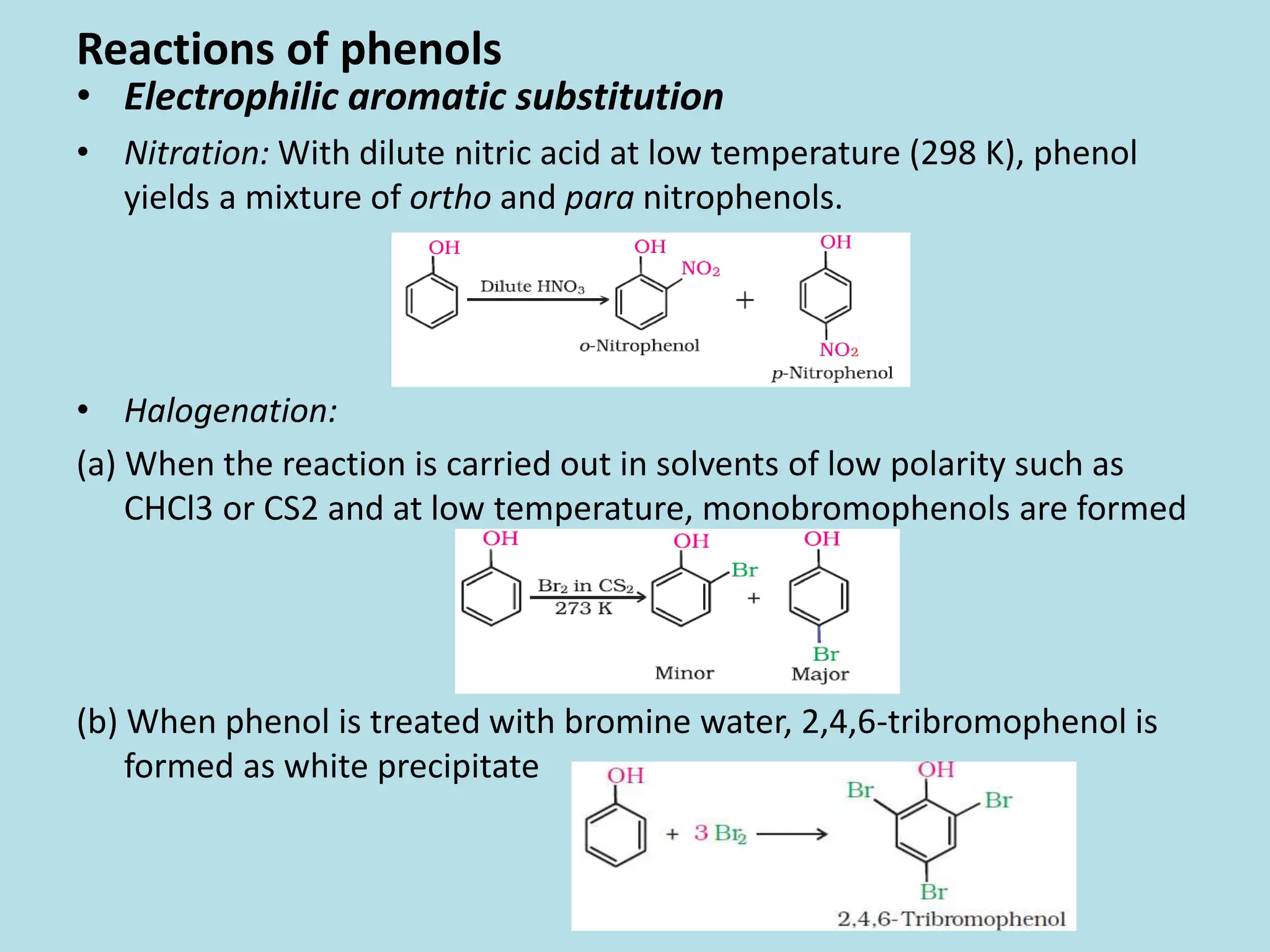
• Electrophilic aromatic substitution
• Nitration: With dilute nitric acid at low temperature (298 K), phenol
yields a mixture of ortho and para nitrophenols.
• Halogenation:
(a) When the reaction is carried out in solvents of low polarity such as
CHCl3 or CS2 and at low temperature, monobromophenols are formed
(b) When phenol is treated with bromine water, 2,4,6-tribromophenol is
formed as white precipitate
Kolbe’s reaction
• Phenoxide ion generated by treating phenol with sodium hydroxide
is even more reactive than phenol towards electrophilic aromatic
substitution. Ortho hydroxybenzoic acid is formed as the main
reaction product.
Reimer-Tiemann reaction
• On treating phenol with chloroform in the presence of sodium
hydroxide, a –CHO group is introduced at ortho position of benzene
ring. This reaction is known as Reimer - Tiemann reaction.
• The intermediate substituted benzal chloride is hydrolysed in the
presence of alkali to produce salicylaldehyde
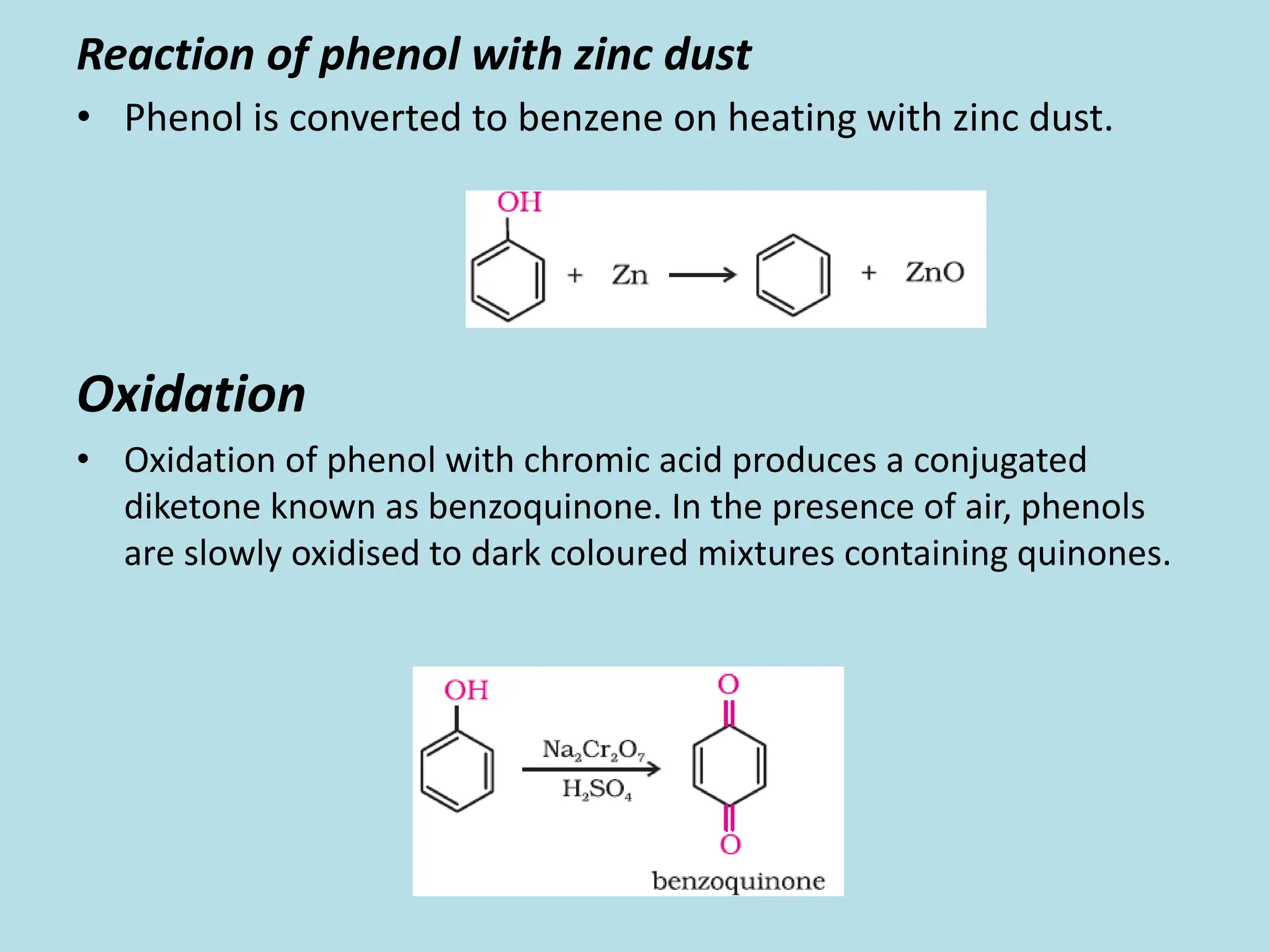
Reaction of phenol with zinc dust
• Phenol is converted to benzene on heating with zinc dust.
Oxidation
• Oxidation of phenol with chromic acid produces a conjugated
diketone known as benzoquinone. In the presence of air, phenols
are slowly oxidised to dark coloured mixtures containing quinones.
Some Commercially Important Alcohols
Methanol
• Methanol, CH3OH, also known as ‘wood spirit’, was produced by
destructive distillation of wood.
• Methanol is a colourless liquid and boils at 337 K. It is highly
poisonous in nature. Ingestion of even small quantities of methanol
can cause blindness and large quantities causes even death.
Methanol is used as a solvent in paints, varnishes and chiefly for
making formaldehyde
Ethanol
• Ethanol, C2H5OH, is obtained commercially by fermentation, the
oldest method is from sugars.
• Ethanol is a colourless liquid with boiling point 351 K. It is used as a
solvent in paint industry and in the preparation of a number of
carbon compounds. The commercial alcohol is made unfit for
drinking by mixing in it some copper sulphate (to give it a colour)
and pyridine (a foul smelling liquid). It is known as denaturation of
alcohol.
Ethers
Preparation of Ethers
By dehydration of alcohols
• Alcohols undergo dehydration in the presence of protic acids
(H2SO4, H3PO4).
• Williamson synthesis
• It is an important laboratory method for the preparation of
symmetrical and unsymmetrical ethers.
Physical Properties
• The C-O bonds in ethers are polar and thus, ethers have a net
dipole moment.
• Much lower than the boiling points of alcohols.
• The large difference in boiling points of alcohols and ethers is due
to the presence of hydrogen bonding in alcohols.
• The miscibility of ethers with water resembles those of alcohols of
the same molecular mass.
• Both ethoxyethane and butan-1-ol are miscible to almost the same
extent i.e., 7.5 and 9 g per 100 mL water, respectively while
pentane is essentially immiscible with water. This is due to the fact
that just like alcohols, oxygen of ether can also form hydrogen
bonds with water molecule .
Chemical Reactions
• Cleavage of C–O bond in ethers
• Ethers are the least reactive of the functional groups. The cleavage
of C-O bond in ethers takes place under drastic conditions with
excess of hydrogen halides. The reaction of dialkyl ether gives two
alkyl halide molecules
• The order of reactivity of hydrogen halides is as follows:
HI > HBr > HCl.
Electrophilic substitution
i. Halogenation: Phenylalkyl ethers undergo usual halogenations in
the benzene ring. It is due to the activation of benzene ring by the
methoxy group. Para isomer is obtained in 90% yield
(ii) Friedel-Crafts reaction: the alkyl and acyl groups are introduced at
ortho and para positions by reaction with alkyl halide and acyl
halide in the presence of anhydrous aluminium chloride (a Lewis
acid) as catalyst.
(iii) Nitration:
Anisole reacts with a mixture of concentrated sulphuric and nitric
acids to yield a mixture of ortho and para nitroanisole.
THANK
YOU

Grade XII Alcholos,phenols , Ethers .pptx

  • 1.
  • 2.
    INTRODUCTION • Alcohols andphenols are formed when a hydrogen atom in a hydrocarbon, aliphatic and aromatic respectively, is replaced by –OH group. • The substitution of a hydrogen atom in a hydrocarbon by an alkoxy or aryloxy group (R–O/Ar–O) yields ethers. USES • Ordinary spirit used for polishing wooden furniture is chiefly a compound containing hydroxyl group, ethanol. • The sugar we eat, the cotton used for fabrics, the paper we use for writing, are all made up of compounds containing –OH groups.
  • 3.
    Classification of alcohols Mono,Di, Tri or Polyhydric Compounds • Alcohols and phenols may be classified as mono–, di–, tri- or polyhydric compounds depending on whether they contain one, two, three or many hydroxyl groups respectively.
  • 4.
    Monohydric alcohols maybe further classified according to the hybridisation of the carbon atom to which the hydroxyl group is attached (i) Compounds containing sp3C-OH sp bond: In this class of alcohols, the –OH group is attached to an sp3 hybridised carbon atom of an alkyl group. Primary, secondary and tertiary alcohols: In these three types of alcohols, the –OH group is attached to primary, secondary and tertiary carbon atom, respectively. Allylic alcohols: In these alcohols, the —OH group is attached to a sp3 hybridised carbon next to the carbon-carbon double bond, that is to an allylic carbon.
  • 5.
    Benzylic alcohols: Inthese alcohols, the —OH group is attached to a sp3—hybridised carbon atom next to an aromatic ring. (ii) Compounds containing sp2C-OH sp bond: These alcohols contain —OH group bonded to a carbon-carbon double bond i.e., to a vinylic carbon or to an aryl carbon. These alcohols are also known as vinylic alcohols.
  • 6.
    Classfication of Ethers •Ethers are classified as simple or symmetrical, if the alkyl or aryl groups attached to the oxygen atom are the same, and mixed or unsymmetrical, if the two groups are different. Diethyl ether, C2H5OC2H5, is a symmetrical ether whereas C2H5OCH3 and C2H5OC6H5 are unsymmetrical ethers.
  • 7.
    Nomenclature • (a) Alcohols: •The common name of an alcohol is derived from the common name of the alkyl group and adding the word alcohol to it. • According to IUPAC system ,the name of an alcohol is derived from the name of the alkane from which the alcohol is derived, by substituting ‘e’ of alkane with the suffix ‘ol’. • For naming polyhydric alcohols, the ‘e’ of alkane is retained and the ending ‘ol’ is added. The number of –OH groups is indicated by • adding the multiplicative prefix, di, tri, etc., before ‘ol’. The positions of –OH groups are indicated by appropriate locants • Cyclic alcohols are named using the prefix cyclo and considering the —OH group attached to C–1.
  • 8.
    (b) Phenols: Thesimplest hydroxy derivative of benzene is phenol. It is its common name and also an accepted IUPAC name. As structur of phenol involves a benzene ring, in its substituted compounds th terms ortho (1,2- disubstituted), meta (1,3- disubstituted) and par (1,4-disubstituted) are often used in the common names.
  • 9.
    (c) Ethers: Commonnames of ethers are derived from the names of alkyl/ aryl groups written as separate words in alphabetical order and adding the word ‘ether’ at the end. If both the alkyl groups are the same, the prefix ‘di’ is added before the alkyl group. For example, C2H5OC2H5 is diethyl ether. According to IUPAC system of nomenclature, ethers are regarded a hydrocarbon derivatives in which a hydrogen atom is replaced by a – OR or –OAr group, where R and Ar represent alkyl and aryl groups, respectively. The larger (R) group is chosen as the parent hydrocarbon.
  • 10.
    Structures of FunctionalGroups • In alcohols, the oxygen of the –OH group is attached to carbon by a sigma bond formed by the overlap of a sp3 hybridised orbital of carbon with a sp3 hybridised orbital of oxygen. The bond angle in alcohols is slightly less than the tetrahedral angle (109°-28′). • In phenols, the –OH group is attached to sp2 hybridised carbon of an aromatic ring. The carbon– oxygen bond length (136 pm) in phenol is slightly less than that in methanol. • In ethers, the four electron pairs, i.e., the two bond pairs and two lone pairs of electrons on oxygen are arranged approximately in a tetrahedral arrangement. The bond angle is slightly greater than the tetrahedral angle. The C–O bond length (141 pm) is almost the same as in alcohols.
  • 11.
    Preparation of Alcohols Fromalkenes (i) By acid catalysed hydration: Alkenes react with water in the presence of acid as catalyst to form alcohols. In case of unsymmetrical alkenes, the addition reaction takes place in accordance with Markovnikov’s rule. (ii) By hydroboration–oxidation: Diborane (BH3)2 reacts with alkenes to give trialkyl boranes as addition product. This is oxidised to alcohol by hydrogen peroxide in the presence of aqueous sodium hydroxide.
  • 12.
    • (i) Byreduction of aldehydes and ketones: Aldehydes and ketones are reduced to the corresponding alcohols by addition of hydrogen in the presence of catalysts . The usual catalyst is a finely divided metal such as platinum, palladium or nickel. It is also prepared by treating aldehydes and ketones with sodium borohydride (NaBH4) or lithium aluminium hydride (LiAlH4). Aldehydes yield primary alcohols whereas ketones give secondary alcohols. (ii) By reduction of carboxylic acids and esters: Carboxylic acids are reduced to primary alcohols in excellent yields by lithium aluminium hydride, a strong reducing agent. From carbonyl compounds
  • 13.
    Commercially, acids arereduced to alcohols by converting them to the esters, followed by their reduction using hydrogen in the presence of catalyst (catalytic hydrogenation). From Grignard reagents Alcohols are produced by the reaction of Grignard reagents with aldehydes and ketones. The first step of the reaction is the nucleophilic addition of Grignard reagent to the carbonyl group to form an adduct. Hydrolysis of the adduct yields an alcohol.
  • 14.
    Preparation of Phenols •From haloarenes • Chlorobenzene is fused with NaOH at 623K and 320 atmospheric pressure. Phenol is obtained by acidification of sodium phenoxide so produced • 2. From benzenesulphonic acid • Benzene is sulphonated with oleum and benzene sulphonic acid so formed is converted to sodium phenoxide on heating with molten sodium hydroxide. Acidification of the sodium salt gives phenol.
  • 15.
    Commercially, acids arereduced to alcohols by converting them to the esters, followed by their reduction using hydrogen in the presence of catalyst (catalytic hydrogenation). From Grignard reagents Alcohols are produced by the reaction of Grignard reagents with aldehydes and ketones. The first step of the reaction is the nucleophilic addition of Grignard reagent to the carbonyl group to form an adduct. Hydrolysis of the adduct yields an alcohol.
  • 16.
    Commercially, acids arereduced to alcohols by converting them to the esters, followed by their reduction using hydrogen in the presence of catalyst (catalytic hydrogenation). From Grignard reagents Alcohols are produced by the reaction of Grignard reagents with aldehydes and ketones. The first step of the reaction is the nucleophilic addition of Grignard reagent to the carbonyl group to form an adduct. Hydrolysis of the adduct yields an alcohol.
  • 17.
    From diazonium salts •A diazonium salt is formed by treating an aromatic primary amine with nitrous acid (NaNO2 + HCl) at 273-278 K. Diazonium salts are hydrolysed to phenols by warming with water or by treating with dilute acids. From cumene • Phenol is manufactured from the hydrocarbon, cumene. Cumene (isopropylbenzene) is oxidised in the presence of air to cumene hydroperoxide. It is converted to phenol and acetone by treating it with dilute acid.
  • 18.
    • Boiling Points •The boiling points of alcohols and phenols increase with increase in the number of carbon atoms. In alcohols, the boiling points decrease with increase of branching in carbon chain. • The –OH group in alcohols and phenols is involved in intermolecular hydrogen bonding • Boiling points of alcohols and phenols are higher in comparison to other classes of compounds, namely hydrocarbons, ethers, haloalkanes and haloarenes of comparable molecular masses. • The high boiling points of alcohols are mainly due to the presence of intermolecular hydrogen bonding in them which is lacking in ethers and hydrocarbons. • Solubility • Solubility of alcohols and phenols in water is due to their ability to form hydrogen bonds with water molecules as shown. The solubility decreases with increase in size of alkyl/aryl (hydrophobic) groups. Several of the lower molecular mass alcohols are miscible with water in all proportions. Physical Properties
  • 19.
    Chemical Reactions Reactions involvingcleavage of O–H bond • Acidity of alcohols and phenols (i) Reaction with metals: Alcohols and phenols react with active metals such as sodium, potassium and aluminium to yield corresponding alkoxides/phenoxides and hydrogen.
  • 20.
    In addition tothis, phenols react with aqueous sodium hydroxide to form sodium phenoxides. The above reactions show that alcohols and phenols are acidic in nature. In fact, alcohols and phenols are Brönsted acids i.e., they can donate a proton to a stronger base (B:).
  • 21.
    Acidity of alcohols: •The acidic character of alcohols is due to the polar nature of O–H bond. • Alcohols are weaker acids than water • Alcohols act as Bronsted bases as well. It is due to the presence of unshared electron pairs on oxygen, which makes them proton acceptors Acidity of phenols: • The reactions of phenol with metals and sodium hydroxide indicate its acidic nature. The hydroxyl group, in phenol is directly attached to the sp2 hybridised carbon of benzene ring which acts as an electron withdrawing group. • The presence of electron withdrawing groups such as nitro group, enhances the acidic strength of phenol. It is due to the effective delocalisation of negative charge in phenoxide ion. • Electron releasing groups, such as alkyl groups, in general, do not favour the formation of phenoxide ion resulting in decrease in acid strength
  • 22.
    Esterification • Alcohols andphenols react with carboxylic acids, acid chlorides and acid anhydrides to form esters. • The introduction of acetyl (CH3CO) group in alcohols or phenols is known as acetylation. Acetylation of salicylic acid produces aspirin.
  • 23.
    Reactions involving cleavageof (C–O) bond in alcohols • Reaction with hydrogen halides: Alcohols react with hydrogen halides to form alkyl halides. • The difference in reactivity of three classes of alcohols with HCl distinguishes them from one another (Lucas test). Alcohols are soluble in Lucas reagent (conc. HCl and ZnCl2) while their halides are immiscible and produce turbidity in solution. In case of tertiary alcohols, turbidity is produced immediately as they form the halides easily. Primary alcohols do not produce turbidity at room temperature. • Reaction with phosphorus trihalides: Alcohols are converted to alkyl bromides by reaction with phosphorus tribromide. • Dehydration: Alcohols undergo dehydration (removal of a molecule of water) to form alkenes on treating with a protic acid e.g., concentrated H2SO4 or H3PO4, or catalysts such as anhydrous zinc chloride or alumina. • Ethanol undergoes dehydration by heating it with concentrated H2SO4 at 443K. Secondary and tertiary alcohols are dehydrated under milder conditions
  • 24.
    Oxidation • Oxidation ofalcohols involves the formation of a carbon-oxygen double bond with cleavage of an O-H and C-H bonds. • Strong oxidising agents such as acidified potassium permanganate are used for getting carboxylic acids from alcohols directly. CrO3 in anhydrous medium is used as the oxidising agent for the isolation of aldehydes. • A better reagent for oxidation of primary alcohols to aldehydes in good yield is pyridinium chlorochromate (PCC), a complex of chromium trioxide with pyridine and HCl. • Secondary alcohols are oxidised to ketones by chromic anhydride (CrO3).
  • 25.
    Reactions of phenols •Electrophilic aromatic substitution • Nitration: With dilute nitric acid at low temperature (298 K), phenol yields a mixture of ortho and para nitrophenols. • Halogenation: (a) When the reaction is carried out in solvents of low polarity such as CHCl3 or CS2 and at low temperature, monobromophenols are formed (b) When phenol is treated with bromine water, 2,4,6-tribromophenol is formed as white precipitate
  • 26.
    Kolbe’s reaction • Phenoxideion generated by treating phenol with sodium hydroxide is even more reactive than phenol towards electrophilic aromatic substitution. Ortho hydroxybenzoic acid is formed as the main reaction product. Reimer-Tiemann reaction • On treating phenol with chloroform in the presence of sodium hydroxide, a –CHO group is introduced at ortho position of benzene ring. This reaction is known as Reimer - Tiemann reaction. • The intermediate substituted benzal chloride is hydrolysed in the presence of alkali to produce salicylaldehyde
  • 27.
    Reaction of phenolwith zinc dust • Phenol is converted to benzene on heating with zinc dust. Oxidation • Oxidation of phenol with chromic acid produces a conjugated diketone known as benzoquinone. In the presence of air, phenols are slowly oxidised to dark coloured mixtures containing quinones.
  • 28.
    Some Commercially ImportantAlcohols Methanol • Methanol, CH3OH, also known as ‘wood spirit’, was produced by destructive distillation of wood. • Methanol is a colourless liquid and boils at 337 K. It is highly poisonous in nature. Ingestion of even small quantities of methanol can cause blindness and large quantities causes even death. Methanol is used as a solvent in paints, varnishes and chiefly for making formaldehyde
  • 29.
    Ethanol • Ethanol, C2H5OH,is obtained commercially by fermentation, the oldest method is from sugars. • Ethanol is a colourless liquid with boiling point 351 K. It is used as a solvent in paint industry and in the preparation of a number of carbon compounds. The commercial alcohol is made unfit for drinking by mixing in it some copper sulphate (to give it a colour) and pyridine (a foul smelling liquid). It is known as denaturation of alcohol.
  • 30.
    Ethers Preparation of Ethers Bydehydration of alcohols • Alcohols undergo dehydration in the presence of protic acids (H2SO4, H3PO4). • Williamson synthesis • It is an important laboratory method for the preparation of symmetrical and unsymmetrical ethers.
  • 31.
    Physical Properties • TheC-O bonds in ethers are polar and thus, ethers have a net dipole moment. • Much lower than the boiling points of alcohols. • The large difference in boiling points of alcohols and ethers is due to the presence of hydrogen bonding in alcohols. • The miscibility of ethers with water resembles those of alcohols of the same molecular mass. • Both ethoxyethane and butan-1-ol are miscible to almost the same extent i.e., 7.5 and 9 g per 100 mL water, respectively while pentane is essentially immiscible with water. This is due to the fact that just like alcohols, oxygen of ether can also form hydrogen bonds with water molecule .
  • 32.
    Chemical Reactions • Cleavageof C–O bond in ethers • Ethers are the least reactive of the functional groups. The cleavage of C-O bond in ethers takes place under drastic conditions with excess of hydrogen halides. The reaction of dialkyl ether gives two alkyl halide molecules • The order of reactivity of hydrogen halides is as follows: HI > HBr > HCl.
  • 33.
    Electrophilic substitution i. Halogenation:Phenylalkyl ethers undergo usual halogenations in the benzene ring. It is due to the activation of benzene ring by the methoxy group. Para isomer is obtained in 90% yield (ii) Friedel-Crafts reaction: the alkyl and acyl groups are introduced at ortho and para positions by reaction with alkyl halide and acyl halide in the presence of anhydrous aluminium chloride (a Lewis acid) as catalyst.
  • 34.
    (iii) Nitration: Anisole reactswith a mixture of concentrated sulphuric and nitric acids to yield a mixture of ortho and para nitroanisole.
  • 35.