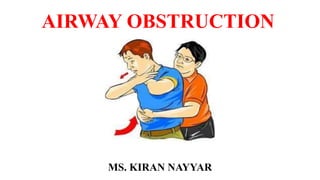
AIRWAY OBSTRUCTION
MS. KIRAN NAYYAR
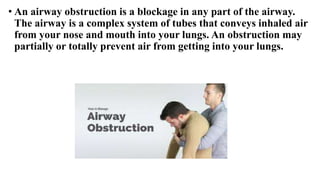
• An airway obstruction is a blockage in any part of the airway.
The airway is a complex system of tubes that conveys inhaled air
from your nose and mouth into your lungs. An obstruction may
partially or totally prevent air from getting into your lungs.
Types of airway
obstructions
• Upper airway obstructions occur in the area from your nose and
lips to your larynx (voice box).
• Lower airway obstructions occur between your larynx and the
narrow passageways of your lungs.
• Partial airway obstructions allow some air to pass. You can still
breathe with a partial airway obstruction, but it’s difficult.
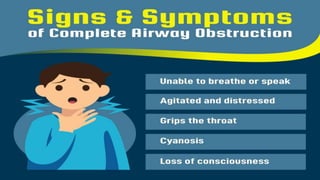
• Complete airway obstructions don’t allow any air to pass. You
can’t breathe if you have a complete airway obstruction.
• Acute airway obstructions are blockages that occur quickly.
Choking on a foreign object is an example of an acute airway
obstruction.
• Chronic airway obstructions occur two ways: by blockages that
take a long time to develop or by blockages that last for a long
time.
CAUSES
• inhaling or swallowing a foreign
object
• small object lodged in the nose
or mouth
• allergic reaction
• trauma to the airway from an
accident
• vocal cord problems
• breathing in a large amount of
smoke from a fire
• viral infections
• bacterial infections
• respiratory illness that causes
upper airway inflammation
• swelling of the tongue or
epiglottis
• abscesses in the throat or
tonsils
• collapse of the tracheal wall
(tracheomalacia)
• asthma
• chronic bronchitis
• emphysema
• chronic obstructive
pulmonary disease (COPD)
SYMPTOMS
• agitation
• cyanosis (bluish-coloured skin)
• Increased anxiety, restlessness and confusion
• difficulty breathing
• gasping for air
• panic
• high-pitched breathing noises such as wheezing
• Unconsciousness
• Choking
DIAGNOSTIC TEST
• X-Ray
• Laryngoscopy
• Bronchoscopy
MANAGEMENT
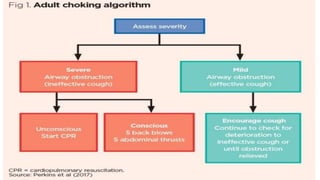
• PARTIAL OBSTRUCTION- Encourage to cough forcefully and
to persist with spontaneous coughing and breathing efforts as
long as good air exchange exists.
• COMPLETE AIRWAY OBSTRUCTION- Establish airway by:
Reposition the patient to prevent the tongue from obstructing
the pharynx.
Oropharyngeal airway obstruction
Endotracheal intubation
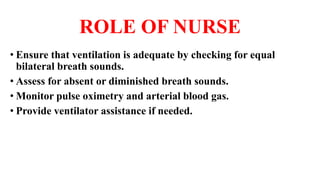
ROLE OF NURSE
• Ensure that ventilation is adequate by checking for equal
bilateral breath sounds.
• Assess for absent or diminished breath sounds.
• Monitor pulse oximetry and arterial blood gas.
• Provide ventilator assistance if needed.
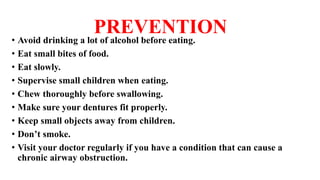
PREVENTION
• Avoid drinking a lot of alcohol before eating.
• Eat small bites of food.
• Eat slowly.
• Supervise small children when eating.
• Chew thoroughly before swallowing.
• Make sure your dentures fit properly.
• Keep small objects away from children.
• Don’t smoke.
• Visit your doctor regularly if you have a condition that can cause a
chronic airway obstruction.
SUMMARY
• Definition
• Types of airway obstruction
• Causes
• Symptoms
• Diagnostic test
• Management
• Role of nurse
• Prevention
Airway obstruction

Airway obstruction

  • 1.
  • 2.
    • An airwayobstruction is a blockage in any part of the airway. The airway is a complex system of tubes that conveys inhaled air from your nose and mouth into your lungs. An obstruction may partially or totally prevent air from getting into your lungs.
  • 3.
  • 4.
    • Upper airwayobstructions occur in the area from your nose and lips to your larynx (voice box). • Lower airway obstructions occur between your larynx and the narrow passageways of your lungs. • Partial airway obstructions allow some air to pass. You can still breathe with a partial airway obstruction, but it’s difficult. • Complete airway obstructions don’t allow any air to pass. You can’t breathe if you have a complete airway obstruction. • Acute airway obstructions are blockages that occur quickly. Choking on a foreign object is an example of an acute airway obstruction. • Chronic airway obstructions occur two ways: by blockages that take a long time to develop or by blockages that last for a long time.
  • 5.
  • 6.
    • inhaling orswallowing a foreign object • small object lodged in the nose or mouth • allergic reaction • trauma to the airway from an accident • vocal cord problems • breathing in a large amount of smoke from a fire • viral infections • bacterial infections • respiratory illness that causes upper airway inflammation • swelling of the tongue or epiglottis • abscesses in the throat or tonsils • collapse of the tracheal wall (tracheomalacia) • asthma • chronic bronchitis • emphysema • chronic obstructive pulmonary disease (COPD)
  • 7.
    SYMPTOMS • agitation • cyanosis(bluish-coloured skin) • Increased anxiety, restlessness and confusion • difficulty breathing • gasping for air • panic • high-pitched breathing noises such as wheezing • Unconsciousness • Choking
  • 9.
    DIAGNOSTIC TEST • X-Ray •Laryngoscopy • Bronchoscopy
  • 10.
    MANAGEMENT • PARTIAL OBSTRUCTION-Encourage to cough forcefully and to persist with spontaneous coughing and breathing efforts as long as good air exchange exists. • COMPLETE AIRWAY OBSTRUCTION- Establish airway by: Reposition the patient to prevent the tongue from obstructing the pharynx. Oropharyngeal airway obstruction Endotracheal intubation
  • 12.
    ROLE OF NURSE •Ensure that ventilation is adequate by checking for equal bilateral breath sounds. • Assess for absent or diminished breath sounds. • Monitor pulse oximetry and arterial blood gas. • Provide ventilator assistance if needed.
  • 13.
    PREVENTION • Avoid drinkinga lot of alcohol before eating. • Eat small bites of food. • Eat slowly. • Supervise small children when eating. • Chew thoroughly before swallowing. • Make sure your dentures fit properly. • Keep small objects away from children. • Don’t smoke. • Visit your doctor regularly if you have a condition that can cause a chronic airway obstruction.
  • 14.
    SUMMARY • Definition • Typesof airway obstruction • Causes • Symptoms • Diagnostic test • Management • Role of nurse • Prevention